Part 1: The Fire
In 1994, my father’s combine caught fire two days before harvest—with the bank already circling. By sunrise, eleven combines from five counties were lined up in our yard. Dad never found out who organized it. Last week, at his funeral, a stranger stood up holding a CB radio.
The fire should have ended us. You can’t harvest 800 acres by hand, and you can’t pay a note with standing wheat.
But at 5 AM, headlights. Eleven combines. Crews we’d never met, from farms two hours out. They took our whole crop off in three days, accepted nothing but sandwiches, and left the way they came.
Dad asked for years who made the calls. Nobody ever claimed it.
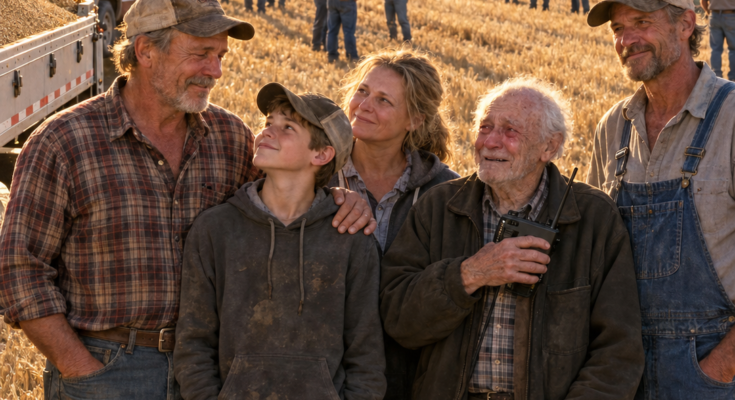
At his funeral, an old man none of us knew walked to the front carrying a battered CB radio, set it on the podium, and said:
“Your daddy doesn’t know me. But in 1981, he did something on Route 12 at 2 AM that I spent thirteen years waiting to repay.”
Then he told the room what happened on Route 12—and who was in the truck.
—
I was fourteen years old when the fire happened.
I remember waking up to the smell of smoke. I remember my father running across the yard in his underwear, screaming for my mother to call 911. I remember the combine—our only combine—engulfed in flames.
It was a 1978 John Deere 7720. My father had bought it used. He had rebuilt the engine himself. He had painted it green and yellow in the spring. He had named it “Lucky.”
Lucky wasn’t lucky.
By the time the fire department arrived, the combine was a blackened skeleton. The header was warped. The engine was destroyed. The cab was melted.
My father stood in the yard and watched it burn.
He didn’t cry. He didn’t scream. He just stood there.
Then he walked back to the house, sat down at the kitchen table, and stared at the wall.
We all knew what this meant. We had 800 acres of wheat ready to harvest. We had a bank note due in thirty days. We had no combine. We had no way to bring in the crop.
We were going to lose the farm.
—
The next morning, I woke up to the sound of engines.
I looked out my bedroom window and saw headlights. Dozens of them. Coming down the county road. Turning into our driveway.
I ran downstairs. My father was already on the porch, still in his pajamas, staring at the line of vehicles.
Combines. Eleven of them. Followed by grain trucks and pickup trucks and men in caps and overalls.
The first man to step out was tall and thin, with a weathered face and a handshake like iron.
“Karl Mueller?” he asked.
My father nodded.
“Heard you had some trouble. We’re here to help.”
“Who sent you?”
The man smiled.
“Does it matter?”
—
They worked for three days.
They harvested every acre. They filled every truck. They hauled the grain to the elevator and brought back the receipts.
They slept in their trucks. They ate sandwiches my mother made. They refused payment.
“This is what neighbors do,” the tall man said.
My father asked for names. He asked for addresses. He asked for phone numbers.
They wouldn’t give them.
“You don’t owe us anything,” the tall man said. “Just remember.”
—
Part 2: The Mystery
My father spent the next twenty years trying to find out who sent them.
He called every farmer he knew. He wrote letters to every co-op in five counties. He asked at every auction, every cattle sale, every farm bureau meeting.
Nobody knew anything.
“Eleven combines?” they’d say. “That’s impossible. You can’t get eleven combines together in two days.”
But it happened. We were there.
My father never stopped wondering. He talked about it every harvest. He talked about it every Thanksgiving. He talked about it when he was dying.
“Who were they?” he asked me one night, holding my hand. “Who sent them?”
“I don’t know, Dad.”
“I need to know. I need to thank them.”
“You’ll never find them.”
He closed his eyes.
“Maybe I’m not supposed to.”
—
He died last week.
It was peaceful. He was 78 years old. He had lived a good life. He had raised three children. He had saved the farm. He had been married to my mother for fifty-two years.
But he never found out who sent the combines.
The funeral was small. Family. Friends. Neighbors. The church was full.
I gave the eulogy. I talked about his love of the land. His dedication to his family. His stubbornness. His kindness.
I talked about the fire. I talked about the combines. I talked about how he never stopped searching.
“Whoever you are,” I said, “thank you. You saved our farm. You saved our family. My father never got to thank you in person. But I’m thanking you now.”
I sat down.
The church was silent.
Then an old man stood up.
—
Part 3: The Reckoning
He was in his eighties. Thin. Frail. He used a cane. He carried a battered CB radio in his other hand.
He walked to the front of the church. Slowly. Carefully. Every eye on him.
He set the radio on the podium.
“My name is Walter Higgins,” he said. “Your daddy doesn’t know me. But I knew him.”
He paused.
“In 1981, I was driving a truck on Route 12. It was 2 AM. I was hauling a load of fertilizer. I was tired. I was drunk. I fell asleep at the wheel.”
He looked at the congregation.
“I woke up when my truck hit the guardrail. I was in the ditch. The truck was on its side. The fertilizer was spilling everywhere. I was trapped.”
He paused.
“Your daddy was the only person on that road. He was driving home from a farm auction. He saw my truck. He pulled over. He climbed into the ditch. He pulled me out of the cab.”
The room was silent.
“I was bleeding. I was scared. I was begging him to leave me. I told him I deserved to die. I told him I was a drunk. I told him nobody would miss me.”
He wiped his eyes.
“Your daddy carried me up the embankment. He put me in his truck. He drove me to the hospital. He stayed with me all night. He told the doctors he was my brother.”
He looked at me.
“He never asked for anything. He never told anyone. He just did it. And when I got out of the hospital, I tried to find him. I wanted to thank him. But I didn’t know his name. I only knew his face.”
He picked up the CB radio.
“I spent thirteen years looking for him. And when I found him, I couldn’t bring myself to face him. I was ashamed. I was still drinking. I was still a mess.”
He looked at the congregation.
“So I made some calls. I called every farmer I knew. I told them about the man who saved my life. I told them about his fire. I told them he needed help.”
He paused.
“Eleven combines. Eleven men who owed their lives to someone. Eleven men who wanted to pay it forward.”
He set the CB radio on the podium.
“I never told him. I never told him that I was the one who organized it. I never told him that I was the one he saved. I was too ashamed. Too proud.”
He looked at me.
“But I’m telling you now. Your daddy was a hero. Not because he saved me. Because he saved everyone he ever met. He saved me. He saved you. He saved this town.”
He stepped back.
“Thank you, Karl. For saving my life. For saving my farm. For being the best man I ever knew.”
—
The church was silent.
Then my mother stood up.
She walked to the front of the church. She took the old man’s hands.
“Walter,” she said. “He knew.”
Walter stared at her.
“What?”
“He knew. He found out years ago. He never told you because he didn’t want you to feel obligated. He said you had already repaid him by turning your life around.”
Walter started to cry.
“He knew?”
“He knew.”
She hugged him.
The church erupted in applause.
—
Part 4: The Legacy
We buried my father next to his father. The cemetery is on a hill overlooking the farm.
Walter stood with us. He held my mother’s hand. He cried.
After the funeral, we went back to the farm. The wheat was ready for harvest. The combines were lined up in the yard.
Eleven of them.
Walter had called them. The same eleven men. Or their sons. Their grandsons. They had come to bring in our crop.
Just like they did in 1994.
“Your daddy helped us,” one of them said. “Now we’re helping you.”
We harvested that week. The weather was perfect. The wheat was golden. The combines worked from dawn to dusk.
And when it was done, we had a feast. In the yard. At the long table my father had built.
We ate. We drank. We told stories. We laughed. We cried.
We remembered Karl Mueller.
And we made a promise.
We would keep the tradition alive. Every year, when a farmer needs help, we would show up. We would bring our combines. We would bring our trucks. We would bring our hands.
Because that’s what neighbors do.
That’s what my father taught us.
That’s what Walter taught us.
That’s what the eleven combines taught us.
—
The End