Part 1: The Arrangement
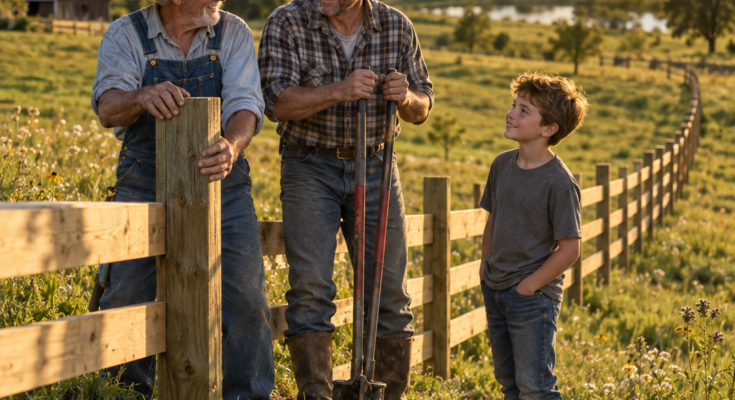
Our neighbor rebuilt the same quarter-mile of fence between our farms every three years for four decades—always his labor, always his lumber, always refusing help. Dad let him. We never understood the arrangement until the estate sale.
Fences between farms are usually split—each family keeps half. Not ours. Mr. Hollis did every post, every rail, alone, waving off my father’s offers with the same words: “This stretch is mine to keep.”
Dad never pushed. That was the strange part. Dad pushed about everything.
Mr. Hollis passed in March. At his estate sale, his son handed my father an envelope marked *”For the Muellers — about the fence.”*
Dad read it standing in the driveway. Then he folded it, looked down the quarter-mile of perfect rails, and said, “Boys, get the post digger. It’s our turn for the next forty years.”
The letter explained what happened on that fence line in 1983.
We keep the stretch now. Same terms. Same quiet. Same hands.
—
I was twelve years old when I finally asked my father why he let Mr. Hollis do all the work.
We were standing on the porch, watching the old man drive his tractor along the fence line, checking every post, every rail. It was September. The leaves were turning. Mr. Hollis had been at it since dawn.
“Dad, why doesn’t he let us help?”
My father didn’t answer right away. He just watched.
“Because it’s not about the fence, son.”
“What’s it about?”
He was quiet for a long time.
“Pride. Forgiveness. Things you won’t understand until you’re older.”
I didn’t understand. Not then.
—
Part 2: The Letter
The letter was three pages long. Handwritten. Dated two weeks before Mr. Hollis died.
My father read it aloud to us that night. His voice cracked twice.
*”Dear Karl,*
*By the time you read this, I’ll be gone. I’m sorry I never told you this in person. I was too proud. Too ashamed. But you deserve to know the truth.*
*In 1983, I almost lost everything. The bank was going to foreclose on my farm. I had three months to come up with $40,000. I didn’t have it. I couldn’t get it. I was going to lose everything my family had built.*
*You found out. I don’t know how. Maybe your wife told you. Maybe you just knew. You showed up at my door with a check for $40,000. You said, ‘Pay me back when you can. No interest. No timeline. Just take care of your family.’*
*I tried to refuse. You wouldn’t let me. You said, ‘We’re neighbors. That’s what neighbors do.’*
*I paid you back over ten years. Every penny. But I never forgot. I never forgot what you did for me.*
*So I built the fence.*
*Every three years. Every post. Every rail. I told myself it was because I owed you. But that wasn’t the truth. The truth is that I wanted to do something for you. Something that would last. Something that would show you how grateful I was.*
*You never asked me to stop. You never questioned it. You just let me work. And you always waved. You always smiled. You always said, ‘Looks good, Hollis.’*
*Those three words meant more to me than you’ll ever know.*
*So now it’s your turn. The fence is yours to keep. Not because you owe me. Because you earned it.*
*Thank you, Karl. For saving my farm. For saving my family. For being the best neighbor a man could ask for.*
*Your friend,*
*Hollis”*
My father folded the letter.
He didn’t say anything for a long time.
Then he looked at my brothers and me.
“Get the post digger.”
—
Part 3: The Legacy
We rebuilt the fence that summer.
It took us six weeks. Every post. Every rail. We did it the way Mr. Hollis did it. Slowly. Carefully. With our own hands.
My father worked alongside us. He was 68 then. His back hurt. His knees ached. But he never stopped.
“He built this fence for forty years,” he said. “I can build it for one summer.”
We finished in August. The fence stretched a quarter-mile, straight and strong. The same as it had always been.
My father stood at the end of it and looked back.
“Looks good, Hollis,” he whispered.
—
It’s been ten years now.
My father passed away three years ago. He’s buried next to Mr. Hollis in the cemetery on the hill.
I own the farm now. My brothers live nearby. We take turns checking the fence. Every three years, we rebuild it. Same terms. Same quiet. Same hands.
Our children ask us why we do it.
We tell them the story.
We tell them about the $40,000 check. About the ten years of repayment. About the forty years of fence-building. About the letter.
We tell them that sometimes, the most important things in life aren’t spoken. They’re built. Post by post. Rail by rail. Year by year.
We tell them that kindness doesn’t always look like kindness. Sometimes it looks like a fence.
And we tell them that some debts can never be repaid.
They can only be passed on.
—
Last month, my son asked me if he could help with the fence.
He’s fourteen. Old enough to work. Old enough to understand.
“Dad, why do we do this? It’s just a fence.”
I looked at him. I thought about my father. About Mr. Hollis. About the letter that explained everything.
“It’s not just a fence, son.”
“Then what is it?”
I smiled.
“Pride. Forgiveness. Things you won’t understand until you’re older.”
He rolled his eyes.
But someday, he will.
Someday, he’ll understand.
And someday, it will be his turn.
—
The End