Part 1: The Rock
There’s a boulder in our north field that four generations refused to move. It sits dead center, costs us a headache every planting season, and machinery big enough to shift it has existed for 60 years. Grandpa’s will finally explained why it stays.
Every new tractor, same conversation: “We could pull that rock in an afternoon.” Every generation, same answer from whoever was oldest: “The rock stays.” No reason given. Ever.
We plowed around it for a century. Surveyors asked about it. A pipeline company once offered to remove it free. Grandpa walked them off the property.
He passed in February. The will covered the land, the equipment, the accounts—and then, in its own numbered paragraph, the rock.
*”To my grandchildren, who will finally ask the right question: it’s not about the rock. Look UNDER the north side, one arm’s length down. It’s been waiting there since 1936. Then decide for yourselves if the rock stays.”*
We dug that same afternoon. We found it. And the rock stays.
—
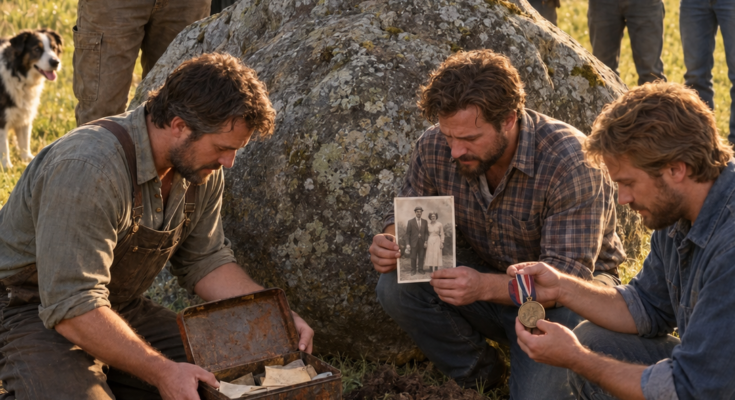
I was the one who found the box.
My brothers and I took turns with the shovels. We dug carefully, afraid of damaging whatever was beneath. The earth was packed hard—decades of roots and clay and time. But we kept going.
Three feet down, my shovel hit metal.
A tin box. Rusted. Sealed with wax that had cracked and crumbled. No bigger than a loaf of bread. I lifted it out and set it on the grass.
My brothers gathered around. My father—Grandpa’s son—stood behind us, his hands in his pockets. He didn’t say a word.
I opened the lid.
Inside was a bundle of papers wrapped in oilcloth. A photograph. A medal. And a letter, folded in thirds, addressed to “Whoever finds this.”
I unfolded the letter. The handwriting was careful. Precise. The ink was faded but legible.
*”My name is Samuel Mueller. I am writing this on the night of August 14, 1936. If you are reading this, I am gone. And you have finally asked the right question.*
*The rock was not always here.*
*I put it here.*
*I put it here because of what is buried beneath it. Because of what happened on this land. Because of what I did.*
*I was twenty-three years old in 1936. The Dust Bowl was killing everything. Our crops. Our cattle. Our hope. My father—your great-great-grandfather—was watching his life’s work turn to dust. He had a heart attack in July. He didn’t die. But he couldn’t work anymore.*
*I was the only one left to save the farm.*
*I did something terrible.*
*I stole from our neighbors. The Hendersons. The only family that had more than we did. They had a well that hadn’t gone dry. They had stored grain. They had money hidden in their barn.*
*I went there at night. I took what I needed. I told myself I would pay it back. I told myself they wouldn’t miss it. I told myself I was saving my family.*
*The Hendersons lost their farm that winter. They couldn’t make their payments. They couldn’t feed their cattle. They moved away in the spring. I never saw them again.*
*I paid them back. Years later. I found them in California. I gave them everything I had. They took it. They forgave me. But I never forgave myself.*
*I bought this land from the bank after they left. I built our farm on top of my sin. And I placed this rock over the place where I buried my shame.*
*I am not telling you this to ask for forgiveness. I am telling you this so you know the truth.*
*The rock stays because the truth stays. The rock stays because we do not forget what we did. The rock stays because we are not the kind of family that hides our sins. We are the kind of family that remembers them.*
*So now you know. The question is: what will you do?*
*Your great-grandfather,*
*Samuel Mueller”*
—
Part 2: The Medal
I read the letter three times.
My brothers read it. My father read it. Then my mother. Then my uncle. Then the farmhands.
Nobody said a word.
I picked up the photograph. It was a black-and-white image of a man in a suit. He was standing next to a woman in a simple dress. They were holding hands. They looked young. They looked happy.
On the back, in the same careful handwriting:
*”Samuel and Ruth. 1936. Before the shame.”*
I picked up the medal. It was bronze. Heavy. It had a ribbon attached. The kind of medal they give to soldiers.
On the front was an eagle. On the back, engraved:
*”For Valor. Sergeant Samuel Mueller. United States Army. 1918.”*
My grandfather had served in World War I. I never knew. Nobody ever told me.
I looked at my father.
“Did you know about this?”
He shook his head.
“No. He never said a word.”
“He was a hero.”
“He was a man who made a mistake. Then he spent the rest of his life trying to make it right.”
—
We sat in the kitchen that night and talked.
We talked about Samuel Mueller. The man who stole from his neighbors. The man who bought their land. The man who built a farm on top of his shame.
We talked about the Hendersons. The family that lost everything. The family that moved away. The family that forgave.
We talked about the rock. The rock that four generations had refused to move. The rock that sat dead center in our north field. The rock that cost us a headache every planting season.
“We could move it now,” my brother said. “We know the truth. We could pull it out and fill in the hole.”
My father shook his head.
“No.”
“Why not?”
“Because the rock stays. That’s what he wanted. That’s what he wrote.”
“But—”
“He didn’t want us to forget. He wanted us to remember. Every time we plow around that rock, we remember. Every time we curse it, we remember. Every time we tell our children about it, we remember.”
He looked at us.
“The rock stays.”
—
Part 3: The Legacy
It’s been a year now.
My father passed away in the spring. He’s buried next to Grandpa. And next to Samuel. And next to Ruth.
The farm is mine now. I run it with my brothers. We still plow around the rock. We still curse it. We still tell the story.
Every planting season, I stand in the north field and look at that boulder. It’s still there. Dead center. A pain in the neck.
But it’s not just a rock anymore.
It’s a reminder.
A reminder that we are not defined by our sins. We are defined by what we do after them.
A reminder that the truth is always worth telling.
A reminder that the past is never really past.
A reminder that the rock stays.
—
Last month, I found something else.
I was going through Grandpa’s old papers. Looking for the deed to the north field. And I found a letter. From the Hendersons.
It was dated 1987. Three years before Samuel died.
*”Dear Samuel,*
*We received your letter. We received the money. We forgive you.*
*We have never forgotten what happened. But we have also never forgotten that you were the only person who helped us after we lost everything. You gave us a place to stay. You gave us food. You gave us a way to start over. We don’t know if you did it out of guilt or kindness. But we don’t care. We only know that you did it.*
*We are doing well now. Our children are grown. Our grandchildren are healthy. We have a small farm in Modesto. We have a good life.*
*You asked us to forgive you. We do.*
*You asked us to forget you. We won’t.*
*Because the truth is, Samuel, we never forgot you. We never stopped praying for you. We never stopped hoping you would find peace.*
*We hope you have.*
*Your friends,*
*The Hendersons”*
I read that letter three times.
Then I folded it carefully. And I put it back in the box.
And I buried it again.
One arm’s length down. Under the north side of the rock.
Because the rock stays.
And now, so does the forgiveness.
—
The End