
Part 1: The Crying
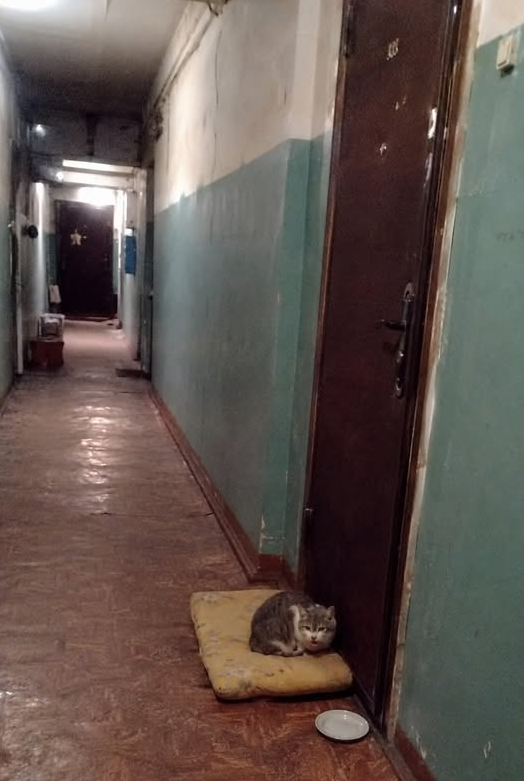
I knew my neighbor wasn’t coming back when her cat spent two nights crying outside her door like the waiting might kill him.
I live in one of those old apartment buildings where you can hear everything and still know almost nothing about the people around you. You hear footsteps overhead. A cough through the wall. Grocery bags hitting the counter. Somebody dropping keys in the hallway after a long day. But people mostly keep to themselves.
Mary lived in 4B, right above me. She was an older woman with soft white hair, house shoes, and cardigans in every color that had faded over the years. She always moved slowly, like she had learned not to rush anything that mattered. Every time I saw her by the mailboxes or coming in from the parking lot, she smiled and said hello like she truly meant it. Not fake polite. Real kind.
She had a little gray-and-white cat that liked to sit in the window beside a yellow cushion. I never knew his name. I just knew that whenever Mary was home, that cat looked peaceful.
Then one week, I stopped seeing her. No light under her door at night. No soft steps overhead. No small cough. No TV murmuring through the ceiling. Nothing.
At first I told myself she was visiting family. Maybe she had gone out of town. Maybe I had just missed her.
Then I heard the crying. It started one evening when I got home from work. Thin. Sharp. Constant. Not loud enough to make a scene. Just sad enough to get under your skin and stay there.
I went upstairs and found Mary’s cat sitting outside her apartment door. He looked at me once, then turned back to the door. Like I didn’t matter. Like he was still waiting for the only person in the world who did.
I stood there for a minute with my keys in my hand, feeling that helpless kind of discomfort people feel when they know something is wrong but hope maybe it will fix itself by morning. I went back downstairs. That night I barely slept.
Part 2: The Waiting
The next day, the cat was still there. So was the next night. Same closed door. Same little body curled up in the hallway. Same cry, only weaker now, like he was wearing himself down one hour at a time.
There was a small dish near the wall. Empty. And somehow that yellow cushion from Mary’s window had ended up outside too. The cat was pressed against it so tightly it looked like he was trying to crawl back into a life that had already ended.
That was the part that broke me. Not just the crying. Not just the hunger. It was the waiting.
So I brought him inside. He didn’t fight me. He didn’t scratch. He barely felt like anything in my arms. At home, I set out water and food. I gave him space. I sat a few feet away on the floor so he wouldn’t feel cornered. He didn’t touch a thing. He went behind the couch and stayed there so long I had to bend down twice just to make sure he was still breathing.
The next morning I tried tuna. Nothing. That night I tried soft food. Nothing. The day after that, I moved Mary’s yellow cushion beside the couch. He came out just long enough to lie against it. Then he went still again, staring at nothing.
That was when I stopped thinking of him as scared. He wasn’t scared. He was grieving.
I took him to the vet because I didn’t know what else to do. They checked him over and told me his body was weak from not eating, but there was nothing seriously wrong with him physically. Then the vet looked at me and said, “Cats grieve quietly. Sometimes so quietly people miss how bad it is.”
I thought that was the worst thing I was going to hear that week. Ten days later, when they finally opened Mary’s door, I learned how wrong I was.
Part 3: The Truth
The building manager finally forced the door open. I was standing in the hallway with the cat in my arms, still waiting, still hoping, still not ready to accept what we all already knew. The apartment was dark. The air was stale. And Mary was gone. She had passed away quietly, alone, in her bed, sometime during that first week of silence.
The cat in my arms started trembling. He knew. He had always known. He had been waiting outside that door not because he thought she would come back, but because he couldn’t bear to be anywhere else.
The manager called the authorities. They came, took photos, removed Mary’s belongings, and sealed the apartment. I watched from the hallway, holding that thin body against my chest, stroking his gray-and-white fur.
I thought about the last time I saw her. She had been checking her mail, her cardigan buttoned unevenly, and she had smiled at me. “Have a good evening, dear,” she had said. And I had said, “You too, Mary.” I hadn’t known it would be the last time.
The cat spent the next few weeks adjusting to my apartment. He ate a little. He slept a lot. He never purred. But he stopped hiding. He started sitting on the back of the couch, staring out the window, the same way he used to stare out Mary’s window. I like to think he was remembering her.
One night, I sat beside him and said, “I don’t know your name. She never told me. I’m sorry.” He turned and looked at me, just for a moment. Then he looked back at the window.
I reached down and touched his head. He let me. And in that moment, I understood that grief doesn’t have to be loud to be real. Sometimes it just curls up in a hallway and waits.
Weeks passed. The cat started eating more regularly. He started sleeping on my bed, not Mary’s cushion, but close enough that I could feel his warmth. I started calling him Charlie. It just came out one day. He didn’t seem to mind.
I still think about Mary. I think about her kindness, her cardigans, her quiet presence in the building. I think about how easy it is to live beside someone and never really see them. I think about how a cat’s love is simple and fierce and doesn’t stop just because the person is gone.
Charlie is doing better now. He follows me around the apartment. He waits by the door when I come home. He curls up beside me at night. He still doesn’t purr much, but he talks to me in his own way. And I talk back.
Sometimes I sit with him and tell him about Mary. I tell him she was kind. I tell him she remembered to smile at people even when they didn’t smile back. I tell him she would want him to be happy.
I think he understands. He doesn’t cry anymore. He doesn’t wait at doors. He just stays close, like he finally knows he belongs somewhere.
I thought I was rescuing him. But maybe he was rescuing me too. Because for the first time in a long time, my apartment doesn’t feel empty. And I don’t feel alone.
Sometimes the people we barely notice leave behind the biggest holes. And sometimes the creatures they loved become the bridge back to something worth living for.
Charlie is that bridge for me. And I will always be grateful to Mary for bringing him into the world—and into my life.
He still has Mary’s yellow cushion. It sits in the corner of my bedroom. He doesn’t use it anymore, but I can’t bring myself to put it away. It’s a reminder. A reminder that love doesn’t disappear. It just changes shape. ❤️