Part 1: The Watcher
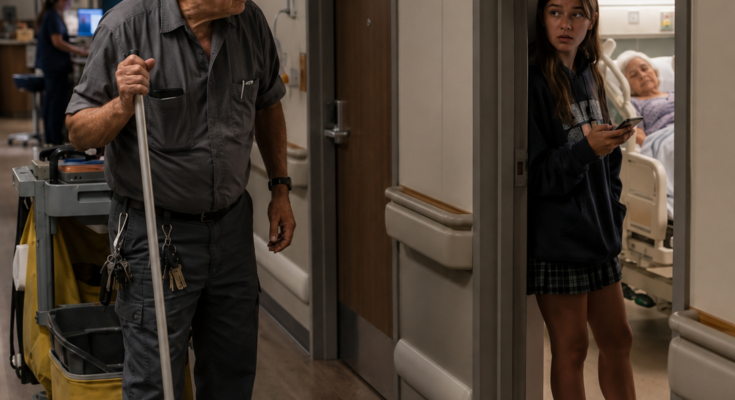
The first time I saw the old cleaner stop outside Room 214, I thought he was listening for something he had no right to hear. He stood there with one hand on his mop handle, his gray uniform wrinkled at the elbows, his keys hanging heavy from his belt. The hallway lights had already dimmed for the night. Most of the nurses had lowered their voices. The visitors had gone home with tired eyes and folded discharge papers they didn’t understand. But he stayed. Just stood there. Outside Room 214.
My grandmother’s room was across the hall, Room 213, close enough that I could watch him through the half-open door while pretending to scroll on my phone. He didn’t knock. He didn’t go in. He just lowered his head for a moment, like the door was a person, then reached into his pocket and touched something I couldn’t see. After almost a minute, he quietly moved on.
I remember thinking, That’s strange. By the third night, strange had turned into annoying. I was sixteen that summer, old enough to think I understood adults and young enough to be wrong about almost all of them.
My grandmother had been admitted after a bad fall in her kitchen. Nothing dramatic, the doctors kept saying. A few bruises, some weakness, more tests. But when you love someone, even the word “tests” can sit in your stomach like a stone.
Every evening after school, Mom dropped me at the hospital with a backpack, a container of soup, and strict instructions not to let Grandma charm me into giving her vending machine cookies. Grandma tried anyway. “Just one pack,” she’d whisper, pointing at the hallway like the crackers were medicine. “No.” “You are cruel like your mother.” “You raised her.” She would smile then, but only for a second. Hospitals have a way of stealing even the good moments before they fully land.
At night, when visiting hours stretched thin and the halls grew quiet, I started noticing things. A nurse rubbing her forehead at the station. A man sleeping upright in a chair with a visitor badge stuck to his shirt. Cold coffee cups lined up near the microwave. The squeak of shoes. The soft beep of machines behind closed doors. And always, around 9:40, the old cleaner.
His name tag said Mr. Elias. He moved slowly but not weakly. Carefully. Like every room deserved respect. He wiped handrails. Emptied trash. Refilled paper towels. Mopped around slippered feet and sleeping sons and daughters who forgot to say thank you. But Room 214 was different. He always saved it for last. And he always paused before going in.
One night, I finally asked a nurse about him. “Why does that cleaner keep hanging around 214?” I whispered. The nurse, whose name was Carla, glanced up from a chart. “Mr. Elias?” “I guess.” “He cleans this floor.” “I know, but he stands outside that room every night. It’s creepy.” Carla’s face changed, just a little. Not anger. Not exactly. More like disappointment that arrived before she could hide it. “He’s harmless,” she said. That made me feel worse, though I didn’t know why.
Part 2: The Question
The next night, Grandma was more tired than usual. Her silver hair was flattened against the pillow, and her hospital bracelet looked too large on her wrist. I was opening her soup when she turned her head toward the hallway. “Is he here yet?” “Who?” “The man with the keys.” I looked up. Mr. Elias was pushing his cart past the nurse station, yellow gloves tucked into his back pocket, a stack of fresh linens folded neatly on top. “You mean the cleaner?” Grandma’s eyes followed him. “Yes,” she said softly. “Elias.”
“You know him?” She didn’t answer right away. Her fingers moved over the blanket, smoothing a wrinkle that wasn’t there. “He closes that room last,” she said. “I noticed.” Grandma looked at me then, and something in her face made me stop talking. There was sadness there, but not fear. Recognition. Like she had been waiting for me to ask the right question.
“Room 214,” she said. “Is the man still there?” I glanced toward the closed door across the hall. “Yeah. I think so.” “Does anyone visit him?” I shrugged. I had seen a woman come once in a blazer, staying less than ten minutes. A man came another day and left with a phone pressed to his ear. Mostly, Room 214 was quiet. Mostly, nobody came. “I don’t know,” I said. “Not much.” Grandma closed her eyes. “That poor boy.” “Boy? Grandma, he’s old.” “To someone my age, most people are boys.” I smiled, but she didn’t.
That night, Mr. Elias reached Room 214 later than usual. The hallway was nearly empty. Mom had texted that she was stuck finishing a shift and would come soon. Grandma had drifted off, one hand curled around the edge of the blanket. I watched Mr. Elias stop outside the door. Same pause. Same bowed head. But this time, instead of moving on, he reached into his cart and took out a small paper cup of water. Then he knocked softly and opened the door.
I shouldn’t have followed. I know that now. But curiosity can feel like righteousness when you’re young. I slipped into the hallway and stood near the supply closet, close enough to see through the narrow gap before the door closed.
The patient in Room 214 was sitting up in bed, thin shoulders under a blue hospital gown, face turned toward the window where the city lights blurred against the glass. Mr. Elias placed the water cup on the tray. Then he did something no cleaner had to do. He took a folded blanket from his cart and laid it gently over the man’s legs. The man didn’t speak. Mr. Elias did. “Your feet get cold after nine,” he said, almost too quiet to hear. “I remembered.”
The patient turned his head. For a second, his face changed. Not into a smile exactly. Something smaller. Something more painful. I backed away fast before they could see me.
When Mom arrived, I told her. “I think that cleaner is doing stuff he’s not supposed to do,” I said. “He goes into 214 and talks to the patient. Brings him things.” Mom was tired, still in her pharmacy scrubs, her hair falling from its clip. “Maybe he’s being kind.” “But what if he’s not allowed?” Mom gave me that look parents give when they don’t have the strength to argue but still know you’re missing something. “Not every rule is the same as goodness, Mia.” I hated when adults said things that sounded wise instead of useful.
Part 3: The Reckoning
The next evening, Grandma seemed brighter. She ate half her soup and complained that the hospital carrots tasted like wet shoelaces. Then, just after nine, she reached for my hand. “If Elias comes by,” she said, “ask him to come in.” “The cleaner?” “Yes.” “Why?” Her grip tightened. “Because I need to tell him something before it’s too late.” My throat went dry. “Before what’s too late?” She didn’t answer.
Across the hall, the wheels of the cleaning cart squeaked. Mr. Elias appeared under the dim hallway light, moving slowly toward Room 214. Grandma pushed herself up with more strength than I’d seen all week. “Mia,” she whispered. “Go get him.”
I stepped into the hallway just as Mr. Elias stopped outside Room 214. For the first time, he saw me watching. His eyes were tired. Not strange. Not lazy. Tired in a way I suddenly didn’t know how to judge. “My grandma wants you,” I said. He looked past me into Room 213. At the sound of his name, Grandma lifted one trembling hand. Mr. Elias went still. Then Grandma said a sentence that made the hallway feel like it had dropped beneath my feet.
“Elias,” she called softly, “does he know you’re the reason he’s still alive?”
Mr. Elias’s face crumpled. He looked down at his worn shoes, then back at her. “No, ma’am,” he said, his voice breaking. “He doesn’t know. And I don’t think he ever will.”
Grandma motioned for him to come closer. He walked to her bedside slowly, like every step cost him something. She reached up and took his hand. “What’s your son’s name again?” she asked gently. “Eli,” he whispered. “He’s named Eli.”
Grandma nodded. “And he’s in that room because he doesn’t remember who he is. But you remember. You remember everything.”
Tears slipped down Elias’s face. “Yes, ma’am. I remember.”
I stood in the doorway, my heart pounding. The patient in Room 214 was Elias’s son. He had been in a terrible accident years ago. He survived, but his memory was gone. He didn’t recognize his own father. And Elias, the cleaner, had taken a job at the hospital just to be near him. Every night, he brought him water, blankets, and small kindnesses that his son would never understand. He did it because he was a father. And because love didn’t stop just because the person you loved stopped remembering.
Grandma squeezed his hand. “You need to tell him, Elias. You need to tell him who you are.” “I can’t,” he said, his voice cracking. “What if he doesn’t believe me? What if it hurts him more?” “What if it heals him?” Grandma asked.
Elias was silent. Then he nodded slowly. “I’ll try,” he said. “Tomorrow. I’ll try.”
The next evening, I watched from the hallway as Elias walked into Room 214. He sat down beside his son’s bed and took his hand. He told him everything. The name. The story. The love that had never stopped. The patient, Eli, stared at him for a long, confused moment. Then something flickered in his eyes. Recognition. “Dad?” he whispered. Elias broke down crying. “Yes, son. I’m here.”
Two weeks later, the patient in Room 214 was discharged. His son had moved him to a memory care facility closer to home. Elias continued working at the hospital, but he didn’t pause outside Room 214 anymore. He didn’t have to. His son remembered him. And that was enough.
Before Grandma left the hospital, she and Elias sat together one last time. He thanked her. She smiled. “I had a feeling,” she said. “That’s what grandmothers are for.”
Years later, I still think about that summer. I still think about Mr. Elias, the cleaner who loved his son so much that he spent years standing outside his door, hoping for a miracle. And I think about Grandma, who saw what I couldn’t see. Who knew what I couldn’t know. Who reminded me that kindness isn’t always loud. Sometimes it’s quiet. Sometimes it’s a folded blanket. Sometimes it’s a father who never stopped waiting.
I learned something that summer. The people who seem like they’re just doing their jobs are often doing something much bigger. They’re holding the world together. They’re loving in ways we can’t see. And sometimes, all it takes is one person to notice.
Elias never asked for recognition. He just kept showing up. And when his son finally remembered, that was all the reward he needed.
I’ll never forget him. I’ll never forget Grandma. And I’ll never forget that love is always worth fighting for—even when the person you love forgets your name. ❤️