Part 1: The Restaurant
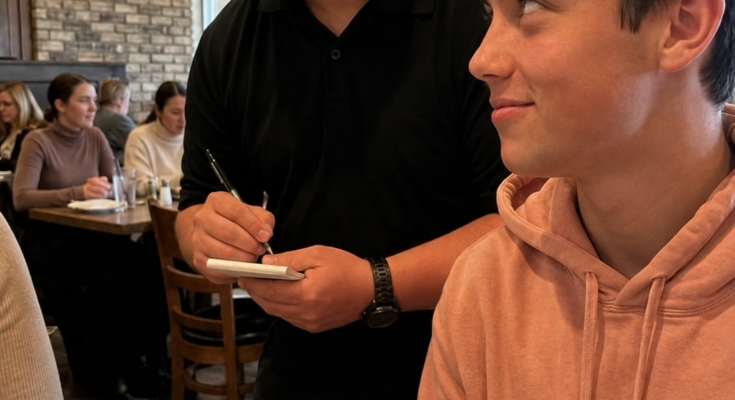
I took my 14-year-old son, Leo, out to his favorite steakhouse to celebrate his good report card. Everything was fine until our waiter, Sam, walked over to take our order. Sam was a polite young man in his early twenties who clearly had Down syndrome. He was extremely focused and took his job very seriously.
But as soon as Sam started speaking and carefully writing down our drinks, I noticed Leo smirking. I nudged him under the table, giving him a sharp warning look, but he completely ignored me. When Sam slightly stumbled over pronouncing one of the daily specials, Leo didn’t just laugh—he openly rolled his eyes, mimicked Sam’s posture, and snickered while texting his friend.
My heart sank right into my stomach. A wave of cold horror and deep shame washed over me. I couldn’t believe this cruel teenager sitting across from me was the boy I had raised.
I immediately put my credit card down on the table, apologized profusely to Sam, tipped him generously, and asked for the bill. I didn’t say a single word to Leo as we walked out to the parking lot. He tried to brush it off in the car, saying, “Mom, come on, I was just joking around; why are you making such a huge deal out of it?”
I remained completely silent during the entire twenty-minute drive home. The atmosphere in the car was suffocatingly tense. When we finally pulled into the driveway, I didn’t let him go to his room. I made him sit down at the kitchen table.
I walked into my bedroom, reached into the back of my closet, and pulled out an old, faded wooden box that I hadn’t opened in nearly twenty years. When I placed it on the table between us and lifted the lid, Leo’s sarcastic smile completely vanished.
Inside the box were photographs. Old, yellowed photographs of a young boy with Down syndrome. He was smiling, holding a stuffed animal, sitting on a swing. There were also letters, handwritten in careful, childlike script. And at the very bottom, a small, worn bracelet with beads spelling out a name.
Part 2: The Box
Leo stared at the photographs, confused. “Who is this?” he asked, his voice quieter than before.
I took a deep breath. “His name was Caleb. He was my brother.”
Leo looked at me, his eyes wide. “You never told me you had a brother.”
“Because I couldn’t,” I said. “It hurt too much. But I think it’s time you knew.”
I picked up one of the photographs and held it gently. “Caleb was born when I was ten years old. He had Down syndrome. My parents loved him more than anything, and so did I. He was the sweetest, kindest soul I’ve ever known. He used to sit on the porch with me and tell me about the birds. He would draw pictures and leave them under my pillow. He taught me that the world is full of beauty, if you’re willing to see it.”
Leo’s eyes had grown wider. “What happened to him?”
“He died when he was sixteen,” I said softly. “He had a heart condition that was common for people with Down syndrome. It was sudden. He was playing in the backyard one afternoon, and the next thing we knew, he was gone. My parents never recovered. I never recovered.”
I reached into the box and pulled out the bracelet. “This was his. He made it for me when he was twelve. He said it was his most special gift because I was his most special sister.”
Leo’s face had lost all its arrogance. He looked ashamed. “Mom, I didn’t know.”
“I know you didn’t,” I said. “But that doesn’t make what you did okay. When you laughed at Sam today, you laughed at someone who has the same condition my brother had. You laughed at someone who is just as kind, just as hardworking, and just as deserving of respect as Caleb was.”
“Mom, I’m sorry—”
“I’m not done,” I said. “I need you to understand something. People with disabilities are not a joke. They are not something to be mocked. They are human beings, Leo. They have dreams, feelings, and families who love them. And when you treat them like they’re less, you’re not just hurting them—you’re hurting me. Because every time I see someone mock a person with Down syndrome, I see Caleb. I see my brother. And it breaks my heart all over again.”
Part 3: The Apology
Leo was crying now. The sarcastic, cruel teenager who had mocked our waiter was gone. In his place was a fourteen-year-old boy who had finally understood the weight of his actions.
“Mom, I’m so sorry,” he said, his voice breaking. “I didn’t think. I was just trying to be funny. I didn’t know—”
“I know you didn’t think,” I said gently. “That’s why we’re having this conversation. Because you need to learn that your words and actions have consequences. They can hurt people in ways you don’t even see.”
“What do I do?” he asked.
I reached across the table and took his hand. “You go back to that restaurant. You find Sam. And you apologize. Not because I’m making you, but because you understand what you did was wrong.”
Leo nodded, wiping his eyes. “Okay. I will.”
The next day, we drove back to the steakhouse. Leo was nervous, but he walked in with me by his side. We found Sam at the host stand, smiling and greeting guests.
Leo stepped forward. His hands were shaking, but his voice was steady. “Sam, hi. I’m Leo. I was here yesterday with my mom.”
Sam smiled. “Of course! I remember you.”
“I—I wanted to apologize,” Leo said. “What I did yesterday was really mean and disrespectful. I laughed at you, and I was wrong. I’m so sorry.”
Sam’s smile never wavered. He looked at Leo with kindness in his eyes. “Thank you for apologizing. That’s very brave of you.”
Leo’s eyes filled with tears. “You’re not mad?”
Sam shook his head. “Everyone makes mistakes. The important thing is that you learn from them. And you came back to say sorry. That takes a lot of courage.”
Leo looked at Sam differently after that. He saw the kindness, the patience, the genuine warmth in his eyes. He saw a human being, just like anyone else.
“Thank you, Sam,” Leo said.
“You’re welcome,” Sam replied. “Now, are you guys here to eat, or were you just in the neighborhood?”
Leo laughed, a genuine laugh this time. “Actually, I think my mom deserves a steak dinner.”
Sam smiled and led us to our table. He was the same attentive, focused waiter he had been the day before. But this time, Leo didn’t mock him. He treated him with respect. He even asked about his hobbies and his family.
When Sam walked away to put in our order, Leo turned to me. “He’s really nice, Mom. I was an idiot yesterday.”
“You were,” I said. “But you’re not today. That’s what matters.”
Over the next few weeks, I noticed a change in Leo. He became more patient, more kind. He started volunteering at a local community center that worked with people with disabilities. He became friends with some of the participants and learned more about their lives, their struggles, and their triumphs.
One afternoon, he came home with a grin on his face. “Mom, I met someone today who reminded me of Caleb.”
My heart stopped. “Really?”
“His name is Marcus. He’s got Down syndrome too. He’s really funny. He told me a joke about a chicken that was so stupid I almost fell off my chair.”
I laughed. “Sounds like a good friend.”
“He is,” Leo said. “I’m going to volunteer there every week from now on. I want to help.”
I hugged him. “That’s the best thing I’ve ever heard.”
Months later, Leo received an award for his volunteer work. The ceremony was held at the community center, and Leo’s name was called to the stage. He stood in front of the crowd, nervous but proud.
“I want to thank my mom,” he said, his voice steady. “She taught me a lesson I’ll never forget. She showed me that the people we’re tempted to laugh at are the ones we should be learning from. They have so much to teach us about kindness, patience, and love. I’m a better person because of her. And I’m a better person because of the friends I’ve made here.”
I cried. I couldn’t help it. My son had grown up. He had learned something that would stay with him for the rest of his life.
Sam was in the audience that night. He smiled and gave Leo a thumbs up. Leo smiled back.
In that moment, I knew everything was going to be okay.
The box went back into my closet, but not to be forgotten. I opened it sometimes, when I needed to remember Caleb. But now, I also remembered Leo’s journey. I remembered how a cruel moment had turned into a powerful lesson.
I remembered that change is possible. That growth is possible. That love is possible.
And I remembered that sometimes, the best lessons are the hardest ones to learn.
Leo is a man now. He’s kind, compassionate, and generous. He works with people with disabilities and advocates for them in his community. He never forgot Sam. He never forgot Caleb. And he never forgot what I taught him that day at the kitchen table.
Sometimes, we have to be cruel to be kind. Sometimes, we have to break our children’s hearts to help them build better ones.
That day, I broke Leo’s heart. But I also built something better in its place.
And that was the greatest gift I could have given him. ❤️