Part 1: The Quarantine
Maya, the youngest vet tech on shift, planted herself in the hallway and tried to sound braver than she felt. “Sir, you can’t go back there.”
Samuel Gage stopped with both hands on the handles of his feed cart. The bags of dog food were stacked higher than his chest, dusty from the back of his old pickup, and his flannel shirt carried the smell of hay, cold air, and a farm that had survived more winters than most people.
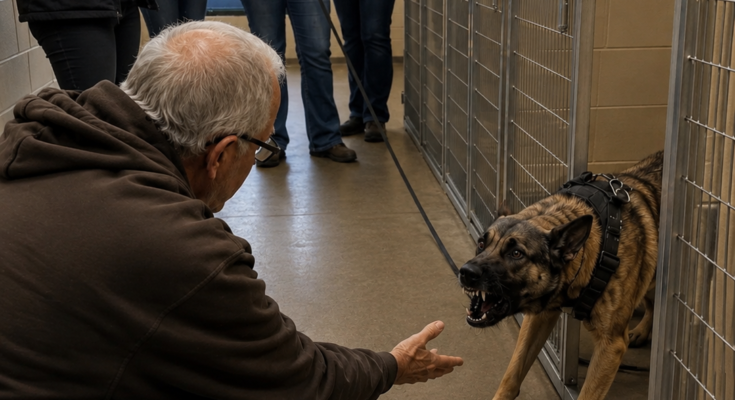
Down the concrete hall, something hit metal hard enough to make every dog in the adoption wing start barking. The sound that followed was not barking. It was lower. It was a growl that seemed to come from the floor.
Maya swallowed. “Animal control brought him in three days ago,” she said. “Belgian Malinois. Extreme aggression. Nobody can get near him.”
Samuel looked past her. He did not lean around her. He did not puff up. He simply listened.
Brenda Yates, the shelter director, hurried around the corner with a clipboard pressed to her chest like a shield. “Mr. Gage, thank you for the delivery,” she said. “Leave the invoice up front. Kevin is bringing the dart rifle.”
Samuel’s faded blue eyes moved to her. “Has he taken any water?”
The question landed strangely in the hallway. Not had they offered it. Had he taken it. Brenda blinked. “We can’t get a bowl in. He lunges. He flips it. He has already bent one kennel door.”
The growl rolled again, raw and steady.
Dr. Anya Sharma stepped out of her office and saw the old feed man still standing there as if the panic in the building was weather moving around a fence post. She had noticed him before. The straight back. The small movements. The way he never turned his blind side to a room. Her father had stood like that when he came home from the Marines.
Animal control officer Kevin Finch pushed through the front door with a catch pole in one hand and the dart rifle in the other. “All right,” he said too loudly. “Let’s give Napoleon his nap.”
Samuel turned his head toward him. “The dart won’t work.” Kevin laughed once. “And what makes you the expert, pops?”
Samuel did not answer the insult. He looked at the barred door at the end of the hall and said, “A dog trained to stay standing under stress will fight the drug until his body gives out.”
Anya felt the room go still. Those were not farmer words. Those were not guess words.
Brenda frowned. “This animal is dangerous.”
“Yes,” Samuel said. “And fear is not a crime.”
No one spoke after that. The old man set his worn gloves on the counter. Then he pointed with his chin toward the quarantine hall. “Let me try.”
Part 2: The Door
Brenda shook her head before he finished. “I cannot let a civilian walk into a dangerous enclosure.”
“He is dying in there,” Samuel said. “Not from hunger. Not yet from thirst. From not knowing who is friend and who is enemy.”
Kevin lifted the rifle a little higher. Anya stepped between them. “Brenda,” she said quietly, “if we dart him now, I think we may kill him.”
That was the sentence that cracked the room. Brenda looked at the door. She looked at the old man. Then she nodded once, even though every rule in her head was screaming at her.
“Kevin stays on the door,” she said. “If that dog moves wrong, you fire.”
Samuel did not argue. He walked down the hall with the same measured pace he had used to bring in feed bags every Tuesday. Only now everyone could see it. He was not walking like an old farmer. He was walking like a man returning to a place he knew.
At the quarantine door, the growling rose into a violent storm. Kevin slid the bolt back. Samuel stopped him from opening the door all the way. He cracked it only a few inches and waited. One minute passed. Then another. The shelter staff crowded behind him, barely breathing.
“Lower the rifle,” Samuel said without turning around. Kevin’s jaw tightened. Anya put a hand on his arm. The barrel dipped.
Samuel slipped inside.
Through the little barred window, they saw the dog at the end of the chain, filthy and magnificent, every muscle locked, teeth white against black gums. Samuel did not stare at him. He crouched sideways, hands loose, eyes lowered to the concrete.
The dog strained forward. The chain snapped tight. Kevin raised the rifle again. Samuel lifted one palm.
Then the old man took one slow breath and whispered a word none of them had ever heard.
“Kestrel.”
The dog’s head lifted.
Part 3: The Remembering
The growling stopped. The dog’s ears flicked forward. His whole body went still—not frozen with fear, but listening. Waiting. Remembering.
Samuel said the word again, softer this time. “Kestrel.”
The dog’s tail moved. Just once. A single, hesitant wag.
“She was your handler,” Samuel said quietly. “The woman who trained you. The woman who trusted you. She called you by that name when no one else was listening.”
The dog whined. A sound so broken and raw that Maya pressed her hand to her mouth.
Samuel lowered himself fully to the concrete floor. He sat cross-legged, his back against the wall, his hands resting on his knees. He didn’t reach for the dog. He didn’t offer food. He just sat there, patient and still.
“Kestrel was my daughter,” he said, his voice barely above a whisper. “She was a military working dog handler. She trained dogs like you. She told me about a dog named Kestrel once—a Belgian Malinois with a scar above his left eye and a heart bigger than any field she’d ever run.”
The dog took a step forward. Then another. The chain dragged across the concrete.
“I buried her last spring,” Samuel said. “She was killed in action. And when I heard there was a dog in the county shelter who couldn’t be touched, I knew it was you. I knew you were waiting.”
The dog reached him. He lowered his head and pressed his nose against Samuel’s chest. The old man’s hand came up slowly, gently, and rested on the dog’s neck.
“It’s okay, Kestrel,” Samuel whispered. “It’s okay.”
The dog’s body began to shake. The growls faded into soft, shuddering whines. And then, for the first time in three days, the dog lay down. He pressed himself against Samuel’s side and closed his eyes.
The shelter staff watched through the window in stunned silence. Kevin lowered the dart rifle completely. Brenda wiped her eyes. Anya pressed her hand to her heart.
“He knew,” Maya whispered. “He knew the word.”
“That wasn’t just a word,” Anya said. “That was a connection. That was a promise.”
Samuel stayed on the floor with Kestrel for nearly an hour. He didn’t rush. He didn’t force the dog to move. He let him rest, let him remember, let him understand that he was finally safe.
When Samuel finally stood, Kestrel rose with him. The chain clanked against the concrete, but the dog didn’t growl. He simply stayed close to Samuel’s side, as if he had finally found the thing he had been searching for.
“What happens now?” Brenda asked.
Samuel looked at the dog. “He comes with me.”
“You can’t—”
“I can,” Samuel said quietly. “He was my daughter’s partner. He belongs with family.”
No one argued.
Samuel led Kestrel out of the quarantine kennel and down the hallway. The dog walked beside him, calm and steady, his eyes clear for the first time in days. The other dogs in the adoption wing barked, but Kestrel didn’t react. He was focused on the man beside him.
At the front door, Samuel paused. He looked back at Anya. “The scar above his left eye,” he said. “That’s how I knew it was him. My daughter told me about it. She said he got it protecting her from an attack. He never stopped protecting her, even when it cost him.”
Anya nodded. “He’s still protecting her memory.”
“Yes,” Samuel said. “And now he’ll protect mine.”
He led Kestrel to his old pickup truck. The dog jumped into the passenger seat without being asked, then turned to look at Samuel with those same bright, watchful eyes.
“Home,” Samuel said softly. “You’re going home.”
The truck pulled out of the parking lot and disappeared down the road. The shelter staff stood at the front door, watching it go.
Maya wiped her eyes. “That’s the best thing I’ve ever seen.”
Anya smiled. “That wasn’t just a rescue. That was a reunion.”
In the weeks that followed, Samuel and Kestrel became inseparable. They walked the farm together. They sat on the porch together. They visited Kestrel’s handler’s grave together. Samuel would sit beside the headstone with the dog at his feet, telling his daughter about everything that had happened.
“She would have wanted this,” he would whisper. “She would have wanted you to be free.”
And the dog would lay his head on Samuel’s lap and close his eyes, grateful and safe.
Kestrel never showed signs of aggression again. He was gentle with the farm animals, patient with the neighbors, and completely devoted to the old man who had remembered his name. He had spent years serving his country. Now he spent his golden years serving love.
Samuel and Kestrel became famous in the local community. The shelter told their story. The newspaper wrote an article. People came from miles around just to meet the military dog who had been saved by his handler’s father.
But Samuel didn’t care about any of that. He only cared about the quiet moments—the early mornings, the long walks, the gentle presence of a dog who had finally found his peace.
“She saved you,” Samuel would tell Kestrel. “And you saved me.”
The dog would wag his tail, just once, and press his head against Samuel’s hand.
That was all the answer he needed.
Because sometimes, the greatest rescue isn’t about saving someone from danger. Sometimes, it’s about saving them from being forgotten. And Samuel had done exactly that.
Kestrel had been waiting for someone who remembered. And Samuel had been waiting for someone who needed him.
Together, they found each other.
And that was enough. ❤️