
Original Fiction: This story is fictional. Names, characters, dialogue, locations, and events were created for storytelling purposes.
PART 1 — THE CAKE WITHOUT A NAME
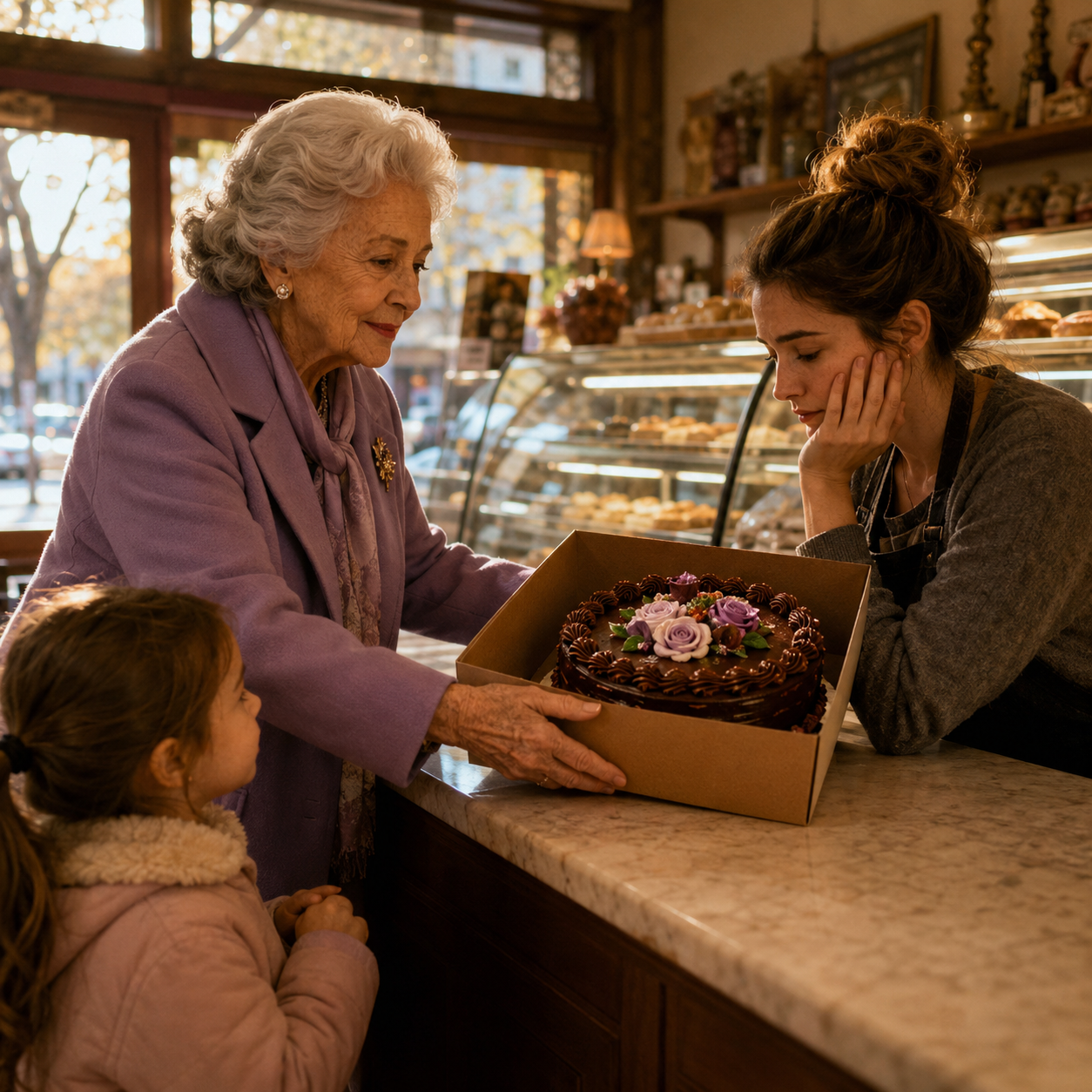
Every Friday at exactly 4:30, an elderly woman entered our bakery and purchased a birthday cake.
Not a slice.
Not a cupcake.
A full eight-inch chocolate cake with buttercream roses around the edge.
She always paid in cash.
She never requested a name.
And she never took the cake home.
“Give it to someone who needs it,” she would say.
Then she walked away before we could ask what she meant.
My name is Nora Hayes, and at the time I was the evening manager of Bellweather Bakery.
I was thirty-one, recently divorced, and raising an eight-year-old daughter named Lily.
The bakery barely paid enough to cover rent, childcare, groceries, and the monthly stack of envelopes I avoided opening until the red print became impossible to ignore.
I understood needing food.
I understood needing money.
I did not understand needing a birthday cake.
The woman’s name was Evelyn Mercer.
She was small and elegant, with silver hair pinned behind her head and a lavender coat she wore regardless of the weather.
On her first visit, I assumed she was purchasing the cake for a relative.
After paying, she slid it back across the counter.
“I’d like you to give this away.”
“To whom?”
“Someone who looks as though no one remembered.”
I laughed because I thought she was joking.
She did not laugh with me.
That evening, I gave the cake to a young father who had entered with two children.
He spent several minutes calculating whether he could afford three cookies.
When I offered him the cake, he looked suspicious.
“What’s wrong with it?”
“Nothing.”
“Why are you giving it away?”
I pointed toward the window, but Evelyn was already gone.
“Someone paid for it.”
The father stared down at the box.
“It isn’t anyone’s birthday.”
His little girl tugged his sleeve.
“It could be.”
So they took it.
The following Friday, Evelyn returned.
“Did you find someone?” she asked.
“Yes.”
She smiled.
Then she bought another cake.
For months, the routine continued.
Sometimes we gave the cake to an exhausted nurse ending a double shift.
Sometimes to a college student who counted coins before ordering coffee.
Once, I gave it to a woman who had just signed divorce papers in the corner booth and had been staring at the same untouched muffin for nearly an hour.
“You don’t have to be born today to deserve cake,” I told her.
Evelyn liked that.
She began writing it on small cards:
You don’t have to be born today to deserve something worth celebrating.
We placed one inside every box.
My coworkers invented theories about her.
Perhaps she had lost a child.
Perhaps she had dementia.
Perhaps she had won the lottery and this was her unusually specific form of charity.
I asked her once.
“Why Friday?”
“Because Friday is when people become hardest to see.”
“What does that mean?”
“Everyone is hurrying home to someone.”
“And the cake?”
She looked toward the bakery tables.
“A cake makes people ask who the celebration is for.”
Her eyes met mine.
“Sometimes the answer should be the person sitting alone.”
Then she changed the subject.
In October, Lily’s school reduced its aftercare hours.
I began bringing her to the bakery after class.
She completed homework at a corner table, decorated leftover cookies, and charmed customers into buying things they had not intended to purchase.
Evelyn adored her.
“Are you the official quality inspector?” she asked one afternoon.
Lily nodded solemnly.
“I test the frosting.”
“Important work.”
“Very dangerous.”
Evelyn began arriving ten minutes early so she could talk with Lily.
She taught her how to fold napkins into roses and always carried butterscotch candies in her handbag.
One Friday, Lily asked the question none of us had managed to ask directly.
“Did somebody forget your birthday?”
Evelyn became still.
I expected her to change the subject.
Instead, she said, “A very long time ago.”
“How old were you?”
“Ten.”
“Did you cry?”
“Yes.”
Lily considered this.
“I cried when Mom forgot Crazy Hair Day.”
“I did not forget,” I said. “I remembered after we reached school.”
“That is called forgetting.”
Evelyn smiled, but sadness remained in her eyes.
“Someone I did not know bought me a cake that day,” she told Lily. “It was the first birthday cake I ever had.”
“Who?”
“I never learned his name.”
“Then how did you thank him?”
“I’m still trying.”
That was all she said.
The Friday before Lily’s ninth birthday, my bank account contained twenty-three dollars.
Rent was due Monday.
My car needed a new alternator.
And Lily had spent three months talking about the small roller-skating party she wanted.
I canceled it two days before her birthday.
I told her the skating rink had made a scheduling mistake.
She knew I was lying.
Children often do.
They simply pretend not to notice because they love us.
“Can we still have cake?” she asked.
“Of course.”
I planned to bake one after closing using leftover ingredients.
That Friday became one of the busiest shifts of the year.
Two employees called in sick. A wedding order was returned because the icing color was wrong. The mixer stopped working, and a customer shouted at me over a misspelled name.
At 4:30, Evelyn did not arrive.
At 5:00, I began watching the door.
At 5:30, I called the number listed on her customer account.
No one answered.
By closing time, I was frightened.
Evelyn had never missed a Friday.
After locking the bakery, I drove to the address on her account.
The building was a modest retirement community on the edge of town.
A receptionist met me in the lobby.
“Are you family?”
“No. I’m from Bellweather Bakery.”
Her expression changed.
“Mrs. Mercer was taken to the hospital this morning.”
“What happened?”
“She collapsed in her apartment.”
Lily gripped my hand.
“Is she going to be okay?”
“I don’t know, sweetheart.”
The receptionist handed me an envelope.
“She left this at the desk yesterday. It has your bakery’s name on it.”
Inside were forty dollars and a handwritten note.
Dear Nora,
I may not be able to come Friday.
Please buy the cake anyway.
This week, I already know who needs it.
Her name is Lily.
Tell her birthdays are not measured by parties, presents, or how much money her mother has.
Tell her she is worth celebrating.
And tell her mother the same thing.
—Evelyn
I read the note twice.
Then Lily wrapped her arms around my waist.
“You didn’t have to lie about the skating rink,” she whispered.
“I wanted to give you a real birthday.”
She looked up at me.
“Being with you is real.”
That night, we returned to the bakery.
I unlocked the door, switched on one row of lights, and baked a chocolate cake.
Lily decorated it badly.
The roses leaned sideways.
The lettering was uneven.
Across the top, she wrote:
HAPPY BIRTHDAY TO US
We ate two slices at the corner table.
Then Lily cut a third.
“This one is for Evelyn,” she said.
But Evelyn was not there to eat it.
PART 2 — THE BOY IN THE PHOTOGRAPH
Evelyn had suffered a mild stroke.
She survived, but her left side was weak and speaking required effort.
Lily and I visited her the next afternoon.
She lay beneath a white blanket with her silver hair unpinned around her shoulders.
When she saw Lily carrying the remaining birthday cake, she smiled.
“You… saved me… some.”
“Mom wanted a second slice.”
“I did not.”
Evelyn looked at me.
“Liar.”
Her speech was slow, but her sense of humor remained intact.
We visited every day that week.
Evelyn had no children. Her husband had died twelve years earlier, and the only relative listed in her medical file was a nephew living in another state.
On the third visit, Lily found an old photograph inside Evelyn’s handbag.
It showed a boy standing outside a grocery store.
He appeared about sixteen.
He wore a paper hat and held a small cake box.
“Is this the man who bought your first cake?” Lily asked.
Evelyn nodded.
The photograph had faded so badly that the boy’s face was difficult to see.
“You said you never knew his name.”
“I didn’t.”
“Then how did you get his picture?”
Evelyn looked at me.
“Newspaper.”
Years earlier, she had clipped the photograph from an article.
She explained the story slowly.
Evelyn grew up in a house where birthdays were treated like ordinary days. Her father drank heavily. Her mother worked constantly. Money disappeared before reaching the kitchen.
On Evelyn’s tenth birthday, she wandered into a grocery store and stared at the cakes through the bakery glass.
A teenage employee noticed her.
He asked which cake she wanted.
Evelyn told him she had no money.
The boy purchased the smallest chocolate cake with his own wages and wrote HAPPY BIRTHDAY, EVIE across the top.
“He sat with me behind the store,” she said. “Found two plastic forks.”
“Did you tell him your name?” I asked.
“Only Evie.”
“Why didn’t you ask his?”
“I was ten. I thought kind people simply appeared.”
The following week, Evelyn returned to thank him.
He no longer worked there.
The manager said the boy’s family had moved.
Years later, Evelyn discovered his photograph in an old newspaper article about a grocery-store charity drive.
The caption identified the manager but not the teenage volunteers.
She never found his name.
“So you buy cakes because of him?” I asked.
“One cake changed what I believed about myself.”
“What did you believe before?”
“That being forgotten meant I was forgettable.”
Her eyes moved toward Lily.
“That boy showed me the difference.”
After Evelyn left the hospital, she temporarily moved into a rehabilitation center.
She could no longer walk to the bakery.
So every Friday, Lily and I brought the cake to her.
Evelyn paid for it.
We found the recipient together.
The rehabilitation center was full of people who needed something worth celebrating.
Mr. Harris had not received a visitor in six months.
Mrs. Donnelly completed ten steps without her walker.
A quiet man named Bernard spoke his first full sentence after a brain injury.
Each Friday, we placed a cake in the dining room.
At first, residents asked whose birthday it was.
Eventually, they understood.
The cake belonged to whoever needed it most.
Three months passed.
Evelyn became stronger.
She could walk short distances with a cane and speak clearly when she was not tired.
Then, one Friday afternoon, a man entered Bellweather Bakery carrying the old newspaper photograph.
He was in his seventies, broad-shouldered, with a gray beard and a hearing aid behind one ear.
“I’m looking for Evelyn Mercer,” he said.
My heart began beating faster.
“Who are you?”
He placed the photograph on the counter.
“My name is Thomas Avery.”
I looked from him to the teenage boy in the picture.
The eyes were the same.
“Did you work at a grocery store when you were sixteen?”
“For eight months.”
“Did you buy a little girl a birthday cake?”
Thomas became silent.
Then he sat down heavily in the nearest chair.
“Her name was Evie.”
I called Lily.
I called the rehabilitation center.
Then I closed the bakery early.
When we brought Thomas into Evelyn’s room, she was seated beside the window.
For several seconds, neither of them spoke.
Thomas removed his glasses.
“I’ve wondered about you for fifty-eight years,” he said.
Evelyn’s cane slipped from her hand.
“You remember?”
“I remember the cake had too much icing.”
“You wrote my name crooked.”
“I was sixteen.”
“You were terrible at decorating.”
Thomas laughed.
Then Evelyn began crying.
He crossed the room and knelt beside her chair.
“I went back looking for you,” he said.
“When?”
“The next year. Your family had moved.”
Evelyn covered his hand with hers.
“I wanted to thank you.”
“You did.”
“I didn’t.”
Thomas looked toward the photograph.
“You smiled when you saw your name on that cake. No one had ever looked at something I made like it mattered.”
His voice broke.
“My father had spent years telling me I was useless. I was planning to leave school. After that day, I thought maybe I could become the kind of person who made things better.”
“What did you become?” Lily asked.
Thomas smiled.
“A social worker.”
He had spent thirty-seven years working with children in temporary housing.
The boy who gave Evelyn her first cake believed she had changed his life.
Evelyn believed he had changed hers.
Neither had understood what happened behind that grocery store.
It had not been one person rescuing another.
It had been two forgotten children proving to each other that kindness could interrupt the story they had been given.
PART 3 — THE FRIDAY TABLE
Thomas began joining us every Friday.
He and Evelyn argued constantly.
She said his coffee was too weak.
He said her handwriting had become impossible to read.
Lily said they behaved like married people.
They both denied it with suspicious enthusiasm.
By spring, Evelyn returned to her apartment.
Bellweather Bakery created a permanent Friday tradition.
At 4:30, we placed a chocolate cake on the large table by the window.
A small sign stood beside it:
THIS CAKE BELONGS TO ANYONE WHO NEEDS SOMETHING WORTH CELEBRATING.
Customers began contributing.
Some paid for slices.
Some left cards for strangers.
A local florist brought leftover bouquets.
A high-school student started playing piano in the corner.
People arrived carrying good news, bad news, and news they could not yet name.
We celebrated clean medical scans.
New jobs.
Thirty days of sobriety.
First apartments.
Last chemotherapy sessions.
A woman once requested cake because she had managed to get out of bed after losing her husband.
No one asked whether that accomplishment was large enough.
We simply gave her the biggest slice.
The tradition became known as The Friday Table.
One year after Evelyn’s stroke, Lily and I arrived at the bakery expecting an ordinary Friday.
Instead, every table had been pushed together.
Dozens of people filled the room.
The father who had received the first cake stood beside his children.
The divorced woman sat near the window.
Residents from the rehabilitation center occupied an entire row.
Thomas stood beside Evelyn.
“What is this?” I asked.
Evelyn pointed toward the cake.
Across the top were the words:
HAPPY BIRTHDAY, NORA
I stared at her.
“My birthday was two months ago.”
“We know,” Lily said.
“Then why—”
“Because you don’t have to be born today,” everyone answered together.
I looked at the faces around me.
During the hardest year of my life, I had believed I was barely holding everything together.
I believed my inability to give Lily parties and presents meant I was failing her.
But Lily did not remember the party I canceled.
She remembered decorating a crooked cake in a dark bakery.
She remembered delivering slices to lonely people.
She remembered a woman in a lavender coat who taught us that celebration was not a reward for having a perfect life.
It was how people reminded one another to keep living an imperfect one.
Evelyn placed a small envelope in my hand.
Inside was the newspaper photograph of Thomas at sixteen.
On the back, she had written:
One person bought a cake.
One person remembered.
One person continued the kindness.
Then another.
This is how small things become larger than the people who began them.
Evelyn died peacefully three years later.
She was eighty-six.
At her memorial, we did not serve funeral food.
We served chocolate cake.
Thomas placed the first slice beside her photograph.
The following Friday, I expected the bakery to feel empty.
Instead, more than sixty people arrived.
Some had known Evelyn.
Many had not.
They brought cash, flowers, handwritten cards, and stories about cakes they had given away because of her.
Lily, now twelve, stood behind the counter wearing an apron covered in flour.
At 4:30, she carried the cake to the window table.
A young woman sat alone nearby.
Her eyes were swollen from crying.
Lily cut a slice, placed it on a plate, and approached her.
“Is it someone’s birthday?” the woman asked.
Lily shook her head.
“Not exactly.”
“Then why are you giving me cake?”
“Because someone once forgot Evelyn’s birthday.”
The woman looked confused.
Lily smiled.
“And a stranger made sure she never felt forgotten again.”
For most of my life, I thought generosity belonged to people with extra money, extra time, or lives that were already stable.
Evelyn taught me otherwise.
Sometimes generosity begins with a frightened teenage boy spending part of his wages on a little girl he will never see again.
Sometimes it begins with an elderly woman buying a cake she will never eat.
Sometimes it begins with a tired mother unlocking a bakery after closing because her daughter still deserves a birthday.
The cake was never really about birthdays.
It was about the dangerous belief that no one would notice whether you came home.
It was about interrupting that belief.
One slice.
One chair.
One Friday at a time.
Evelyn spent fifty-eight years trying to thank the boy who bought her first cake.
But kindness does not always travel backward to the person who gave it.
Sometimes it travels forward—
until an entire room is filled with people who finally understand that they were never as forgettable as they feared.