The Stray Dog Waited Outside Room 214 Every Night—Until a Patient Whispered His Name

Original Fiction: This story is fictional. Names, characters, dialogue, locations, and events were created for storytelling purposes.
PART 1 — THE DOG IN THE HALLWAY
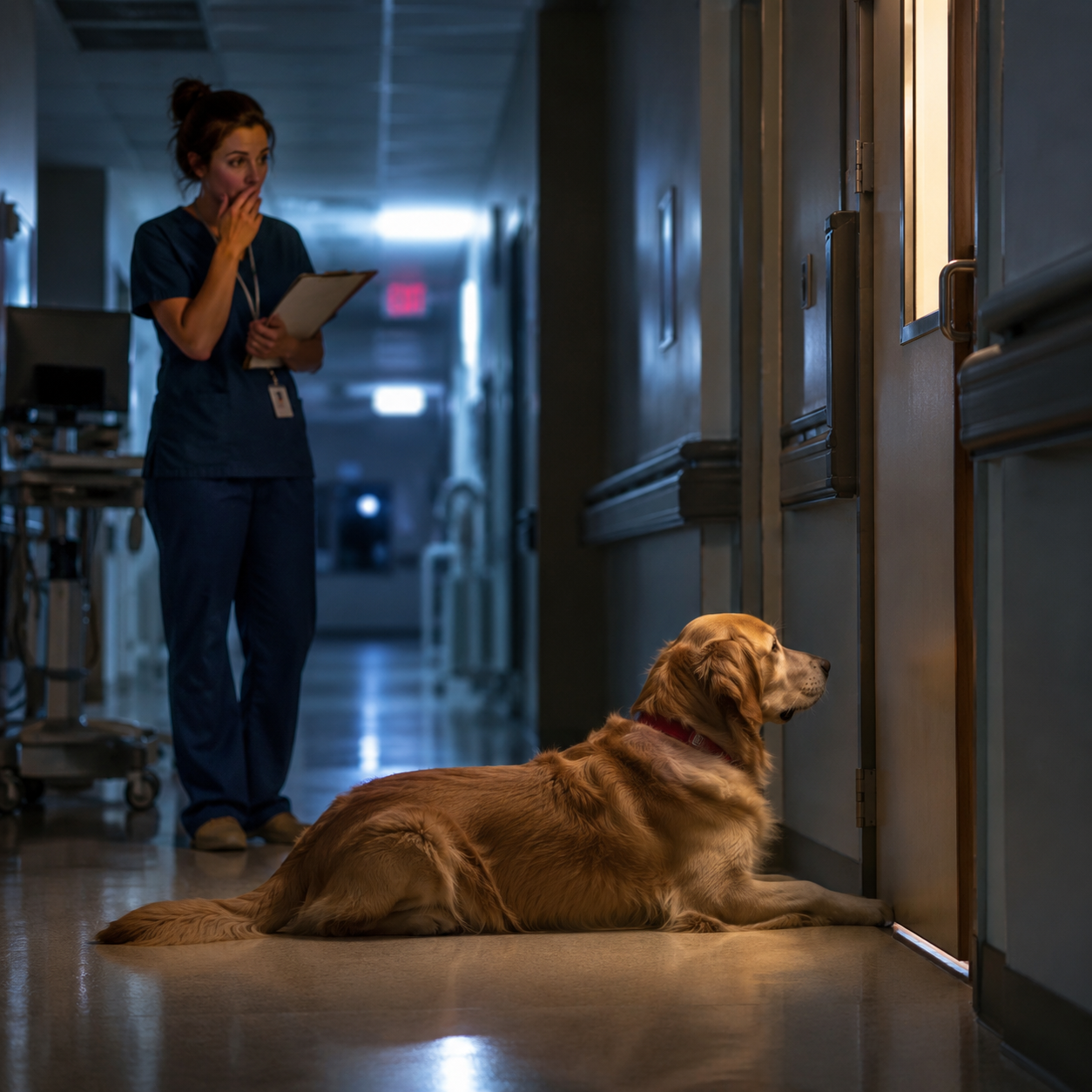
The dog appeared outside Room 214 every night at 8:17.
He never entered.
He never barked.
He simply lay beside the closed door with his nose resting on his paws and waited for someone who was no longer there.
My name is Rachel Bennett, and I worked the night shift at Briarwood Rehabilitation Hospital.
Most nights followed a familiar rhythm.
Medication rounds at seven.
Vital checks at eight.
Call lights, paperwork, and arguments with the vending machine until sunrise.
Then the dog began arriving.
He was a large golden retriever with muddy paws, a faded red collar, and a patch of white fur around his muzzle.
The first night, I assumed he belonged to a visitor.
At 9:00, he was still outside Room 214.
At 10:30, I brought him water.
At midnight, security escorted him outside.
The following evening, he returned at 8:17.
Exactly.
“How is he getting in?” I asked.
The security guard pointed toward the automatic doors.
“He waits for someone using a walker. Slips in beside them.”
“Why Room 214?”
“No idea.”
The room was empty.
Its previous patient, Walter Briggs, had been transferred to a long-term-care facility two weeks earlier.
Walter was seventy-nine and recovering from a severe stroke.
He rarely spoke.
He had no family listed in his file and had received only one visitor during his six-week stay—a neighbor who brought him a jacket.
When I called Walter’s new facility, a nurse confirmed that he had never owned a dog.
So the retriever was not waiting for him.
Animal control scanned the dog for a microchip.
The chip was registered to a disconnected number. The listed address had been demolished years earlier.
His collar contained no name.
Only a small brass tag engraved with two numbers:
214
“That settles it,” the security guard said. “He’s here for the room.”
“That makes no sense.”
“Dogs do not care whether things make sense.”
The shelter agreed to take him.
The following morning, they collected him from the hospital entrance.
That night, at 8:17, he was back.
He had escaped through a damaged section of fence, crossed nearly four miles of traffic, and returned to Room 214.
The shelter collected him again.
He returned again.
After the third escape, they stopped pretending they could contain him.
“We can hold him in a kennel,” the shelter manager told me, “but he’ll hurt himself trying to get out.”
So Briarwood’s administrator reluctantly allowed the dog to remain while we investigated.
We called him Friday because that was the night he first appeared.
Friday spent his days sleeping beneath the nurses’ station.
But every evening at 8:17, he rose, walked to Room 214, and waited.
The patients loved him.
Mrs. Lawson, who refused physical therapy, walked twenty feet because Friday was holding a tennis ball.
Mr. Cho, who had not smiled since his amputation, began saving bacon from breakfast.
Even the administrator stopped complaining after Friday alerted us that a patient had fallen behind a closed bathroom door.
But the mystery remained.
Why Room 214?
One evening, a new patient arrived.
Her name was Margaret Ellis.
She was seventy-four and had suffered a stroke during surgery.
Margaret could understand speech, but she had not spoken in nearly two months. Her right side was weak, and frustration followed her everywhere.
She pushed away meals.
She refused therapy.
She turned her face toward the wall whenever anyone entered.
The admissions department assigned her to Room 214.
At 8:17, Friday approached the door.
He stopped.
His ears lifted.
Then he began trembling.
I opened the door.
Friday rushed inside.
Margaret turned from the window.
The moment she saw him, her entire body changed.
Her eyes widened.
Her left hand reached toward him.
Friday pressed his head against the side of her bed and made a sound somewhere between a whine and a sob.
Margaret’s mouth moved.
No sound came out.
She tried again.
Her face twisted with effort.
Then, in a broken whisper, she said one word.
“Arthur.”
Friday’s tail struck the side of the bed.
Margaret began crying.
I knelt beside her.
“Is that his name?”
She shook her head.
Then she pointed toward the dog’s collar.
“Arthur,” she repeated.
Not the dog.
Someone else.
The next morning, I searched the hospital’s archived patient records.
Room 214 had belonged to Walter Briggs most recently.
Before Walter, it had housed dozens of patients.
Then I found the name.
Arthur Ellis.
Margaret’s husband.
He had been admitted to Room 214 eleven months earlier.
And he had died there after a sudden cardiac arrest.
PART 2 — THE PROMISE ON THE COLLAR
Arthur Ellis had spent three weeks at Briarwood following hip surgery.
Friday—whose real name was Sunny—had been Arthur’s dog.
The visitor logs showed that Margaret brought Sunny to the hospital courtyard almost every evening.
Always at approximately 8:15.
Arthur could not walk far, so an orderly helped him outside. He sat beneath the maple tree while Sunny rested beside his chair.
When winter arrived, the visits moved indoors.
Hospital policy prohibited animals on the patient floors, but someone had apparently made an exception.
Sunny visited Room 214.
Every night.
At 8:17.
Arthur died unexpectedly during the final week of his rehabilitation.
Margaret took Sunny home.
Three months later, she suffered complications during surgery and was transferred between hospitals. During that confusion, a family acquaintance agreed to care for Sunny.
The man later moved away.
Sunny disappeared.
Margaret’s nephew assumed the dog had been surrendered to a shelter.
But Sunny had not forgotten the hospital.
He had returned to the last place where his family had been together.
The brass tag did not contain a house number.
It contained a room number.
Arthur had engraved it shortly before he died.
Margaret’s nephew brought us a box of Arthur’s belongings.
Inside was a small notebook.
Most pages contained medication schedules, therapy exercises, and complaints about hospital food.
The final page contained a message.
If something happens to me, bring Sunny to Margaret.
He will know what to do when words fail.
She pretends she takes care of him.
The truth is, he has always taken care of us.
Arthur must have sensed that his health was worsening.
He placed the room number on Sunny’s collar because he feared the dog might become lost during hospital visits.
But when Sunny eventually did become lost, the number led him back.
Not to Arthur.
To Margaret.
After their reunion, Margaret changed.
She still struggled to speak, but she began trying.
Her first clear sentence was directed at Sunny.
“You got old.”
His tail thumped against the floor.
Her second sentence was:
“So did I.”
Sunny slept beside her bed.
He attended physical therapy, speech sessions, and meals.
When Margaret refused to stand, the therapist placed Sunny several steps away.
Margaret glared at everyone.
Then she stood.
When speech exercises frustrated her, she practiced saying his name.
“Sun.”
“Sun-ny.”
“Sunny.”
Each syllable was a victory.
I watched their progress with more emotion than I wanted to admit.
A year earlier, my younger brother, Ethan, had died after a motorcycle accident.
He had called me the night before.
I was working.
I rejected the call and texted:
Can’t talk. Tomorrow?
There was no tomorrow.
Since then, I had treated every unanswered call as evidence against myself.
I became excellent at caring for strangers and terrible at speaking to anyone who cared for me.
My mother called every Sunday.
I usually let it ring.
Grief had convinced me that loving people made their eventual absence more dangerous.
Sunny seemed to understand.
On difficult nights, he sat beside me at the nurses’ station and placed his head on my knee.
“You’re supposed to be helping Margaret,” I told him.
He looked toward my silent phone.
My mother’s name glowed across the screen.
Sunny nudged my hand.
“I am not taking emotional advice from a dog.”
He nudged me again.
I answered.
“Rachel?” my mother said.
The surprise in her voice hurt.
“Hi, Mom.”
“Is everything okay?”
“No.”
That was the first honest word I had said to her in months.
We spoke until my medication alarm sounded.
When I ended the call, Sunny was still beside me.
“You’re very annoying,” I told him.
He wagged his tail.
Margaret continued improving.
By early spring, she could walk the length of the hallway with a cane.
Her speech remained slow, but her humor returned.
One afternoon, I asked whether Arthur had trained Sunny as a therapy dog.
Margaret laughed.
“Arthur couldn’t train him to stay off the sofa.”
“Then how does he know when people are upset?”
“He listens.”
She pointed toward my phone.
“Better than humans.”
I smiled.
Then Margaret studied me.
“You lost someone.”
It was not a question.
“My brother.”
“Recently?”
“Last year.”
“You think silence protects you?”
I looked away.
Margaret reached across the table and placed her left hand over mine.
“Arthur and I were married forty-eight years. Losing him broke everything.”
Sunny rested at her feet.
“But love did not cause the breaking,” she said. “Death did.”
I felt my throat tighten.
“Those are not the same thing.”
Before I could answer, an alarm sounded in the hallway.
I stood to leave.
Margaret squeezed my hand.
“Call your mother again.”
“I called her yesterday.”
“Call her twice.”
PART 3 — WHO THE DOG WAS WAITING FOR
Margaret was scheduled to leave Briarwood in June.
Her nephew had prepared a downstairs room for her, installed railings, and repaired the backyard fence for Sunny.
On the morning of her discharge, staff members gathered in the lobby.
Mrs. Lawson brought the tennis ball Friday—now Sunny—had carried during therapy.
Mr. Cho gave him an entire package of bacon despite repeated warnings.
The administrator presented Margaret with Sunny’s temporary hospital identification badge.
It read:
SUNNY ELLIS
UNLICENSED THERAPIST
Margaret laughed so hard that she had to sit down.
Before leaving, she asked me to walk with her to Room 214.
The room was empty again.
Sunny entered and sniffed near the window.
Margaret stood beside the bed where Arthur had spent his final night.
“I thought he came here for Arthur,” I said.
“He did.”
“Then why did he keep returning after Arthur was gone?”
Margaret looked at Sunny.
“Maybe he knew I would come.”
“He couldn’t have known.”
“No.”
She smiled faintly.
“But perhaps waiting is another kind of hope.”
She removed the brass tag from Sunny’s collar.
The number 214 had nearly worn away.
Then she placed the tag in my palm.
“I think this belongs here.”
“Why give it to me?”
“Because you found him.”
“He found us.”
Margaret nodded.
“Exactly.”
After they left, the second floor felt strangely quiet.
At 8:17 that evening, I automatically looked toward Room 214.
The hallway was empty.
For the first time in months, no dog waited outside the door.
I expected to feel relieved.
Instead, I missed him.
I walked into the room and found an envelope on the bedside table.
Margaret had left it for me.
Dear Rachel,
You believed Sunny kept returning because he was waiting for someone who had died.
I believed that too.
But Arthur was never coming back, and Sunny understood absence better than either of us.
I think he returned because hospitals are filled with people standing between the lives they had and the lives they must now accept.
He was not only waiting for Arthur.
He was waiting for whoever entered that room needing him next.
First Arthur.
Then me.
Perhaps, in a quieter way, you.
Do not spend your life standing outside a closed door.
Go home.
Someone is still waiting to hear your voice.
—Margaret
I read the letter twice.
Then I called my mother.
“I’m coming over after my shift,” I said.
“It will be seven in the morning.”
“I know.”
“I’ll make coffee.”
That became our new routine.
Every Monday morning, I drove to my mother’s house after work.
We drank coffee at her kitchen table.
Sometimes we talked about Ethan.
Sometimes we talked about ordinary things.
For a long time, I had avoided mentioning my brother because I feared grief would enter the room if I said his name.
But grief was already there.
Speaking about him simply gave love somewhere to sit beside it.
Sunny visited Briarwood every month.
Margaret called it “volunteer work.”
He moved through the hallways greeting patients and stealing crackers.
Whenever he reached Room 214, he paused.
Sometimes the room was empty.
Sometimes someone new lived there.
Sunny always seemed to know whether to enter.
Two years later, Margaret died peacefully at home.
Her nephew called me that morning.
“She made me promise Sunny would keep visiting the hospital,” he said.
So Sunny became Briarwood’s official therapy dog.
He was older now.
His legs moved slowly, and the white fur around his muzzle had spread across his face.
But every evening he visited, he reached Room 214 at precisely 8:17.
One night, the room belonged to a frightened seventeen-year-old recovering from spinal surgery.
He had not spoken to his parents all day.
Sunny entered and placed his head beside the boy’s hand.
The boy began crying.
Sunny did not move.
He simply waited.
That was his gift.
He did not demand that people recover quickly.
He did not ask them to explain their sadness.
He stayed.
I once believed waiting was passive.
Sunny taught me otherwise.
Waiting can be an act of faith.
It can mean sitting beside a hospital door because someone you love may still need you.
It can mean answering a telephone after months of silence.
It can mean giving another person enough time to find words that no longer come easily.
The brass tag marked 214 now hangs behind the nurses’ station.
Beneath it is a photograph of Sunny and Margaret sitting beneath the courtyard maple tree.
A small plaque reads:
HE ALWAYS KNEW WHO NEEDED HIM NEXT.
People often ask why Sunny returned to a hospital where his owner had died.
They expect an explanation about scent, memory, or animal instinct.
Perhaps those things played a part.
But I believe Sunny returned because Arthur gave him one final job.
Find Margaret.
Stay with her when words fail.
And after that, keep looking.
The dog outside Room 214 was not waiting for the dead.
He was watching for the living—
especially those of us who had forgotten that being broken did not mean we had to be alone.