The Boy Saved an Empty Seat at Every School Concert—Then I Learned Who It Was Really For

Original Fiction: This story is fictional. Names, characters, dialogue, locations, and events were created for storytelling purposes.
PART 1 — THE CHAIR IN THE FRONT ROW
The empty chair appeared at every concert.
It was always in the same place.
Front row.
Far-left aisle.
And taped across its back was a crooked piece of notebook paper with four words written in blue marker:
PLEASE DO NOT SIT HERE.
The first time I noticed it, I assumed someone’s parent was running late.
The second time, I thought perhaps the family had misunderstood the seating rules.
By the fifth concert, I knew the chair belonged to eleven-year-old Mateo Ruiz.
I just did not know why he kept saving it for someone who never came.
My name is Calvin Lewis, and for sixteen years I have worked as the head custodian at Roosevelt Middle School.
“Head custodian” sounds more impressive than it is.
Mostly, it means I am the person everyone finds when a toilet overflows, a basketball gets stuck behind the bleachers, or the auditorium lights refuse to turn on ten minutes before a performance.
I know every hallway by sound.
I can tell which classroom door is closing from two floors away. I know which teachers secretly keep space heaters under their desks and which students hide in the library during lunch because the cafeteria feels too loud.
And I knew Mateo.
He was a thin, serious boy with dark curls that constantly fell into his eyes. He carried a violin case almost as tall as his torso and apologized whenever he took up more than six inches of hallway.
Every afternoon, Mateo arrived early for orchestra rehearsal.
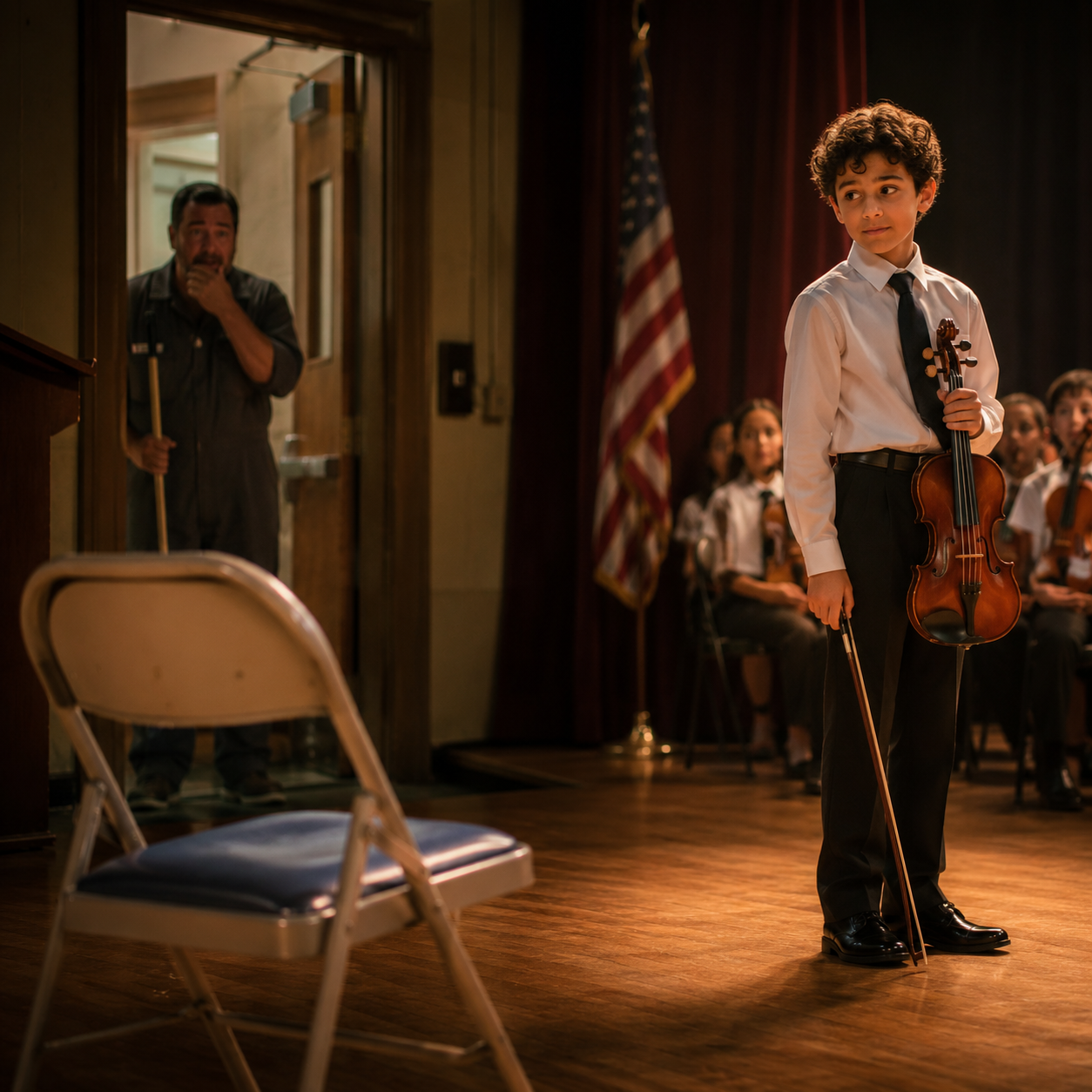
Before tuning his violin, he entered the auditorium, placed his backpack on the front-row chair, and taped up his handwritten sign.
Then, just before the audience arrived, he moved his backpack—but left the chair empty.
No one ever sat there.
No one ever arrived to claim it.
At the winter concert, I watched Mateo repeatedly glance toward that chair from the stage.
His classmates had families waving from every direction.
Mothers raised phones above their heads.
Fathers crouched in the aisles taking photographs.
Grandparents whispered loudly about how grown-up everyone looked.
Mateo had no one.
At least, that was what I believed.
After the concert, children flooded the lobby carrying flowers and balloons. Mateo carefully packed his violin and slipped toward the side exit.
I found him taking down the sign.
“Your person couldn’t make it?” I asked.
Mateo looked at the empty chair.
“Not tonight.”
“You save this seat every time.”
“Yes, sir.”
“For a parent?”
He folded the paper in half.
“No.”
“A brother or sister?”
He shook his head.
I waited, but Mateo offered nothing more.
That was the thing about middle-school children. They could talk for forty minutes about a video game and then become completely silent when a question actually mattered.
I stacked chairs while Mateo watched.
“You need a ride home?” I asked.
“My sister is coming.”
Nearly forty minutes later, an old sedan pulled into the staff parking lot.
A young woman hurried toward the entrance wearing navy scrubs beneath a winter coat. She looked barely twenty-five.
“I’m sorry,” she called. “The bus was late, and then my supervisor asked me to stay.”
“It’s okay, Elena,” Mateo said.
She hugged him tightly.
“Was the concert good?”
“It was fine.”
“I wanted to be here.”
“I know.”
Her eyes moved toward the dark auditorium.
“Did you save me a seat?”
Mateo hesitated.
Then he said, “Of course.”
It was a lie.
I had asked him directly, and he had told me the chair was not for his sister.
But Elena smiled, relieved to believe it.
She had been raising Mateo since their mother died six years earlier. I learned that from Mrs. Crane, the orchestra teacher.
Elena worked mornings at an assisted-living facility and evenings at a pharmacy. She attended community college classes whenever her schedule allowed.
“She has missed every performance,” Mrs. Crane told me. “Not because she doesn’t care. Because keeping the lights on keeps winning.”
That explanation should have solved the mystery.
It did not.
Mateo continued saving the seat.
And he continued telling Elena it belonged to her.
In February, Roosevelt hosted the district solo competition.
Mateo had been selected to perform a piece called Winter Window.
I knew that song.
I knew every note.
My daughter, Claire, had written it when she was seventeen.
Claire had played violin in that same auditorium nearly twenty years earlier. Music had been the center of her life. She composed songs on napkins, receipts, and the backs of grocery lists.
Then, at twenty-three, she died in a car accident on an icy road.
Afterward, my wife and I packed away her violin, her sheet music, and every recording because hearing them hurt too much.
My wife eventually left town.
I stayed.
People sometimes asked why I continued working at the school where Claire had spent so many afternoons.
I told them I needed the health insurance.
That was easier than admitting I could not bear to abandon the last building where I remembered her being completely happy.
On the morning of the competition, I heard Winter Window drifting through the auditorium.
Mateo stood alone onstage, practicing beneath a single work light.
I remained in the doorway.
He finished the final note and looked up.
“You know this song?” I asked.
“Mrs. Crane found it in an old music cabinet.”
“Did she tell you who wrote it?”
“A student who went here a long time ago.”
I stepped closer.
“Her name was Claire Lewis.”
Mateo studied my face.
“Lewis?”
“My daughter.”
His eyes widened.
“You’re Claire’s dad?”
I had not heard anyone say those words in years.
Most people called me a widower, a custodian, or simply Calvin.
No one called me Claire’s dad anymore.
“Yes,” I said.
Mateo lowered his violin.
“I’m sorry.”
“Don’t be. It sounded beautiful.”
He glanced toward the front row.
The empty chair was already waiting.
Its sign had been freshly rewritten.
“Is the chair for Claire?” I asked.
Mateo looked startled.
“No.”
“Then who?”
His fingers tightened around the violin bow.
“I can’t tell you yet.”
“Why not?”
“Because you might stop coming.”
Before I could ask what he meant, Mrs. Crane entered with the other students.
Mateo returned to rehearsal.
I returned to work.
But for the rest of that day, his answer followed me through every hallway.
Because you might stop coming.
That evening, I stood at the back of the auditorium as Mateo walked onto the stage.
The room became silent.
He raised his violin and began playing my daughter’s song.
Halfway through the piece, the auditorium doors opened.
Elena entered, still wearing her pharmacy uniform.
She looked exhausted.
But she had come.
Mateo saw her.
For one brief second, his bow trembled.
Elena hurried toward the empty chair.
Mateo’s face changed.
Not with happiness.
With panic.
Before she could sit, he stopped playing.
The final note vanished unfinished into the auditorium.
Then Mateo lowered his violin and said into the microphone:
“Elena, that seat isn’t yours.”
Hundreds of people turned toward her.
Elena froze in the aisle.
Mateo looked past her.
Directly at me.
“Mr. Lewis,” he said, “it’s yours.”
PART 2 — THE SONG HE FOUND
I did not move.
Teachers, parents, and students turned toward the back of the auditorium.
Mateo remained beneath the stage lights, holding his violin against his chest.
“That seat has always been for you,” he said.
I looked at Mrs. Crane.
She appeared just as surprised as everyone else.
Elena glanced between us.
“Calvin?” she whispered.
My legs felt strangely heavy as I walked down the aisle.
When I reached the front row, I stopped beside the chair.
The paper sign was still taped across its back.
PLEASE DO NOT SIT HERE.
“Why?” I asked Mateo.
He stepped closer to the microphone.
“Because you come to every rehearsal.”
“I work here.”
“You don’t have to stand in the doorway and listen.”
I felt the audience watching us.
“You fix the music stands before we ask,” Mateo continued. “You turn on the stage lights when I practice early. When I mess up, you wait until I start again before leaving.”
I swallowed.
“That’s just my job.”
“No, it isn’t.”
His voice was quiet but certain.
“My sister works two jobs. She wants to come, but she can’t always come.”
Elena covered her mouth.
“I kept looking into the audience and seeing everybody else’s families. Then one day, I realized you were always in the back.”
Mateo pointed toward the chair.
“I thought maybe no one had saved you a seat either.”
No one in the auditorium spoke.
I stared at the chair.
For sixteen years, I had stood near exits.
I told myself it was because custodians needed to remain available.
But the truth was simpler.
Sitting among the families felt like entering a room where I no longer belonged.
My daughter was gone.
My marriage was gone.
The word family had become something that happened to other people.
“You could have told me,” I said.
Mateo shook his head.
“You always leave before people clap.”
He was right.
Whenever the music ended, I found something to clean.
“You thought I wouldn’t sit?”
“I thought you might say the chair belonged to someone more important.”
My eyes burned.
I removed the sign and sat down.
The chair creaked beneath me.
Mateo raised his violin again.
“This song is for Claire,” he said. “But it’s also for her dad.”
Then he began from the beginning.
This time, I did not stand in the doorway.
I listened from the front row with Elena beside me.
When Mateo reached the final note, he held it longer than Claire had written.
The sound filled the auditorium and seemed to hover above us.
Then it faded.
Everyone stood.
I remained seated for several seconds because I could not trust my legs.
After the competition, I found Mateo backstage.
“You played it better than Claire did at your age,” I told him.
He looked horrified.
“You’re only saying that.”
“I absolutely am.”
He smiled.
Elena approached and wrapped her arms around him.
“I can’t believe you stopped the whole concert to tell me the chair wasn’t mine.”
“I knew you’d understand.”
“I do not.”
But she kissed his forehead.
Then she turned to me.
“Thank you for being here when I couldn’t.”
“I didn’t do anything.”
Mateo groaned.
“He says that about everything.”
Over the following months, I stopped watching rehearsals from the doorway.
I sat in the auditorium.
Sometimes Mateo saved me the chair.
Sometimes he did not need to.
Everyone began to understand that the far-left seat in the front row belonged to Mr. Lewis.
Mateo learned more of Claire’s music.
Mrs. Crane discovered an entire folder of handwritten compositions that had been donated to the school after my daughter died.
I had never known they were there.
We organized them, copied the fading pages, and created a small collection for the orchestra.
Mateo insisted on calling it The Claire Lewis Songbook.
At home, I unpacked Claire’s violin for the first time in sixteen years.
The case smelled faintly of cedar and old rosin.
I carried it to school the next morning.
Mateo stared at it.
“Is that hers?”
“Yes.”
The wood had darkened with age, but the small scratch near the bridge was still there. Claire had made it when she dropped the instrument during seventh grade and cried for three days.
“I want you to play it at the spring concert,” I said.
Mateo immediately shook his head.
“I can’t.”
“You can.”
“What if I damage it?”
“Then Claire will finally have someone else to blame for that scratch.”
He laughed nervously.
I placed the violin in his hands.
Mateo held it as though I had given him something alive.
Spring arrived.
Elena managed to attend the final concert by trading three shifts and working an overnight weekend.
She sat beside me in the front row.
Mateo performed Claire’s violin concerto using Claire’s instrument.
Halfway through the song, I looked at Elena.
Tears ran freely down her cheeks.
“She would be proud of him,” she whispered.
“Yes.”
Then Elena shook her head.
“I meant Claire.”
I looked back toward the stage.
For years, I had believed grief meant guarding what remained.
The violin.
The music.
The memories.
I thought loving Claire meant preserving everything exactly as she had left it.
But objects locked inside closets do not keep people alive.
People do.
A child playing her song.
A teacher saving her handwritten pages.
A chair reserved in a crowded auditorium.
That night, after everyone left, Mateo found me sweeping beneath the seats.
He held out the familiar paper sign.
The corners were torn from being folded so many times.
“Do you want to keep this?” he asked.
I read the four words again.
PLEASE DO NOT SIT HERE.
“I think we’re finished with it,” I said.
Mateo nodded.
Then he tore it in half.
“Good.”
“Why good?”
“Because next year I’ll need two seats.”
“For whom?”
He smiled.
“You’ll see.”
PART 3 — TWO RESERVED SEATS
During the summer, Elena completed her nursing-assistant certification.
She found a position at the assisted-living facility where she had worked for years and no longer needed the evening pharmacy job.
For the first time since their mother’s death, she and Mateo ate dinner together most nights.
I began joining them on Sundays.
Elena cooked.
Mateo complained.
I repaired whatever appliance had broken since my previous visit.
None of us discussed what those dinners were becoming.
We simply kept showing up.
In September, the new school year began.
Mateo entered seventh grade.
He was taller now, though his violin case still seemed nearly as large as he was.
At the first concert, I entered the auditorium and discovered two empty chairs in the front row.
Each had a sign taped across the back.
The first said:
MR. LEWIS
The second said:
CLAIRE
I stood staring at them.
Mateo appeared beside me.
“You said you needed two seats,” I said.
“I did.”
“You know Claire can’t sit there.”
“I know.”
“Then why save it?”
Mateo looked toward the empty stage.
“Because someone can be gone and still be part of the audience.”
I could not answer.
During the performance, Claire’s chair remained empty beside me.
But it did not feel abandoned.
It felt honored.
At the end of the concert, Mateo played a new song.
It began with the melody from Winter Window, but then it changed, growing warmer and brighter.
Afterward, he handed me the sheet music.
Across the top, he had written:
THE FRONT-ROW CHAIR
Composed by Mateo Ruiz
Based on a theme by Claire Lewis
“You finished one of her songs?” I asked.
“No. I started mine where hers ended.”
That sentence stayed with me.
For sixteen years, I had treated Claire’s death like the final note of my life.
Everything afterward felt like silence.
But endings are not always endings.
Sometimes another person hears the final note and begins a new song from it.
The following spring, Mateo auditioned for a state youth orchestra.
Elena and I drove him three hours to the audition.
He was accepted.
Before his first professional performance, he mailed me a ticket.
Printed beneath the seat number were the words:
FRONT ROW, LEFT AISLE
I still work at Roosevelt Middle School.
My knees hurt more now, and I complain about the students leaving gum beneath their desks.
Mateo visits whenever he can.
He is sixteen and almost tall enough to look me directly in the eye.
Claire’s violin remains his primary instrument.
He calls it “ours.”
Sometimes new orchestra students ask why there is an old photograph hanging beside the auditorium entrance.
It shows Claire at seventeen, holding her violin beneath the stage lights.
Below it is a small plaque:
Music does not disappear when the musician leaves.
It waits for someone else to listen.
For years, I thought Mateo kept saving an empty chair because someone important had failed to come.
I was wrong.
He was saving it for a man who had come every time but never believed he belonged.
A man who stood in doorways.
A man who left before the applause.
A man who thought his place in the audience had disappeared when his daughter did.
Mateo did not simply give me a chair.
He gave me permission to sit among the living again.
And sometimes, that is how a person saves you.
Not by pulling you from danger.
Not by repairing everything you have lost.
But by noticing that you are standing alone at the back of the room—
and quietly saving you a place in the front.