Three Families Returned Him for Being “Aggressive”—Then I Found the Name on His Old Tag

Original Fiction: This story is fictional. Names, characters, locations, dialogue, and events were created or fictionalized for storytelling purposes.
PART 1 — CAGE 42
Three families had adopted him.
Three families had brought him back.
By the time I found the enormous gray cat sitting inside Cage 42, someone had clipped three handwritten reports to the front of his file.
Aggressive.
Impossible to handle.
Something is wrong with this cat.
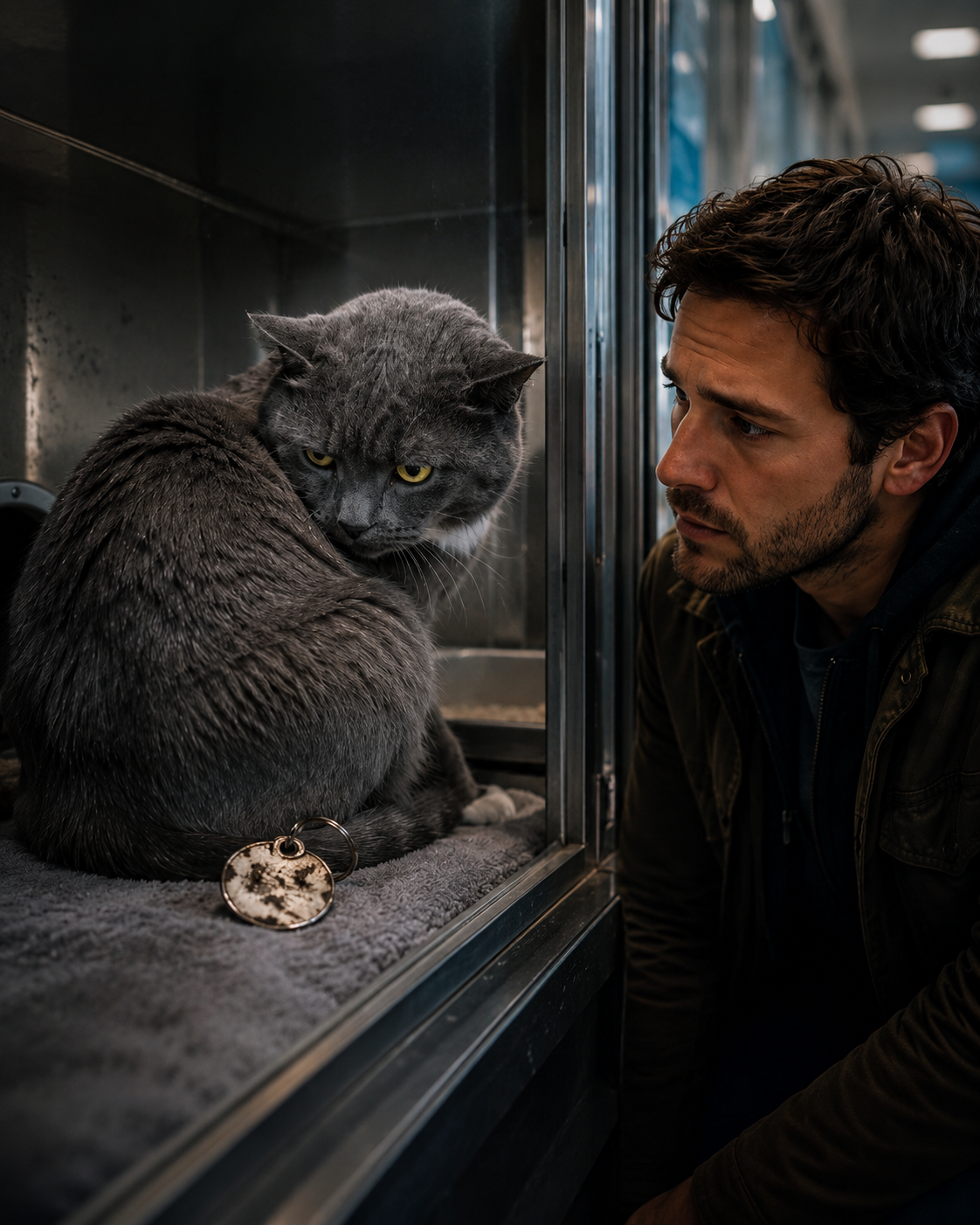
He sat with his back to the glass, staring at the tiled wall.
He did not meow when visitors passed. He did not press his nose against the door or lift a paw toward the children tapping on the glass.
He looked like an animal who had finally learned that being noticed only led to another goodbye.
“I wouldn’t choose that one.”
A shelter volunteer stood behind me holding a thick folder. Her name tag said Betty, and she had the tired expression of someone who had watched too many hopeful adoptions end badly.
“The first family wanted a cuddly pet for their children,” she said. “He scratched their four-year-old when she tried to pull him out from beneath a bed.”
Betty opened the folder.
“The second adopter was an older woman. She said he hissed whenever she approached him. The third man kept him for two days, then abandoned him in the parking lot before we opened.”
I looked through the glass again.
“What’s his name?”
“That depends on which paperwork you read. One family called him Smokey. Another called him Prince.”
“And the third?”
Betty hesitated.
“Psycho.”
At the sound of that word, the cat’s ears flattened.
That was the first time he had reacted to anything.
I worked in IT. Most of my life was spent repairing systems that had stopped responding. When a server crashed, people complained about what it was doing wrong.
I was trained to ask what had happened to it first.
I moved closer to the glass.
The cat turned his head just enough for me to see one yellow eye.
“What was he called when he first arrived?”
“We don’t know. He was brought in without usable records. The carrier had been passed around with him, but no one could tell us where he originally came from.”
“Is he sick?”
“The veterinarian found no obvious medical reason for the behavior. He’s frightened, defensive, and tired of being handled.”
Betty closed the folder.
“He needs someone who can accept that he may never become affectionate.”
I watched the cat turn back toward the wall.
“I’ll take him.”
Betty stared at me.
“Did you hear anything I just said?”
“Yes.”
“He may never sit in your lap.”
“That’s fine.”
“He might hide from you for months.”
“That’s fine too.”
“He may never love you the way you expect a pet to love you.”
That one hurt more than it should have.
But I nodded.
“I’m not asking him to love me.”
Betty studied my face for several seconds.
“Why him?”
The honest answer was that I recognized the way he had turned toward the wall.
My mother had died when I was sixteen. My father followed seven years later, and by thirty-one, I had become very skilled at telling people I preferred being alone.
I had a good apartment, a stable job, and friends I rarely saw because I was always too busy to accept invitations.
Most evenings, I ate in front of my computer.
On weekends, I repaired things that were not broken because fixing objects was easier than admitting I had no one to talk to.
“I think he needs somewhere quiet,” I said.
Betty glanced at the cat.
“Maybe you both do.”
A House With Two Strangers
I named him Oscar.
The moment I opened the carrier in my apartment, he shot beneath the sofa and disappeared.
For three days, I saw nothing but two yellow eyes shining from the darkness.
His food vanished while I slept. The litter box was used. Occasionally, I heard claws clicking across the floor in the middle of the night.
But whenever I entered the room, he became invisible again.
I followed the instructions Betty had given me. I kept the apartment quiet. I placed food and water near his hiding place. I sat on the floor without reaching toward him.
I read aloud from work reports so he could become accustomed to my voice.
He seemed unimpressed by software documentation.
On the fourth evening, I came home after one of the worst days I had experienced in years.
A project I had spent three months building had failed during a presentation. My manager blamed me in front of the entire department, even though I had warned him about the problem days earlier.
By the time I reached home, I was exhausted, humiliated, and desperate for something to be glad I existed.
I found Oscar beneath the sofa.
“Come on,” I whispered. “You’ve been here four days. You know I’m not going to hurt you.”
He pressed himself deeper into the shadows.
I reached toward him.
A low growl vibrated against the floorboards.
It was a warning.
I ignored it.
“Oscar, it’s okay.”
I stretched my hand farther.
He exploded from the darkness.
His claws tore across my wrist. I shouted and fell backward as blood ran toward my palm.
“What is wrong with you?”
Oscar flattened himself against the wall.
His ears were pinned back. His body trembled so violently that I could see it from across the room.
He did not look angry.
He looked terrified.
But I was too hurt to understand the difference.
“Fine,” I snapped. “Stay under there.”
For the next two weeks, we lived inside the same apartment without sharing it.
If I entered the kitchen, Oscar fled.
If I looked directly at him, he turned away.
When a cabinet door closed too loudly, he vanished for hours.
I began to understand why the others had returned him.
People adopted animals because they wanted to feel chosen. They wanted a cat that waited at the window, rubbed against their legs, or climbed into bed at night.
Oscar gave me none of those things.
Instead, he made my loneliness louder.
One Tuesday night, I opened the shelter’s number on my phone.
My thumb hovered over the call button.
All I had to do was tell Betty that I had tried.
No one would blame me. Three other families had already reached the same conclusion.
I would return Oscar, remove the food bowls, vacuum the gray hair from the carpet, and go back to the quiet life I had known before him.
Then my manager called.
He informed me that the company had eliminated my position.
After nine years, my entire career ended in a conversation that lasted less than four minutes.
I hung up, walked into the hallway, and sat on the floor without turning on the lights.
I did not call Oscar.
I did not reach beneath the sofa.
For the first time since bringing him home, I wanted nothing from him.
No affection.
No gratitude.
No proof that adopting him had been the right choice.
I simply sat with my back against the wall and covered my face with my hands.
After several minutes, I heard the soft click of claws.
Oscar appeared at the end of the hallway.
I kept my head lowered.
“I’m not going to touch you,” I whispered.
He took one step.
Then another.
He stopped beside my knee.
For a long time, neither of us moved.
Finally, Oscar lowered himself onto the floor beside me.
He did not purr. He did not rub against me or climb into my lap.
He simply stayed.
And somehow, that felt more honest than affection.
We sat together until my legs went numb.
The Name Beneath the Lining
The next morning, Oscar was still nearby.
He sat beside the battered plastic carrier the shelter had sent home with us. One corner of its fabric lining had come loose, and Oscar was pulling at it with his paw.
“Are you destroying the only thing you own?” I asked.
He stepped away as I approached, but he did not run.
I lifted the torn fabric.
Something metallic slid across the plastic floor.
It was a small round pet tag, badly scratched and dark with age. It must have been trapped beneath the carrier lining for years.
I cleaned it with the edge of my shirt.
A name slowly appeared.
MILO
A telephone number had been engraved on the back.
I called it.
The line rang six times before an elderly man answered.
“Hello?”
“My name is Ethan Cole,” I said. “I recently adopted a gray cat, and I found an old tag inside his carrier.”
The man said nothing.
“The name on it is Milo.”
I heard him inhale sharply.
“Did you say Milo?”
“Yes.”
His voice began to tremble.
“Is he large? Gray, with a white patch under his chin?”
I looked toward Oscar.
A small streak of white fur crossed his chest.
“Yes.”
“Is the tip of his left ear bent?”
Oscar watched me from the kitchen doorway.
His left ear folded slightly at the top.
“Yes.”
The man began to cry.
Not quietly.
He cried like someone hearing the voice of a person he had buried.
“My God,” he whispered. “Milo is alive.”
PART 2 — THE MAN WHO NEVER STOPPED WAITING
The man’s name was Harold Bennett.
Milo had belonged to his wife, Elaine.
She had found him twelve years earlier beneath their porch during a thunderstorm. He had been so small that she carried him inside in the pocket of her bathrobe.
“He slept beside her every night,” Harold told me. “Even when she became ill.”
During Elaine’s final months, Milo rarely left her bed. He rested against her ribs as though counting every breath.
After she died, he waited beside the bedroom door for weeks.
Harold had barely been able to care for himself. A few months later, he suffered a stroke and moved into an assisted-living facility.
“My nephew promised he would keep Milo,” Harold said. “Then he told me the cat escaped.”
“When was that?”
“Almost three years ago.”
Three years.
Three years of strange homes and unfamiliar hands.
Three years of being renamed, rejected, and returned.
Every new family had expected Milo to forget the people he had lost. When he could not, they decided something was wrong with him.
“Would you like to see him?” I asked.
Harold became quiet.
“I don’t know if he’ll remember me.”
“I think we should let him decide.”
The Blue Blanket
The following Sunday, I carried Oscar—Milo—to Harold’s care facility.
The director allowed pet visits, but I still had to provide vaccination records and arrange a private room.
Harold was waiting beside a window overlooking the garden.
He looked smaller than I had imagined. His silver hair was combed neatly, and an old blue blanket rested across his lap.
“My wife made this,” he said. “Milo slept on it every night.”
I placed the carrier on the floor and opened the door.
Milo remained inside.
Harold did not reach for him.
He did not call loudly or shake a bag of treats.
He laid one hand on the blanket and waited.
Five minutes passed.
Then Milo lifted his head.
His nose twitched.
He stepped out of the carrier and stared across the room.
Harold’s eyes filled with tears.
“Milo,” he whispered.
The cat froze.
His ears moved forward.
“Hello, old friend.”
Milo took one step.
Then another.
He crossed the room slowly, as though he did not trust what his eyes were telling him.
When he reached Harold’s wheelchair, he sniffed the blue blanket.
Then he jumped.
The cat three families had described as aggressive climbed onto Harold’s lap, buried his face against the blanket, and released a deep, broken purr.
Harold covered his mouth.
“There you are,” he sobbed. “There you are.”
Milo pressed his body against Harold’s chest.
I turned toward the window because I could no longer hide my tears.
For twenty minutes, Milo did not move.
When it was time to leave, Harold held my hand.
“You brought him back to me.”
“I think he’s been trying to get back to you for three years.”
“Will you bring him again?”
“Every Sunday.”
What Patience Looked Like
Milo quickly learned which day was Sunday.
Each weekend, he sat beside the carrier before I removed it from the closet. The moment we reached Harold’s room, he climbed onto the blue blanket.
During the rest of the week, he slowly began trusting me too.
He ate while I sat nearby. He slept on the far end of the sofa. Sometimes he stood in my bedroom doorway at night, watching until he was certain I was still there.
He still did not like being held.
I stopped trying.
I also stopped calling him Oscar.
“Milo,” I said one evening.
His left ear turned toward me.
It was the first name he had been given by someone who loved him.
He deserved to keep it.
Harold and I became friends during those Sunday visits.
He told me stories about Elaine, his years repairing machinery, and the small house they had purchased when they were newly married.
He also asked questions about me.
Too many questions.
“Are you married?”
“No.”
“Girlfriend?”
“No.”
“Friends?”
“I have friends.”
“People you occasionally click ‘like’ on do not count.”
I laughed.
“You sound like my father.”
Harold’s expression changed.
“What did you say your last name was?”
“Cole. Ethan Cole.”
He looked at me for several seconds.
“Did your father’s name happen to be David?”
My stomach tightened.
“Yes.”
Harold lowered his eyes to Milo.
“I knew a David Cole a long time ago.”
“How?”
“We worked together.”
Before I could ask anything else, a nurse entered to give Harold his medication.
He changed the subject afterward.
I assumed the connection was nothing more than coincidence. My father had worked in several machine shops when he was young. He must have known hundreds of people I had never met.
But during the drive home, I could not stop thinking about Harold’s face.
He had not looked surprised.
He had looked afraid.
The Sunday Harold Was Missing
Six months after our first visit, Milo and I arrived to find Harold’s chair empty.
A nurse met us in the hallway.
“Harold was taken to the hospital this morning.”
“What happened?”
“His heart. We don’t know how serious it is yet.”
Milo cried inside the carrier.
It was the first time I had heard him make that sound.
The nurse handed me the blue blanket.
“He asked us to give this to you.”
An envelope was folded inside it.
My name was written across the front.
At home, Milo climbed onto the blanket while I opened the letter.
Ethan,
If something happens to me, promise you will keep Milo.
Do not let anyone convince you that he is difficult to love. He has simply learned that people disappear.
There is something else I should have told you sooner.
Please forgive me for waiting.
—Harold
A photograph had been placed behind the letter.
Harold and Elaine stood beside a red pickup truck. Elaine held a much younger Milo against her shoulder.
Another man stood beside them with one hand resting on the truck.
He was smiling in a way I had almost forgotten.
It was my father.
PART 3 — THE PROMISE MY FATHER NEVER TOLD ME ABOUT
My father had been dead for eight years.
Yet there he was in Harold’s photograph, standing beside Milo as though he belonged to a life I had never known existed.
On the back, someone had written:
Harold, Elaine, David and Milo — Summer 2017
I drove to the hospital the next morning.
Harold was awake but weak. Tubes ran beneath his hospital gown, and the blue blanket lay folded beside him.
I placed the photograph on his tray.
“How well did you know my father?”
Harold stared at it.
“For more than thirty years.”
“My father never mentioned you.”
“I know.”
“Why?”
Harold looked toward the window.
“Because your father was a private man. And because, toward the end, he was ashamed.”
“Ashamed of what?”
“Of being lonely.”
The answer struck me harder than I expected.
I had always believed my father preferred solitude. After my mother died, he stopped accepting invitations, stopped calling friends, and spent most evenings alone in his workshop.
Whenever I asked whether he wanted company, he said he was fine.
So I believed him.
As my career became more demanding, I visited less often. I told myself that he understood. I convinced myself that independence was what he wanted.
Harold folded his hands.
“Your father and I worked at the same machine shop when we were young. He was the best man at my wedding. Elaine made him godfather to the daughter we lost before she was born.”
I sat down slowly.
“He never told me any of this.”
“He carried grief quietly. Your father thought silence protected the people he loved.”
Harold smiled sadly.
“It usually protected them from knowing him.”
During the final years of my father’s life, he had driven to Harold and Elaine’s house nearly every weekend.
He repaired their porch, helped Harold restore the red truck, and sat beside Elaine during her illness.
Milo often slept in his lap.
“Your father loved that cat,” Harold said. “Milo loved him too.”
I looked at the photograph.
“Why didn’t you contact me after my father died?”
“We attended the funeral, but you were surrounded by people. Afterward, I wrote to you twice. Both letters came back.”
I remembered changing apartments after my father’s death.
I had left no forwarding address.
“Then Elaine became worse,” Harold continued. “Everything else disappeared beneath that.”
He paused to catch his breath.
“When she knew she was dying, she worried about Milo. Your father promised that if Harold and I could no longer care for him, he would take him.”
“But my father died first.”
Harold nodded.
“He knew his health was failing. So he gave me a second name.”
Harold opened the drawer beside his bed and removed a folded piece of paper.
The writing was faded, but I recognized it immediately.
My father had written:
If I cannot take Milo, contact Ethan.
He will say he is too busy.
Ask him anyway.
He has spent his whole life pretending he does not need anyone, but he has the gentlest heart of anyone I know.
I read the words twice.
Then a third time.
My father had understood me better than I had understood him.
“Why didn’t anyone call me when you had your stroke?”
“My nephew took control of the house. He threw away most of my papers. I suspect he gave Milo to someone because his apartment did not allow pets.”
Harold closed his eyes.
“When I asked about Milo, he told me the cat had escaped. I believed him because the alternative was admitting that someone in my own family had abandoned the last living connection I had to Elaine.”
“And the tag?”
“It was attached to his old collar. The number was mine. It must have broken loose inside the carrier.”
I looked down at my father’s note.
“You recognized me when I told you my last name.”
“Yes.”
“Why didn’t you say anything?”
Harold’s eyes met mine.
“Because I needed to know why you had chosen Milo.”
“I don’t understand.”
“If I had told you about your father immediately, you might have kept him out of obligation. Or guilt.”
Harold reached for my hand.
“I wanted to see whether you would choose him when you believed no one was watching.”
I thought about the night I had opened the shelter’s number.
“I nearly returned him.”
“But you didn’t.”
“I shouted at him.”
“Then you learned to listen.”
“He still doesn’t completely trust me.”
Harold squeezed my fingers.
“Trust is not a door that opens once. Sometimes it is built from a hundred quiet moments when someone expects you to leave—and you stay.”
The Second Goodbye
Harold recovered and returned to the care facility.
For the next eight months, Milo and I visited every Sunday.
By then, Harold had begun introducing me as family.
He never explained exactly what kind.
He did not need to.
One winter morning, the facility director called me.
Harold had died peacefully in his sleep.
A nurse told me that Milo had been with him the evening before. He had rested on the blue blanket while Harold stroked the bent tip of his ear.
After the funeral, I brought Milo home.
For several days, he searched the apartment.
He checked behind the sofa. He sat beside the carrier. Every time the elevator sounded in the hallway, he lifted his head.
On Sunday morning, he waited beside the front door.
I placed Harold’s blue blanket on the sofa.
Milo climbed onto it and stared toward the window.
I sat beside him without touching him.
“I miss him too,” I whispered.
For a long time, neither of us moved.
Then Milo stood.
He stepped off the blanket and crossed the small space between us.
He placed one paw on my leg.
I held my breath.
Slowly, he climbed into my lap.
For the first time since I had adopted him, he curled against my chest.
His body was heavy and warm. His purr vibrated through both of us.
I began to cry.
For Harold.
For Elaine.
For my father.
And for every lonely evening when each of us had pretended we did not need anyone.
Milo lifted his head and pressed his forehead beneath my chin.
That was when I finally understood what my father’s promise had meant.
He had not chosen me because he believed I could rescue a frightened cat.
He had chosen Milo because he believed a frightened cat might rescue me.
The Name He Kept
Milo sleeps beside me now.
He still dislikes sudden movements. He leaves the room when strangers arrive, and he has never become the kind of cat who allows anyone to pick him up whenever they please.
But every evening, he waits near the door when I return home.
Sometimes he sits in my lap.
Sometimes he only sits nearby.
I have learned that love does not always announce itself loudly.
Sometimes it is a cat crossing a dark hallway.
Sometimes it is an old man placing his hand on a blue blanket.
Sometimes it is a father writing your name on a piece of paper and trusting that, when the moment comes, you will become the person he always believed you were.
For years, people called Milo aggressive, unmanageable, and broken.
They were wrong.
He had simply lost too many homes to believe the next one would last.
I understand that now.
The scratched metal tag hangs beside my father’s photograph.
It still says Milo.
I never replaced it.
Oscar was the name I gave him when I thought I was offering him a new life.
Milo was the name given to him when he was first loved.
And after everything he had survived, he deserved to know that love had remembered his name.