
Original Fiction: This story is fictional. Names, characters, dialogue, locations, and events were created for storytelling purposes.
PART 1 — THE EMPTY BARBER CHAIR
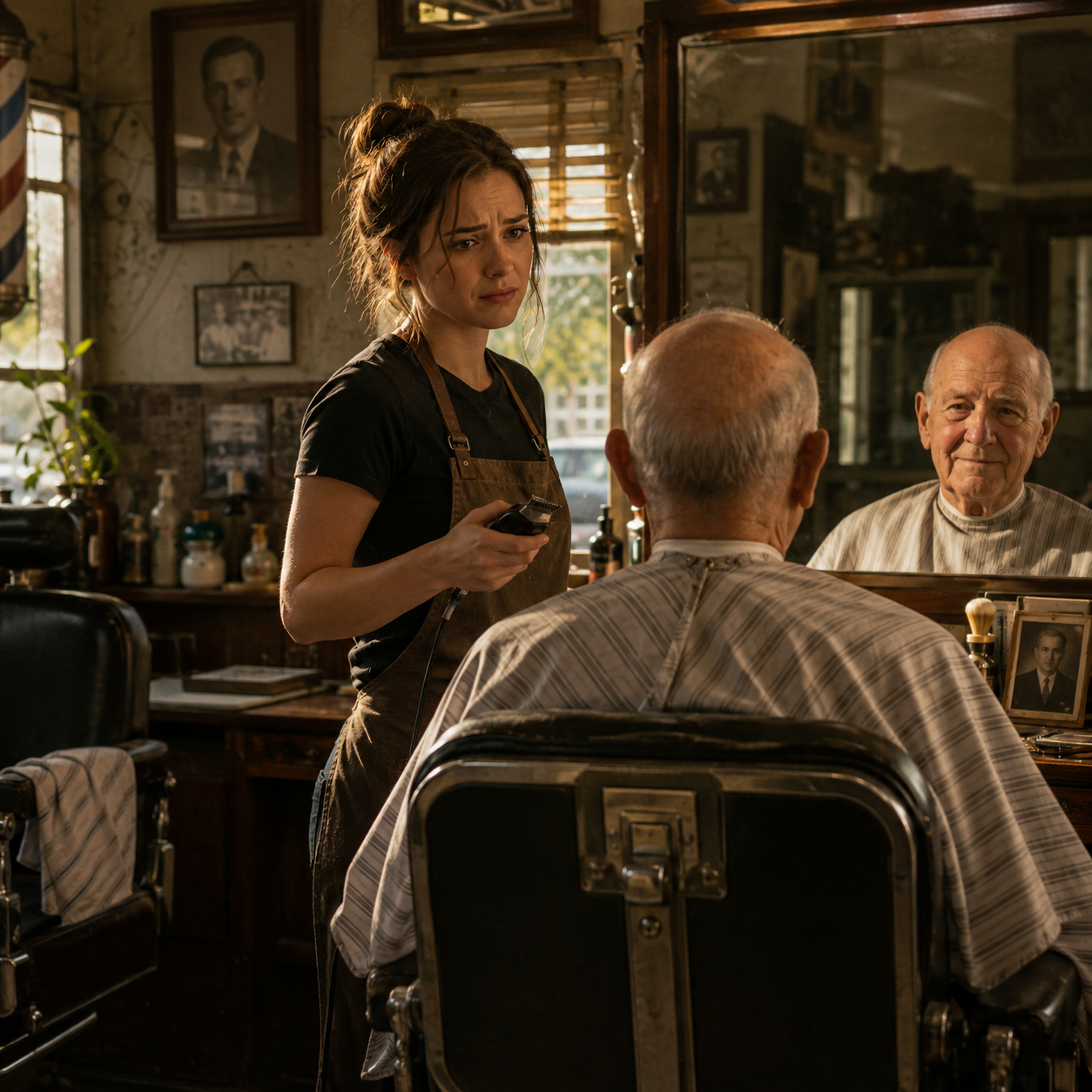
Every Thursday at exactly 10:15, Mr. Ellis paid me twenty-two dollars for a haircut he did not need.
He was almost completely bald.
A thin ring of white hair remained above his ears, but there was never enough to cut.
Still, he entered my father’s barbershop, removed his brown hat, and lowered himself into the second chair.
“The usual, Mia.”
At first, I thought he was joking.
Then I thought he might be lonely.
Eventually, I wondered whether he had begun forgetting that he had visited the week before.
I was wrong about all three.
Mr. Ellis remembered every appointment.
He simply was not paying for the haircut.
My name is Mia Bennett, and Bennett’s Barbershop had belonged to my father for thirty-one years.
Dad could remember every customer’s preferred haircut but never where he left his keys.
He knew who wanted conversation, who wanted silence, and which children needed to hold the electric clippers before trusting him near their heads.
The shop was small.
Three chairs.
Two cracked mirrors.
A radio that only played clearly when the weather was dry.
Dad refused to replace anything.
“People aren’t coming for the furniture,” he always said.
“They’re coming because someone remembers how they like their sideburns.”
Then one Tuesday morning, he collapsed while unlocking the front door.
A heart attack.
He was fifty-eight.
Three days later, I stood inside the closed shop staring at his coffee mug beside the register.
The coffee had dried into a dark ring at the bottom.
His jacket still hung behind the door.
A customer’s name remained written in his appointment book for the following morning.
I had trained under Dad after finishing high school, but I had never planned to stay permanently.
I wanted to move to another city.
Open a modern salon.
Work somewhere without thirty years of hair trapped beneath the floorboards.
After the funeral, I decided to keep the shop open temporarily.
Just long enough to finish Dad’s appointments and give his regular customers time to find someone else.
The first week, twelve people came.
The second week, seven.
By the third, only three chairs had been occupied.
People said they missed Dad.
What they meant was that the shop no longer felt like Bennett’s without him.
I understood.
It no longer felt like Bennett’s to me either.
Then Mr. Ellis arrived.
He was eighty-one, tall but stooped, with large glasses and a voice that sounded like gravel rolling inside a tin can.
He sat in the second chair.
“Your father always used this one,” he said.
“The first chair was his.”
“He cut hair in the first chair. I sat in the second.”
I fastened the cape around his neck.
“What would you like done?”
“The usual.”
I stared at the thin white hair above his ears.
“What exactly was the usual?”
“Your father knew.”
“I’m not my father.”
The words came out more sharply than I intended.
Mr. Ellis looked at me through the mirror.
“No,” he said gently. “You aren’t.”
I trimmed around his ears, brushed loose hairs from his collar, and removed the cape.
The entire haircut lasted four minutes.
He placed twenty-two dollars on the counter.
“You don’t have to pay full price.”
“A haircut costs twenty-two dollars.”
“I barely cut anything.”
“That sounds like a problem with my hair, not your pricing.”
The following Thursday, he returned.
Then the Thursday after that.
Every appointment was the same.
He entered at 10:15.
He sat in the second chair.
I pretended to trim his hair.
He paid twenty-two dollars and left a five-dollar tip.
After a month, I finally said, “Mr. Ellis, you know your hair does not grow this quickly.”
“I suspected something was wrong.”
“You do not need a weekly haircut.”
“Most people don’t need half the things that keep them alive.”
I lowered the clippers.
“What is that supposed to mean?”
He looked around the empty shop.
“What time did you open today?”
“Nine.”
“How many customers have you had?”
“You’re the first.”
“And yesterday?”
“That’s none of your business.”
“Your father used to say everything became his business if he sat still long enough.”
I turned the chair away from the mirror.
“I don’t need charity.”
Mr. Ellis’s expression hardened.
“Good. I didn’t offer any.”
“Then why do you keep coming?”
“Because Thursday at 10:15 is my appointment.”
“For hair you don’t have.”
He lifted his hat.
“Are you insulting a paying customer?”
Despite myself, I laughed.
He smiled.
It was the first time I had laughed inside the shop since Dad died.
Over the following weeks, Mr. Ellis began staying longer.
He told me about his late wife, Ruth, who had corrected his grammar for fifty-four years.
He told me about working at the railroad yard and once falling asleep inside an empty freight car.
He complained about young people, television news, and the bakery that had stopped putting enough cinnamon in its rolls.
Other customers occasionally entered while he sat in the chair.
Mr. Ellis greeted every one of them by name.
“Frank, Mia still remembers how you like the back squared.”
“Mrs. Torres, your grandson needs a haircut before that school photograph.”
“Dale, stop pretending you cut your own hair on purpose.”
Slowly, people began returning.
Not many.
But enough.
One Thursday in November, Mr. Ellis did not arrive.
At 10:15, the second chair remained empty.
At 10:30, I called him.
No answer.
At 11:00, I closed the shop and drove to the address written in Dad’s old appointment book.
An ambulance was parked outside Mr. Ellis’s house.
A paramedic carried equipment through the open front door.
My stomach dropped.
A neighbor told me Mr. Ellis had fallen in his kitchen.
At the hospital, a receptionist asked whether I was family.
“No,” I said.
Then I looked at the barber scissors still inside my coat pocket.
“I cut his hair.”
The receptionist gave me a strange look.
“That’s not normally considered family.”
“It is in our shop.”
She let me sit beside him.
Mr. Ellis had fractured his hip, but the doctors expected him to recover.
When he woke, he looked at the clock.
“What day is it?”
“Thursday.”
He frowned.
“I missed my appointment.”
“You almost broke every bone in your body.”
“That is not a haircut.”
I pulled the chair closer.
“Tell me the truth. Why do you come every week?”
Mr. Ellis looked toward the hospital window.
For the first time since I had known him, he had no joke ready.
“Your father asked me to.”
PART 2 — THE PROMISE
I stared at him.
“When?”
“The week before he died.”
“That’s impossible. Dad didn’t know he was going to die.”
“No. But he knew you were planning to leave.”
I looked away.
I had told Dad about a job offer in another city.
The argument lasted two days.
He believed the shop should remain in the family.
I believed keeping it meant surrendering the rest of my life.
We never resolved it.
The morning he died, the last thing I said to him was:
“I don’t want your life.”
Mr. Ellis continued.
“Your father was worried that if anything ever happened to him, you would close the shop before deciding whether you actually wanted to.”
“He told you that?”
“He told everyone everything.”
“What exactly did he ask you to do?”
“To keep my Thursday appointment.”
“For how long?”
“Until you stopped looking at the door as if you wanted to run through it.”
I stood.
“So this was charity.”
“No.”
“You paid me every week because Dad told you to keep the shop open.”
“He told me to show up. Paying was my decision.”
“I don’t need people pretending they need haircuts.”
Mr. Ellis’s eyes narrowed.
“Sit down, Mia.”
“I’m not one of your railroad workers.”
“No. You’re Joseph Bennett’s daughter, which means you inherited his stubbornness without his patience.”
I sat.
Mr. Ellis folded his hands over the blanket.
“Do you know when I first met your father?”
I shook my head.
“He was seventeen. Sweeping hair in a shop across town. The owner rarely let him touch a customer.”
“One afternoon, the owner went to lunch. Your father asked whether he could cut my hair.”
“And you let him?”
“I had more hair then. It was a greater risk.”
“How bad was it?”
Mr. Ellis smiled.
“One side was shorter. The back looked like it had been attacked by gardening equipment.”
“That sounds like Dad.”
“The owner fired him.”
“Because of your haircut?”
“Because your father argued that I had moved.”
“Did you?”
“Of course I moved. He nearly removed my ear.”
I laughed again.
Mr. Ellis’s smile faded.
“Your father believed his career was over before it began. He said no shop would hire him.”
“What did you do?”
“I came back the next morning with six men from the railroad yard.”
He told the owner they all wanted Joseph Bennett to cut their hair.
The owner reluctantly rehired him.
Those six men returned every month.
Years later, when Dad opened Bennett’s Barbershop, Mr. Ellis became the first customer in the second chair.
“I didn’t save your father,” he said. “I only gave him enough time to become good at something he already loved.”
He looked directly at me.
“That was all he wanted for you.”
I lowered my eyes.
“What if I don’t love this?”
“Then leave.”
His answer surprised me.
“But leave because you chose another life. Not because grief frightened you out of this one.”
Mr. Ellis spent six weeks in rehabilitation.
Every Thursday at 10:15, I closed the shop for half an hour and visited him.
I brought the cape.
The scissors.
A spray bottle.
His hospital room became a temporary barbershop.
The nurses teased us.
“You cut the same three hairs every week,” one said.
“Four,” Mr. Ellis corrected.
During his absence, customers kept asking about him.
Frank brought a card.
Mrs. Torres baked cookies.
Dale offered to install a handrail in his bathroom.
I began to understand what Mr. Ellis had been doing while sitting in that second chair.
He was not merely filling an appointment.
He was reminding people that the shop was still a place where they belonged.
Customers began staying after their haircuts.
They told stories about Dad.
Stories I had never heard.
Dad had once driven through a snowstorm to shave a customer before chemotherapy.
He had given free haircuts to children before the first day of school.
He had quietly paid an employee’s rent after her husband left.
I had spent my entire childhood believing Dad’s life was small because he rarely left the neighborhood.
But his life had stretched into hundreds of homes without me noticing.
One afternoon, I found an envelope beneath the register.
Dad’s handwriting was on the front.
FOR MIA—WHEN SHE IS READY
Inside was a letter.
Mia,
You may think this shop is the life I chose for you.
It isn’t.
I only hope you do not mistake leaving for courage or staying for failure.
Both can be brave.
Both can be fear.
Take your time before deciding.
A good haircut grows out.
A rushed decision sometimes doesn’t.
Love,
Dad
At the bottom, he had added:
P.S. Mr. Ellis will probably annoy you. It is one of his few reliable skills.
I sat in Dad’s chair and cried until the afternoon light disappeared from the mirrors.
Mr. Ellis returned to the shop in January using a walker.
At 10:15, I held the door open.
He made his way to the second chair.
“The usual,” he said.
This time, I did not argue.
PART 3 — THE FOURTH CHAIR
A year passed.
I never took the job in the other city.
But I did not keep the shop exactly as Dad had left it either.
I replaced the cracked mirrors.
Repaired the radio.
Painted the walls.
Added online appointments, though Mr. Ellis refused to use them because he believed the internet was “a rumor with electricity.”
Then I added a fourth chair.
It was smaller than the others and shaped like a red race car.
Every first Monday of the month, children from the local shelter received free haircuts.
I named the program Joseph’s Chair.
Mr. Ellis attended every session.
He sat beside nervous children and told them his first haircut from my father had been so terrible that birds tried to build nests in it.
The children loved him.
One Thursday morning, two years after Dad died, Mr. Ellis entered carrying a wooden box.
He placed it on the counter.
Inside was an old pair of barber clippers.
The metal was scratched.
The cord had been carefully wrapped.
“Those belonged to your father,” he said.
“I’ve never seen them.”
“They were his first clippers.”
“Why do you have them?”
“After he ruined my haircut, the shop owner threw them in the trash. I took them home.”
“You kept broken clippers for more than forty years?”
“They were not broken. Your father was inexperienced.”
He handed them to me.
“I thought he might want them back after proving everyone wrong.”
“Did you ever offer?”
“Several times.”
“What did he say?”
“That I should keep them until someone needed to be reminded that being bad at the beginning does not mean you should stop.”
I placed the clippers beneath the mirror at the fourth chair.
A small plaque now sits beside them:
EVERYONE STARTS SOMEWHERE.
Mr. Ellis continued coming every Thursday.
As he grew older, I began visiting his house instead.
I trimmed his four remaining hairs beside the kitchen window.
He still paid twenty-two dollars.
I still returned most of it by hiding groceries in his refrigerator.
We never discussed this arrangement.
When Mr. Ellis died at eighty-six, the second chair remained empty on the following Thursday.
At 10:15, I locked the shop door.
Frank arrived first.
Then Mrs. Torres.
Then Dale.
Within twenty minutes, the sidewalk was full of people who had known him.
Some had come for haircuts.
Most had simply come because Thursday at 10:15 belonged to Mr. Ellis.
His attorney later delivered a letter.
Mia,
Your father thought I was keeping his shop alive for you.
You probably believed I was keeping it alive for him.
Both of you were mistaken.
After Ruth died, Thursday morning became the longest part of my week.
Your father’s chair gave me somewhere to go.
When he died, you gave me a reason to keep going there.
I did not rescue the shop.
The shop rescued me twice.
Keep the second chair.
Someone else will need it.
—Ellis
For several months, I refused to book anyone in his chair.
Then one rainy Thursday, a teenage boy entered.
His hair was uneven, as if he had tried to cut it himself.
“Do you take walk-ins?” he asked.
I looked at the empty second chair.
“Yes.”
He sat down.
While I worked, he told me he had recently moved into a foster home nearby.
He hated his new school.
He planned to leave town the moment he turned eighteen.
I listened.
When the haircut was finished, he reached into his pocket and counted several crumpled bills.
I pushed the money back toward him.
“This one is already paid for.”
“By who?”
I glanced toward the old photograph of Mr. Ellis and Dad hanging beside the mirror.
“A customer with very slow-growing hair.”
The boy looked confused.
But he smiled.
For years, I believed Mr. Ellis paid for haircuts because he was lonely, forgetful, or trying to save my father’s business.
The truth was quieter.
He kept his appointment because showing up can become a form of love.
He occupied a chair until I was ready to fill it.
He brought customers back.
He gave grief somewhere to sit while it slowly became memory.
And in the end, he left behind more than an empty place.
He left a chair waiting for the next person who needed enough time to become who they were meant to be.