An Elderly Woman Called Me Every Wednesday Asking for Her Son—Then I Learned She Knew I Wasn’t Him

Original Fiction: This story is fictional. Names, characters, dialogue, locations, and events were created for storytelling purposes.
PART 1 — THE WRONG NUMBER
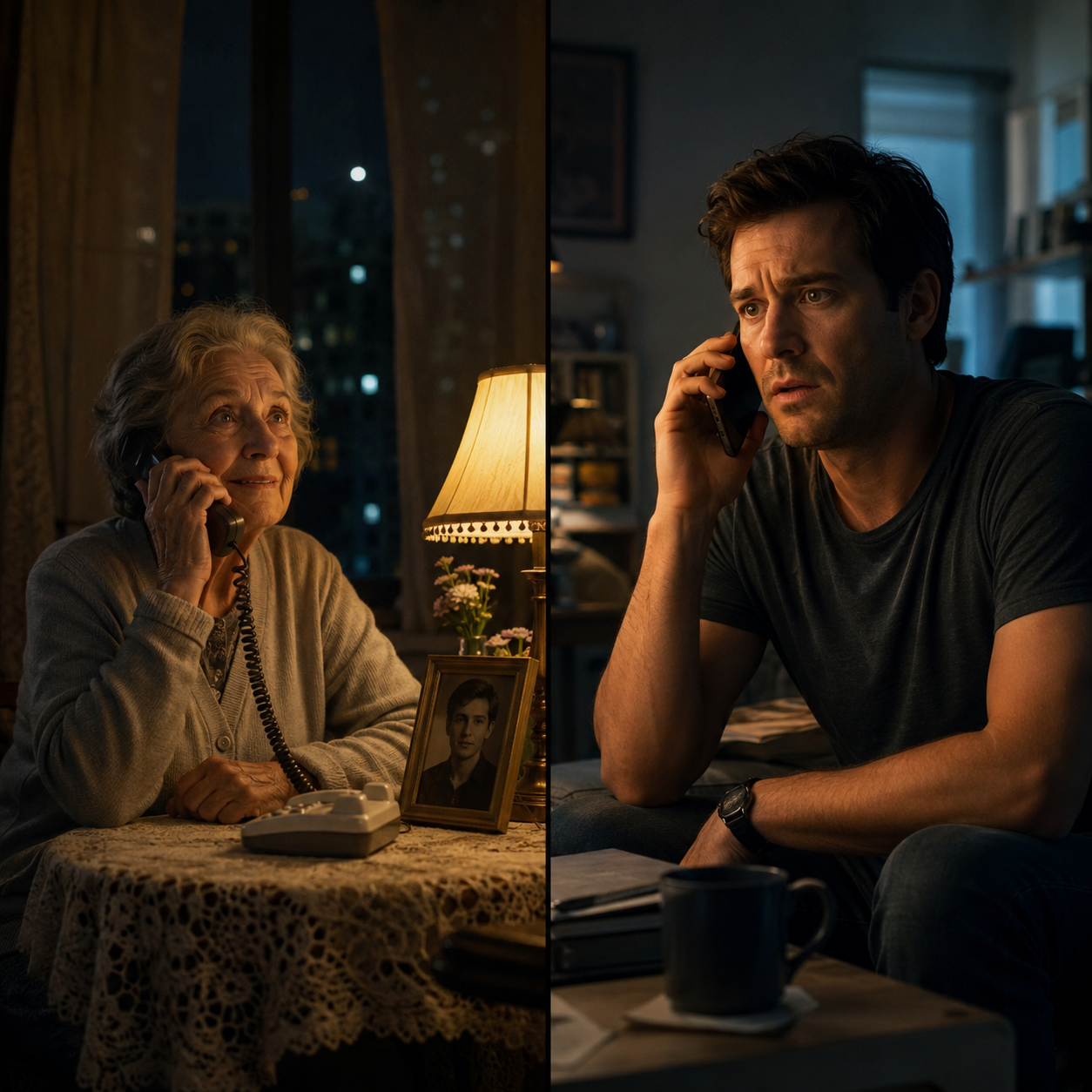
The first time the elderly woman called, she asked whether I had remembered to wear a coat.
“Daniel, the weather report says snow.”
I looked at my phone.
The number was unfamiliar.
“I’m sorry. You have the wrong person.”
There was a pause.
Then she said, “Oh.”
Her disappointment was so immediate that I almost apologized.
“My name is Aaron,” I explained. “There’s no Daniel here.”
“I must have pressed the wrong number.”
“It happens.”
“Of course.”
She hung up.
Exactly one week later, she called again.
Wednesday.
7:00 p.m.
“Daniel, I found the blue scarf you thought you lost.”
“It’s Aaron.”
Another pause.
“The wrong number again.”
“Yes.”
“I’m sorry.”
She hung up.
The next Wednesday, she called at 7:00.
Then the Wednesday after that.
For nearly two months, the conversations lasted less than thirty seconds.
“Daniel, did you eat?”
“My name is Aaron.”
“Of course. Forgive me.”
Click.
At first, I assumed she had memory problems.
Then I became irritated.
Why did she keep making the same mistake?
Why had no one corrected the number in her phone?
Why did she always call at exactly the same time?
One Wednesday, after a particularly miserable day, I answered more sharply than I should have.
“I’ve told you seven times. Daniel does not live here.”
The line became silent.
Then she whispered, “I know.”
Before I could respond, she ended the call.
My name is Aaron Cole.
At the time, I was thirty-five and living alone in a one-bedroom apartment above a closed hardware store.
Six months earlier, my fiancée, Rebecca, had returned her engagement ring.
She said I was physically present but emotionally absent.
I told her she was being unfair.
Then she listed every birthday dinner I had left early for work, every conversation I had answered with one word, and every time I had promised things would improve after the next deadline.
She was not being unfair.
She was exhausted.
After she left, I responded by working more.
I ate at my desk.
I slept with the television on.
I avoided my older sister’s calls because she always asked whether I was all right.
I was not.
But saying so seemed worse than remaining silent.
The elderly woman called the following Wednesday.
I considered ignoring her.
Instead, I answered.
“Hello?”
“Hello, Aaron.”
It was the first time she had used my name.
“You knew?”
“Yes.”
“Since when?”
“The first call.”
I sat up.
“You asked for Daniel.”
“I did.”
“Why?”
Her breath trembled against the receiver.
“Because this used to be his number.”
I waited.
She continued.
“My son called every Wednesday at seven.”
“What happened to him?”
“He died three years ago.”
I closed my eyes.
“I’m sorry.”
“So am I.”
“Why call the number if you knew it belonged to someone else?”
“For the first year, I called to hear his voicemail.”
“What did it say?”
“‘You’ve reached Daniel. Leave something worth calling back about.’”
She laughed softly.
“He thought he was funny.”
“When did the number become mine?”
“Last spring. The voicemail disappeared. Then you answered.”
“Why did you keep calling?”
She did not respond immediately.
“Wednesday became very quiet.”
Her name was Evelyn Hart.
She was seventy-eight and lived in a small apartment across town.
Daniel had been her only child.
He worked as a high-school history teacher and called every Wednesday because Evelyn’s husband had died on a Wednesday.
Daniel worried the day would always feel empty to her.
After Daniel died, Wednesday became empty for a different reason.
“I understand if you want me to stop,” Evelyn said.
I should have said yes.
Instead, I asked, “Did you find the blue scarf?”
She laughed.
“Yes.”
“Was it his?”
“No. Mine. Daniel never wore scarves. He said they made him look theatrical.”
We talked for twelve minutes.
The following Wednesday, I watched the clock.
At 6:59, the phone rang.
“Did you wear a coat?” Evelyn asked.
“Yes.”
I had not.
But I began wearing one after that.
Our calls became a routine.
She told me about Daniel.
He hated tomatoes but loved ketchup.
He once accidentally took twenty-eight students to the wrong museum.
He could not sing, yet sang loudly in church.
I told her about Rebecca.
About work.
About my father, who had died when I was twenty and whose tools remained unopened in my sister’s garage.
Evelyn did not offer easy advice.
She listened.
Sometimes that was worse because silence gave me nowhere to hide.
One evening she said, “You sound like Daniel did near the end.”
My stomach tightened.
“How did he die?”
Evelyn hesitated.
“Cancer.”
“I’m sorry.”
“He kept working after the doctors told him to stop. He said his students needed him.”
“Maybe they did.”
“Yes.”
Her voice became firm.
“But needing someone does not give us permission to watch them disappear.”
The words stayed with me.
The next morning, I left work at five for the first time in months.
I called my sister.
She answered on the first ring.
“Aaron? What happened?”
“Nothing.”
“You never call when nothing happened.”
“I know.”
That Sunday, I visited her.
She made too much food and did not ask whether I was all right until dessert.
By spring, Evelyn and I had spoken every Wednesday for almost a year.
Then one week, she did not call.
At 7:05, I checked my phone.
At 7:15, I called her number.
No answer.
At 7:40, I called again.
Still nothing.
I had never asked for her address.
I did not know the names of her neighbors.
All I had was a phone number and three years of stories about a man I had never met.
Then I remembered something.
Evelyn once complained that the pharmacy beneath her apartment played terrible music.
I searched for pharmacies near her number’s area code and began calling them.
The fourth pharmacist recognized her name.
“She was taken to St. Vincent’s this afternoon,” he said. “A neighbor found her after a fall.”
At the hospital, the receptionist asked who I was.
I opened my mouth.
I could not say son.
I could not say relative.
“I’m Wednesday,” I said.
The receptionist stared at me.
Then an exhausted nurse behind the desk looked up.
“You’re Aaron?”
I nodded.
Her expression softened.
“She’s been asking whether you wore your coat.”
PART 2 — DANIEL’S LAST LESSON
Evelyn had fractured her wrist and bruised her hip.
She looked smaller than I had imagined.
Her hair was white and loosely braided. Her glasses sat crooked on her face.
When I entered, she stared at me.
“You’re taller than you sound.”
“You’re shorter.”
“That is not polite.”
“Daniel would have said it.”
Her eyes filled with tears.
“No,” she whispered. “He would have.”
I sat beside her.
For the first time, our Wednesday conversation happened in the same room.
After Evelyn recovered, I began visiting every week.
We still spoke at seven, but now the phone remained in my pocket.
I brought dinner.
She criticized my cooking.
I repaired small things in her apartment using tools borrowed from my sister.
Photographs of Daniel covered the walls.
In one, he stood in front of a classroom holding a cardboard crown.
In another, he and Evelyn wore matching Christmas sweaters.
I had heard so many stories about him that the photographs felt like pictures of someone I almost remembered.
One Wednesday, Evelyn handed me a sealed envelope.
Daniel’s name was written across the front.
“I found this after he died,” she said.
“You never opened it?”
“It wasn’t addressed to me.”
“Who was it for?”
“He wrote, ‘For the person who answers next.’”
I frowned.
“That could mean anyone.”
“That is what Daniel liked about it.”
Inside was a letter.
Hello,
If you are reading this, my mother has probably called my old number again.
Please be gentle.
She knows I am gone.
Grief does not always make people confused.
Sometimes it makes them repeat the last ordinary thing that made them feel safe.
Wednesday calls were ours.
I hope she eventually finds another reason to look forward to them.
You do not have to become that reason.
But if you stay on the line for a minute, thank you.
—Daniel Hart
I looked at Evelyn.
“He knew you would keep calling?”
“He knew me.”
“Why didn’t you give me this sooner?”
“I wanted to know whether you stayed because of guilt.”
“Did you decide?”
“Yes.”
“And?”
“You stayed because you were lonely too.”
I tried to object.
Evelyn raised one hand.
“Do not insult an old woman by lying badly.”
She was right.
I believed I had answered her calls out of kindness.
But every Wednesday, Evelyn gave me something I had not realized I needed.
A person expecting me.
A reason to leave the office.
A place where my absence would be noticed.
Several months later, Evelyn’s health began declining.
Her heart was weakening.
She tired easily and sometimes fell asleep while I washed dishes.
One evening, she asked about Rebecca.
“I haven’t spoken to her in over a year.”
“Do you still love her?”
“Yes.”
“Then apologize.”
“She has moved on.”
“An apology is not a fishing hook, Aaron. You do not offer one only when you expect to pull something back.”
The following day, I wrote Rebecca a letter.
I did not ask her to return.
I told her she had been right.
I apologized for making her feel alone while sitting beside me.
She replied two weeks later.
She thanked me.
She had begun seeing someone else.
The news hurt.
But it did not destroy me.
For the first time, I understood that accepting responsibility could be worthwhile even when it did not repair the outcome.
Evelyn died quietly on a Tuesday night.
I was with her.
So was my sister.
Near midnight, Evelyn opened her eyes.
“You’ll answer tomorrow?” she whispered.
“There won’t be a call.”
“That was not my question.”
I held her hand.
“Yes.”
At 7:00 the following evening, Wednesday, I sat alone in Evelyn’s apartment.
Her phone rested on the table.
It did not ring.
For several minutes, I listened to the silence she had feared for so long.
Then I called my sister.
She answered.
“Hey,” I said. “Did you wear a coat?”
PART 3 — THE WEDNESDAY LIST
Evelyn left me Daniel’s phone.
Inside the contacts was a list titled:
PEOPLE WHO SHOULD NOT SPEND WEDNESDAY ALONE
There were eleven names.
A retired teacher named Mr. Graham.
Evelyn’s widowed neighbor, Lena.
A former student of Daniel’s named Marcus.
The local pharmacist.
My name appeared at the bottom.
Beside it, Evelyn had written:
Pretends he doesn’t need anyone. Call anyway.
I began calling one person each Wednesday.
At first, it felt awkward.
“Evelyn had your number,” I would explain.
That was usually enough.
Everyone had a story.
Daniel had helped Marcus apply to college.
Evelyn had delivered soup to Lena after surgery.
Mr. Graham had taught Daniel how to teach.
The pharmacist had once stayed open late because Evelyn forgot her medication.
The list was not a collection of lonely people.
It was a map of people who had spent years taking turns caring for one another.
They simply had not realized they were connected.
Eventually, we began meeting on Wednesdays.
Seven o’clock.
Evelyn’s favorite diner.
The first week, four people attended.
By winter, twelve chairs surrounded the table.
My sister came.
Then her children.
Marcus brought his fiancée.
Mr. Graham brought photographs from Daniel’s first year of teaching.
We called it The Wednesday Table.
No speeches.
No membership.
Anyone who did not want to be alone could sit down.
Two years later, a young woman named Sophie joined us.
She had been one of Daniel’s students.
“He used to call students’ parents every Wednesday,” she told me.
“To discuss grades?”
“Sometimes. But usually to say something good.”
She explained that Daniel believed parents heard quickly when their children failed but rarely when they were kind.
Every Wednesday afternoon, he called five families.
He told them their child had helped a classmate, asked an intelligent question, or improved on an assignment.
“That is why he called Evelyn at seven,” Sophie said. “He finished his good-news calls and saved the last one for his mother.”
I looked around the table.
For years, Evelyn believed Daniel called because she needed him.
But Daniel had built his entire Wednesday around telling people they mattered.
Evelyn had continued the tradition without knowing it.
And somehow, the phone number had reached me.
I eventually changed my number.
The phone company asked whether I wanted to release the old one.
I said no.
Every Wednesday at seven, Daniel’s phone sits in the middle of the diner table.
Sometimes it rings.
Wrong numbers.
Telemarketers.
Once, a man called asking for a plumbing company.
We invited him to dinner.
He thought it was strange.
He came anyway.
I used to believe Evelyn called because she could not accept that her son had died.
But she knew.
She had always known.
She called because grief often hides inside ordinary habits.
A familiar number.
A weekly question.
A reminder to wear a coat.
She was not searching for Daniel in my voice.
She was searching for a way to survive the silence he left behind.
And I was not rescuing an elderly woman by answering.
Every time I picked up, she was teaching me the lesson Daniel left for whoever came next:
You do not need the perfect words.
You do not need to solve another person’s loneliness.
Sometimes you only need to stay on the line long enough for them to know that someone answered.