My Mother Gave Our Family Home to My Brother at Christmas—Then I Found the Letter She Had Hidden Beneath My Plate

Original Fiction: This story is fictional. Names, characters, dialogue, locations, and events were created for storytelling purposes.
PART 1 — THE HOUSE KEY
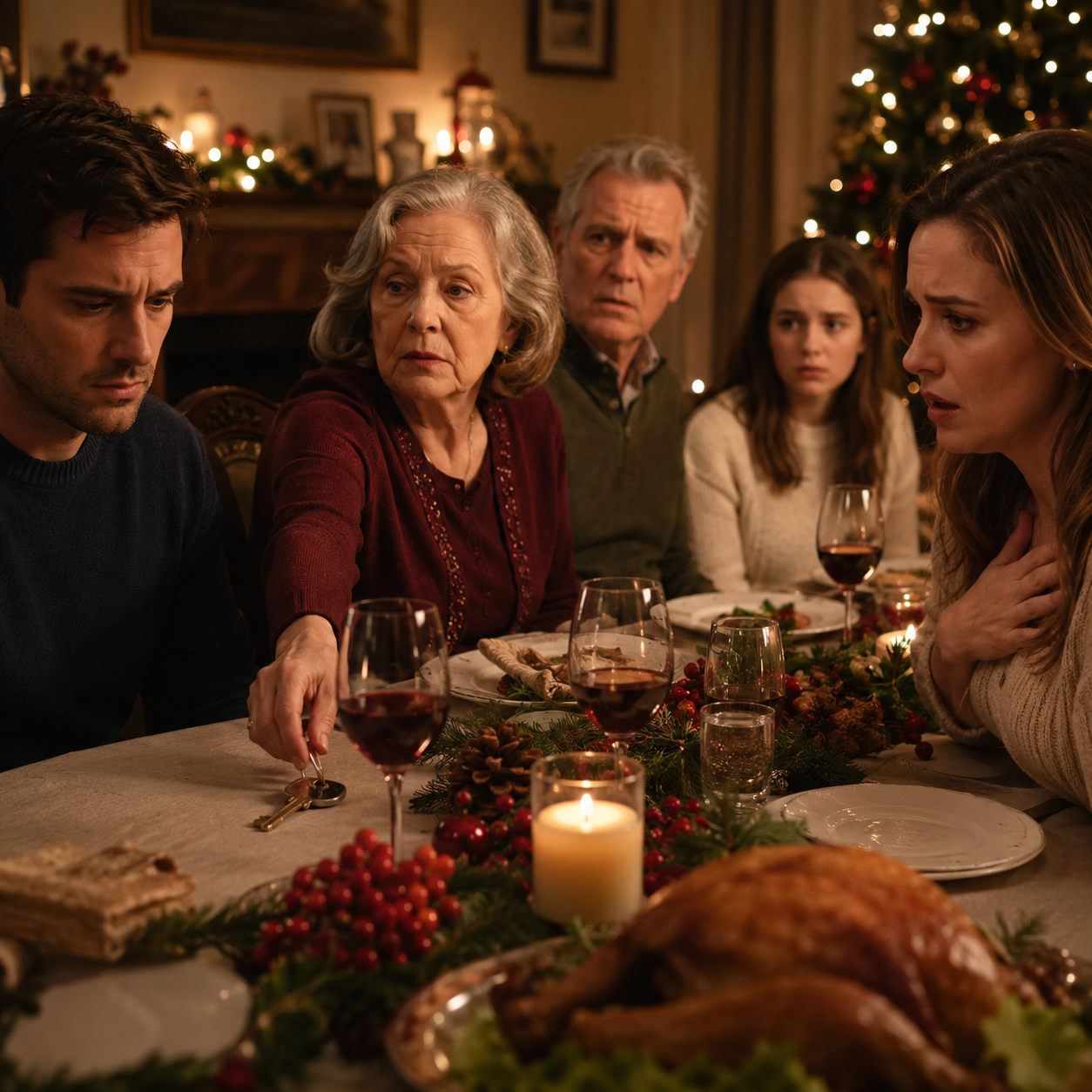
My mother gave my brother our childhood home during Christmas dinner.
She placed the key beside his wineglass, smiled at him, and said:
“The house belongs to Daniel now.”
Then she looked directly at me.
“Claire has already taken enough from this family.”
The dining room became silent.
My husband stopped cutting his turkey.
My daughter, Sophie, stared at her plate.
Daniel leaned back in his chair with the expression he had worn since childhood whenever our mother chose him over me.
Surprised enough to appear innocent.
Satisfied enough that I knew he was not.
“What exactly have I taken?” I asked.
Mother folded her napkin carefully.
“You know.”
“No. I don’t.”
Daniel reached for the key.
“Maybe tonight isn’t the time.”
“You’re accepting our mother’s house in front of my child, but tonight isn’t the time to explain why I apparently robbed the family?”
“Claire,” Mother warned.
I looked around the room where every important moment of my childhood had happened.
The wall behind Daniel still carried a faint mark from the chair he threw during an argument at seventeen.
The cabinet beside Mother held the blue dishes my grandmother gave her.
The ceiling above us had been repaired with money I sent home after a winter storm.
For twelve years, I had helped pay the property taxes.
I replaced the furnace.
Covered two mortgage payments after my father became ill.
And when Mother needed surgery, I used most of my savings to hire a home-care nurse.
Daniel visited on Sundays.
Sometimes.
Yet the key rested beside his glass.
“What did I take?” I repeated.
Mother’s face hardened.
“Your father’s last years.”
The words struck harder than I expected.
Dad had suffered a stroke six years earlier.
Afterward, his speech became difficult and his right side weakened.
I visited every day before work.
I managed his appointments, medications, physical therapy, and insurance forms.
Daniel said hospitals made him uncomfortable.
He usually called Dad from the parking lot.
“You made every decision,” Mother continued. “You controlled the doctors. You controlled the money. You controlled who saw him.”
“I took care of him.”
“You pushed everyone else aside.”
Daniel lowered his eyes, performing grief.
“That isn’t true,” I said.
“You didn’t even tell me he was getting worse,” Daniel murmured.
“I called you eleven times.”
“I was working.”
“You were in Florida.”
His wife shifted uncomfortably.
Daniel glared at her before looking back at me.
Mother pushed the key closer to him.
“Your brother deserves something that is his.”
I stood so quickly my chair struck the wall.
Sophie flinched.
That stopped me.
My daughter was thirteen.
Old enough to understand humiliation.
Young enough to believe adults only acted cruelly when someone deserved it.
I did not want her wondering whether her mother had done something unforgivable.
I picked up my coat.
“We’re leaving.”
Mother did not ask me to stay.
Outside, snow covered the front steps.
My husband, Mark, guided Sophie toward the car.
As I bent to tie my boot, I noticed a corner of white paper beneath the plate I had abandoned.
I almost left it.
Then I returned.
No one was watching.
Mother had gone into the kitchen.
Daniel and his wife were whispering beside the tree.
I lifted the plate.
Beneath it was an envelope.
My name was written across the front in my father’s uneven handwriting.
CLAIRE—READ THIS ALONE.
Dad had been dead for two years.
My hands began shaking.
I slipped the envelope into my coat.
At home, I locked myself in the bathroom and opened it.
Inside was a single page.
Claire,
If your mother gives the house to Daniel, do not fight her.
Let him take it.
The house is not the gift.
It is the debt.
Check the red folder in my old workshop.
Trust no one until you see it.
Love,
Dad
I read the letter twice.
Then I called Mother.
She did not answer.
I called again.
Daniel picked up.
“Stop upsetting her.”
“Put Mom on the phone.”
“She doesn’t want to speak to you.”
“What is in the red folder?”
Silence.
Daniel’s voice changed.
“What folder?”
“The one in Dad’s workshop.”
“I don’t know what you’re talking about.”
Behind him, I heard a door slam.
Then Mother shouted something I could not understand.
Daniel hung up.
I drove back alone.
The house was dark except for the porch light.
Daniel’s car was gone.
Mother opened the door before I knocked.
Her face looked pale and exhausted.
“You weren’t supposed to find that letter tonight,” she said.
“Why did Dad tell me not to fight for the house?”
Mother glanced toward the stairs.
“Because your brother has already borrowed against it.”
PART 2 — THE RED FOLDER
Daniel had forged Mother’s signature eighteen months earlier.
He used the house as security for a business loan.
His restaurant had failed within six months.
Then he borrowed more money to hide the first loss.
By the time Mother discovered what he had done, the house carried nearly three hundred thousand dollars in debt.
“Why didn’t you report him?” I asked.
“He would go to prison.”
“He committed fraud.”
“He is my son.”
“So am I.”
Mother closed her eyes.
“I know.”
“No, you don’t.”
My voice echoed through the hallway.
“You stood in front of my daughter and told everyone I had taken enough. You made me look like a thief to protect the person who actually stole from you.”
“I needed him to accept legal responsibility for the property.”
“So you gave it to him.”
“If he signs the transfer, the debt follows him.”
“And you thought humiliating me was necessary?”
Mother gripped the stair rail.
“Daniel would never accept the house if he believed you didn’t want it.”
I stared at her.
“He has spent his entire life competing with you,” she said. “Your father knew it. I knew it.”
“So you used that.”
“I needed him to believe he had won.”
My anger did not disappear.
It grew.
The plan was clever.
It was also cruel.
“You could have trusted me.”
“I was afraid you would protect him.”
“I have never protected Daniel.”
“You protected everyone.”
She looked toward Dad’s photograph on the wall.
“You protected your father from knowing how frightened I was. You protected Sophie when she heard us arguing. You protected me every time a bill arrived.”
Her voice broke.
“I thought you would try to save your brother too.”
“I might have helped him surrender.”
“And I could not risk him running.”
I remembered the letter.
“The red folder.”
Mother led me into Dad’s old workshop.
Nothing had changed since his death.
His tools remained arranged above the bench.
His work boots rested beneath a chair.
Mother removed a loose wooden panel behind the cabinet.
Inside was a red folder.
It contained copies of Daniel’s loan documents, bank transfers, forged signatures, and messages to a lender.
There was also a recording device.
Dad’s hands had become too weak to write clearly after his stroke, but his mind remained sharp.
Months before he died, he discovered Daniel’s first unauthorized loan.
He began collecting evidence.
“Why didn’t Dad confront him?”
“He did.”
Mother pressed a button on the recorder.
Dad’s strained voice filled the workshop.
“Tell Claire.”
Daniel answered.
“No.”
“She can help.”
“She’ll make me look like a criminal.”
“You are committing a crime.”
“I’ll repay it.”
“With what?”
“Give me time.”
Then Daniel said something I had never expected.
“She already thinks she owns this family. She took the hospital. She took the finances. She took you away from me.”
Dad’s answer came slowly.
“Claire did not take my last years. She gave them back to me.”
I covered my mouth.
Mother stopped the recording.
“Your father wanted to report Daniel immediately,” she said. “I begged him not to.”
“So Dad knew you would protect him.”
“Yes.”
“And he prepared this for me.”
“He prepared more than that.”
At the bottom of the folder was a property document.
Three years earlier, Dad had transferred ownership of the small lakeside cabin he inherited from his brother.
To me.
I had not visited the cabin since childhood.
It was modest.
Two bedrooms.
A leaking porch.
But the land around it had become valuable.
A developer had recently offered almost twice the amount owed on Mother’s house.
“He gave me this?”
“He wanted you to have something Daniel could never touch.”
“Why didn’t you tell me?”
“Your father said to wait until you stopped believing the house was your inheritance.”
I looked around the workshop.
“I never wanted the house because of money.”
“I know.”
“I wanted it because Dad was here.”
Mother touched the workbench.
“That is why he left you the place where he was happiest.”
The cabin had belonged to Dad before he married.
He proposed to Mother on its porch.
Taught Daniel and me to fish from its dock.
After his stroke, he kept a photograph of the lake beside his hospital bed.
Mother’s knees weakened.
I helped her into the chair.
“I said those things at dinner because Daniel needed to believe I had chosen him,” she whispered. “But I watched your face, and I knew I had broken something.”
“You did.”
“I’m sorry.”
I wanted to forgive her immediately.
That was my old instinct.
Protect everyone.
Make the room peaceful.
Carry the damage home alone.
Instead, I said, “Sorry doesn’t repair this tonight.”
Mother nodded.
“No.”
“But it may be where repairing it begins.”
Her eyes filled with tears.
Then headlights swept across the workshop window.
Daniel’s car pulled into the driveway.
He entered holding the house key.
“You went through Dad’s things?” he demanded.
I held up the red folder.
His face drained of color.
Mother stood.
“You signed the transfer,” she said.
Daniel looked between us.
“You set me up.”
“No,” Mother replied. “I gave you the opportunity to take responsibility.”
“For a debt you knew about?”
“A debt you created.”
Daniel turned to me.
“You think you’re better than me.”
“No.”
“You always have.”
“I spent years trying to understand why you hated me.”
“I don’t hate you.”
“Then why did you tell Dad I took him away from you?”
His anger cracked.
Beneath it was something smaller.
“You became the person everyone called,” he said. “Doctors called you. Mom called you. Dad asked for you.”
“Because I showed up.”
“I didn’t know how.”
“You could have learned.”
“You made it look easy.”
“It was never easy.”
For the first time, Daniel looked ashamed.
Then he glanced toward the folder.
“What happens now?”
Mother answered.
“You surrender to the authorities and cooperate with the bank.”
“I’ll lose everything.”
“You already did,” she said. “Now you decide whether you lose us too.”
PART 3 — WHAT THE HOUSE WAS WORTH
Daniel turned himself in three days later.
Because he cooperated, repaid part of the debt, and had no previous record, he avoided prison.
But he received probation, community service, and strict financial monitoring.
His marriage ended.
His restaurant remained closed.
The house was sold to cover most of what he owed.
Mother moved into a smaller apartment near me.
For months, our conversations were careful.
She apologized to Sophie directly.
“I said something untrue about your mother,” she told her. “I was trying to solve one problem and created another.”
Sophie asked, “Did Grandma love Uncle Daniel more?”
Mother looked at me before answering.
“I protected him more. That is not the same as loving him more.”
“Why did he need more protection?”
“Because I kept rescuing him from consequences. Eventually, that became another way of harming him.”
I had never heard Mother speak so honestly.
The lakeside cabin became mine.
I refused the developer’s offer.
Instead, Mark and I repaired the porch.
Sophie painted the bedrooms.
Mother planted flowers beside the dock.
The first summer, Daniel did not come.
The second summer, he sent a card.
The third, he called.
“I found Dad’s old fishing rod,” he said. “Do you want it?”
“It belongs at the cabin.”
There was a pause.
“Am I allowed there?”
I looked through the window.
Mother and Sophie were sitting on the dock.
“Not as if nothing happened.”
“I know.”
“But you can come.”
Daniel arrived carrying the fishing rod and a red folder of his own.
Inside were receipts showing every payment he had made toward the remaining debt.
“I’m not asking you to be impressed,” he said.
“Good.”
“I’m trying to stop needing people to be.”
We sat on the porch where Dad had proposed to Mother.
Daniel stared at the lake.
“Dad loved this place.”
“Yes.”
“He left it to you.”
“Yes.”
“That still hurts.”
“I know.”
“But I understand.”
I looked at him.
“Do you?”
“He left the house problem to me because I created it. He left the cabin to you because you kept the family from becoming only a problem.”
That was not quite true.
I had not kept the family together alone.
I had simply become the person who carried what everyone else dropped.
Dad’s final gift was not a reward for carrying more.
It was permission to put some of it down.
Mother joined us on the porch.
Daniel stood awkwardly.
For a moment, none of us knew whether to hug.
Families imagine reconciliation as a dramatic moment.
Often, it is smaller.
Someone sits down.
Someone stays.
Someone tells the truth without demanding immediate forgiveness.
Mother placed three glasses of lemonade on the table.
“Your father would say this needs more sugar,” she said.
Daniel tasted it.
“It does.”
She slapped his arm.
He laughed.
So did I.
Not because everything had been repaired.
Because, for the first time, no one was pretending nothing had broken.
For years, I believed our childhood home represented my place in the family.
When Mother gave it to Daniel, I thought she had finally confirmed my oldest fear:
That the person who demanded the most would always receive the most.
But the house was never his reward.
It was the truth he could no longer escape.
And the cabin was never simply my inheritance.
It was my father’s final message.
A family is not saved by one person carrying everyone else forever.
Sometimes love means helping.
Sometimes it means waiting.
And sometimes love means placing the key beside the person who created the damage—
and finally making them open the door themselves.