
Original Fiction: This story is fictional. Names, characters, dialogue, locations, and events were created for storytelling purposes.
PART 1 — THE SECOND CUP
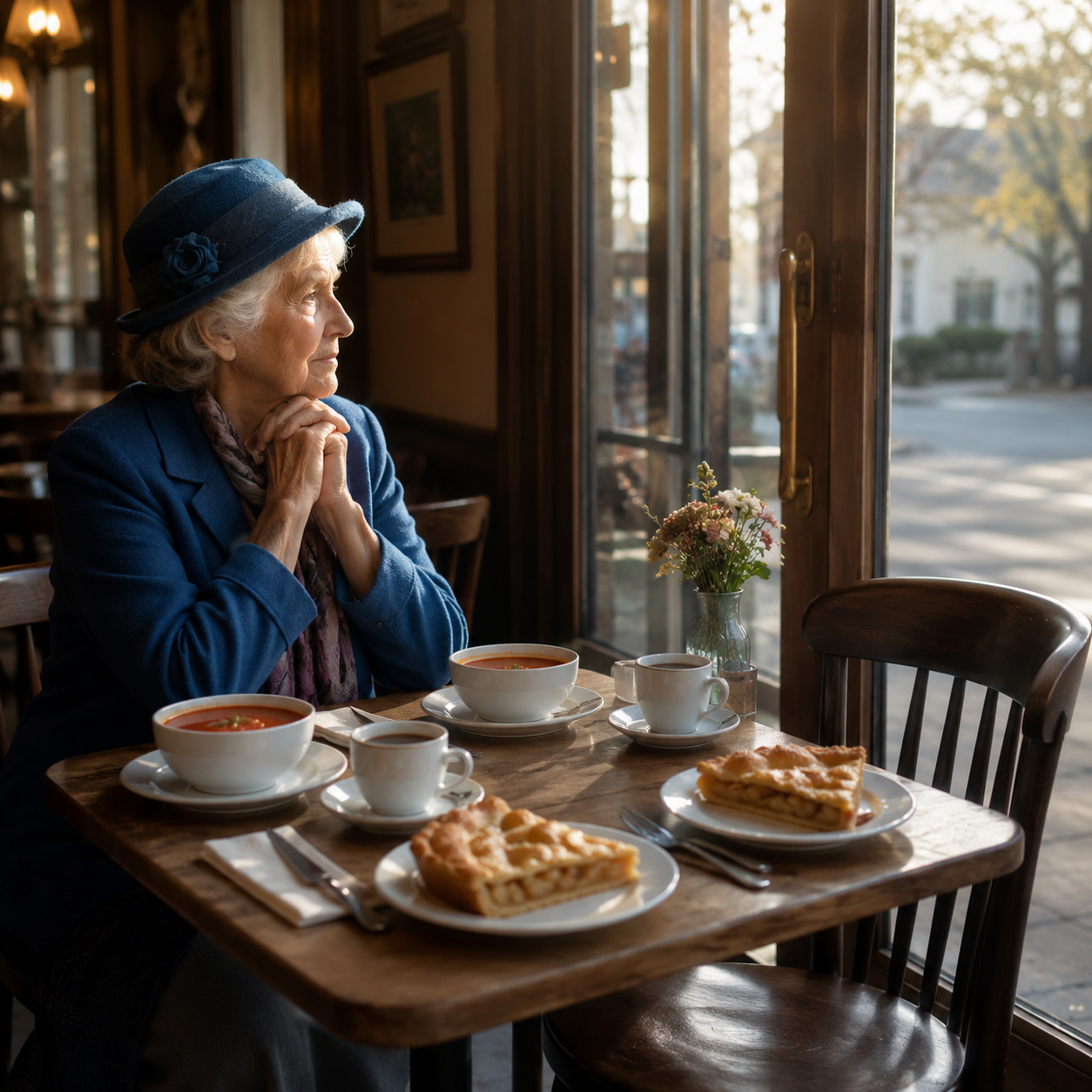
Every Sunday at noon, Mrs. Whitaker reserved a table for two.
She always arrived alone.
She ordered two cups of coffee.
Two bowls of tomato soup.
Two slices of apple pie.
Then she sat beside the window until three o’clock, waiting for someone who never came.
My name is Claire Dawson, and I worked at the Briar Street Café.
I noticed Mrs. Whitaker during my first week.
She was seventy-nine, small and neatly dressed, with silver hair pinned beneath a blue hat.
At exactly 11:55, she entered carrying a leather handbag.
“Table Seven, please.”
Table Seven sat beside the front window.
The café did not take reservations, but the owner had made an exception long before I started.
I placed two menus on the table.
Mrs. Whitaker never opened them.
“Two coffees,” she said. “One black. One with cream.”
“Are you expecting someone?”
“Yes.”
“Will they be here soon?”
She looked toward the street.
“I hope so.”
At noon, I delivered the soup.
At one, the pie.
At three, Mrs. Whitaker paid for both meals.
She wrapped the untouched food in napkins and left it beside a bench outside the train station.
A homeless man usually collected it after she walked away.
The following Sunday, she returned.
The same table.
The same order.
The same empty chair.
After several weeks, I asked my manager, Paul, whom she was waiting for.
“Her daughter,” he said.
“Where does she live?”
“No one knows.”
“Does she ever come?”
“Not in the fourteen years I’ve worked here.”
Fourteen years.
Mrs. Whitaker had ordered more than seven hundred untouched meals.
At first, I assumed her daughter had died and Mrs. Whitaker could not accept it.
Then I heard her speaking to the empty chair.
“You would hate my hat,” she said one Sunday.
The next week:
“I finally threw away that awful green lamp. You were right about it.”
And later:
“I’m sorry I said you would come crawling back.”
She was not confused.
She knew the chair was empty.
She was rehearsing a conversation she had never been allowed to finish.
One snowy Sunday, the café remained nearly empty.
I poured her coffee and sat across from her.
“You’ll get in trouble,” she said.
“There are no customers.”
“You are neglecting that salt shaker.”
“It has been emotionally independent for years.”
She smiled.
“Who are you waiting for?” I asked.
Her expression changed.
“My daughter, Anna.”
“When did you last see her?”
“Twenty-two years ago.”
“Did she move away?”
“She ran.”
Mrs. Whitaker wrapped both hands around her cup.
Anna had been nineteen.
She wanted to become a photographer.
Her mother wanted her to attend nursing school.
They argued constantly.
Then Anna became pregnant.
The father disappeared.
Mrs. Whitaker was ashamed.
Not of Anna, she later insisted.
Of what neighbors might say.
But shame often disguises itself as concern.
“You are ruining your life,” she told her daughter.
Anna packed one suitcase.
Before leaving, she said, “Someday you will wish you had chosen me over people who were never going to love you anyway.”
Mrs. Whitaker replied, “You’ll come back when you learn how difficult the world is.”
Anna never did.
“Did you look for her?” I asked.
“For years.”
“Police?”
“She was an adult.”
“Relatives?”
“No one knew where she went.”
“Why wait here?”
Mrs. Whitaker looked around the café.
“This was our place.”
When Anna was a child, they visited every Sunday after church.
Anna ordered tomato soup and apple pie.
She stirred cream into her coffee years before she was old enough to drink it.
“When she left, I told myself she would return in a week,” Mrs. Whitaker said. “Then a month. Then Christmas.”
“And after that?”
“I began reserving the table.”
“Does she know?”
“I mailed letters to every address I found. They were all returned.”
She reached into her handbag and removed a bundle tied with blue ribbon.
Hundreds of letters.
Each addressed to Anna.
Each unopened.
“Why keep ordering her food?”
Mrs. Whitaker looked at the second cup.
“Because if she walks in and sees only one place set, she may think I stopped expecting her.”
I did not know what to say.
I thought about my own mother.
We had not spoken in nine months.
Our argument had been smaller than theirs.
She disliked my boyfriend.
I accused her of controlling my life.
She said I only called when I needed money.
We both said things designed not to be honest, but to hurt.
Nine months of silence had followed.
That evening, I called her.
She answered after one ring.
“Claire?”
“I’m not apologizing yet,” I said.
“Good. I’m not ready either.”
“But maybe we could have coffee.”
A long silence.
“Sunday?”
I looked toward Table Seven.
“Sunday.”
The next week, my mother joined me after my shift.
We argued again.
But this time, we stayed at the table.
Mrs. Whitaker watched us from beside the window.
Before leaving, she touched my arm.
“Do not wait twenty-two years to become less stubborn.”
“I inherited it from her.”
“So did Anna.”
The following Sunday, Mrs. Whitaker did not arrive.
At 12:10, I called her home.
No answer.
At 12:30, Paul drove to her apartment.
He returned with an ambulance following behind him.
Mrs. Whitaker had suffered a stroke.
At the hospital, she struggled to speak.
Her right hand no longer moved.
But when I placed her bundle of letters beside the bed, she whispered one word.
“Anna.”
I promised I would find her.
I had no idea how.
PART 2 — THE PHOTOGRAPH
I began with the letters.
Most addresses led nowhere.
Old apartments.
Closed businesses.
Forwarding addresses that expired decades earlier.
Then I found a photograph inside one envelope.
Mrs. Whitaker had intended to send it to Anna.
It showed Table Seven.
Two cups.
Two bowls of soup.
On the back she had written:
Your chair is still here.
I posted the photograph online.
I included no private medical details.
Only the story of an elderly mother who had waited every Sunday for twenty-two years.
The post spread farther than I expected.
Thousands of people shared it.
Many criticized Mrs. Whitaker.
Some said Anna owed her nothing.
Others said a parent should be forgiven.
I stopped reading the comments.
Real relationships rarely fit inside sentences written by strangers.
Three days later, I received a message.
My name is Lucy Reyes.
I think Anna Whitaker was my mother.
Lucy was twenty-one and lived two states away.
Her mother had died from cancer six months earlier.
She had rarely spoken about her family.
But among Anna’s belongings, Lucy found a photograph of a café table beside a window.
On the back:
Sunday with Mom, before everything broke.
Lucy sent me a picture of Anna.
She had Mrs. Whitaker’s eyes.
I showed it to Mrs. Whitaker at the hospital.
Her left hand shook as she touched the screen.
“Anna.”
“I found her daughter.”
Mrs. Whitaker closed her eyes.
She understood what I had not yet said.
Anna was gone.
For twenty-two years, Mrs. Whitaker had imagined every possible reunion.
Anger.
Tears.
An embrace.
A slammed door.
She had never imagined finding her daughter one lifetime too late.
Lucy agreed to visit.
She entered the hospital carrying an old camera.
Mrs. Whitaker stared at her.
Lucy stood near the door.
“My mother kept this,” she said.
She placed the camera on the bed.
It was scratched and worn.
Mrs. Whitaker touched it with her left hand.
“I bought this for Anna’s sixteenth birthday,” she whispered.
“She became a photographer.”
Mrs. Whitaker began crying.
“Was she happy?”
Lucy hesitated.
“Sometimes.”
It was the most honest answer she could give.
Anna had struggled.
She worked several jobs.
Raised Lucy alone.
Moved frequently.
But she also photographed weddings, graduations, families, and children.
She taught Lucy to develop film in a bathroom converted into a darkroom.
“She talked about you,” Lucy said.
Mrs. Whitaker looked up.
“What did she say?”
“That you made the best tomato soup.”
Mrs. Whitaker laughed through her tears.
“And?”
“That you were strong.”
“And?”
“That she was angry.”
The room became quiet.
“She wanted to call you,” Lucy continued. “Especially near the end.”
“Why didn’t she?”
“She thought you had stopped looking.”
Mrs. Whitaker shook her head frantically.
“I never stopped.”
“She didn’t know.”
I placed the photograph of Table Seven between them.
Lucy studied it.
“My mother had a picture like this.”
“She did?”
“It was taped inside her closet.”
Lucy reached into her bag and removed the photograph.
It showed Mrs. Whitaker and Anna at Table Seven many years earlier.
Anna was perhaps fifteen.
Both were laughing.
On the back, Anna had written:
If I ever go home, start here.
Mrs. Whitaker pressed the photograph to her chest.
The tragedy was not that neither woman loved the other.
It was that both had spent decades waiting for the other to move first.
Lucy visited every day.
She showed Mrs. Whitaker photographs Anna had taken.
Children running through sprinklers.
A bride fastening her mother’s necklace.
An old man holding his wife’s hand in a hospital room.
Then Lucy showed us Anna’s final project.
It was a collection titled Empty Places.
An unused crib.
An abandoned porch swing.
A second pillow on a bed.
An empty chair across from a café table.
“She photographed places where someone was missing,” Lucy said.
Mrs. Whitaker stared at the empty chair.
“Was that chair mine?”
Lucy nodded.
“She never forgot it.”
Mrs. Whitaker’s recovery was slow.
She learned to walk with a cane.
Her speech remained uneven.
When she was discharged, she asked to return to the café.
Sunday.
Noon.
Table Seven.
This time, Lucy sat in the second chair.
I brought two coffees.
One black.
One with cream.
Mrs. Whitaker looked at the cream.
“Anna drank it this way.”
“So do I,” Lucy said.
I served tomato soup and apple pie.
Lucy took one bite.
“My mother made this.”
“Mine is better,” Mrs. Whitaker said.
Lucy smiled.
“That sounds like something she would have argued about.”
They spent three hours talking.
Not pretending Lucy was Anna.
Not trying to replace anyone.
Simply building the relationship that Anna had never lived long enough to bring together.
At three o’clock, Mrs. Whitaker asked me for the bill.
“There are only two meals,” I said.
“Yes.”
“But you usually pay for another one.”
She looked toward the window.
“Bring one more bowl of soup.”
“For whom?”
“Someone outside the station will be hungry.”
PART 3 — THE TABLE THAT NEVER STAYED EMPTY
Lucy began visiting once a month.
She photographed Mrs. Whitaker constantly.
Mrs. Whitaker complained about every picture.
“My neck looks old.”
“Your neck is old.”
“Your mother was more respectful.”
“According to you, she ran away.”
“That was different.”
They learned each other slowly.
Lucy learned that Mrs. Whitaker hummed while cooking.
Mrs. Whitaker learned that Lucy hated tomatoes but loved tomato soup.
They discovered Anna had inherited her stubbornness from both sides.
A year after they met, Lucy organized an exhibition of Anna’s photographs at the café.
The final image was the empty chair at Table Seven.
Beside it hung a new photograph.
Mrs. Whitaker and Lucy sitting together in the same place.
The exhibition was titled:
THE CHAIR WAS NEVER EMPTY
A reporter asked Lucy why.
She replied, “Because my mother had been sitting there in her mind for twenty-two years.”
Mrs. Whitaker lived three more years.
Every Sunday, she reserved Table Seven.
Sometimes Lucy joined her.
Sometimes my mother and I sat nearby.
Sometimes Mrs. Whitaker invited strangers who were dining alone.
She stopped asking whether people were expecting someone.
She simply pointed to the empty chair and said, “Sit. The soup is already coming.”
After she died, the café owner wanted to remove the reservation card.
I refused.
Table Seven remained reserved every Sunday from noon until three.
Not for Mrs. Whitaker.
Not for Anna.
For anyone who needed a place.
We placed a small card on the table:
NO ONE SHOULD HAVE TO WAIT ALONE.
The tradition grew.
Widows came.
Estranged siblings met there.
Parents apologized to adult children.
Some conversations ended in forgiveness.
Others ended with boundaries.
Not every relationship could be repaired.
But every person was allowed to speak.
Years later, Lucy returned with a little girl.
“My daughter,” she said.
The child carried Anna’s old camera around her neck.
“What’s her name?” I asked.
“Anna Claire.”
I looked at her.
“You used my name?”
“Grandma Whitaker said you were the reason we found each other.”
I shook my head.
“A photograph found you.”
“No,” Lucy said. “You noticed an empty chair.”
We sat at Table Seven.
I brought three bowls of soup and three slices of apple pie.
For twenty-two years, Mrs. Whitaker believed she reserved that table so her daughter would know she was still welcome.
But the table became something larger than an apology she never delivered.
It became a bridge between a grandmother and granddaughter.
A place where my own mother and I stopped choosing pride over conversation.
A chair for strangers who thought no one was expecting them.
Mrs. Whitaker spent decades waiting for one person to sit across from her.
In the end, hundreds did.
And perhaps that is what love sometimes does when it arrives too late for the person we intended.
It does not disappear.
It waits at the table—
until someone else needs a place to sit.