My Husband Invited the Mother Who Abandoned Him to Our Daughter’s Birthday—Then She Gave Me a Box of Letters He Had Never Seen

Original Fiction: This story is fictional. Names, characters, dialogue, locations, and events were created for storytelling purposes.
PART 1 — THE WOMAN AT THE GATE
My husband invited the mother who abandoned him to our daughter’s tenth birthday party.
He did not tell me.
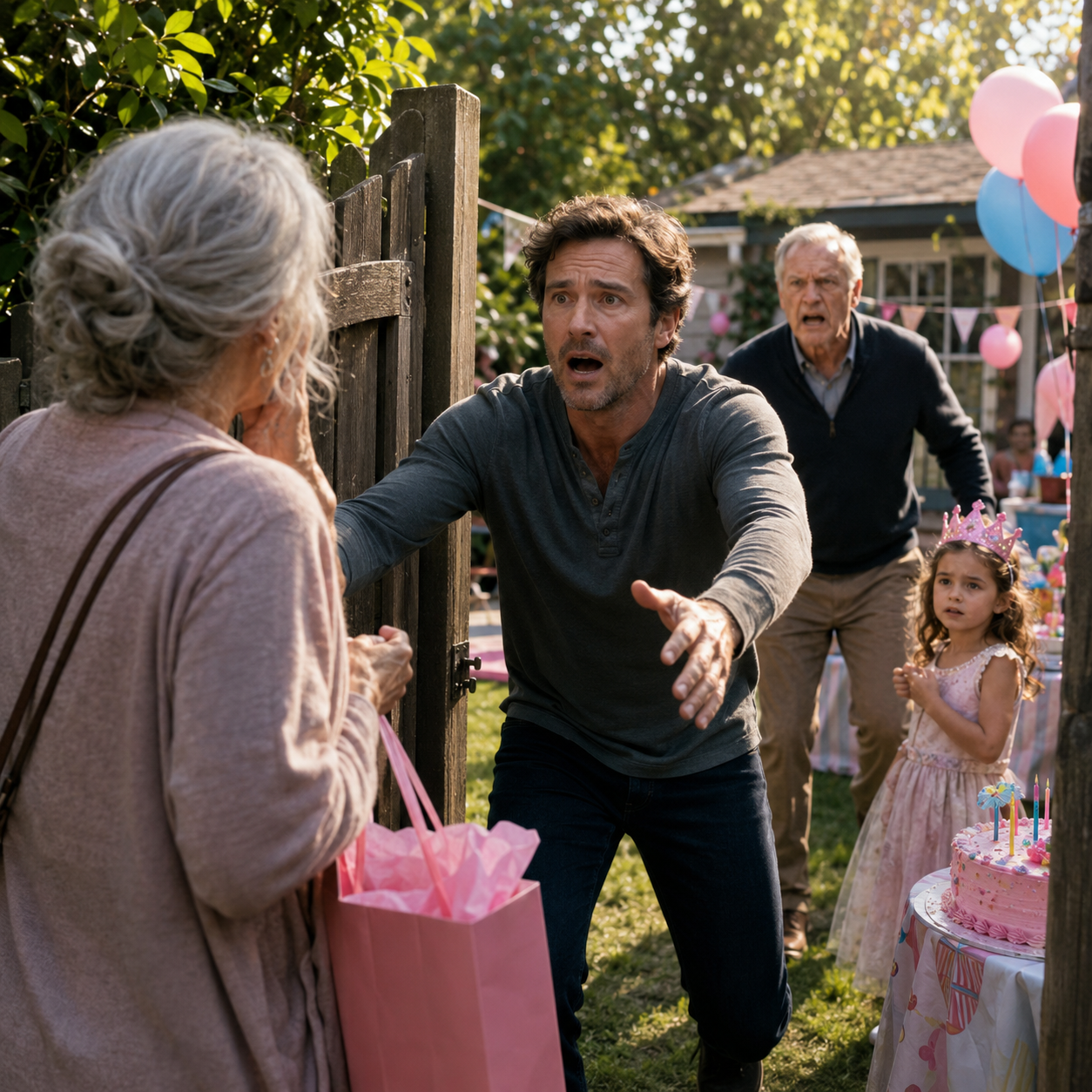
I discovered it when a silver-haired woman appeared at our backyard gate holding a pink gift bag.
My husband rushed toward her.
Then he wrapped his arms around her and said:
“Mom.”
Every conversation around me stopped.
Our daughter, Emma, stood beside her birthday cake wearing a paper crown.
My father-in-law, Robert, rose so quickly that his chair fell backward.
“You have no right to be here,” he said.
The woman did not move.
My husband stepped between them.
“I invited her.”
Robert stared at his son.
“After everything she did?”
“I know what she did.”
“No, Michael. You know what she told you.”
My name is Laura Bennett.
I had been married to Michael for twelve years.
During that time, I heard exactly one version of his mother’s story.
Her name was Helen.
She left when Michael was six.
She packed a suitcase while he slept, took money from the family account, and vanished with another man.
Robert raised Michael alone.
He attended school meetings.
Coached baseball.
Worked two jobs.
Whenever Michael asked why his mother had left, Robert gave the same answer:
“Some people love freedom more than their children.”
Michael grew up believing he had not been worth staying for.
It shaped everything.
He panicked when I traveled for work.
He checked Emma’s bedroom every night.
If an argument became too quiet, he asked whether I was leaving.
I hated Helen for wounds I had never seen her create.
Now she stood inside our yard.
She looked nothing like the woman I had imagined.
No dramatic entrance.
No expensive clothes.
She wore a simple gray dress and held the gift bag with both hands.
Emma approached.
“Are you my grandmother?”
Helen’s eyes filled.
“Yes.”
“I already have Grandpa Robert.”
Robert turned away.
Emma considered this.
“Can people have three grandparents?”
“They can have as many as love them,” Helen whispered.
Robert laughed bitterly.
“That excludes you.”
“Dad,” Michael said.
“Do not call me that while she is standing here.”
Robert grabbed his jacket and walked toward the house.
I followed him.
“What is happening?”
He looked toward the yard.
“She found him.”
“Michael invited her.”
“She manipulated him.”
“What did she tell him?”
Robert’s mouth tightened.
“Ask your husband.”
I did.
Michael refused to speak until the party ended.
Helen remained for forty minutes.
She gave Emma a wooden music box engraved with flowers.
She did not eat cake.
She did not attempt to speak privately with Michael.
Before leaving, she handed me a small cardboard box.
“These belong to him,” she said.
“What are they?”
“Letters.”
“From you?”
She nodded.
“Why give them to me?”
“Because he may not believe me yet.”
“Believe what?”
Helen looked through the kitchen window at Robert.
“That I did not leave him.”
Then she walked away.
That night, after Emma fell asleep, I placed the box on our kitchen table.
Michael stared at it.
“I haven’t opened it,” I said.
“I know what’s inside.”
“How?”
“She told me.”
“Start from the beginning.”
Three weeks earlier, Helen had contacted him through social media.
Michael almost blocked her.
Then she sent a photograph.
Six-year-old Michael asleep in a hospital bed.
Helen sat beside him with one hand wrapped around his.
On the back was a date.
Three months after the day Robert claimed she had abandoned the family.
“She said Dad lied about when she left,” Michael explained.
“What happened?”
“She says he forced her out.”
“Why?”
Michael looked toward the box.
“Because she discovered what he was doing to my older sister.”
I felt the room tilt.
“You don’t have a sister.”
“I did.”
Her name was Anna.
She was four years older than Michael.
Robert had never mentioned her.
Neither had any relative.
According to Helen, Anna died at nine after falling from an upstairs window.
The family called it an accident.
Helen claimed it was not.
“What is she accusing your father of?” I whispered.
“Not what you think.”
Michael rubbed his face.
“Dad had a temper. He hit walls. Broke things. Locked Anna in her room when she disobeyed.”
“And the window?”
“Anna tried to climb down using tied bedsheets.”
I closed my eyes.
“She fell.”
“Yes.”
Helen wanted to take Michael and leave.
Robert threatened to accuse her of causing Anna’s death through neglect.
He had friends in the local police department.
He controlled the bank accounts.
Helen had no job and nowhere to go.
Still, she tried.
Two months after Anna died, she took Michael to a motel.
Robert found them the same night.
He brought Michael home and obtained an emergency custody order claiming Helen was unstable and suicidal.
“Was she?”
“She had been hospitalized after Anna died.”
Robert used the hospitalization against her.
“He told her she would never see me again,” Michael said. “Then he moved us out of state.”
“What about the letters?”
“She wrote every month.”
I opened the box.
Inside were hundreds of envelopes arranged by year.
Each bore Michael’s childhood address.
Every one had been returned unopened.
Some were stamped:
MOVED—NO FORWARDING ADDRESS
Others:
REFUSED
Michael selected one from his seventh birthday.
His hands trembled as he opened it.
Dear Michael,
Today you are seven.
I hope you still like strawberry cake.
I did not choose to leave you.
I am trying to find you.
Please remember the song I sang when you were afraid.
I love you every day, including the days you cannot see me.
Mom
Michael covered his face.
I sat beside him.
“I asked Dad whether she ever tried to contact me,” he whispered.
“What did he say?”
“That she sent divorce papers and nothing else.”
We read until midnight.
Birthday letters.
Christmas letters.
Newspaper clippings she thought he would enjoy.
Photographs of herself standing beside empty birthday cakes.
Then we found an envelope addressed to Robert.
Unlike the others, it had been opened.
Inside was a copy of a legal petition Helen had filed seeking visitation.
Across the bottom, a handwritten note appeared in Robert’s writing.
Withdraw this, or I tell Michael you killed Anna.
Michael stood.
“I’m going to confront him.”
“Not tonight.”
“He lied my entire life.”
“Yes.”
“And he is sleeping ten minutes away.”
“You are angry enough to destroy whatever truth is left.”
He stared at me.
“What truth could possibly help him?”
“I don’t know.”
That was the part no one likes admitting in family dramas.
A person can lie terribly and still have a reason worth understanding.
Not excusing.
Understanding.
The next morning, Robert arrived before we called.
He had seen the box through the kitchen window during the party.
He looked at the opened letters.
Then he sat down.
“I wondered when she would give those to you,” he said.
Michael’s voice shook.
“You knew she wrote.”
“Yes.”
“You sent them back.”
“Yes.”
“You told me she forgot me.”
Robert looked older than he had the day before.
“I wanted you to hate her enough that you would stop waiting.”
“Why?”
“Because I was afraid she would take you too.”
PART 2 — ANNA’S ROOM
Robert admitted almost everything.
His temper.
The locked bedroom.
The threats.
The lies.
After Anna died, grief turned the house into a battlefield.
Helen blamed Robert.
Robert blamed Helen.
Both blamed themselves.
“She wanted to leave with Michael,” Robert said. “I believed she would disappear forever.”
“So you made sure she did,” I replied.
He lowered his head.
“Yes.”
Michael paced beside the table.
“You erased my sister.”
“I could not say her name.”
“You removed every photograph.”
“I thought forgetting would keep you safe.”
“From what?”
“From knowing what kind of father I had been.”
Michael stopped.
Robert’s eyes filled.
“I locked Anna in that room because she lied about finishing her homework. She climbed out because she was afraid I would come back angry.”
He pressed both hands against his face.
“I did not push her. But my anger put her on that windowsill.”
No one spoke.
“I told myself your mother was unstable,” he continued. “She was grieving. She barely ate. She cried in front of you.”
“She had lost her daughter.”
“I know that now.”
“You knew it then.”
“Yes.”
The honesty was unbearable.
Michael pointed toward the letters.
“You let me believe she abandoned me.”
“I thought if you loved her, you would leave me too.”
“You were the adult.”
“I was a coward.”
The front door opened.
Emma walked into the kitchen wearing pajamas.
“Why is everyone crying?”
Robert immediately wiped his face.
“No reason, sweetheart.”
Michael looked at him.
“No. We are finished telling children there is no reason.”
He knelt beside Emma.
“Grandpa and Grandma Helen made serious mistakes when I was little.”
“Which one was bad?”
“Both were hurting. Grandpa did things that were wrong.”
“Is he still my grandpa?”
Robert looked away.
Michael answered carefully.
“Yes. But loving someone does not mean pretending they never hurt anyone.”
Emma turned to Robert.
“Are you sorry?”
“Every day.”
“Then why didn’t you fix it?”
Robert’s lips trembled.
“I kept waiting to become brave.”
Children sometimes ask the question adults build entire lives to avoid.
Emma climbed onto my lap.
“Can Grandma Helen come back?”
Michael looked at his father.
“I don’t know.”
Robert whispered, “She should.”
That afternoon, Helen returned.
Not for reconciliation.
For Anna.
She wanted to visit the old house where her daughter died.
The property now belonged to another family, but the owners allowed us inside after hearing the story.
Anna’s room had become an office.
The window had been replaced.
Helen stood in the center of the room holding the wooden music box she had given Emma.
“I bought one like this for Anna,” she said.
“She loved music.”
Robert remained in the doorway.
“I’m sorry,” he whispered.
Helen did not turn.
“You said that at the funeral.”
“I meant I was sorry she died. I never said I was sorry she was afraid of me.”
“No.”
“I am.”
Helen faced him.
“You stole my son.”
“Yes.”
“You made him believe I chose another life.”
“Yes.”
“You do not get forgiveness because the truth finally exhausted you.”
“I know.”
Michael stood between them.
For years, he had imagined meeting his mother.
He expected to run into her arms or demand an explanation.
Instead, he looked like a child trapped inside an adult body, trying to decide which parent’s pain he was responsible for.
Helen saw it too.
She touched his arm.
“You do not have to choose.”
Michael stared at her.
“Dad made me choose.”
“I won’t.”
“After everything he did?”
“What he did belongs to him. Your relationship with him belongs to you.”
Robert began crying.
Helen continued.
“I did not come back to replace your father. I came back because I wanted you to know that you were loved during every year you thought you weren’t.”
Michael opened the music box.
A soft melody played.
He froze.
“I know this song.”
“I sang it when you were afraid.”
He looked at Robert.
“Did you remember it?”
Robert nodded.
“You hummed it in your sleep for years.”
“Why didn’t you tell me?”
“Because it belonged to her.”
Michael laughed bitterly.
“So did half of me.”
That evening, Helen gave him one final letter.
It had never been mailed.
Dear Michael,
Your father may someday tell you I left because I wanted freedom.
He will be partly right.
I wanted freedom from fear.
But I never wanted freedom from you.
I have spent years wishing I had fought harder.
Perhaps one day you will believe that losing a battle is not the same as surrendering love.
Mom
Michael folded the letter.
Then he did something neither parent expected.
He took Helen’s hand.
He took Robert’s hand.
But he did not bring them together.
He simply stood between them.
“I need both of you to stop making me carry what happened before I was old enough to understand it.”
They nodded.
For the first time, both listened.
PART 3 — THE ELEVENTH BIRTHDAY
The year that followed was complicated.
Helen did not become part of our family overnight.
She and Michael met for coffee.
Then stopped speaking for three weeks after an argument.
Then began again.
Robert entered therapy.
He stopped calling his behavior “discipline.”
He used the word abuse.
Helen attended one session with him.
She left halfway through.
That was her right.
Emma asked about Anna constantly.
We found photographs Helen had saved.
A girl with Michael’s eyes.
Dark hair.
A crooked smile.
Emma placed one beside her bed.
“This is my aunt,” she told friends.
At first, Robert could not look at it.
Eventually, he brought another photograph.
Anna and Michael sitting inside a blanket fort.
“Your father used to follow her everywhere,” he told Emma.
Michael touched the picture.
“I don’t remember this.”
“I do,” Robert said.
Then he told a good memory without using it to erase the bad ones.
That mattered.
On Emma’s eleventh birthday, she invited both grandparents.
Robert arrived first.
Helen came ten minutes later.
They greeted each other politely.
No accusations.
No performance of closeness.
Just two people standing inside the truth of what they had done and lost.
Before Emma opened her presents, she carried the wooden music box to the center of the room.
“I want Grandma Helen to tell us about Anna.”
Helen looked at Michael.
He nodded.
So she told stories.
Anna hated carrots.
She collected smooth stones.
She once cut Michael’s hair while he slept.
Robert added, “She blamed the dog.”
“There was no dog,” Michael said.
For one second, everyone laughed.
Then cried.
After the party, Robert approached Helen.
“I kept one thing,” he said.
He handed her a small envelope.
Inside was a lock of Anna’s hair tied with white thread.
Helen’s knees nearly gave way.
“I thought I had lost everything.”
“I had no right to keep it.”
“No,” she said.
But she held it against her chest.
Michael stood beside them.
For most of his life, he believed his mother left because he was not enough.
Then he learned his father kept her away because he feared losing the only child he had left.
Neither truth made the damage smaller.
But understanding changed the shape of it.
Helen had not abandoned him.
Robert had not raised him with love alone.
A person could be both the father who packed school lunches and the man who destroyed hundreds of letters.
A person could be the mother who kept searching and the woman too broken to fight successfully.
Families become dangerous when they demand that one person be entirely innocent and another entirely monstrous.
Sometimes the truth is harder.
People love us.
People fail us.
Sometimes they do both for years.
Emma’s birthday did not reunite a perfect family.
It created an honest one.
And honesty gave Michael something neither parent had offered when he was six:
The freedom to love them without lying about what they had done.