At My Father’s Funeral, My Brother Announced I Wasn’t His Daughter—Then the Lawyer Opened a Second Envelope

Original Fiction: This story is fictional. Names, characters, dialogue, locations, and events were created for storytelling purposes.
PART 1 — THE EMPTY CHAIR BESIDE THE COFFIN
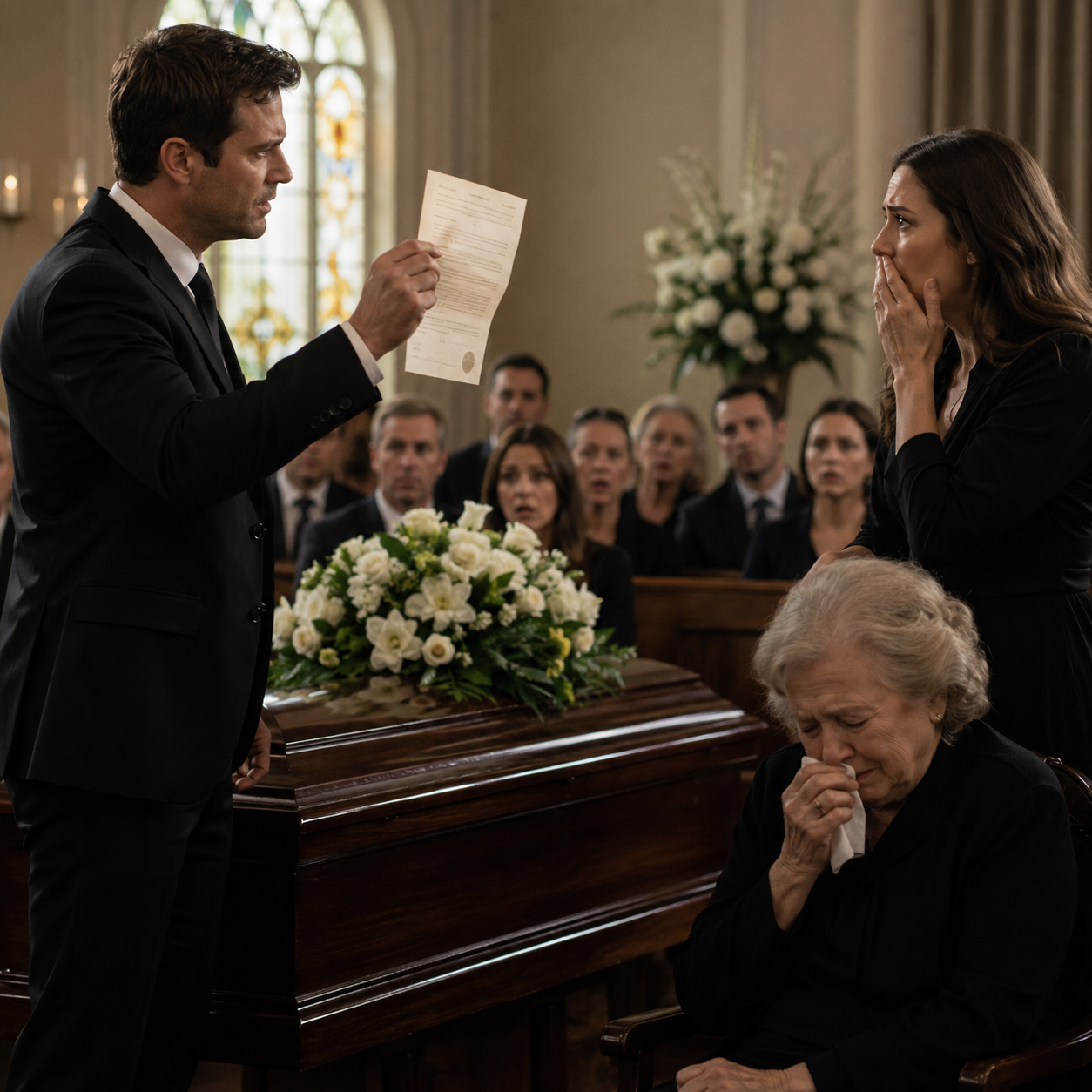
My brother waited until our father’s funeral to tell everyone I was not really his daughter.
He stood beside the coffin, adjusted his black tie, and said:
“Before anyone treats Julia like Dad’s grieving little girl, they should know the truth.”
More than eighty people turned toward me.
My mother stared at the floor.
My brother, Evan, held up a yellowed laboratory report.
“Julia is not our father’s biological child.”
The church became so quiet that I heard the air conditioner switch off.
My name is Julia Mercer.
Until that moment, I had believed I was the youngest daughter of Thomas Mercer.
Dad taught me to ride a bicycle.
Drove six hours when my first marriage ended.
Called every Sunday morning and pretended he needed computer help so I would stay on the phone.
Three days before the funeral, I had sat beside his hospital bed while he took his final breath.
Now Evan was telling the room that none of it counted.
“Put that away,” Mother whispered.
Evan ignored her.
“I found this in Dad’s desk.”
The report was dated thirty-two years earlier.
My birth year.
Probability of paternity:
0.0 percent.
Someone gasped.
My aunt covered her mouth.
I looked at Mother.
“Is it true?”
She began crying.
That was answer enough.
Evan folded the paper.
“Dad spent his life raising another man’s child.”
“Why are you doing this here?” I asked.
“Because the will is being read tomorrow.”
His honesty was almost impressive.
“You think I shouldn’t inherit.”
“I think Dad’s actual family should know what he sacrificed.”
“Actual family?”
“Mom. Me. His grandchildren.”
“My children are his grandchildren.”
“Not biologically.”
My sixteen-year-old son stood from the pew.
“Say that again.”
I grabbed his arm.
“Sit down, Noah.”
Evan looked almost pleased.
He had waited for the largest possible audience.
He wanted witnesses to my humiliation.
The funeral director approached, but Mother suddenly stood.
“Thomas knew,” she said.
Evan turned.
“What?”
“Your father knew Julia was not his biological child.”
“For how long?”
“From the beginning.”
The room shifted again.
Evan’s victory faltered.
Mother looked at me.
“I was going to tell you after the funeral.”
“You had thirty-two years.”
“I was afraid.”
“Who was my father?”
She closed her eyes.
“His name was David Hale.”
Dad’s best friend.
The man whose photograph had hung in our garage throughout my childhood.
David died in a construction accident two months before I was born.
I knew the official story.
He and Dad had been friends since high school.
Dad served as a pallbearer.
Helped David’s parents empty his apartment.
Named our family dog after him.
I had never known my mother had loved him.
“Was it an affair?” I asked.
Mother nodded.
Once.
The movement felt like a door closing.
Evan laughed without humor.
“So Dad knew his wife betrayed him, and he still raised Julia?”
“Yes.”
“Why?”
Mother’s face twisted.
“Because Thomas was better than both of us.”
I stood.
I could not remain inside that church.
People reached for me as I passed.
My aunt.
My son.
My husband.
I kept walking.
Outside, rain darkened the church steps.
Dad’s lawyer, Mr. Patel, followed me.
He was nearly seventy and had known our family for decades.
“Julia.”
“I can’t do this.”
“There is something your father wanted you to have before tomorrow.”
He handed me a sealed envelope.
My name appeared in Dad’s handwriting.
I opened it beneath the church awning.
Julia,
Your brother may discover the report.
I should have destroyed it.
I kept it because it reminded me that becoming your father was the only important decision of my life that required no blood at all.
If Evan uses it to hurt you, ask Mr. Patel to open the second envelope.
Do not let biology reduce our family to a science experiment.
You are my daughter.
That sentence has never required an explanation.
Love,
Dad
My knees weakened.
Mr. Patel steadied me.
“What is in the second envelope?”
He looked back toward the church.
“The truth your father hoped none of you would need.”
PART 2 — BOTH CHILDREN
The will was read the next afternoon.
Evan sat beside Mother.
I sat across from them with my husband.
Mr. Patel placed two envelopes on the table.
He began with the will.
Dad divided nearly everything equally.
The house to Mother.
Half the remaining estate to Evan.
Half to me.
Evan interrupted.
“That was written before he knew.”
Mother looked at him.
“He always knew.”
“You expect me to believe he intentionally gave half his estate to David Hale’s daughter?”
I tightened my grip around Dad’s letter.
Mr. Patel opened the first envelope.
Inside was a video drive.
Dad had recorded himself six months before his death.
He appeared thinner, seated in his workshop.
“If you are watching this,” he began, “then my children are probably arguing over whether one of them is truly mine.”
Evan looked away.
Dad continued.
“Julia is not my biological daughter. I knew before she was born.”
He explained that Mother confessed after David’s death.
Dad had planned to leave.
Then he attended a prenatal appointment because Mother was too frightened to go alone.
He heard my heartbeat.
“I did not become Julia’s father in that room,” Dad said. “But that was when I realized leaving a child fatherless to punish two adults would not make me honorable.”
Mother covered her face.
Dad stayed.
The marriage survived, though never unchanged.
He raised me.
He also loved Evan.
“I made mistakes with both children,” Dad continued. “But loving Julia was not one of them.”
Evan pushed back his chair.
“This proves nothing about the inheritance.”
Mr. Patel looked at him.
“Your father anticipated that response.”
He opened the second envelope.
Inside was another report.
This one carried Evan’s name.
Probability that Thomas Mercer was his biological father:
0.0 percent.
Evan stared at it.
“That’s fake.”
Mother began sobbing.
I looked at her.
“Evan too?”
She nodded.
Dad’s video continued.
“I discovered Evan was not biologically mine when he was three.”
Evan’s face became gray.
“Who is my father?” he demanded.
Mother could barely speak.
“His name was Richard Lane.”
A coworker.
The relationship occurred during a brief separation between our parents.
Mother believed Richard was Evan’s father but never told Dad.
Years later, Evan needed blood during surgery.
The mismatch exposed the truth.
“Dad knew?” Evan whispered.
“Yes.”
“And stayed?”
“Yes.”
Dad looked directly into the camera.
“Evan may believe this makes us even. It does not. Children are not debts adults balance against one another.”
He leaned closer.
“Evan, you were my son before I knew the truth, and you remained my son afterward.”
Evan stood abruptly.
“You all lied to me.”
Mother reached for him.
He pulled away.
“You lied to both of us.”
“Yes.”
“Dad lied.”
Dad’s recorded voice filled the room.
“I told myself silence protected my children. Perhaps it only protected me from difficult conversations.”
Evan stared at the screen.
“I wanted you both to feel secure. Instead, I may have left you vulnerable to anyone who mistakes blood for belonging.”
Dad explained why he kept both reports.
Not as evidence against Mother.
As reminders.
Two children.
Neither biologically his.
Both entirely his.
He had instructed Mr. Patel to reveal Evan’s report only if Evan used mine to challenge my place in the family.
“If you opened the second envelope,” Dad said, “then one of my children tried to push the other outside the family.”
His eyes looked tired.
“I am sorry I am not there to stop you.”
The video ended.
No one spoke.
Evan walked out.
Mother remained at the table crying.
I should have felt vindicated.
Instead, I felt sick.
My brother had attempted to destroy my identity.
But in doing so, he had destroyed his own.
I found him in the parking lot.
He stood beside his car, tearing the laboratory report into strips.
“You knew?” he asked.
“No.”
“You’re lying.”
“I found out yesterday.”
He laughed bitterly.
“So neither of us is his.”
“We both are.”
“Didn’t you hear the reports?”
“I heard Dad.”
“He felt sorry for us.”
“No.”
“He stayed because Mom kept humiliating him.”
“Evan, stop.”
“You were David’s. I was Richard’s. Dad had nothing.”
“He had us.”
Evan looked at me.
For the first time since childhood, he did not appear confident.
He looked terrified.
“All my life, I was the real one,” he whispered.
The sentence hurt more than his funeral announcement.
“You needed me to be less real so you could feel secure.”
He lowered his eyes.
“Dad was closer to you.”
“He called you every week.”
“To ask about the children.”
“He asked me whether you were happy.”
Evan’s face changed.
“What?”
“Every Sunday. After asking me to fix his phone, he asked whether you were happy.”
“Why didn’t he ask me?”
“Probably because you would have told him you were fine.”
Evan sat on the curb.
“I thought he loved you more.”
“I thought he respected you more.”
We looked at each other.
Two adults who had spent years measuring love by comparing what the other received.
Neither had noticed Dad was trying to reach us differently.
Evan began crying.
“I announced it at his funeral.”
“Yes.”
“I wanted everyone to see you weren’t his.”
“Yes.”
He covered his face.
“And the whole time, neither was I.”
I sat beside him.
“No. The whole time, both of us were.”
PART 3 — THE FAMILY TREE
Forgiveness did not happen quickly.
For months, I barely spoke to Evan.
He apologized to my children.
Then to my husband.
Then publicly to relatives who had attended the funeral.
“I used private information to humiliate my sister,” he said. “I was wrong.”
Some family members praised him for apologizing.
I did not.
An apology was necessary.
It was not heroic.
Mother began therapy.
She answered questions she had avoided for decades.
David Hale had been kind, impulsive, and afraid of commitment.
Richard Lane never knew Evan existed.
Thomas knew all of it and chose to stay.
“Did Dad ever forgive you?” I asked.
“Some days,” Mother said.
The answer was more honest than claiming complete forgiveness.
“Did he still love you?”
“Yes.”
“Was love enough?”
“No.”
That answer mattered too.
Dad’s decision to remain did not make the marriage simple.
It made it real.
Love, anger, loyalty, betrayal, tenderness, and resentment had shared the same house for decades.
Families often tell one clean story because the complicated version makes everyone uncomfortable.
Ours could no longer do that.
A year after Dad died, Evan invited me to the cemetery.
He carried a small tree.
A young maple.
“What is this?”
“A replacement.”
“For what?”
“The family tree.”
Despite myself, I smiled.
We planted it near Dad’s grave with permission from the cemetery.
Evan placed a metal marker beside it.
It read:
THOMAS MERCER
FATHER BY CHOICE
EVERY DAY
Mother joined us later.
She brought two photographs.
One of David.
One of Richard.
“I thought you might want them,” she said.
Evan studied Richard’s face.
I studied David’s.
There were similarities.
My eyes.
Evan’s jaw.
But the faces felt strangely distant.
Biology explained certain features.
It did not explain who we had become.
Dad taught Evan to repair engines.
He taught me to cook eggs without burning the edges.
He held Evan’s first child.
He walked me down the aisle.
He chose us before we were old enough to earn anything.
That was the inheritance neither report could measure.
Years later, my son completed a school genealogy project.
He drew a family tree with too many branches.
Thomas Mercer.
David Hale.
Richard Lane.
Mother.
Evan.
Me.
When his teacher said family trees usually followed biological lines, Noah replied:
“Then this is a family map.”
I kept that project.
Evan and I are not as close as people imagine siblings should be.
But we are honest now.
When jealousy appears, we name it.
When old wounds return, we do not turn them into weapons.
Every year, we visit the maple tree on Dad’s birthday.
It has grown taller than both of us.
At the funeral, Evan believed one laboratory report could remove me from the family.
Then a second report removed the certainty he had built his entire identity upon.
Dad’s final lesson was not that biology meant nothing.
It meant something.
It gave us history.
Faces.
Questions.
But it did not outrank the thousands of ordinary choices that made Thomas Mercer our father.
The lunches packed.
The bills paid.
The arguments survived.
The calls answered.
The decision to stay.
Blood can explain where a person began.
It cannot always explain who came back every day to help them become someone.
Dad was not our father because a test said so.
He was our father because, twice, the test said no—
and he answered yes.