Uncle Jeff’s big face broke into a grin.
“I’d be honored,” he said.
So we walked her down the aisle. The two of us.
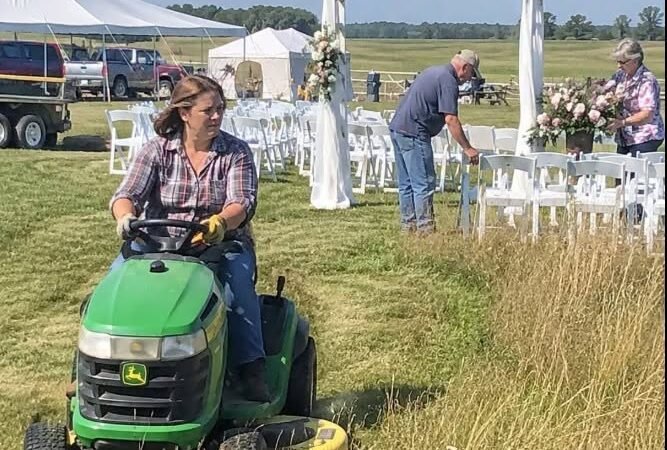
Uncle Jeff on her left. Me on her right. In my navy dress from Belk, with green still in the creases of my knuckles.
Past two hundred folding chairs. Past two hundred faces. Past Mama, crying in the front row in her pale yellow dress.
To the white arbor.
With Grandpa’s name behind it, forty feet tall in the hay.
When we got to the front, the preacher asked, “Who gives this woman to be married to this man?”
Uncle Jeff opened his mouth.
Then he closed it. He looked at me.
I looked at my sister.
At Grandpa’s gold watch on her wrist. At the pollen on her fingers. At the green on the hem of her dress from walking up the E.
“Her family does,” I said. “All of us.”
Then I looked up the hill. At the letters.
“Especially him,” I said.
Part Eighteen: The Pictures
The photographer stood exactly where I knew she would.
At the back of the aisle. Shooting down toward the arbor. With the bottom forty rising behind it.
She was a young woman from Nashville. She’d been photographing weddings for six years. She told me later, at the reception, that she’d never once shot a wedding like this.
“I didn’t even have to frame it,” she said. “It framed itself.”
The pictures are on Megan’s living room wall now.
The biggest one is over the fireplace. Twenty by thirty inches.
Megan and Scott at the arbor, kissing. The two hundred chairs. The guests on their feet, clapping.
And behind them, rising up the hill in the gold June hay, forty feet tall, cut clean and dark and perfect:
EARL.
Somebody posted a picture on Facebook that night. One of the guests. Scott’s cousin from Murfreesboro.
Most beautiful wedding I’ve ever been to. The bride’s sister cut their late granddad’s name into his hayfield at 4am. There wasn’t a dry eye.
It got shared eleven thousand times.
I got calls for a month. From newspapers. From a TV station in Nashville. From a woman in Ohio who wanted me to cut her late husband’s name into her alfalfa field for their anniversary.
I said no to all of them.
It wasn’t something I could do for just anybody.
It was only something I could do for Grandpa.
Part Nineteen: The Check
The Monday after the wedding, I cut the bottom forty.
All of it. The whole field. Including the letters.
It was past its prime, like I knew it would be. Stemmy and coarse. It made about seventeen hundred square bales instead of two thousand, and they’d sell for eight dollars instead of twelve.
I didn’t care.
While I was raking it on Wednesday, Megan’s car came down the lane.
She got out. She was wearing jeans and an old T-shirt and a dust mask. Carrying her inhaler in her back pocket.
She walked out to the edge of the field. She stood there and watched me rake.
When I came around to the end of the row, I stopped the tractor.
“What are you doing here?” I asked.
“Helping,” Megan said. “If you’ll show me how.”
I looked at her.
“You’re allergic,” I said.
“I’ve been getting shots for six months,” she said. “And I’ve got a mask. And I’ve got my inhaler. Show me, Laney.”
So I showed her.
I put her up on the seat of the little Ford, the old 3000 with the paint worn off the fenders. I stood on the drawbar behind her, holding on to the back of the seat, the way Grandpa used to stand behind me.
I showed her the clutch. The throttle. The PTO.
She drove the rake down one windrow. Slowly. Crooked. She missed half the hay.
When she got to the end of the row, she stopped.
She turned around and looked at me.
She was grinning so wide her dust mask moved.
“I did it,” she said.
“You did it,” I said.
Before she left that afternoon, she handed me an envelope.
Inside was a check. Made out to me.
Fourteen hundred dollars.
“For the tents,” she said. “They should have been mine. You were right.”
I looked at the check for a long time.
“Meg,” I said. “I don’t want this.”
“I know,” she said. “But I want you to have it.”
I thought about it.
Then I handed it back to her.
“Put it toward a headstone bench,” I said. “For the cemetery. Next to Grandpa. Somewhere to sit when we go out there.”
Megan looked at the check.
“A bench,” she said.
“Grandpa always sat at the edge of the field,” I said. “In his lawn chair. Watching. He’d want somewhere to sit.”
Part Twenty: The Bench
The bench was put in at the Shelbyville Cemetery in September.
Gray granite. Plain and simple. Right next to Grandpa’s headstone, under a big cedar tree, facing west.
On the front, it says:
EARL TIDWELL
1937 – 2025
HE KEPT IT HAY.
On the back, Megan had something else engraved. She didn’t tell me what until it was installed.
I walked around to look.
From the girl in the field
and the girl at the window.
We both belonged.
Part Twenty-One: Next June
It’s June again now.
The bottom forty is standing tall. Timothy and orchardgrass, gold at the tips. I’m going to cut it next week, at the boot stage, when the protein’s highest. The horse people in Franklin are already calling to reserve bales.
Megan’s been out here every Saturday since April.
She’s been getting her shots for a year and a half now. She still has to wear a mask during cutting. She still keeps her inhaler in her back pocket.
But she comes.
She can run the rake now. Straight rows. She’s learning the baler. She’s terrible at it. She jams it about every forty bales.
Grandpa’s barn coat still hangs on the nail by the barn door.
Last Saturday, it was cold in the morning, and Megan took it down and put it on.
She found the last peppermint in the left pocket.
She stood there in the barn doorway for a long time, holding it.
Then she unwrapped it and broke it in half.
She handed me one half. She put the other half in her mouth.
We stood there in the barn, in the early morning light, eating our grandfather’s last peppermint.
“It tastes like being nine,” she said.
“Six,” I said. “You were six.”
She laughed.
Next month, she and Scott are having a baby.
A little girl. Due in August.
They’re going to name her Earlene.
Megan says that when Earlene is old enough, she’s going to bring her out to the field. She’s going to put her on the seat of the little Ford. She’s going to stand on the drawbar behind her, holding on to the back of the seat.
“And if she’s allergic like me?” I asked.
Megan thought about it.
“Then I’ll get her shots,” she said. “And a mask. And an inhaler.”
She looked out at the bottom forty. At the hay waving in the wind.
“But she’s not going to stand at the window,” Megan said. “Not my girl. Not ever.”
Last night, after supper, I walked out to the edge of the field.
The sun was going down over the west ridge. The hay was gold and pink and orange in the last of the light. The barn swallows were swooping low over the timothy, catching bugs.
I stood there with my hands in my pockets. Just looking.
The way he used to.
I don’t know if he can see it.
I don’t know if he was watching on the morning of the wedding, when the sun came up and lit the E and the A.
I don’t know if he saw two sisters walk up into the middle of his name, in their good dresses, holding hands, while a little cloud of pollen rose up around them.
But I know this.
When I cut that field next week, I’m going to start at the bottom of the slope. Behind the farmhouse. Right where the arbor stood.
And I’m going to cut it slow.
Two passes wide.
Not the whole name. Just the first letter.
Just enough so that when Megan drives down the lane on Saturday morning, with her mask and her inhaler and her daughter on the way, she’ll come around the side of the house and look up at the hill.
And she’ll know.
That the field has a voice.
And it’s still saying the same thing.
You just have to know how to cut it.