I’d have to shut it off, climb down, and dig the wet grass out of the deck with my hands. Then climb back on and start again.
My fingers went green to the knuckle. My jeans were soaked to the waist. My boots squished.
I didn’t stop.
The sun came up over the east ridge at five-forty.
It came up slow and gold, the way it does in June. It spilled down the hill and across the bottom forty, and it caught the dew on every blade of hay and turned the whole field to fire.
It lit the first letter. Then the second.
The sun lit the E and the A.
I stopped the lawn tractor for a minute and just looked at them. Two letters, forty feet tall, cut clean and dark in the shining hay.
I thought about Grandpa on the porch in April. Watching the sunset over this field.
I started the tractor again.
By a quarter to eight, I was on the last letter.
I cut the long stroke and backed up.
Then I shut the mower off.
The silence came down over the field like a blanket. No engine. No clatter. Just the frogs at the pond and a mourning dove somewhere in the tree line and my own heart pounding.
I climbed down off the tractor.
I walked into the middle of the word.
I stood there for a long time.
In the cut grass, with the standing hay rising on all sides of me. In Grandpa’s barn coat, soaked through, with green fingers and two peppermints in the pocket.
I took one of the peppermints out. I unwrapped it. I put it in my mouth.
It tasted like being nine years old.
Part Ten: One O’Clock
The cars came down the road at one.
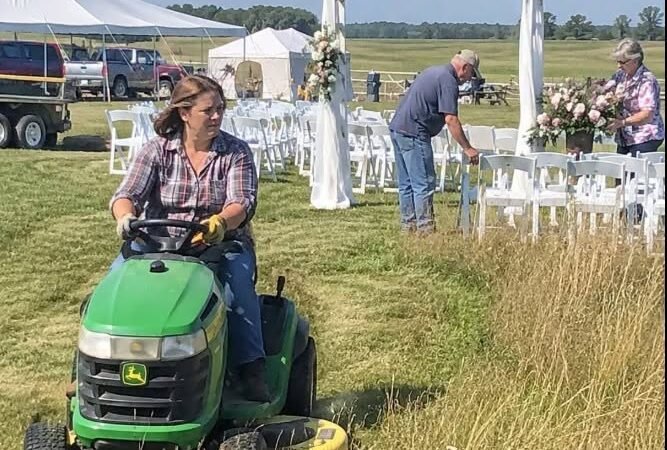
I was standing behind the second tent, where nobody could see me, in a navy dress I’d bought at Belk in Murfreesboro. I’d showered and scrubbed my hands for twenty minutes, but you could still see the green in the creases of my knuckles.
I’d hung Grandpa’s barn coat back on its nail in the barn.
They parked in the hay stubble along the lane. Fifty cars, then a hundred. Pickups and minivans and a few nice cars from Nashville. Scott’s people from Murfreesboro. Megan’s friends from the salon where she works in Shelbyville.
They came walking down from the parking strip in their nice clothes. Women in sundresses and sandals. Men in khakis and button-downs. Kids in clip-on ties.
They came down the mowed path I’d made from the lane to the clearing. Past the farmhouse. Past the big oak tree.
And then they came around the side of the house, where the slope opened up and you could see the whole field.
A woman in a blue dress stopped dead.
She was maybe sixty. Silver hair. A big hat with a flower on it. She’d been talking to her husband, and she stopped mid-sentence and stood there on the path.
She put her hand over her mouth.
Then the people behind her stopped.
Then the people behind them.
Then all of them turned.
A whole crowd. Two hundred people. Heads all turned in the same direction. Looking past the white arbor and the folding chairs.
Up the hill. Into the hay.
Phones started going up.
One, then ten, then fifty.
From the slope they came in on, the letters lined up and read clean. Just like I’d planned on the graph paper.
Forty feet tall. Cut dark green into the gold of the standing timothy. The sun was right overhead, and every letter was sharp as a stamp.
EARL
Part Eleven: The Guests
Nobody said anything for a long time.
Then I heard somebody near the front say it out loud. A man. Older. Maybe seventy. In a feed store cap and a pressed shirt.
“Earl,” he said. “That’s Earl Tidwell.”
It was Harlan Pruitt. He’d farmed the ground across the road from Grandpa for forty years. He and Grandpa had traded work every summer since 1973.
He took off his cap.
People started whispering.
Earl Tidwell.
Megan’s granddad.
He raised those girls.
Who did that?
It’s cut right into the hay.
I heard a little girl ask her mother, “Who’s Earl?”
Her mother bent down.
“That’s the man who used to own this farm,” she said. “He passed away last year. He was the bride’s grandpa.”
The little girl looked up at the field.
“Is he watching?” she asked.
Her mother didn’t answer right away.
“Maybe,” she said.
Scott was already standing at the arbor with the preacher and his groomsmen. He was looking up at the field too.
His face had gone very still.
He looked at the letters for a long time. Then he looked around at the crowd. Then he found me, standing behind the tent.
He didn’t say anything. He just nodded once.
My mother came out of the farmhouse.
She was wearing a pale yellow dress and a corsage. She’d been inside helping Megan get ready. She came out on the back porch to see if the guests were seated.
She saw the field.
She stopped on the porch steps.
She held on to the railing.
She didn’t look at the guests. She didn’t look at the arbor.
She looked at the letters for a long time.
Then she looked for me.
When she found me behind the tent, she didn’t say anything. She just stood on the porch with her hand over her heart and tears running down her face.
Part Twelve: Megan
Then Megan came around the house in her dress.
She was beautiful. I want to say that clearly. She was the most beautiful bride I’d ever seen.
Ivory lace. Long sleeves. A train that dragged in the grass. Her dark hair pinned up with little white flowers from Mama’s garden.
She was on Uncle Jeff’s arm.
Mama’s younger brother. Fifty-eight. A mechanic at the Ford dealership in Shelbyville. A big man with a gray beard and hands like shovels.
Because there was no dad to walk her.
She came around the corner of the house with her eyes down. Watching her feet. Watching the grass so she wouldn’t trip on her train.
She didn’t see the crowd. She didn’t see the phones.
She didn’t see the field.
Uncle Jeff saw it.
He stopped walking.
Megan almost bumped into him. She looked up at him, confused.
“Uncle Jeff?” she said. “What’s wrong?”
He didn’t answer.
He was looking past her. Over her head. Up at the hill.
His big chin was trembling.
Megan turned to see what he was looking at.
She lifted her eyes to the field.
Part Thirteen: What Megan Saw
She saw the white arbor. The two hundred chairs. The guests standing, every one of them, with their faces turned toward the hill.
She saw Scott at the altar.
And behind him, behind the arbor, rising up the slope in the standing gold hay, she saw the letters.
EARL
She stood very still.
Her bouquet hung in her hand. White roses and baby’s breath and three stems of Mama’s purple iris.
She didn’t move. She didn’t make a sound. Her face didn’t change at all.
For a long, long time.
Then her hand went to her wrist.
Under the lace sleeve of her dress.
To something there.
I knew what it was before she pulled the sleeve back.
The gold Hamilton watch. Grandpa’s watch. The one he’d worn every day for sixty years.
She was wearing it on her wedding day.
She held her wrist. She looked at the letters.
And then my sister started to cry.
Not a few tears. Not a dab at the corner of her eye with a tissue.
She broke.
Her shoulders shook. Her face crumpled. She dropped her bouquet in the grass. Uncle Jeff caught her by the arms so she wouldn’t fall.
Two hundred people watched the bride sob at the edge of the field, holding her grandfather’s watch to her chest.
I didn’t know what to do.
I’d expected her to be angry. I’d expected her to look for me and glare. I’d expected her to say, You couldn’t let me have one day, could you, Laney?
I hadn’t expected this.
Then she looked around. Searching the crowd.
She found me behind the tent.
She let go of Uncle Jeff’s arm.
She walked across the grass toward me. In her ivory lace dress. Her train dragging behind her through the clover. Her face wet and blotchy.
People moved out of her way.
She stopped in front of me.
“You did this,” she said.
It wasn’t a question.
“I did,” I said.
She looked at me for a long time.
“When?” she asked.
“Four o’clock this morning,” I said. “Until about a quarter to eight.”
She looked down at my hands. At the green still stuck in the creases of my knuckles. At the scratches on my wrists from the wet hay.
“Why?” she whispered.
Part Fourteen: The Truth
I had a whole speech ready.
I’d been rehearsing it in my head since Tuesday. About the twelve thousand dollars of first-cutting hay. About bush-hogging twice. About dirt.
About fifty-one years of Grandpa’s hands.
About how decent isn’t the same as doormat.
I opened my mouth to say it.
But I looked at my sister’s face.
At the tears running through her makeup. At Grandpa’s watch, clutched against her chest. At the little white flowers from Mama’s garden falling out of her hair.
And I didn’t say any of it.
“Because you called it dirt,” I said quietly. “And I wanted everybody here to know whose dirt it was.”
Megan closed her eyes.
“I didn’t mean it,” she said. “Laney, I didn’t mean it.”
“You said it to Mama.”
“I know,” she said. “I know I did. I was so angry. I wasn’t thinking.”
“Angry about what?” I asked. “About fourteen hundred dollars?”
She opened her eyes.
“No,” she said. “About everything.”
She looked up at the field.
At the letters. At the gold hay rising up the hill.
“Do you know why I never came to the hayfield?” she asked. “When we were kids? When you were out there every day with Grandpa?”
I shook my head.
“Because I wasn’t allowed,” Megan said.
I stared at her.
“I’m allergic to timothy,” she said. “Remember? The pollen. I had asthma when I was little. I used to wheeze so bad in June I couldn’t breathe.”
I did remember. Vaguely. Megan with an inhaler. Megan sleeping with the windows shut in summer. Megan staying inside with Mama.
“Grandpa wouldn’t let me go out there,” Megan said. “He was scared I’d have an attack. He said I had to stay inside where the air was clean.”
“I used to stand at the kitchen window,” she said. “Every summer. And watch you and Grandpa on the tractor. Watch you raking hay. Watch him teaching you how to run the baler.”
Her voice cracked.
“I used to watch him put his hand on your shoulder,” she said. “And I’d think, That’s what he does with Laney. That’s who Laney is to him.”
She wiped her face.
“I was the girl in the kitchen,” she said. “You were the girl in the field. And the field was where Grandpa was.”
I didn’t know what to say.
All those years. I thought she didn’t want to be out there. I thought she thought she was too good for it.
She was standing at the kitchen window, wheezing, wishing she could come.
“And then he left you the land,” Megan said. “All eighty acres. Because you’d keep it hay.”
She laughed. It was a wet, broken sound.
“I knew he was right,” she said. “I knew I couldn’t keep it. I can’t even walk through it without my eyes swelling shut.”
She looked at me.
“But it felt like he was saying you were the one who belonged here,” she said. “And I didn’t.”
“Meg,” I said. “He left you his watch. And his savings.”
“I know,” she said. “I know he did.”
She pulled back her lace sleeve. She held out her wrist.
The gold Hamilton watch. Ticking.
“I’ve worn it every day since he died,” she said. “Every single day. Under my sleeve. Where nobody can see.”
Part Fifteen: Why the Field
“Then why did you want to get married here?” I asked. “In the hayfield? If you’re allergic?”
Megan looked at me for a long time.
Then she reached into the bodice of her wedding dress. Into the little hidden pocket Mama had sewn there, for something old and something blue.
She pulled out a folded piece of paper.
It was old. Yellowed. Folded in quarters and soft from being handled.
She handed it to me.
I unfolded it.
It was Grandpa’s handwriting. Shaky and slanted. The way he wrote at the end, when his hands were bad.
It was dated March. A month before he died.
Megan,
I know you think I loved Laney more because she was always out in the field with me. That’s not so. I kept you inside because I was scared to death of losing you. You used to turn blue when you couldn’t breathe. I couldn’t stand it.
I’ve watched you at that kitchen window for twenty years. I knew you wanted to come. I should have found a way. I’m sorry I didn’t.
I’m leaving Laney the land because she’ll farm it. But I want you to know it’s yours too. It always was. You grew up on it the same as she did, even if you grew up looking at it through glass.
When you get married someday, I hope you’ll do it out there. In the hay. Where I spent my life. I’d like to think I’ll be watching from somewhere.
Take a pill for the pollen first.
Love,
Granddaddy
I read it twice.
I couldn’t see the words anymore by the second time.
“Mama gave it to me after the funeral,” Megan said quietly. “He’d left it with her. She said he told her to give it to me when I got engaged.”
She wiped her eyes.
“I was going to show you,” she said. “When I asked you about the wedding. I had it in my purse. I was going to read it to you on the phone.”
She looked down.
“But you said yes before I finished asking,” she said. “So I didn’t.”
“And then the tents,” I said.
“And then the tents,” Megan said. “And I felt like a guest. Like I had to pay to get married on Grandpa’s land. Land he said was mine too.”
She shook her head.
“That’s why I called Mama,” she said. “That’s why I said that word. I didn’t mean the dirt, Laney. I meant—”
She stopped.
“I meant I felt like I had to pay to come home,” she said.
Part Sixteen: Into the Field
I didn’t say anything for a long time.
The guests were all watching. Two hundred people. Standing in their nice clothes in the June sun, looking at the bride and her sister behind the tent.
Uncle Jeff had picked up Megan’s bouquet. He was holding it in his big mechanic’s hands, waiting.
Mama was still on the porch steps, with her hand over her heart.
I folded the letter carefully. I handed it back to her.
“Meg,” I said. “Did you take your allergy pill?”
She looked at me, confused.
Then she started laughing. Through the tears.
“Two of them,” she said. “And I used my inhaler in the bathroom. And I’ve been getting allergy shots since January. Every week. At a clinic in Murfreesboro.”
“Since January?”
“Since the day you said yes,” Megan said. “So I could stand out here.”
I looked at my sister.
At her ivory lace dress. Her ruined makeup. Grandpa’s gold watch on her wrist.
At twenty-five years of standing at a kitchen window.
I held out my hand.
“Come on,” I said.
“Where?”
“Into the field,” I said.
She looked at me. She looked at the hay.
At the standing timothy, gold and pollen-heavy, rising up the hill. At the letters cut into it.
She took my hand.
We walked past the tent. Past the folding chairs. Past the guests, who parted to let us through.
Past the white arbor, where Scott was standing with the preacher. He didn’t say anything. He just smiled.
We walked up the slope. Into the cut grass. Into the bottom of the E.
Megan’s train dragged through the stubble behind her. It was getting green and wet. She didn’t care.
We walked up the long stroke of the E. All forty feet. To the top.
We stood there. In the middle of Grandpa’s name. With the standing hay rising around us on all sides, waist-high, gold at the tips, swaying in the wind.
Megan looked out over the field. Over the whole bottom forty. Over the barn and the farmhouse and the pond and the tree line.
“I’ve never been out here,” she said quietly. “Not once. Not in my whole life.”
She reached out and touched the standing hay at the edge of the letter. The timothy heads. She ran her fingers along them.
A little cloud of golden pollen rose up around her hand.
She sneezed.
We both started laughing.
We laughed so hard we had to hold on to each other. Standing in the top of the E, in Grandpa’s name, in our good dresses, while two hundred people watched from below.
“He’s here, isn’t he?” Megan said when she could talk.
I looked at the letters. At the field. At the barn at the top of the lane, where his coat still hung on the nail by the door.
“He’s always been here,” I said.
Part Seventeen: Giving Her Away
When we walked back down the hill, Uncle Jeff was waiting at the bottom of the aisle.
He held out Megan’s bouquet. She took it.
He held out his arm.
Megan looked at it. Then she looked at me.
“Uncle Jeff,” she said. “Would you mind if Laney walked with us?”