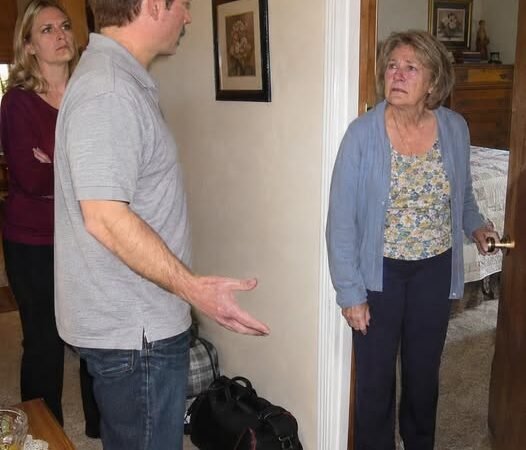
David stood.
“Mom, we’re not trying to steal your house.”
“Then stop talking about it as though it belongs to you.”
I walked out of the dining room before either of them could answer.
I went into the garden and sat on the wooden bench Robert had built.
The roses needed pruning.
I noticed that because it was easier than thinking about what had just happened.
For thirty years, I’d tried to be a good mother.
I’d helped David with homework, driven him to practices, stayed awake when he was sick, and worked extra hours when college tuition came due.
Robert and I had helped him with the down payment on his first apartment.
When he married Sarah, I welcomed her into the family.
I wasn’t perfect.
No parent is.
But I had never imagined that helping my son would eventually mean defending my own front door against him.
That evening, David knocked on my bedroom door.
“Mom?”
I opened it.
He looked tired.
“Can we talk without Sarah?”
I stepped into the hallway.
He lowered his voice.
“She’s upset.”
“I gathered that.”
“She thinks you don’t like her.”
“David, I don’t like the way she’s treating me.”
He sighed.
“She just wants stability.”
“So do I.”
He looked at me.
I continued.
“Your father and I bought this house when interest rates were high and money was tight.
We made repairs ourselves because we couldn’t afford contractors.
We skipped vacations to pay down the mortgage.”
“I know, Mom.”
“No, I don’t think you do.”
His expression hardened.
“That’s not fair.”
“Neither is asking your widowed mother to move into a retirement apartment so you can have a bigger kitchen.”
He looked away.
I waited.
Finally, he said, “We thought maybe you’d want to be closer to people your own age.”
I almost laughed.
“I have friends, David.
I have neighbors.
I have a life.”
He rubbed his forehead.
“Sarah’s been talking about starting a family.
We just thought—”
“You thought you’d need more space.”
He nodded.
“And you thought my house would solve that problem.”
He didn’t deny it.
I felt an unexpected sadness.
I wasn’t angry about the possibility of grandchildren.
I would have loved to become a grandmother.
What hurt was realizing that David had looked at the home where I’d raised him and seen something he could use, rather than something I still needed.
I told him he and Sarah would have to leave at the end of the three weeks.
He looked startled.
“Mom, we haven’t figured everything out yet.”
“Then you’ll have to figure it out.”
“Can’t you give us more time?”
“I already gave you three weeks.”
He stared at me for a moment.
Then he said something I still remember clearly.
“Dad would have wanted you to help us.”
I went cold.
David had rarely mentioned Robert during disagreements.
He knew how much I missed him.
He also knew that invoking his father was one of the few ways he could make me doubt myself.
I took a slow breath.
“Your father would have helped you move your suitcases into the guest room,” I said.
“And then he would have told you to stop taking advantage of your mother.”
David’s face flushed.
He turned and walked away.
I closed the bedroom door.
For the first time since they’d arrived, I cried.
Not because I thought I’d made the wrong decision.
Because I was finally beginning to understand how far apart my son and I had become.
The following morning, I called my attorney.
Her name was Margaret Ellis, and she’d helped Robert and me update our wills several years before he died.
I explained the situation.
She listened without interrupting.
Then she asked a simple question.
“Caroline, whose name is on the deed?”
“Mine.”
“Only yours?”
“Yes.”
“Good.
Have you signed anything giving David or Sarah an ownership interest or any long-term right to occupy the property?”
“No.”
She advised me to put the agreed move-out date in writing and keep a copy.
She also explained that if they refused to leave, I needed to follow the applicable legal process rather than attempt to force them out myself.
I felt better just hearing someone speak plainly.
That afternoon, I wrote a short letter.
It thanked David and Sarah for understanding that their temporary stay would end on the date we’d originally agreed upon.
It stated that no extension had been offered and that I expected them to remove their belongings and return their keys.
I signed it.
I placed a copy in an envelope and handed it to David when he came home.
He read it standing in the kitchen.
“Seriously, Mom?”
“Seriously.”
“You got a lawyer involved?”
“I asked for advice about my property.”
He shook his head.
“This is unbelievable.”
I looked at him.
“What’s unbelievable is that I felt I needed advice about protecting my home from my own family.”
He had no answer.
Sarah did, of course.
She came into the kitchen, read the letter, and announced that I was being vindictive.
She said I was damaging my relationship with my son.
She said families were supposed to support each other.
I let her finish.
Then I said, “Supporting family doesn’t mean surrendering your home.”
For the next few days, Sarah barely spoke to me.
It was the most peaceful the house had been since she’d arrived.
Then, on the second Thursday of their stay, I came home from the grocery store and found a man standing in my driveway with a measuring tape.
He was studying the front of my house.
A clipboard rested against his hip.
I parked and got out.
“Can I help you?”
He smiled.
“Are you Caroline?”
“Yes.”
“I’m here to take some preliminary measurements for the renovation.”
I stared at him.
“What renovation?”
He looked confused.
“The kitchen and primary bathroom.
I spoke with Sarah earlier.”
For a moment, I couldn’t speak.
Then I asked him to wait while I called her.
Sarah answered on the third ring.
“Caroline, I’m in a meeting.”
“There’s a contractor standing in my driveway.”
“Oh, good.
He’s early.”
“Why is he here?”
She sighed.
“We wanted to get an estimate.
If we’re going to make this house work for everybody, the kitchen needs updating.”
I closed my eyes.
“Sarah, you are not renovating my house.”
“It’s just an estimate.”
“You didn’t ask my permission.”
“We were trying to surprise you.”
I looked at the contractor, who was politely pretending not to listen.
“Then consider me surprised.”
I ended the call.
I apologized to the man and explained that no work had been authorized by the homeowner.
He looked embarrassed.
He said he’d been told the family was considering improvements and hadn’t realized there was a disagreement about the property.
I assured him he hadn’t done anything wrong.
After he left, I carried my groceries inside.
My hands were trembling so badly that I dropped a carton of eggs.
Two broke on the kitchen floor.
I stood there looking at the mess, and something inside me finally settled.
I wasn’t going to spend another week arguing about the obvious.
When David came home, I was waiting at the dining room table.
The original house-rules paper sat in front of me.
I’d retrieved it from the trash that first night, smoothed it out, and tucked it into my notebook.
Beside it were the retirement community brochure, the contractor’s business card, and my letter confirming the move-out date.
David stopped in the doorway.
“What’s all this?”
“Sit down.”
He sat.
I pushed the papers toward him.
“Your wife arrived with instructions about how I should run my home.
Then she tried to take my bedroom.
Then the two of you suggested I move out.
Today, she arranged for a contractor to inspect my kitchen and bathroom without asking me.”
David looked at the business card.
“She told me she was getting an estimate.”
“So you knew?”
He hesitated.
“Yes.”
I nodded.
“Then I need you to listen carefully.”
He looked up.
“You and Sarah have until Sunday evening to leave.”
His mouth fell open.
“Sunday?
Mom, that’s two days away.”
“The original three-week agreement would have ended next Friday.
I’m asking you to leave earlier because you continue making decisions about property you don’t own.”
He pushed back his chair.
“You can’t just throw us out!”
I kept my voice calm.
“I’ve spoken with an attorney, David.
I know there are procedures I must follow if you refuse to leave.
I am not going to do anything unlawful.”
He stared at me.
“But I am telling you that I no longer consent to extending your stay.
I want you to make arrangements to go.”
He looked furious.
For a moment, I thought he might shout.
Instead, he said, “I never thought you’d treat your own son this way.”
That sentence hurt.
But I didn’t let it change my answer.
“I never thought my own son would treat me this way either.”
He stood and walked out.
Sarah came home an hour later.
Their argument started almost immediately.
I could hear raised voices through the hallway.
For once, David wasn’t simply agreeing with her.
I heard him say, “We should have asked first.”
Sarah replied, “Your mother is being impossible.”
Then David said something that surprised me.
“Maybe because it’s her house.”
I sat in the living room and stared at my book.
I hadn’t turned a page in twenty minutes.
Late that evening, Sarah knocked on my bedroom door.
I opened it only partway.
She stood in the hallway with her arms crossed.
“I hope you’re happy,” she said.
I didn’t answer.
“David and I are fighting because of you.”
I looked at her.
“Sarah, you and David are responsible for your marriage.
I’m responsible for my home.”
She shook her head.
“You’re choosing a house over your son.”
“No,” I said.
“I’m choosing not to be pushed out of my house.”
Her eyes narrowed.
“You’ll regret this when you need us someday.”
I felt the sting of those words.
There was a time when the possibility of growing older without my son nearby would have frightened me into agreeing to almost anything.
But I thought of Helen next door.
I thought of the friends I’d made through volunteering.
I thought of Margaret, my attorney, and the people who had helped me through the years after Robert died.
I wasn’t as alone as Sarah seemed to think.
“Maybe I will need help someday,” I said.
“But help that comes with threats isn’t the kind I want.”
She stared at me.
Then she walked away.
Saturday was miserable.
David and Sarah packed in silence for most of the morning.
Occasionally, I heard them arguing behind the guest-room door.
I stayed out of their way.
I didn’t celebrate.
I didn’t feel victorious.
I felt tired and sad.
These were people I loved, or had tried to love, and somehow we’d reached a point where I was counting the hours until they left.
On Sunday afternoon, David began carrying boxes to the car.
Sarah didn’t speak to me.
She walked past with her handbag over her shoulder and sat in the passenger seat.
David came back inside for the final suitcase.
He stopped in the entryway.
For a moment, he looked like the little boy who used to stand there with his school backpack, waiting for me to help him find something he’d lost.
“Mom,” he said quietly, “I didn’t think it would turn out like this.”
“Neither did I.”
He swallowed.
“We really did need somewhere to stay.”
“I know.”
“And I thought maybe if we all lived together, it could be good for everyone.”
I looked at him.
“David, you never asked me whether I wanted that.”
He lowered his eyes.
“I guess I didn’t.”
There it was.
Not a complete apology.
Not an explanation for everything.
But the first honest acknowledgment I’d heard from him since he’d arrived.
I stepped closer.
“I love you,” I said.
“That hasn’t changed.”
He nodded.
“But loving you doesn’t mean I have to agree with every decision you make.”
His eyes filled.
“I know.”