Two Hundred Gowns
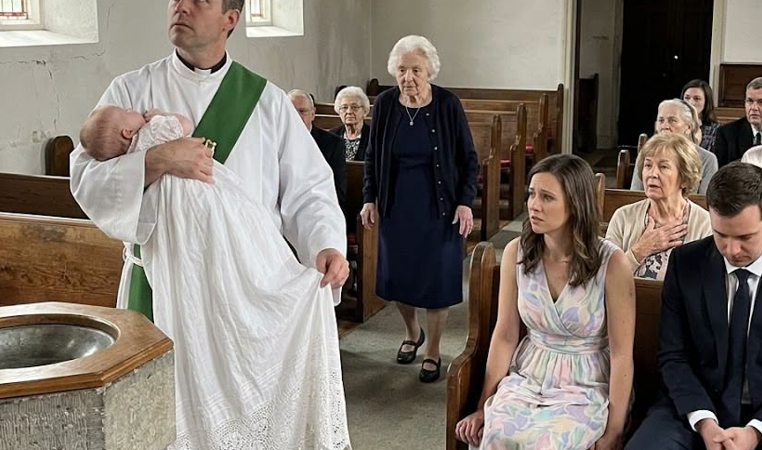
Pastor Anders didn’t hand me the baby right away. He looked at my hands first, the way a person looks at a thing he means to treat carefully, and then he looked at me.
“Barbara,” he said, loud enough for the whole church, “would you hold him?”
“Pastor, I shake.”
“I know. So does the font water when the furnace kicks on. It’s never spilled yet.” A few people laughed, softly, and then stopped, because they weren’t sure they were allowed. “Hold him as long as you like. I’ll keep a hand under.”
He laid my grandson in my arms.
Jessica’s mother said, “Oh,” out loud. And my son, Michael, who had sat through the whole thing with his eyes on the hymnal, stood up in the front pew so fast his knee hit the kneeler.
I should tell you who I am, because for two years my daughter-in-law had a version of me, and it was built around my hands.
My name is Barbara Hollins. I’m seventy-nine. I was a school bus dispatcher in Duluth, Minnesota, for thirty-one years, which is a job that mostly consists of knowing where everyone is and being blamed when they aren’t. My husband, Earl, drove a delivery truck for a bakery and sang bass in the church choir, badly and with total conviction. He died six years ago in March, of a stroke, in the garden, with a trowel in his hand. We buried him from Grace Lutheran, in the snow.
We had one child. Michael is forty-four, a regional manager for a hardware chain, tall, with Earl’s long jaw and a habit of agreeing with the last person who spoke. I love him. I’d like that on the record before I tell you the rest.
The tremor started four years ago. A doctor named Okafor, kind and rumpled, called it essential tremor, and said, “It’s not dangerous, Mrs. Hollins. It’s just rude.” It comes when my hands are resting. Put a crochet hook in them, and they’re steady as a surgeon’s. I’ve made a christening gown for every baby baptized at Grace since 1971, two hundred and eleven of them by my count, and I did the last forty with the tremor.
I never put my name on one. It seemed bragging. I stitched a line inside the hem instead, small, in white thread, where only the person who turned it back would see.
Jessica came into the family six years ago. She is thirty-seven, a pharmaceutical sales rep, polished and quick, with a laugh that turns on like a porch light. Her family is large and close and loud, with a lake cabin and a group chat. I tried. I made her a lap quilt for the wedding. I brought a hotdish to every gathering. I was never quite the right shape for her photographs.
When she announced the pregnancy, I cried in my kitchen. I started the gown that night, from a pattern in my head, in cotton thread so fine it felt like spun air. A row of tiny roses at the neck, the way I’d done for my own Michael in 1981. It took me seven weeks. I finished it in January, and I wrapped it in tissue, and I waited for the right moment to give it.
I never found one. Jessica had her own plans.
The baby was born in August. Samuel Earl, seven pounds, two ounces, with a full head of dark hair and Earl’s chin. I saw him through the nursery glass.
“Nurses said family only, Barbara,” Jessica said, from the doorway of the room, with her arms crossed over her robe.
“I’m his grandmother.”
“Immediate family. They’re strict.”
Her own mother walked past me, into the room, a minute later, with a balloon. Nobody stopped her.
I didn’t argue. I’ve learned, over seventy-nine years, that some doors you can only knock on once.
At Christmas, Michael hosted. I arrived with a tin of cardamom cookies and a small wrapped box, the gown, tissue and ribbon. Samuel was in a bouncer by the tree, fussing. I knelt, stiffly, and held out my arms.
“He’s overtired, Barbara,” said Jessica. “Maybe later.”
Later didn’t come. I watched my grandson pass from lap to lap all afternoon, her sisters’, her mother’s, a cousin’s, and at five o’clock I put on my coat. The box stayed in my purse. Michael walked me to the door.
“She’s just anxious, Mom,” he said. “It’s the tremor. She worries you’ll drop him.”
“Have I ever dropped anything?”
“No.”
“Then what is she worried about?”
He looked at his shoes.
“I’ll talk to her,” he said.
He didn’t. I know the sound of a promise that’s been made to make a door close.
I should tell you about the gown, and why I didn’t just give it to them.
I tried. In February, I mailed it, in a flat box, with a note. For Samuel’s christening, if you’d like it. A week later, the box came back, with a printed label. Return to sender. Jessica had refused delivery, I learned, because she hadn’t recognized the return address.
I don’t think she was being cruel. I think she’d stopped looking at anything with my name on it.
So I did the one thing I could. I took the gown to Pastor Anders’s office, on a Wednesday, and I laid it on his desk.
“I’d like you to have it,” I said. “For the christening. In case they’d like to use it. Or in case they’ve got another.”
He looked at it for a long moment. He’s a quiet man, a pastor from Bemidji, with a beard and a habit of tapping his knuckle on his chin when he’s thinking.
“Barbara,” he said. “Is this one of yours?”
“I don’t know what you mean.”
“I’ve heard about the gowns.” He smiled. “The church secretary told me, my first week. Mrs. Brandt. She said, ‘There’s a woman who’s made every christening gown in this church for fifty years, and not one person has ever thanked her.’”
I felt my face go hot.
“It’s nothing,” I said. “It’s a hobby.”
“It’s two hundred gowns.”
“Two hundred and eleven.”
He laughed, a short, warm, startled laugh, and picked up the tissue paper, and lifted the gown by its shoulders. The cotton fell in a long white fall. The roses at the neck caught the light.
“May I tell you something?” he said. “I baptized my own daughter in one of these. In 2021. Before I even knew who made it.”
I stared at him.
“We were new. We didn’t have a gown. Mrs. Brandt lent us one, from a closet. I turned back the hem, and found a line of stitching. ‘For Hannah. B.H. 2021.’” His eyes were wet. “I’ve been wanting to thank you for four years.”
I couldn’t say a word.
“I’ll make sure it gets there,” he said gently. “I’ll put it in the vestry. If they want it, it’s theirs.”
The Sunday of the christening was bright and cold, in late April, with the last gray snow along the curbs. Grace Lutheran is a small, white, steepled church on a hill, with a red door, a stained glass window of the Good Shepherd, and a bell Earl once rang for forty minutes straight at a wedding because the groom was late.
I arrived at ten-twenty, in my good navy dress, with a cardigan I’d crocheted myself. The front pews were full. Jessica’s mother, a tall, silver-haired woman named Constance, in a pink suit. Her sisters, in matching blue. A knot of cousins in from Minneapolis, with a toddler who shrieked at intervals and was shushed with a cracker.
Michael found me in the vestibule. He was wearing a suit I didn’t recognize, and his tie was crooked.
“Mom.” He wouldn’t meet my eyes. “Jess thinks it’d be better if you sat a few rows back. With the baby and everything. Just so there’s no, you know. Accidents.”
I looked at him.
“Accidents.”
“She’s nervous. It’s a big day.”
“I’m his grandmother, Michael.”
“I know.”
“I made his, I’ve sat in the second pew of this church for fifty-four years.”
“I know, Mom. I’m sorry.”
“All right,” I said.
I’d like to tell you what it cost. It cost nothing, in that moment, because I’d already paid. I turned and walked down the aisle, past the second pew, past the fifth, past the tenth, and sat in the last one, beside the coat rack, in a spot where the light from the red door fell across my knees.
I folded my hands. They shook.
A rustle beside me. A smell of lavender and peppermint.
Mrs. Lindqvist, who is eighty-eight, lowered herself into the pew with a small groan and the aid of a cane. She is tiny, fierce, with a face like a walnut and a hat she’s worn since the Eisenhower administration. She’s buried two husbands from that church. She knows what a last pew means.
She didn’t say a word. She took my right hand in hers, and held it, still, against her lap. Her fingers were cool and dry and also trembling, a little, with age.
“Thank you, Ingrid,” I whispered.
“Hush,” she said. “Sing.”
We sang. A hymn I’d known since I was six. My voice, which has never been good, cracked on the high note, and she squeezed my hand.
When it came time for the baptism, Jessica carried the baby to the font.
I’d like to tell you what I felt, and I can’t, quite. I saw a thin, dark-haired, polished woman in a cream dress, holding a bundle of white. I saw Michael beside her, with his hand on her elbow. I saw Constance, in the front pew, dabbing her eyes with a lace handkerchief.
And I saw the gown.
I could see it from the last pew. The vestry door had opened, and somebody, Pastor Anders, I realized, had laid it into Jessica’s arms with a nod. I’d wondered if she’d use it. I’d braced for her to refuse. Instead, she’d wrapped Samuel in it, and tied the little ribbon at the neck, and stood holding him against her shoulder as if it were hers.
White cotton. Long, to the hem. A row of crocheted lace from the collar all the way down, in the pattern my mother had taught me in 1958. A tiny line of roses at the neck, each one the size of a thumbnail.
My throat closed.
Pastor Anders came down from the chancel. He’s forty, tall, a little awkward in his white robe, with kind eyes and a voice that carries. He opened his arms. Jessica placed Samuel into them.
He looked down at the baby.
He stopped.
I saw it from forty feet away.
He’d been about to begin. He had his mouth open, for the first word of the baptismal rite. But his gaze had fallen on the gown, and something happened to his face. It softened, and then sharpened, and then went very still.
He ran his thumb along one of the little roses.
The congregation shifted. A cough. A rustle of programs. Jessica, beside him, leaned forward, with a smile, and I saw her whisper something.
He didn’t answer.
He looked up.
“I’m sorry,” said Pastor Anders. His voice was quiet, but it filled the church. “Before we go on. Does anyone here know who made this gown?”
A pause. A long one.
Then Jessica laughed, a light, bright, practiced laugh, and said, “Oh, I found it online, Pastor. A little boutique. It was expensive, but I wanted something special.”
I felt Mrs. Lindqvist’s fingers tighten on mine.
Pastor Anders didn’t smile back.
He looked at Jessica. Then, slowly, past her. Past Constance, in her pink suit. Past the blue sisters and the cousins. Past the middle pews and the choir loft and the old oak font.
All the way to the back.
His eyes found mine.
“No, Jessica,” he said gently. “You didn’t.”
The church was very quiet.
I could hear the furnace tick. I could hear a child, somewhere, ask a question and be shushed. I could hear my own heart.
“I know this gown,” Pastor Anders said. He spoke slowly, to the whole congregation, in the calm, clear voice he uses for the Gospel. “I’ve baptized eleven babies in gowns just like it. There’s always a row of roses at the neck. There’s a particular pattern in the lace, a trellis. It’s, I’ve never seen it anywhere else.”
Jessica’s smile had begun to slip.
“And if you turn back the hem,” he said, “there’s something.”
He lifted the long white skirt. He turned the hem, a fold of cotton, with careful fingers. He looked at the inside.
I watched his lips move as he read.
When he spoke, his voice had changed. It was low and thick.
“‘For Earl’s grandson. B.H. 2025.’”
I put my hand over my mouth.
Jessica’s face went white.
“Barbara Hollins,” said Pastor Anders, to the church, “has made a christening gown for every baby baptized at Grace Lutheran since 1971.”
A murmur. A sharp little intake of breath, from an old man in the choir.
“Fifty-four years. Over two hundred gowns. She has never once put her name on the outside of one.” He turned the baby, gently, in his arms. “I only know because Mrs. Brandt, our secretary, told me, my first week here. She said, ‘Pastor, if you ever see a gown that’s perfect, and no one knows who made it, it’s Barbara.’”
Michael had turned in the pew. I saw his face. He was staring at the back of the church, at me, with an expression I’d never seen on him. A kind of dawning, appalled recognition.
“She made one for my own daughter,” said Pastor Anders. “She never said a word.” He took a breath. “Barbara. Would you come up here, please?”
I didn’t move.
I couldn’t. My legs had gone to water. I sat, in the last pew, with my hands in my lap, shaking, and I thought: I can’t. They’ll all look.
Mrs. Lindqvist put her hand against my back.
She pushed.
I walked up the center aisle of Grace Lutheran with my hands shaking.
It’s forty-one steps. I counted. I’d walked it a thousand times, to the Communion rail, to the choir loft, to my husband’s casket. But I’d never walked it with a hundred and forty faces turned toward me, in a hush so complete I could hear my own shoes.
I passed the pews. The cousins, from Minneapolis, who stared. The blue sisters, one of whom, to my astonishment, had tears running down her face. Constance, in her pink suit, with her handkerchief halfway to her mouth, and her eyes, very wide and very bright, fixed on the gown.
I passed my son.
He couldn’t look at me. He’d turned his face toward the floor.
Pastor Anders met me at the font. He stood in his white robe, with the baby in his arms, and the light from the Good Shepherd falling in colored panes across his shoulders.
“Barbara,” he said, quietly, for me alone.
“Pastor.”
“I’m sorry. I’d hoped to do this differently.”
“It’s all right.”
“It isn’t. But I couldn’t let it pass.” He looked at my hands. “May I ask you something?”
“Yes.”
“Would you hold him?”
I’d like to tell you what happened then, and I can only tell you what I remember.
“Pastor,” I said, “I shake.”
“I know.” He said it, and then, with a faint, rueful smile, he added, loud enough for the first six pews, “So does the font water, when the furnace kicks on. It’s never spilled yet.”
A few people laughed, softly. Then they stopped, because they weren’t sure they were allowed.
“Hold him as long as you like,” said Pastor Anders. “I’ll keep a hand under.”
He laid my grandson in my arms.
I’d been waiting nine months. I’d imagined it, in my kitchen, at night, with a hook in my hand. I’d imagined the weight. The warmth. The sweet, milky, sleepy smell. I hadn’t imagined the way he’d turn his face, with a small, wet, startled snuffle, and look straight up at me, with Earl’s eyes.
Dark. Slate-gray. Solemn.
I looked down at him, and my hands, which had shaken for four years, went still.
I don’t know how else to say it. They simply stopped. Pastor Anders’s hand, beneath mine, wasn’t bearing any weight. I held Samuel Earl Hollins against my chest, in a gown I’d made, with a line of stitches in the hem, and my hands were steady as a rock.
“Hello, Sam,” I whispered.
He yawned.
I heard a sound. A small, wounded, choked sound, from the front pew. Constance, with her handkerchief crushed against her mouth, said, out loud, in a cracked voice, “Oh.”
And my son stood up.
He rose so fast his knee struck the kneeler with a crack. He stood in the aisle, in his unfamiliar suit, with his tie crooked and his face gray, and for a moment I thought he might speak.
He didn’t. He walked.
Down the aisle, past the front pew, across the chancel steps, to the font. He stopped in front of me. He was shaking, I saw. A big, tall, broad man of forty-four, with Earl’s jaw, shaking like a boy.
“Mom,” he said.
His voice cracked on it.
“Michael.”
“I’m so sorry.”
I didn’t answer.
“I’m so, I didn’t, I should have said something.” His eyes were streaming. “At the hospital. At Christmas. I should have said, ‘She’s my mother.’ I let Jess, I let it, I told myself it was easier.”
“It was.”
“It wasn’t.”
“No,” I said. “It never is.”
He put his hands over his face. A sob came out of him, thick and ugly, the sound of a man who hasn’t wept in years. In the front pew, Jessica had risen. She stood with her hand pressed to her mouth, white to the lips, with tears running down.
“Michael,” I said. “Look at me.”
He did.
“I’m not angry,” I said.
“You should be.”
“I was. For a while.” I shifted the baby gently against my shoulder. “I’m just tired. I’m so tired of being a hazard.”
He flinched.
“I held you, you know,” I said. “When you were six hours old. I was shaking then, too. I was twenty-nine. I’d never held anything so small.”
“Mom.”
“I didn’t drop you.”
He laughed. It broke in the middle, and became something else, and he put his arms around both of us, me and the baby, in the middle of the chancel, in front of a hundred and forty people, and wept into my shoulder.
I’d like to tell you the service continued smoothly.
It didn’t. For a long moment, nobody moved. Pastor Anders stood back, a little pale, with his hand pressed to his chest. Constance was crying openly. A man in the third pew, a retired plumber named Walt, had stood, and removed his hat, and was holding it against his heart.
Jessica came forward.
She walked slowly, with her hand on the end of each pew, as if she were walking on ice. Her face was blotched and swollen. Her mascara had run. She stopped a yard from me, and for a long time she didn’t speak.
“Barbara,” she said, finally.
“Jessica.”
“I told a lie.”
“You did.”
“I said I’d bought it.” Her voice was a thread. “I, when I opened the box, in the vestry. Pastor Anders put it in my hands. He said, ‘Someone made this for Samuel.’ And I looked at the stitches, and I knew.”
“You knew.”
“I knew it was yours.” She wiped her face with the heel of her hand. “I’ve been, for two years, I’ve seen you crocheting, at every, at every family dinner, with the, with the little hook. I knew. I just, I didn’t want to.”
“Why not?”
She closed her eyes.
“Because it was so much better than anything I could have bought,” she said.
I didn’t answer. I looked at her. She was very young, I thought. Thirty-seven, and entirely, miserably honest.
“I didn’t want you to be good at something,” said Jessica, “that I couldn’t be.”
I’d expected rage. Or triumph. I’d had two years to prepare for one or the other.
I felt neither. What I felt, standing in the chancel with a warm weight against my chest, was a strange, soft, immense tiredness, like the end of a very long day.
“Jessica,” I said. “Come here.”
She hesitated.
“I won’t bite.”
She came. She stood beside me, small and shaking, in her cream dress, and I shifted the baby, carefully, with my steady hands, so that his head lay in the crook of my left arm.
“Hold out your arm,” I said.
She did. I laid his hand, a tiny, crumpled, dimpled thing, against her palm. His fingers curled around her thumb.
“There,” I said. “That’s how.”
Her face crumpled.
“I’m so sorry,” she whispered. “I’m so sorry, Barbara. I was scared.”
“Of what?”
“That you’d, that you’d love him more than me.”
“I couldn’t.”
“You could.”
“I couldn’t,” I said. “He’s yours. I’m just the one who knits.”
She laughed, a wet, helpless, hiccuping sound. She put her free arm around my shoulders, awkwardly, stiffly, a girl who’d never learned how.
“I’ll learn,” she said. “I’ll learn it all. The, the hook. The roses.”
“I’d like that.”
“Will you teach me?”
“It takes years.”
“I’ve got years.”
I looked at her. At this tall, polished, frightened girl, with the baby between us.
“Then I’ve got time,” I said.
Pastor Anders cleared his throat.
He’d been standing at a delicate distance, with the baptismal shell in his hand and a faintly stunned expression. He looked from one of us to the other.
“I think,” he said gently, “that this might be a good time to continue.”
A ripple of laughter, shaky and warm, ran through the pews.
“Barbara,” he said. “Would you do me the honor of standing with the family?”
I looked at Michael. He wiped his eyes. He nodded.
“I’d like that,” I said.
So I stood. At the font, between my son and his wife, with a baby in my arms, in a gown I’d made. And Pastor Anders, in his clear, steady voice, with the light falling in blue and gold across the stone, poured water over my grandson’s head, three times, and said the words.
“Samuel Earl Hollins, I baptize you in the name of the Father, and of the Son, and of the Holy Spirit.”
Samuel woke up, and screamed.
It was a great, outraged, indignant scream, the kind that rattles windows. The whole church burst into laughter. Pastor Anders, grinning, wiped his eyes, and from the last pew, I heard a thin, cracked, delighted cackle that could only be Mrs. Lindqvist.
I held my grandson against my shoulder, and rubbed his back. And my hands, which have shaken for four years, were as still as stone.
I’ll tell you what happened afterward.
It wasn’t a miracle. I want to be honest. The tremor came back that afternoon, in the church basement, over a plate of ham sandwiches. It always does. Dr. Okafor says it’s rest. When I’m holding something, a baby, a hook, a cup of coffee, it eases. It’s why I make things.
But something else changed. It changed slowly, over months, the way a river changes a bank.
Jessica called on the Monday. She asked if she could come over. She arrived in jeans and a gray sweatshirt, with no makeup, carrying Samuel in a sling, and stood on my front step, and said, “I brought a hook.”
It was a bright green plastic hook, size H, from a craft store. She’d bought a ball of yarn, too, a lumpy, bright orange acrylic that made me wince.
“I don’t know what I’m doing,” she said.
“Nobody does.”
“I watched a video. It was a disaster.”
“Come in.”
We sat at my kitchen table, with a pot of tea and a plate of cardamom cookies. The baby slept on a quilt on the floor. I showed her the slip knot. She did it wrong. I showed her again. She did it wrong again.
“I’m terrible at this,” she said.
“You’re doing fine.”
“I’m not.”
“Jessica.” I took her hand, her smooth, young, restless hand, and folded it around the hook. “You can’t rush it. You hold it like a pencil. You let the thread do the work.”
“That’s what my mother said about, about everything.”
“She’s right.”
“She’s right about a lot,” said Jessica, ruefully.
We worked for three hours. By the end, she’d made a lopsided orange chain, eleven stitches long, which she held up with enormous pride.
“It’s the ugliest thing I’ve ever seen,” she said.
“It’s wonderful.”
“It looks like a worm.”
“It’s your first,” I said. “Mine looked like a boot.”
She laughed. A real, loud, startled laugh. She put down the hook and wiped her eyes.
“Barbara,” she said. “May I ask you something?”
“Of course.”
“Why didn’t you ever say anything? About the hospital. About the, about holding him.”
I thought about it.
“I thought if I fought,” I said, “you’d have a reason.”
She was quiet.
“A reason not to let me in,” I said. “I thought if I stayed quiet, you’d come around. I thought patience was the same as love.”
“It isn’t.”
“No. I think a little fighting is how you say, ‘I matter.’”
She nodded slowly.
“I should have said it,” I said. “At the door. ‘Jessica, I’m his grandmother.’ I should have said it plainly.”
“I’d like you to say it now.”
“I’m his grandmother.”
“And I’m his mother.”
“And?”
“And we’re both on his side.”
I smiled.
“That’s the best thing you’ve said all week,” I said.
I’ll tell you about the gowns.
After the christening, the story went around the church the way stories do. By Wednesday, I’d had four phone calls. By Friday, a stack of cards. By the following Sunday, as I came up the walk to the red door, a line of people had formed in the vestibule, waiting.
They were women, mostly. Some old, some young. A girl of sixteen, in braces, whom I’d taught in Sunday school. A woman of fifty, a nurse, who’d been baptized in a gown I’d made in 1974.
“Mrs. Hollins,” she said. She was crying. “I still have it. In a box. I wore it, I mean, I was baptized in it. And so were my daughters.”
“It wasn’t the same one.”
“No, but they were all yours.” She took my hands, shaking, in her own. “Every one. I never knew. I thought it was a church thing. I thought they came from a closet.”
“They came from my kitchen.”
“I know that now.”
She hugged me. Then the girl in braces hugged me. Then a man, a big, gruff, white-haired man in a Carhartt jacket, whom I’d known for forty years, stood in front of me with his cap in his hands.
“Barbara,” he said. “My wife made me come. She’s in the hospital. But she said, she said, ‘You tell Barbara Hollins she made our Danny’s gown.’” His voice cracked. “He died, in 2009. He was twenty-two. We buried him in it.”
I put my hand over my mouth.
“We kept it,” said the man. “We never told you. We thought you’d, we didn’t want you to know he’d gone.”
I took his big, rough, shaking hand. I held it, and I could feel, through his palm, the tremor of his grief. It matched my own.
“Thank you,” I said. “For telling me.”
We stood there a long time, in the vestibule, in the colored light, with the coat rack and the red door. Behind us, a line of people waited, with cards and flowers and small, awkward, immense things to say.
I’d made two hundred and eleven gowns.
I hadn’t known, until that morning, that I’d made two hundred and eleven doors.
The church held an event in June.
They called it, over my objection, A Celebration of the Christening Gowns. It was in the fellowship hall, on a Saturday, with folding tables and paper streamers and a long white-clothed table down the middle. Mrs. Brandt, the secretary, a tiny, brisk, silver-haired woman in a flowered dress, had spent two months gathering them.
She’d put out a call, in the bulletin. If you have a Barbara Hollins gown, bring it.
They came. Fifty-four years of them. Wrapped in tissue, in boxes, in hat bags, in a pillowcase. Women carried them in their arms like infants. Men, shy, awkward, brought them in grocery sacks. One came in a cardboard tube.
By noon, the long table was covered.
Sixty-three gowns. I stood in front of it, in my good navy dress, and looked.
I’d never seen them together. In my kitchen, over fifty years, I’d made each one alone, in the lamplight, with a ball of white thread and a hook. I’d never once imagined them side by side. A river of white. A field of snow. Each different, each with its little row of roses, each with its own trellis, its own patient mathematics.
I touched one. 1974. The thread had yellowed, a little, to the color of cream.
“Mrs. Hollins.” A small hand tugged my sleeve.
A girl of about nine, in a green dress, with a missing front tooth. I knew her. Ava Brandt, the secretary’s granddaughter.
“Yes, dear?”
“Which one’s mine?”
I looked at her. I looked at the table. I thought.
“Nineteen ninety-seven,” I said.
She frowned, working it out. “I was born in 2016.”
“Ah. Then it’s a different one. Wait a moment.”
I walked down the table. I looked at each. There. At the far end, a small, simple, perfect gown, with a short skirt and a single row of roses.
“This,” I said. “2016.”
She took it. She held it against her chest, carefully, with both hands.
“Can I turn the hem?”
“Of course.”
She did. She found the stitches. She read them aloud, in a slow, careful, wondering voice.
“‘For Ava. B.H. 2016.’”
She looked up at me. She was beaming.
“You made this?”
“I did.”
“By yourself?”
“With a hook.”
“That’s the coolest thing I ever heard.”
I laughed. I laughed until I had to wipe my eyes.
It’s been a year.
Samuel is walking now. He’s a stout, solemn, curly-haired child, with Earl’s gray eyes and a habit of staring at strangers until they confess. He calls me “Ba-ba.” Jessica says it’s Barbara. Michael insists it’s “bubbe,” from a Yiddish grandmother he’s never had. I don’t care. I answer to both.
I see him every Wednesday. I take the bus to their house, a ten-minute ride, and let myself in with a key Jessica pressed into my hand at Easter. She’s often at work. The baby and I sit on the living room rug, and I make a chain of yarn, and he crawls after it, and we are both, I think, entirely content.
Jessica has made six rows of a scarf. It’s orange, and wobbly, and she knows it. She comes on Thursdays, after work, and sits beside me at the table, and swears at her hook. Last week, she finished a small square, no bigger than a coaster.
“It’s for you,” she said.
“It’s crooked.”
“I know.”
“It’s the best thing I’ve ever been given.”
“Don’t lie.”
“I’m not,” I said. And I wasn’t.
I keep it on my refrigerator, under a magnet shaped like a pie.
Michael comes on Sundays. He sits beside me, in the second pew. I’d forgotten how it felt, the warmth of him, the creak of his shoes. He sings, now. He’s not good. He sings like his father, with total conviction, a cracked, flat, joyful bass. When the hymn is over, he squeezes my hand.
The tremor’s still there. It always will be. Dr. Okafor says it’s progressive, slowly. One day, he says, I may not be able to hold a hook.
I’ve thought about that. I think about it in the evenings, in my kitchen, with the lamp on and a ball of white thread in my lap.
I’ve decided something.
I’ve taught fourteen women, so far. Jessica, and her sisters, and a girl from the youth group, and a retired schoolteacher named Marguerite, who’s eighty-one, and has a tremor of her own. We meet in the fellowship hall, on Tuesdays, over tea. We call ourselves, over my protest, the Hollins Circle. They make the gowns now. I stand behind them, with my hands in my lap, shaking, and say, “Gently. You don’t pull. You let the thread do the work.”
They’re getting good.
In November, we made forty. For the hospital. For babies whose parents can’t afford a gown. We stitched, inside each hem, a small white line. Not my initials. Theirs.
B.H. was the first.
I don’t mind that it’s gone.
I think about the last pew, sometimes.
It’s still there, by the coat rack, with a worn cushion and a hymnal tucked into the rack. Nobody sits in it now. Or rather, everybody does, in rotation. Mrs. Lindqvist, who’s ninety, and uses a walker. A young father, with a fussy infant. A teenager, late, in a hooded sweatshirt.
I sat there last Sunday, for old times’ sake.
The light from the red door fell across my knees. I folded my hands. They shook.
Mrs. Lindqvist lowered herself in beside me, with a groan and a clatter. She took my right hand in hers, as she had on a bright cold morning in April, and held it, still, against her lap.
“Ingrid,” I whispered. “I’ve never thanked you.”
“For what?”
“For pushing.”
She snorted. She stared straight ahead, at the altar, with her chin up and her hat at a rakish angle.
“You’d have sat there till Judgment,” she said.
“I might have.”
“You’re a stubborn woman, Barbara.”
“I’ve been told.”
“It’s what made the gowns.”
I laughed. The organ began, soft and low. Pastor Anders came down the aisle in his white robe, with Samuel on his hip, and a grin, and a pair of tiny, bright, wriggling feet.
He’d come to hand the child to his mother. But he stopped, at the last pew, and looked at me.
“Barbara,” he said. “Would you hold him a moment?”
I held out my arms.
He laid Samuel in them. The baby squirmed, and burbled, and grabbed my little finger, hard, with his whole fist.
And my hands, which have shaken for five years, which will shake until I die, grew quiet.
I looked down. I looked at the small, round, solemn face, with its gray eyes and its fierce, determined grip.
This, I thought. This is the thing it was for.
Beside me, Mrs. Lindqvist said, softly, so that only I could hear:
“There.”
“Yes,” I said.
“That’s how.”
And I held him, in the last pew of Grace Lutheran, in the colored light, while the congregation rose around us, and began, in one great, ragged, loving voice, to sing.