Certificate 0071
“Mrs. Rooker,” said the board secretary, laying the two pages side by side on the long walnut table, “would you be kind enough to tell us who told you this document was signed in March?”
Nobody in that boardroom breathed. Through the tall windows behind the board, the red rock of Sedona glowed in the morning sun, the same cliffs I’d watched from Casita 12 for thirty years. Denise’s mouth opened, and closed again.
I should tell you who I am, because for three Christmases my children had a version of me, and it was convenient.
My name is Roberta Chalmers. I’m seventy. For thirty-one years I was the registrar at a state university in Tempe, Arizona, which means I spent my working life deciding whether a signature was real, whether a date was true, and whether a record said what someone claimed it said. I was very good at it. I am, I’ve learned, the worst possible person to forge anything in front of.
My husband, Warren, was a heavy-equipment mechanic with grease in the creases of his hands and a habit of whistling “Moon River” off-key. He died eight years ago in February, of a heart attack, under a backhoe, which is the way he’d have chosen. We had two children. Denise is forty-six, a hospital administrator, sleek and quick, married to a man named Craig Rooker who sells commercial insurance. Kurt is forty-three, a general contractor, big and sunburned, married to Tamsin, a dental hygienist. Between them, four grandchildren, whom I adore.
I tell you that so you’ll know what the next part cost.
Warren and I bought into Juniper Mesa Club in 1994.
It was a founding membership, certificate number 0071, a share in a modest, adobe-style resort outside Sedona with twenty-two casitas, a spring-fed pool, and a view of Cathedral Rock that makes strangers go quiet. The certificate cost $8,000. We didn’t have it. Warren sold his work truck, a 1988 Ford he loved, to a man in Mesa for $6,500, and we borrowed the rest from his brother.
“Rob,” he told me, standing in the club office with the paperwork, “we’ll never regret it.”
The certificate carried a permanent Christmas reservation privilege, December 19th through the 26th, in the casita of our choice, subject to the club’s membership rules. We chose Casita 12. It sleeps eight. It has a kiva fireplace, a deep red tile floor, and a window seat where Denise, at eleven, read all of Little Women in a single December.
For nearly thirty years, it was our Christmas. Pecan pie. A tree Warren cut himself from the national forest with a permit and a hatchet. Kurt, at nine, leaving cookies on the windowsill and writing a note to Santa that said, in careful block letters, PLEASE FIND US HERE.
After Warren died, I kept it going. I think I needed it more than they did.
The first Christmas, Denise called in early November.
“Mom, I wanted to tell you early. It’s complicated this year.”
“What’s complicated?”
“Casita 12 sleeps eight. We have four. Kurt’s family has four. So there’s no, I mean, it just doesn’t work. For everybody.”
“I can rent another unit. I’d be happy to.”
“They’re all booked.”
“I’ll check.”
“Mom.” A small sigh. “Next Christmas. Definitely.”
I believed her. I’d like that on the record. I’d spent thirty-one years believing paperwork, and a daughter’s voice, to me, was a kind of document.
I spent that Christmas at home, in Tempe, with a ham I couldn’t finish. On the twenty-fifth, scrolling through my phone, I found a photograph my granddaughter, Madison, had posted. The living room of Casita 12. The kiva fireplace. A garland of juniper. Nine people on the sofa, in matching pajamas.
Nine.
I counted twice. Denise had invited a friend from Scottsdale, and her husband, and their child.
I put the phone face-down on the counter. I told myself it was a kindness. They’d asked, I told myself, because the friend had nowhere to go.
The second Christmas, nobody called at all.
I learned about it from another photograph. Our fireplace. Our wreath. And above the mantel, on a small carved wooden plaque Warren had made in 1996, in letters burned with a soldering iron, the name.
CHALMERS.
Under it, my four grandchildren, squinting into the camera, with their arms around each other.
I sat in my kitchen and looked at it for a long while. I thought of Warren, bent over a scrap of oak with a hot iron, saying, Rob, hold it steady.
I spent that Christmas alone. I didn’t cry. I made a pot of soup. I watched an old movie and fell asleep in my chair.
The third Christmas, last December, Denise called while planning.
I’d been waiting. I’d decided, over a year, to be generous. I’d bought a new recipe card box, in case. I’d made a list. Pecan pie. Wrapping paper. Kurt’s favorite bourbon.
“Hello, honey.”
“Hi, Mom. I’m in a hurry. I’m just doing logistics.”
“Should I bring my pecan pie?” I asked.
A pause.
It was a very short one. A half second. But I’ve spent my life reading small gaps in paperwork, and I knew the shape of that silence.
“Mom,” said Denise. “It’s just easier without you there.”
In the background, I heard a sound. A low, easy, masculine chuckle. Kurt.
Not loud. Just enough.
I stood in my kitchen, holding a wooden spoon. I looked at the window, at the bare tangle of the jacaranda, at a sparrow on the fence.
“All right,” I said.
She hung up. I stood there a long time.
I’d like to tell you what I felt. It wasn’t anger. Anger is hot, and I was cold. It was the feeling of an old archivist opening a box, and finding the wrong date on the label.
Easier without you.
I wrote it down. On a yellow pad, in block letters, with the time. 4:12 p.m., December 3rd. It’s a habit.
I’d like to tell you about the card.
It arrived in January, in a plain white envelope, with a Sedona postmark. The return address was a P.O. box. I opened it standing at my kitchen counter.
Inside lay a sympathy card, cream-colored, with a watercolor of a dove. The message, handwritten, in a shaky blue-ink script:
Dear Roberta,
We were so sorry to hear you’ve moved into Sonoran Trails. You’re in our prayers. If there’s anything the founding members can do, please don’t hesitate. With love, Dot Pruitt, Certificate 0044.
I read it three times.
Dot Pruitt was eighty-four, a founding member, a retired schoolteacher with a laugh like a cracked bell. She’d shared a Christmas Eve sherry with Warren and me for twenty years. I’d never once heard her make a mistake.
Sonoran Trails?
I took out my phone. I typed the name. A moment later, the screen filled with a photograph of a low, tan, tasteful building, with a courtyard and a bird fountain and a sign. Sonoran Trails Memory Care Community. Compassionate Living for Those with Alzheimer’s and Dementia.
I put the phone down, very gently.
I’d never lived there. I’d never visited. I was seventy, and I still drove, and balanced my own checkbook, and lived in the same brick ranch in Tempe I’d owned since 1991. I had a library card and a standing hair appointment and a very bad temper about parking.
Why did Dot Pruitt think I’d been moved into a memory-care home?
I’d like you to understand that I didn’t panic. I’m a registrar. When a story contradicts the paperwork, I don’t ask who’s lying. I ask where the record went wrong.
I called Dot that night.
She picked up on the fifth ring, with her usual crackle. “Roberta! Oh, my dear. I didn’t think you’d, are you well?”
“Dot, I’m fine. I’m at home. I never moved.”
A pause.
“But Denise said.”
“Said what?”
“At the annual meeting, in October. She spoke very kindly. She said you’d had a, a decline. That you’d been placed. She asked us to keep you in our thoughts.” A rustle. “She cried, Roberta. I held her hand.”
I closed my eyes.
“What else did she say?”
“That she was taking over the membership. For your care. She had a form. The board was very sympathetic.”
I didn’t speak.
“Roberta?” said Dot. “Is something wrong?”
“Dot,” I said. “I’d like to ask you a favor. And I’d like you to keep it between us.”
“Of course.”
“Don’t tell Denise I called.”
The annual report arrived in July.
It was a thick, glossy, spiral-bound thing, with a photograph of Cathedral Rock on the cover and a letter from the board president. I’d received one every year since 1994. I always read it, front to back, with a pencil, because I’m that kind of person.
On page nine, under Membership Changes, I found a table.
Cert. No. | Original Holder | Status | Notes.
And there, in neat sans-serif type, in the middle of a list of deceased members and resignations:
0071 | R. Chalmers | Transfer pending | Member residing in care facility, unable to administer membership. Proposed transferee: D. Rooker (daughter).
Beneath it, a footnote, in smaller type.
“It is easier for the family to administer without her.”
My hands went cold.
I read the sentence four times. The final one wasn’t part of any form. It wasn’t boilerplate. Somebody, a board member, a secretary, had typed it from a document. It was a quotation. And the words were, to the letter, my daughter’s.
Easier without you.
I put the report on the table. I stood in my kitchen, in the late afternoon heat, with the air conditioner humming, and I understood something.
It hadn’t been a slip. It hadn’t been a careless, cruel remark, made in a hurry, over a bad phone line. It had been, in some small, awful way, a plan.
I requested the documents the next morning.
I wrote a formal letter, on my own letterhead, to the club’s membership secretary, a woman named Priya Venkataraman. I cited the bylaws, which entitle any member to inspect records concerning their own certificate. I asked for every document connected to the transfer application.
She called me within the hour. Her voice was warm and a little nervous.
“Mrs. Chalmers. I’d like to say, first, that we’ve all been so, we had no idea.”
“No idea of what?”
“That you weren’t, I mean, that it wasn’t accurate.” She cleared her throat. “We were told you were in a care facility. We were shown a letter from a physician.”
“What physician?”
“A Dr. Aldous Brandt. In Scottsdale.”
“I’ve never heard of him.”
“I see.” A pause. “May I suggest you come in person? There are three boxes.”
I drove up on a Tuesday in August, a hundred and eight degrees in Tempe, ninety-four in Sedona, with the cliffs glowing like coals. The club office was in a long, low, adobe building by the entrance. A small, cool room with a green ceiling fan and a smell of cedar and old paper.
Priya Venkataraman, forty, round, dark-eyed, in a green blouse, met me at the door. She’d laid out three archive boxes on a conference table, with a pot of tea and a plate of shortbread.
“Take as long as you need,” she said.
I took four hours.
I’ll tell you how I read them, because I’d like you to see how a registrar does it.
I start with the cover sheet. Then the dates. Then the signatures. Then the dates again. I read every page twice, once for what it says, once for what it doesn’t. I use a pencil, a small ruler, and a magnifying glass I carry in my purse for the purpose.
Box one held correspondence. Letters from Denise, on her hospital’s stationery, in a smooth, caring, administrative voice. My mother’s condition has progressed. We feel it’s in her best interest. We’d be grateful for the board’s discretion. A letter from Dr. Brandt, one page, on a letterhead I didn’t recognize, saying only that I was “no longer capable of managing complex financial affairs.”
I looked at the letterhead for a long time. The address was a mailbox store in Scottsdale.
Box two held the application. A twelve-page packet, with a cover sheet, a statement of reasons, a certificate of competence, a list of attachments. It was neatly assembled, with a tab for each section. At the back, in a clear plastic sleeve, was the signature page.
I took it out. I laid it on the table.
Transferor: Roberta M. Chalmers. Beneath it, a signature.
My signature.
I looked at it for a long moment. It was mine. The tight, upright, slightly backward-leaning script I’d practiced at fourteen and never changed. The looped R. The long tail on the s. I’d have sworn to it in court.
But something was wrong.
It took me twenty minutes to find it.
The date. At the bottom of the page, in the small box labeled Date Signed, someone had written, in blue ink, October 2, 2023.
I looked up. I looked at the cover sheet of the application, which sat to my left, in a neat stack.
Application revised: March 14, 2025.
I laid one beside the other.
The application had been drafted, and revised, in March of 2025. The signature page was dated October of 2023. Seventeen months earlier.
I sat very still.
A signature can’t predate the document it authorizes. It’s the first thing a registrar learns. You can’t sign a transcript before the grade is entered.
I turned the signature page over. On the back, in the lower right corner, in tiny gray type, was a document number. CJ-2023-1002-07.
I knew that number.
I’d seen it before. I couldn’t think where. I took out my phone, and my own file, a folder I’d brought, with every club document I’d ever received. I went through them, one by one, with a thumb. In the third from the bottom, I found it.
Juniper Mesa Club. Roof Assessment and Repair Agreement. Document CJ-2023-1002-07. Signed by member R. Chalmers, October 2, 2023.
I stared at it.
I remembered. A man with a clipboard, two Octobers ago, who’d come about the casita roofs. A simple one-page agreement permitting an engineer to inspect the roof of Casita 12 for hail damage. I’d signed it on the porch, with a pen from his pocket. A single signature page. Nothing else.
Somebody had taken that page, the signature, the date, the document number, and attached it, with a staple, to a transfer application drafted two years later.
I put my hands on the table.
I’d like to tell you what I felt, and it wasn’t what you’d expect. It wasn’t betrayal. That would come later, in the car, at a red light, in a flood. At the table, in that cool green room, I felt the odd, exact, almost happy click of a thing falling into place.
I know where the record went wrong.
I took a photograph of the page. I took one of the back. I took one of the cover sheet, with its date. I laid the three side by side, and photographed them again.
“Priya,” I said.
She’d been sitting at the far end of the table, with her hands folded. She rose.
“Yes?”
“I’d like to see the intake ledger for October of 2023.”
She hesitated. Then she nodded, and left the room, and returned, three minutes later, with a green clothbound book. A big, flat, official-looking ledger, with a cracked spine. She laid it before me.
I opened it to October. A column of dates, a column of names, a column of document numbers. I ran my finger down the page.
10/2/23. CJ-2023-1002-07. Chalmers, R. Roof assessment. Scanned. Filed.
I read the entry. Then I read the notes, in the right-hand margin, in a hand I knew was Priya’s predecessor’s.
Single-page signature. Member signed on casita porch. Witnessed: M. Alvarado, engineer.
I looked up.
“It’s the same document,” I said.
Priya had gone very pale.
“I’d like to ask a question,” I said. “Have you ever seen a signature page without its accompanying agreement?”
“No.”
“Neither have I.”
I took a breath.
“I’d like to speak to your attorney,” I said.
I hired my own the same afternoon.
Her name was Imani Okonkwo. She was fifty, a short, brisk, silver-haired woman with reading glasses on a chain and an office in Phoenix with a view of a parking structure. I’d found her through a retired colleague, who said, “If you want somebody who reads every page, call Imani.”
I laid out the three photographs. She studied them for ten minutes without a word.
Then she took off her glasses.
“Mrs. Chalmers,” she said. “Do you know what this is?”
“I believe it’s a misappropriated signature.”
“It’s a great deal more than that.” She tapped the page. “The club’s bylaws, Section 14, require a physician’s certificate of incapacity for any involuntary transfer. They’ve got one. From a Dr. Brandt, in Scottsdale. But, Mrs. Chalmers.” She slid a document across the desk. “I looked him up.”
It was a printout from the Arizona Medical Board.
Aldous R. Brandt, M.D. License status: Revoked. 2019.
I read it twice.
“He lost his license for writing false certificates,” said Imani. “In 2019. He’s been working out of a mailbox ever since, selling letters to anyone who’ll pay.”
I put my hand over my mouth.
“I’d like to propose a course of action,” she said. “And I’d like you to hear it all.”
I nodded.
“We don’t accuse. Not yet. We notify the club’s board, in writing, that the application contains an irregularity. We let them suspend the transfer, pending a hearing. We bring our documents. We let the facts speak.”
“And my children?”
She looked at me for a long moment.
“Mrs. Chalmers,” she said gently. “Do you know whether they signed the application?”
“Denise did.”
“Did she attach the signature page?”
“I don’t know.”
“Then that’s what we’ll ask.”
The board suspended the transfer within a week.
I received the notice by registered mail, a single page on cream stationery. In light of certain irregularities, the Board of Directors has suspended the pending transfer of certificate 0071, and has scheduled a formal hearing at the Board’s earliest convenience. The member’s privileges remain in full effect.
I read it standing on my front porch, in the white morning light, with a cup of coffee going cold.
In full effect.
I went inside. I sat at my desk. I opened my laptop. And I did the one thing, I think, that my children hadn’t expected.
I booked Christmas.
Casita 12. December 19th through the 26th. One occupant. Roberta M. Chalmers, Certificate 0071.
The confirmation arrived by email, in a cheerful red banner. We look forward to welcoming you!
I also did one more thing. In my files, I found the authorization form I’d signed, in 2012, allowing Denise and Kurt to reserve under my membership. A simple, one-page permission. I sent a letter to Priya. I hereby revoke all prior authorizations permitting any person other than myself to make reservations under certificate 0071.
I mailed it certified.
I didn’t tell my children.
I’d like to say I hadn’t a motive. But I’d be lying. I wanted them to arrive at the front desk.
I drove up on the nineteenth.
It was a clear, cold, brilliant day. A light dusting of snow lay on the red rock. The air smelled of juniper and woodsmoke and cold stone. I parked in the old gravel lot, beside a pickup with a Christmas tree strapped to its roof, and stood for a long moment, with my hand on the car door, looking at the casitas.
Twenty-two low, adobe buildings, in a loose horseshoe, with tile roofs and corner fireplaces. Strings of white lights along every eave. Wreaths on every door. And at the end of the path, beside a small stone wall, with a tin lantern on the porch, Casita 12.
I walked down the path. My boots crunched on the gravel.
The door was a deep, weathered turquoise. I’d have known it in the dark. I took out my key, a brass key on a tag that said 12, and put it in the lock, and turned it. It slid with the same small, familiar click.
I stepped inside.
I’d like to describe it, because I hadn’t seen it in three years.
The kiva fireplace, round and white, in the corner, with a stack of split piñon waiting. The red tile floor, polished by decades of bare feet. The big beamed ceiling, the viga poles dark with age. The window seat, with its faded Navajo blanket. A long wooden table, where we’d eaten a hundred meals.
And above the mantel, on a carved plaque, one word.
CHALMERS.
I stood a long time in the doorway, with my suitcase in one hand.
Somebody had cleaned it. The room was spotless, and smelled of lemon oil and cedar. Somebody had left a basket on the table, a welcome basket, with a bottle of local wine, a bag of pecans, and a card.
Welcome home, Mrs. Chalmers. —The staff.
I set the suitcase down.
I took off my coat. I lit the fire. It took me three matches, and a good deal of swearing, and then it caught, a small, bright, crackling flame, and the room filled with the sharp sweet smell of burning piñon.
I sat down in Warren’s chair, the old leather armchair by the hearth. I put my feet on the footstool.
For a long time, I didn’t move.
I’d like to tell you what I thought. I thought about a man who’d sold his truck. I thought about a girl of eleven, reading Little Women on a window seat. I thought about a note on a windowsill. PLEASE FIND US HERE.
I let myself cry then, a little, with my hand against my mouth. A short, efficient grief, like a flash fire. When it ended, I blew my nose, and poured a glass of wine, and sat in the firelight.
Well, Warren, I thought. Here we are.
I spent four days in perfect peace.
I’m not ashamed to say it. I woke at seven, every morning, to the sound of a raven on the roof. I made coffee in the little kitchen. I walked the long red trail behind the casitas, with a thermos and a pair of binoculars, and watched a pair of canyon wrens flit among the rocks. I read a paperback mystery by the fire. I ate a bowl of green chile stew in the lodge, alone, at a table by the window, and a waiter named Dominic, a gentle, bearded young man, refilled my water without a word.
I spoke to Dot Pruitt, who’d arrived on the twentieth, with a walker and a thermos of sherry. She sat beside me in the lobby, and took my hand, and said, “Roberta, I’m so sorry.”
“For what?”
“For believing it.”
“It wasn’t your fault.”
“I held her hand.” Her voice shook. “I held your daughter’s hand, and I prayed for you.”
“Then you did something kind.”
“I did something foolish.”
“Dot.” I squeezed her fingers. “You were told a story. That’s all.”
She wept a little. I let her.
On the evening of the twenty-second, I stood at the window of Casita 12 and watched the last light go off the red cliffs. It turned the rock from orange to rose, and then to violet, and then to a deep, cool, starry blue. I thought about my children. I thought about what I’d say.
I’d decided to say nothing. I’d learned, over a lifetime of records, that the paper speaks more clearly than the clerk.
On the twenty-third, at 3:40 in the afternoon, I sat beside the lobby fireplace.
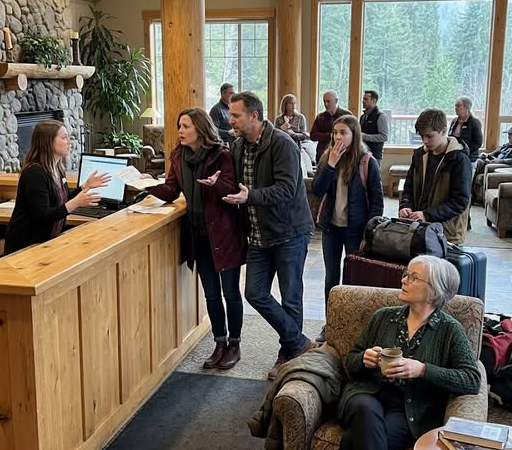
It’s a big, stone, open hearth, in a high-ceilinged room, with leather sofas and a wall of windows facing the cliffs. A tall, glittering tree stood in the corner, hung with copper stars. A fire crackled. I had a cup of tea and a paperback, and I wasn’t reading.
At 3:42, two vehicles pulled into the circular drive.
I watched them through the glass. A white SUV, a black one. Doors opened. Out they came, in a rush of cold air and camel coats. Denise, in a belted cream wool, with her blonde hair swept up, tall and tight and quick. Her husband, Craig, a thick-necked, sandy-haired man in a ski jacket. Kurt, big, sunburned, in a flannel shirt, with a roll of fat at the back of his neck. Tamsin, in a pink parka, carrying a bag of presents.
And behind them, tumbling out of the back seats in a heap of mittens and elbows, the grandchildren. Madison, sixteen, with her phone. Colby, thirteen, with a skateboard. Little Ava, nine, in a Santa hat. And Theo, six, who saw the tree through the window and shrieked.
They crowded through the front doors in a gust of cold, trailing suitcases. Denise strode to the reception desk, with her purse on her arm and her chin up, and the quick, bright, impatient air of a woman who has done this a hundred times.
I didn’t move.
I sat in the leather chair, in the corner, with my book on my knee. They didn’t see me. The fire hid my face.
The clerk was a young woman named Imani, with a ponytail and a name tag. She smiled.
“Welcome to Juniper Mesa. How can I help you?”
“Rooker,” said Denise. “Reservation for Casita 12. Four adults, four children. December twenty-third through the twenty-sixth.”
The clerk typed. She frowned. She typed again.
“I’m sorry, Mrs. Rooker. I don’t see a reservation under that name.”
“That’s impossible.”
“I can check under Chalmers.”
“Check under Chalmers.”
“There’s one reservation under certificate 0071.”
Denise smiled, a quick, tight, triumphant smile.
“Exactly.”
The clerk read the screen. “It’s for Casita 12, December nineteenth through the twenty-sixth. One occupant.”
Denise’s smile stopped.
“What?”
“One occupant. The member herself.”
“The member is in, she’s, my mother doesn’t, that’s not possible.”
“I’m afraid that’s what the system shows.”
Craig stepped forward. “Look, we’ve been coming here for thirty years. This is our family’s casita. We’ve got the paperwork.” He pulled something from his jacket. A small, brass, battered fob, on a leather loop. “Here.”
It was Warren’s.
I knew it at a glance. He’d carried it for twenty-eight years, on his key ring, a membership fob stamped with a pine tree and the number 71. I’d given it to Denise, the week after the funeral, with a hand on her shoulder.
Keep it, I’d said. He’d want you to.
The clerk took it. She turned it over. She handed it back, gently, with a kind, careful smile.
“I’m sorry, sir. That doesn’t authorize a reservation.”
It was Kurt who saw me first.
I don’t know why. Perhaps something drew his eye, a flicker of movement, a glint of firelight on my glasses. He’d been standing a little apart, with his arms crossed, scowling at a brochure rack. He turned his head.
He saw me.
I watched his face change. It was a quick, complicated thing, like watching weather cross a field. Shock, first. Then something smaller and more private, a flicker of fear. Then, in a rush, a flush of red.
“Denise,” he said.
“What?”
“Denise.”
She turned. She followed his gaze.
For a moment, she simply stared. She stood in the middle of the lobby, in her cream coat, with her purse on her arm, and I saw her take in the fireplace, and the leather chair, and the paperback, and the cup of tea, and the woman in the navy cardigan.
“Mom!” she said.
I closed my book.
“Hello, Denise.”
She crossed the room in six quick strides. Her heels rang on the stone. She stopped in front of me, a tall, fine-boned, flushed woman, with her mouth open and her eyes very bright.
“What are you doing here?”
“I’m on vacation.”
“But you’re, this is our, you can’t be here.”
“I’ve been here since the nineteenth.”
“You, but,” she turned, wildly, to the desk. “Sign the authorization. They’ll print it right now. Mom, sign the form. The kids have been traveling five hours.”
“I’m not signing anything.”
“Mom!”
“I’m sorry. I’m not.”
“The children are exhausted!”
“I can help you find another place,” I said. “There’s a lovely inn in Cottonwood. I’d be happy to call.”
“I don’t want your help!”
“Then I respect your decision.”
She stared at me. I watched her try to find a line, a weapon, a clever, cutting reply. She found none. Her mouth worked. A small muscle jumped in her cheek.
Behind her, Kurt strode up, with his big shoulders hunched. “Mom. This is ridiculous. You can’t just, we’ve been doing this for three years.”
“I know.”
“It’s, we’re a family!”
“I know that, too.”
“Then why are you, what’s the matter with you?”
I looked at my son. He was forty-three. He had Warren’s broad forehead, and Warren’s way of scowling when he was cornered. I thought of a boy of nine, writing a note to Santa.
“Kurt,” I said. “Do you remember what you wrote, the year you were nine?”
“What?”
“On the windowsill. For Santa.”
His face went blank.
“‘Please find us here,’” I said.
The lobby had gone quiet.
I became aware of it, slowly. The soft chatter of the other guests had faded. A man in a fleece vest, at the coffee station, had stopped with a stirrer in his hand. A woman in a green sweater was staring openly. A small boy, perhaps four, in a red hat, stood beside the tree with his mouth open.
“Mom,” said Denise, in a low, hard, urgent voice. “Can we please not do this here?”
“I’d be happy to do it anywhere.”
“You’re embarrassing the children.”
“I haven’t said a word to them.”
She flinched.
I put down my book. I rose, slowly, with a hand on the arm of the chair. I’m seventy. My knees aren’t what they were. I stood, in my navy cardigan and sensible shoes, looking up at my daughter.
“I’d like to say one thing,” I said. “And then I’ll go back to my tea.”
“Mom.”
“I received a sympathy card in January.”
She went still.
“From Dot Pruitt. She said she was sorry I’d moved into Sonoran Trails.”
Her face went white. All at once. Like a lamp going out.
“I’ve never been there,” I said. “I’d like you to know I know.”
The manager arrived then.
He’d been, I think, standing at the edge of the lobby for some time. A trim, silver-haired man named Mr. Okafor, in a navy blazer with a gold name badge, and the polished, calm, faintly pained expression of a person who’s spent thirty years soothing the wealthy. He crossed the room, with his hands clasped.
“Mrs. Chalmers,” he said, with a small bow. “Mrs. Rooker. Gentlemen. Might I have a word?”
“Of course,” said Denise, in a voice of thin ice.
“The matter of certificate 0071.” He cleared his throat. “I’m afraid it’s in a delicate position. The board has been reviewing an application for transfer. As of the fifteenth, the transfer has been suspended, pending a hearing.”
“A hearing?” said Kurt.
“Scheduled for tomorrow morning. Nine o’clock. In the boardroom.”
“Tomorrow’s Christmas Eve.”
“Yes, sir.” Mr. Okafor’s voice was gentle. “The board felt it was an urgent matter.”
Denise stared at him.
“Mrs. Rooker,” he said. “You’ve been notified. A letter was sent to your address of record, on the twentieth.”
“I didn’t receive it.”
“It was sent by certified mail.”
“I’ve been traveling.”
“I understand.” He inclined his head. “I’d suggest, if you wish to be heard, that you attend.”
I slept peacefully that night.
I’d like you to know that. I lay in Warren’s old bed, in the dark, with the quilt drawn up to my chin and the last coals ticking in the kiva, and I did not lie awake. I’d done what I could. The paper would speak.
I heard, once, in the small hours, a sound outside. A footstep on the gravel path. A low murmur, a woman’s voice, a man’s. They’d taken a room at the lodge, I learned later, a cramped double with two cots, at a rate of $480 a night, and had spent the evening, I’m told, in a tense, whispered quarrel.
I fell asleep to the sound of the wind in the junipers.
I entered the boardroom at 8:50.
It was a long, high, quiet room, on the second floor of the lodge, with a vaulted ceiling and a wall of windows facing the cliffs. A long walnut table ran down the middle, with eight leather chairs. At the far end sat the board. Four members, in business casual. A tall, stooped man with white hair, Mr. Pruitt. A heavy-set woman in a red cardigan, Mrs. Brandt. A younger man in a quarter-zip, a young woman in a blazer. At the near end, a conference phone, a stack of folders, a pitcher of water.
I carried one green folder.
I’d packed it the night before. Inside were four things. The transfer application, with its cover sheet. The mismatched signature page. A photocopy of the intake ledger, with its handwritten margin note. And a single letter, on cream stationery, from the administrator of the Sonoran Trails Memory Care Community, dated the eleventh of December.
To whom it may concern. Roberta M. Chalmers has never been a resident, patient, or applicant at this facility.
I sat down in a chair at the near end. Imani Okonkwo, my attorney, took the seat beside me, with a legal pad and a pen.
At five to nine, the door opened.
Denise came in first. She wore a charcoal suit, with a white blouse, and her hair in a tight chignon. She looked, I thought, like a woman dressed for a deposition. Behind her came Kurt, in a clean flannel, with his jaw set. Craig and Tamsin, uncomfortable, a half step behind. Beside them walked a man I didn’t know, a thin, balding, pinstriped figure with a leather briefcase.
“Their lawyer,” murmured Imani.
They sat across from me. Denise didn’t look at me. She sat with her hands folded on the table, very straight, very still.
At nine o’clock, Mr. Pruitt, the board president, rapped a small gavel.
I won’t give you the whole hearing. It took ninety minutes, and most of it was procedural. A reading of the notice. A statement of the issue. Their lawyer, a Mr. Halloran, spoke at length about “family stewardship” and “the member’s diminished capacity,” and produced Dr. Brandt’s letter with a flourish.
Imani, in a dry, precise voice, asked three questions.
“Mr. Halloran, have you verified Dr. Brandt’s current licensure?”
A pause. “I understood him to be in good standing.”
“He isn’t. Here is a printout from the Arizona Medical Board.”
She slid it across.
“Second. Have you examined the dates on the transfer application?”
“I have, I believe…”
“Then you’ll have noticed the revision date.”
“March, 2025.”
“And the date on the signature page?”
Mr. Halloran looked down. He turned a page. I watched his face. It did something small and awful, a slow, creeping slackening, like a man discovering his shoe was untied on stage.
“October, 2023,” he said.
“Is that possible?”
“It’s, I’d have to, I’d like to consult my client.”
“Please do.”
He leaned toward Denise. He murmured something. She said something back, sharp and low. His face grew grayer.
“Third,” said Imani, in a very gentle voice. “Mrs. Rooker. Did you attach the signature page to the application?”
The room was silent.
I watched my daughter. She’d lifted her chin. She sat very still, in her charcoal suit, with her hands in her lap, and her face, I saw, had gone the color of paper.
“I submitted the application,” she said. “My assistant prepared it.”
“Your assistant.”
“At the hospital. She’s very capable.”
“Did she have access to your mother’s signature?”
“I assume, I’d have to ask.”
“Mrs. Rooker.” Imani leaned forward. “Did you provide the signature page?”
Denise said nothing.
At the head of the table, the board secretary, Mrs. Brandt, in the red cardigan, cleared her throat. She’d been silent throughout, a heavy, calm, gray-haired woman with half-moon glasses and a ledger open before her. She lifted the two documents, the application and the signature page, and laid them side by side.
She looked at the dates.
She compared them, with her pencil.
Then she opened the 2023 ledger, the green one. She turned to October. She ran her finger down the column, and stopped.
She read the entry.
She read the handwritten note in the margin.
And she looked up, at my children, with an expression I’ll never forget. It wasn’t anger. It was something quieter and worse. The look of a woman who’s been a clerk for thirty years, and has just watched somebody use her ledger as a weapon.
“Mrs. Rooker,” she said. “Mr. Chalmers.”
Kurt flinched.
“This signature page,” said Mrs. Brandt, “bears document number CJ-2023-1002-07. According to our intake ledger, that number was assigned, on October second, 2023, to a roof assessment agreement. It’s a single page. It was signed on a porch. The ledger says so.”
She turned the book, so they could see.
“It has nothing,” she said, “to do with the surrender of a membership.”
Nobody moved.
“So I’d like to ask a question,” said the secretary. She took off her glasses. Her voice was calm and clear and very quiet. “How did your mother’s signature come to be on a document she never saw?”
The silence stretched.
It lasted, I think, about eleven seconds. I counted. It’s a habit. In eleven seconds, a room can hold its breath, and a child can be born, and a lie can finally find the floor.
Denise’s mouth opened. Closed. Her lips trembled.
Kurt said, “Denise.”
She didn’t answer.
“Denise, say something.”
“I don’t,” she said, in a very small voice. “I don’t know.”
“You do.”
“Kurt.”
“You did it. You told me you’d, you said it was a formality!” His voice cracked. He turned to the board, with his big hands spread, in the helpless, stricken gesture of a man discovering the floor isn’t there. “She told me it was just paperwork. She said Mom had agreed. She said she’d, that Mom was, that she wasn’t, that it was for her own good.”
“Kurt!”
“You said she’d signed!”
“I said,” said Denise, “I said what I had to.”
She’d stood. I hadn’t seen her rise. She stood at the table, in her gray suit, with her hands flat against the walnut, and her whole body shaking, and tears running down her face.
She turned, slowly, and looked at me.
I’d like to tell you what her face looked like, because I’ve seen it every night since.
It wasn’t the face of a schemer. I’d braced for that. I’d rehearsed, in the long hours of the drive, a cold, composed response to a clever woman caught. What I saw instead was a girl. A girl of eleven, with her father’s chin, and her mother’s temper, standing in a doorway, with a book against her chest.
“Mom,” she said.
I waited.
“I’m so tired.”
It came out in a breath. A whisper. A small, cracked, astonished sound.
“I’m so tired, Mom. I haven’t slept in two years. Craig’s, we’re, he lost his job. In 2023. And I, I didn’t tell anyone. We’re so far behind. On everything. The house. The, the cars. The kids’ tuition.” She laughed, a hideous, wet, hiccuping laugh. “I couldn’t tell you. You’d have, you were always so, so organized. So proud. And I thought, if I could just get, if we could just keep the casita, if we could just rent it out, in the off-weeks, we could make eighteen thousand a year.”
“Eighteen thousand.”
“Plus the sale value. Of the certificate. A founding membership. They’ve been going for, I looked it up. Two hundred and forty thousand.”
I closed my eyes.
I’d known the number. I’d looked it up myself, in October. A founding membership at Juniper Mesa, number 0071, with a permanent holiday week. It was, by the club’s own estimate, worth about $240,000.
“It’s not stealing,” said Denise. “It’s, you wouldn’t have used it. You’re, you’re old. You don’t, you wouldn’t have wanted. We’d have taken care of you.”
“By telling people I was in a memory-care home.”
“It was, I thought, it was only a way of, of making it, of making them understand.”
“Make who understand?”
“The board.” She was sobbing now. “It would’ve been so much easier.”
Easier without you.
I opened my eyes.
The board adjourned for an hour.
They did it quietly, with a murmur, and a small bow, and a rustle of chairs. They filed out through a side door, with their folders. I sat at the long walnut table, in the sudden silence, with my hands folded, and my children across from me.
Nobody spoke.
Craig had put his head in his hands. Tamsin was crying quietly, a thin, steady, miserable stream. Mr. Halloran, the lawyer, stared at the table with the particular absence of a man calculating his fee.
Kurt rose.
He stood a moment, in his plaid shirt, with his hands hanging. He walked around the end of the table, a big, shambling, sunburned man, and stopped in front of me.
“Mom,” he said.
His voice was hoarse.
“I laughed,” he said.
I looked up.
“On the phone. When Denise said it. I laughed. I didn’t, I don’t even know why. It was, it came out. Like a, like a cough.” He rubbed his face. “And I’ve been, it’s been eating at me. For a year. I’d lie awake. I’d hear it.”
“Kurt.”
“I’m so sorry.”
“I know.”
“It’s, I know it’s not enough.”
“No.”
“But I wanted to say it.”
I took his hand. It was big, and rough, and damp, with Warren’s blunt thumb. I held it between both of mine.
“Thank you,” I said.
He bent his head. He began, quietly, to cry.
The board returned at eleven.
They sat. Mr. Pruitt, the president, tall and stooped, with his white hair standing up, folded his hands.
“We’ve reached a decision,” he said.
Nobody breathed.
“First, the pending application for transfer of certificate 0071 is denied, with prejudice. It will not be reconsidered.”
Denise made a small, strangled sound.
“Second, the club will refer the matter of the altered signature page to the appropriate authorities. We’re advised that it may constitute forgery. We’ll let the county attorney decide.”
Craig lifted his head. His face had gone gray.
“Third, as a matter of club discipline, the privileges of Mrs. Rooker and Mr. Chalmers, to reserve or to enter the premises under any member’s certificate, are suspended, pending further review.”
Kurt flinched.
“And fourth.” Mr. Pruitt looked, for the first time, at me. His old, tired, kind face softened. “To Mrs. Chalmers. We apologize. The club should have verified. We were told a story. We believed it too easily.”
I nodded.
“On behalf of the board,” he said, “we’d like to offer, as a small recompense, a full refund of your dues for the coming year, and the reservation of Casita 12 for the Christmas week, in perpetuity.”
“In perpetuity?”
“It’s what the certificate says.”
I put my hand over my mouth.
I’d like to tell you that was the end of it.
It wasn’t. It was the beginning of a long, ugly, difficult spring.
The county attorney, a young woman named Delphine Reyes, took the case. She met with me in her office, on a bright, bitter day in January, with a file the thickness of a Bible. She was kind, and clear, and entirely without sentiment.
“Mrs. Chalmers, I’ll be direct. There’s enough here for a felony charge. Forgery. Attempted theft by deception. Possibly elder fraud.”
“I know.”
“But I’d like to know what you want.”
I’d thought about it for a month. I’d thought about it in the dark. I’d thought, a good deal, about a girl of eleven on a window seat.
“I don’t want her in prison,” I said.
Delphine nodded.
“I want it on the record.”
“What record?”
“That it happened. That it’s true. That nobody can say, in five years, that I was confused.”
She wrote it down.
“I’d suggest a plea,” she said. “To a lesser charge. Probation. Restitution. A requirement of counseling.”
“What kind of restitution?”
“The cost of the investigation. And, I’d suggest, a letter.”
“A letter.”
“To the club. Acknowledging what she did.”
I considered it.
“And to me?”
Delphine smiled, very slightly.
“That,” she said, “would be up to her.”
Denise pleaded in April.
I attended. I sat in the second row of a small, beige courtroom in Flagstaff, in my navy cardigan, with my purse in my lap. A judge named Harlan Weiss, a heavy, gray-haired man with a voice like a cello, presided. Denise stood before the bench in a plain gray dress, with her hands clasped and her head bowed.
I watched my daughter, a stranger, a woman of forty-six, say, in a small, clear voice, “Guilty.”
Guilty, I thought. Of the thing I knew.
Judge Weiss read the sentence. Three years of probation. Two hundred hours of community service. Restitution of $14,800 to the club and to me, for investigative costs. A requirement that she attend counseling, weekly, for twelve months.
And one more thing.
“Mrs. Rooker,” said the judge, peering over his glasses. “I’d like you to write a letter to your mother. Not for the court. For her. And I’d like you to mean it.”
Denise’s shoulders shook.
“Yes, Your Honor,” she whispered.
The letter arrived in June.
It came in a plain white envelope, with a Flagstaff postmark. My name, in her familiar, upright hand. I carried it into the kitchen, and set it on the table, and put on the kettle.
I let it sit for an hour. I made tea. I drank half. At last, I took a letter opener, and slit the flap.
Four pages. Handwritten, in blue ink, on lined paper.
Mom,
I’ve started this letter eleven times. The court said to be honest, and I don’t know how.
I’ll start with the truth. I wasn’t confused. I wasn’t pressured. I knew exactly what I was doing. I forged your signature because I was afraid, and ashamed, and I wanted, more than anything, to feel like someone who had it together.
I said, “It’s just easier without you.” I want you to know I’ve thought about that sentence every day since. I think it was the truest thing I’ve ever said. It was easier. It was easier not to see the person who knew me. It was easier to put you in a memory-care home, on paper, than to sit across a table from you and admit I was drowning.
You were always so capable. I’m sorry that I made that a reason to leave you out.
I don’t expect you to forgive me. But I’d like to tell you what I’ve learned. I’ve learned that I can’t outrun a signature. I’ve learned that Dad’s truck is the reason you had that casita, and that I was selling it for a down payment.
I’d like to come see you. If you’d let me. Not in Sedona. Not at a table. In your kitchen, with the kettle on.
Denise
I read it twice.
I laid it on the table. I looked at it for a long time. At the blue ink, the careful loops, the one small blot where her pen had paused.
I didn’t cry. I’d like to tell you I did. But I felt, instead, an odd, calm, enormous tiredness, like the end of a long audit.
I picked up the phone.
She came on a Thursday.
I’d made a pie. A pecan pie, from Warren’s mother’s recipe, with a lattice crust I’d gotten a little wrong. I’d put it on the counter to cool. I’d put on a clean blouse. I’d waited at the window, with a cup of tea, watching a white SUV come slowly down my street.
She parked at the curb. She sat in the car for ten minutes.
I’d like to tell you I wasn’t watching. I was. I stood behind the curtain, with my heart going like a drum, and watched my daughter, in the driver’s seat, with her forehead against the steering wheel.
At last, she got out. She came up the walk, in jeans and a gray sweater, with her hair in a ponytail and no makeup. She looked about nineteen. She stood on my porch, with her hands in her pockets, and didn’t knock.
I opened the door.
“Hi, Mom.”
“Hello, Denise.”
“I brought, I didn’t bring anything.”
“You don’t need to.”
“I don’t know what to say.”
“Come in.”
She came in. She stood in my front hall, and looked around. At the photographs on the wall. At the worn blue carpet. At the staircase, with its scuffed rail.
“It smells like pie,” she said.
“It’s pecan.”
She made a small sound, half laugh, half sob. She put her hand over her mouth.
We sat at the kitchen table.
I poured tea. I cut the pie. It was good, a little too sweet, with a crust that had slumped on one side. She ate two slices, in silence, with her eyes down. I let her.
After a long time, she put down her fork.
“I’m sorry,” she said.
“I know.”
“I don’t know how to say it better.”
“You said it very well, in the letter.”
“It was a letter.”
“It was true.”
She wiped her eyes with the heel of her hand.
“Mom,” she said. “I need to ask you something. And you don’t have to answer.”
“Go on.”
“Why didn’t you say anything? In the lobby? When I, when Craig held up Dad’s fob. You could have, you could have just said, ‘I know what you did.’”
I thought about it. I gave the question the respect it deserved.
“Because I wanted you to say it first,” I said.
She stared.
“I’ve been a registrar for thirty-one years,” I said. “I’ve watched a great many people come to the window with a lie. And what I’ve learned is that if you say it for them, they’ll fight you. But if you wait, if you let the paper speak, they’ll tell you themselves.”
“I did.”
“You did.”
“It took a board of directors.”
“It took what it took.” I smiled, a little. “I’d have waited a lot longer.”
She laughed. It was a ragged, helpless, wonderful sound. She put her head in her hands, and her shoulders shook, and I got up, and went around the table, and put my arms around her.
She smelled of cold air and lavender and something older, something I couldn’t name. She was shaking. I held her, a tall, thin, trembling woman of forty-six, against my shoulder, in my own kitchen, as I’d held her at three, with a skinned knee, and at eleven, with a broken heart.
“I’m so sorry, Mom,” she said, into my cardigan.
“I know, sweetheart.”
“I love you.”
“I know that, too.”
I’d like to tell you what we did that Christmas.
It was a small one. The smallest in thirty years. I booked Casita 12 for the week, as I’d done the year before, and, this time, I made a list.
I invited them. All of them. By letter, in my own handwriting.
Denise, Craig, Kurt, Tamsin. Madison, Colby, Ava, Theo. Please come. I’ve got room. —Mom.
I’d added a line, at the bottom, in smaller type.
Bring nothing. I’ll make the pie.
They arrived on the twenty-second, in two cars, with a great clatter of suitcases. I stood at the door of Casita 12, in my navy cardigan, with a wooden spoon in my hand. The kiva was lit. The piñon crackled. A tree, a ragged, wonderful, imperfect fir, stood in the corner, with Warren’s old tin star.
Denise came up the path first. She’d lost weight. She wore a green coat I’d never seen. She stopped, a yard from the door, and looked at the plaque above the mantel, through the open window.
CHALMERS.
“Mom,” she said. “May we come in?”
“You’re asking.”
“I’m asking.”
I stood aside.
They came in, one by one. Craig, subdued, with a bag of presents. Tamsin, with her arms around a child. Kurt, last, with his cap in his hands, and Theo on his shoulders. He stopped in the doorway, and looked up at the beams.
“It’s the same,” he said.
“It is.”
“I thought it’d be, I don’t know. Smaller.”
“It’s just the same size.”
He nodded. He swallowed.
“Mom,” he said. “I wrote something.”
He took a folded paper from his pocket. He held it out. It was a child’s drawing, in crayon, creased and soft with age. A stick-figure house. A tree. A fire. A woman in a blue dress, with a spoon.
And across the top, in careful, wobbling block capitals:
PLEASE FIND US HERE.
“I found it in my old room,” he said. “At your house. In a box.”
I took it. I held it a long time.
“You kept this?” he said.
“I kept everything.”
He began, quietly, to cry. And I set down my spoon, and I put my arms around my son, a big, sunburned, weeping man, in the doorway of a turquoise door, with a six-year-old on his shoulders, laughing, and a fire crackling behind us, and the red cliffs going rose in the winter light.
It’s been two years.
We’ve had two Christmases at Casita 12. The first was awkward and sweet and a little stiff. We ate too much. We sat by the fire, and told stories, and avoided certain subjects. On the twenty-fifth, Madison, who is eighteen now, gave a speech at dinner. She was shy and fierce, with Denise’s cheekbones and Warren’s stubbornness.
“I want to say something,” she said. “I’m, I’ve been thinking.”
“Go ahead,” I said.
“I’m sorry I posted the photograph. The first year. With the nine people.”
“You were fifteen.”
“I knew you weren’t there.” Her voice shook. “I thought it was weird. But I didn’t ask. I just, I just posted it.”
“Madison.”
“I’d like to, I’d like to say. Gram. You’re the person who taught me to read. And I forgot.”
I put my hand over my mouth.
“I didn’t forget,” I said, when I could.
“Neither did I.”
We held each other, a girl and an old woman, in front of a fire, in a room full of the people I loved.
The second Christmas was better.
Denise had finished her probation. She’d taken a new job, at a smaller hospital, for less money, with less title. Craig had found work with a regional insurer. They’d sold the big house, and bought a small one. They arrived in a single car, a battered minivan, and Denise, in a flannel shirt and no makeup, carried in a pecan pie.
It was, I’ll tell you, quite terrible. The crust had slumped. The filling had run. She stood at the counter, with a knife, looking at it in despair.
“I tried,” she said.
“I can see.”
“It’s bad.”
“It’s perfect.”
She laughed. It was a clear, bright, surprised laugh, the first I’d heard from her in years. She put down the knife, and wiped her hands, and, to my astonishment, burst into tears.
“I’m so happy,” she said. “I don’t know why I’m crying.”
“Because you’re allowed.”
“Am I?”
“It’s Christmas.”
She laughed again, wetly. I put my arm around her.
We ate the pie that night. All of it. By the fire, with forks, from the tin.
I’ll tell you the last thing.
On the twenty-sixth, the last night, after the others had gone to bed, I sat alone in Warren’s chair. The fire had burned to coals. A pale blue moon stood over the cliffs. In the corner, the tree glowed faintly, with its tin star.
I looked at the plaque above the mantel.
CHALMERS.
I thought of a man with a soldering iron. A man who’d sold his truck. A man who’d said, in a cool green office, on a hot day in 1994, Rob, we’ll never regret it.
I hadn’t. Not for a moment.
I took out my phone. I opened my notes. I scrolled to the yellow pad I’d written, on the third of December, three years before, in my kitchen, with a wooden spoon in my hand.
4:12 p.m. “It’s just easier without you there.”
I looked at it for a long time.
Then I deleted it.
I typed a new line, below the date, in the small, level, upright script of a woman who’s spent her life reading records:
Easier isn’t the same as better. Everyone’s home.
I put the phone down.
The fire settled, with a soft sigh. Overhead, in the vigas, the old wood creaked, as it always had, as if the house itself were turning over in its sleep.
I closed my eyes.
Well, Warren, I thought. Here we are.
And somewhere, very faintly, in the cold bright night, I thought I heard a man whistling “Moon River,” off-key, as he came up the path.