PART 2 — The Homeless Stranger Who Left Something I Never Expected
I sat down right there on the porch.
My hands were shaking so badly that I nearly dropped the envelope.
Inside were four folded sheets of paper, a small photograph, and a handwritten letter.
But it wasn’t the letter that made my knees go weak.
It was the first document.
A financial statement bearing my ex-husband’s name.
David Ellis.
And beneath his name was a number.
$187,400.
I stared at it.
Then I looked at the date.
Six weeks before our divorce had been finalized.
I recognized the name of the financial institution. I’d seen it on statements David occasionally left on his desk during our marriage.
But the account number was unfamiliar.
So was the company listed beside it.
Cedar Ridge Holdings, LLC.
My breathing became shallow.
During our divorce, David had sworn that his contracting business was struggling financially.
He claimed his assets were tied up in debts, unfinished projects, and outstanding loans.
He told his attorney there was almost nothing left to divide.
I’d believed him longer than I should have.
Now I was staring at a document suggesting there had been a substantial amount of money he hadn’t disclosed.
I picked up the second page.
It was a copy of an email.
The sender was David.
The recipient was someone named Samuel Price.
The message was short.
Sam, move the proceeds into Cedar Ridge before the end of the month. I’ll take care of the rest after the settlement is signed.
I read it twice.
Then I noticed the reply.
David, I cannot approve this without correcting the ownership records. Martha may have an interest in these funds.
And beneath that was David’s answer.
That’s not your concern. Just do what I’m paying you to do.
I stopped breathing.
For two years, I had believed I’d lost almost everything because I trusted my husband.
Now I was wondering whether I’d lost it because he’d deliberately hidden what belonged to us.
My eyes moved to the handwritten letter.
Across the top were two words.
Dear Martha.
I unfolded it.
My name is Samuel Price.
I worked as a bookkeeper for your former husband’s company for nearly nineteen years.
I came to your neighborhood yesterday because I have been trying to find you.
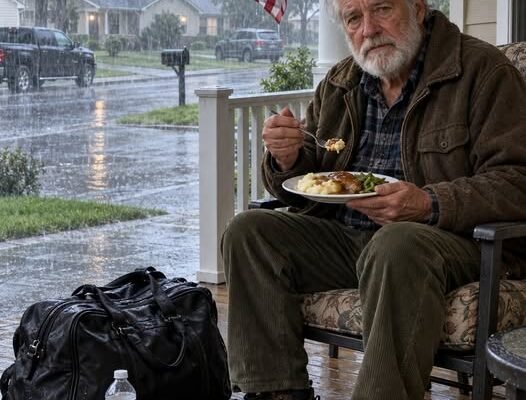
I had these papers with me, but when the storm started, I took shelter beneath that tree across from your house. I didn’t know whether I would have the courage to knock.
My eyes filled.
I continued reading.
You offered me a place inside your home. When I refused, you gave me a dry place to sit, a warm meal, and a blanket.
You didn’t know who I was. You didn’t ask what I could give you in return.
When you said you had enough for both of us, I remembered the kind of person I should have been when I first learned what David was doing.
I pressed a hand against my mouth.
I should have spoken up years ago.
I was afraid of losing my job. Then I lost it anyway.
These documents may not be enough by themselves, but they can help an attorney investigate what happened before your divorce.
Please don’t confront David alone.
There is a telephone number on the last page. It belongs to a community center where I sometimes receive messages.
I’m sorry it took me so long.
Samuel.
I read the letter again.
Then I looked at the photograph.
It showed a group of men standing in front of a construction office.
David was in the center.
Beside him stood a slightly younger version of the man who had spent the previous night on my porch.
He was smiling.
Wearing a clean blue shirt.
Holding a clipboard.
I looked at the photograph for a long time.
The man who had refused to come inside my home had once worked for my husband.
And somehow, he’d ended up sleeping outdoors.
I sat there until Lily came looking for me.
“Mom?”
I quickly wiped my cheeks.
She stood in the doorway wearing her favorite purple pajamas.
“Why are you sitting outside?”
I looked up.
“Just reading something, sweetheart.”
She noticed the folded blanket.
“Did the grandpa leave?”
I nodded.
“Yes.”
Her face fell.
“But I wanted to give him breakfast.”
My throat tightened.
“I know.”
She looked toward the street.
“Did he like the food?”
I smiled.
“I think he did.”
She considered that.
Then asked, “Was he really homeless?”
“I think so, honey.”
Lily looked sad.
“Where did he go?”
I looked at the letter in my hand.
“I don’t know yet.”
Then I added something I hadn’t expected to say.
“But I think we should try to find out.”
That morning, I called the number Samuel had left.
A woman answered.
“Northside Community Resource Center.”
I explained that I was trying to reach Samuel Price.
The woman became cautious.
“Are you family?”
“No.”
“May I ask what this concerns?”
I looked down at the documents.
“He left something important at my house. I’d like to thank him and make sure he’s all right.”
She paused.
“We can’t share someone’s private information without permission.”
“I understand.”
“But if you leave your number, I can pass along a message if he comes in.”
I gave her my name.
My number.
And one sentence.
“Please tell him Martha received the envelope.”
Then I hung up.
For the rest of the morning, I tried to focus on ordinary things.
Making Lily breakfast.
Packing her lunch.
Starting laundry.
But my mind kept returning to those papers.
The money.
The account.
The email.
The date.
I remembered sitting across from David’s attorney during our divorce negotiations.
I remembered being told there was no realistic way to afford a prolonged dispute.
I remembered signing the settlement while exhausted, frightened, and desperate to give Lily somewhere stable to live.
Most of all, I remembered David looking at me afterward.
He’d smiled.
Not happily.
Almost triumphantly.
“You should’ve listened to me years ago, Martha. You were never good with money.”
I’d carried those words with me for two years.
Every time I struggled to pay rent.
Every time I put back something at the grocery store.
Every time I stayed awake calculating expenses.
I’d wondered whether he was right.
Now I wasn’t so sure.
That afternoon, I called an attorney.
Not the one who had handled my divorce.
I wanted someone who could look at the documents without the assumptions that had shaped the first case.
A friend from work recommended a woman named Rebecca Foster.
Her office was across town.
When I explained the situation, she asked me to bring everything I had.
Two days later, I sat across from her in a small conference room.
Rebecca looked through the papers slowly.
She didn’t gasp.
Didn’t promise justice.
Didn’t tell me I was about to become wealthy.
She simply asked questions.
“Do you know this company?”
“No.”
“Did your former husband disclose any ownership interest in it during the divorce?”
“Not that I remember.”
“Have you ever seen these account records?”
“No.”
She made several notes.
Then looked up.
“Martha, I don’t want to give you false hope.”
I nodded.
“But these documents raise questions worth investigating.”
My heart pounded.
“Could he have hidden money?”
“Possibly. We would need to authenticate the records and determine what happened to those funds. There are also deadlines and legal standards for challenging a divorce judgment.”
I swallowed.
“So this might not change anything.”
“It might not.”
She leaned forward.
“But if material financial information was deliberately concealed, there may be options. Let’s find out what the evidence actually supports.”
I looked down at the papers.
For the first time in two years, I felt something I hadn’t allowed myself to feel.
Hope.
Not certainty.
Not revenge.
Just the possibility that my life hadn’t fallen apart because I was foolish.
Maybe someone had taken advantage of my trust.
And maybe there was something I could still do about it.
Rebecca asked another question.
“Where did you get these?”
I explained about Samuel.
The storm.
The porch.
The blanket.
The letter.
When I finished, she sat back in her chair.
“You said he was homeless?”
“Yes.”
“And he worked for your husband?”
“Apparently.”
She looked at the email again.
“We need to speak with him.”
I nodded.
“I’ve been trying.”
Rebecca handed me her business card.
“If he contacts you, please ask whether he’d be willing to talk to me.”
I tucked the card into my handbag.
Then asked the question I’d been afraid to say aloud.
“Rebecca, do you think David knew what he was doing?”
She looked at me carefully.
“I think we need more evidence before drawing that conclusion.”
I nodded.
But I couldn’t stop thinking about the email.
That’s not your concern.
Those five words sounded exactly like my former husband.
For twenty-one years, he’d used some version of them whenever I asked about our finances.
Don’t worry about it, Martha.
I’ve handled it.
You wouldn’t understand the details.
Just sign here.
I used to believe those words meant he was protecting me.
Now they sounded very different.
Three days passed.
Then the resource center called.
I was standing in the grocery store comparing prices on breakfast cereal when my phone rang.
“Martha?”
“Yes?”
“This is Denise from Northside Community Resource Center.”
My heart jumped.
“Yes?”
“Samuel Price came in this morning. He said he’d like to speak with you.”
I nearly dropped the cereal box.
“Is he there?”
“Yes.”
“Can you put him on?”
A moment later, I heard a familiar voice.
“Hello, Martha.”
For some reason, tears immediately filled my eyes.
“Samuel?”
“Yes, ma’am.”
“Are you okay?”
He gave a soft laugh.
“About as okay as an old man can be.”
I stepped away from the grocery aisle.
“I found your letter.”
“I hoped you would.”
“And the documents.”
He became quiet.
“Did you understand them?”
“Some of them.”
I swallowed.
“Samuel, why didn’t you tell me who you were?”
He sighed.
“Because I was ashamed.”
“Of what?”
“Of waiting so long.”
I stood silently.
Then he continued.
“I worked for David for nineteen years. At first, he treated me well. Paid me on time. Let me work shorter hours when my wife became sick.”
His voice softened.
“Then things changed.”
I listened.
“About three years ago, he started moving money through companies I didn’t recognize. He told me it was restructuring.”
Samuel paused.
“I asked questions.”
“What happened?”
“He told me to mind my own business.”
My chest tightened.
Samuel continued.
“I stayed because my wife needed medicine and I needed the insurance. Then, when I wouldn’t approve one of the transactions, he let me go.”
I closed my eyes.
“How long ago?”
“Almost two years.”
“And your wife?”
He went quiet.
“She died last winter.”
My throat tightened.
“I’m so sorry.”
“Thank you.”
He cleared his throat.
“After she passed, I couldn’t keep up with the rent. I stayed with a friend for a while, then in a shelter. Some nights there isn’t room.”
I stared at the shelves in front of me.
This man had spent nineteen years working for David.
He’d lost his wife.
His job.
His home.
And somehow, while I was trying to survive my own financial collapse, he’d been carrying documents that might prove what happened to my money.
“Why were you coming to my house?” I asked.
Samuel sighed.
“I heard you’d moved. A woman who used to work in the office helped me find your new address.”
He paused.
“I’d been sitting with those papers for months, wondering whether I should give them to you.”
“Why hesitate?”
“Because I knew they might reopen wounds.”
I swallowed.
“And because I didn’t know whether you’d believe me.”
That hurt.
Because I probably wouldn’t have believed him two years earlier.
I had trusted David for too long.
Samuel continued.
“When I reached your street, the storm was coming. I was tired. I sat beneath that tree to catch my breath.”
He gave a sad little laugh.
“Then you opened your door.”
I wiped my cheek.
“You could’ve told me.”
“I know.”
“Why leave the envelope?”
“Because after you fed me, I knew I couldn’t walk away without giving you the truth.”
His voice cracked.
“You had every reason to be cautious. But you still helped me.”
I shook my head even though he couldn’t see me.
“Samuel, you didn’t owe me those papers because I gave you dinner.”
“I know.”
He paused.
“I owed you those papers because they concerned you. I should’ve found the courage sooner.”
For a long time, neither of us spoke.
Then I asked, “Can I come see you?”
He hesitated.
“I don’t want to be a burden.”
I smiled through my tears.
“You’re not.”
He gave me the resource center’s address.
We agreed to meet Friday afternoon.
When I arrived, Samuel was sitting outside on a wooden bench.
He wore the same brown jacket he’d had during the storm.
His backpack rested beside his feet.
But in daylight, he looked different.
Not mysterious.
Not frightening.
Just tired.
Very tired.
He stood when he saw me.
“Martha.”
I smiled.
“Hello, Samuel.”
He reached out his hand.
I ignored it and hugged him.
For a moment, he stood completely still.
Then he gently patted my back.
“Thank you,” he whispered.
We sat on the bench.
I brought him a sandwich and coffee.
He laughed when he saw the bag.
“You’re going to spoil me.”
“Hardly.”
He ate slowly.
Then I took Rebecca’s card from my purse.
“Would you be willing to speak with my attorney?”
He stared at it.
“About David?”
“Yes.”
He looked down.
Then nodded.
“I think it’s time.”
Over the next several weeks, Samuel met with Rebecca.
He explained the accounting records.
The transfers.
The business arrangements.
He identified people who might confirm what had happened.
And most importantly, he explained how David had used another company’s name to hold money that should have been examined during our divorce.
Rebecca began gathering independent records.
There were requests for financial information.
Questions about ownership.
Bank records.
Business filings.
Documents I’d never seen during twenty-one years of marriage.
The process wasn’t quick.
And it wasn’t easy.
David found out eventually.
He called me one evening.
I was making dinner.
Lily sat at the table drawing pictures of butterflies.
When I saw his name, my stomach tightened.
I stepped into the hallway before answering.
“Martha.”
His voice was cold.
“David.”
“What’s this nonsense about you hiring another lawyer?”
I leaned against the wall.
“It’s a legal matter.”
“Don’t play games with me.”
I took a breath.
“David, if you have questions, contact Rebecca.”
He laughed.
“You think some old paperwork is going to change anything?”
I went still.
I hadn’t mentioned the documents.
Not to him.
Not to anyone who would have told him.
“What paperwork?” I asked.
A pause.
Then he said, “Whatever that old man gave you.”
My heart began pounding.
“How do you know about Samuel?”
David exhaled angrily.
“He’s been making accusations for years.”
“Then perhaps you should answer them.”
“Samuel is confused.”
I looked toward the kitchen.
Lily was humming while she colored.
For two years, I’d been frightened of this man’s anger.
I’d dreaded his calls.
His accusations.
His certainty that he could make me doubt myself.
But something had changed.
I knew I had an attorney.
I knew I had documents.
And I knew I no longer had to convince David that I deserved fair treatment.
“David, I’m not discussing this with you.”
“Martha—”
“Talk to Rebecca.”
Then I ended the call.
My hands shook afterward.
I won’t pretend they didn’t.
But I didn’t call him back to apologize.
That was new.
Months passed.
The investigation uncovered more than I’d expected.
The $187,400 transfer wasn’t the entire story.
It was part of a series of transactions involving a storage property and a small commercial building that David had helped purchase during our marriage.
Ownership had been shifted through business entities.
Some of the proceeds had been kept outside the financial disclosures I’d received during the divorce.
Rebecca was careful with every discovery.
She never promised me a particular outcome.
But as records were verified, David’s attorneys became increasingly interested in discussing a settlement.
The process took nearly ten months.
There were days when I wanted to give up.
Days when attorney bills frightened me.
Days when I wondered whether I was spending money I couldn’t afford chasing something that might never be recovered.
Rebecca and I reviewed the costs and risks repeatedly.
Then, one afternoon, she called.
“Martha, we have a settlement proposal.”
I sat down.
My heart began pounding.
She explained the terms.
David would pay a substantial amount to resolve the disputed financial claims, with safeguards for the payment schedule.
The agreement also addressed outstanding financial obligations involving Lily.
It was less than everything we’d identified as potentially disputed.
It was far less than the life I had once believed I was building.
But after legal expenses, it would give me something I hadn’t had in years.
A genuine financial cushion.
Enough to clear my overdue bills.
Establish an emergency fund.
And put a down payment on a modest home if I chose carefully.
I listened until Rebecca finished.
Then asked, “Are you sure?”
She was quiet for a moment.
“I’m sure these are the terms being offered. Whether to accept them is your decision.”
I appreciated that.
For twenty-one years, someone else had made financial decisions and told me to trust him.
Rebecca never did that.
She explained the risks.
Answered questions.
Then let me decide.
After reviewing everything, I accepted the agreement.
The first payment arrived several weeks later.
I sat in my car outside the bank and stared at the confirmation.
Then I started crying.
Not because I was suddenly wealthy.
I wasn’t.
Not because money could replace the twenty-one years I’d lost.
It couldn’t.
I cried because for the first time since the divorce, I wasn’t calculating whether one unexpected expense would leave Lily and me without somewhere to live.
I could breathe.
I called Samuel.
He answered at the community center.
“Hello?”
“Samuel?”
“Martha!”
His voice brightened.
“How are you?”
I swallowed.
“It’s finished.”
He became quiet.
“The case?”
“Yes.”
“Did it help?”
I started crying again.
“Yes.”
For several seconds, neither of us spoke.
Then Samuel whispered, “Thank God.”
I wiped my cheeks.
“Samuel, I don’t know how to thank you.”
He gave a soft laugh.
“You already did.”
“No, I mean—”
“Martha.”
His voice became gentle.
“You fed an old man when you thought he had nothing.”
I closed my eyes.
“You don’t need to repay me for telling the truth.”
That sentence stayed with me.
But it didn’t stop me from wondering how I could help him.
Over the months, I’d learned more about Samuel.
He had been married to his wife, Evelyn, for forty-six years.
They’d had one daughter, Caroline, who lived several states away.
After Evelyn died, Samuel had stopped answering Caroline’s calls.
He was ashamed of losing his apartment.
Ashamed of needing help.
Ashamed that after a lifetime of working, he had nowhere permanent to sleep.
He had convinced himself that telling his daughter would make him a burden.
I understood that feeling more than I wanted to admit.
One afternoon, I asked him about Caroline.
“Does she know where you are?”
He looked away.
“She knows I’m around.”
“Samuel.”
He sighed.
“No.”
“Would she want to know?”
He stared at his hands.
“I suppose.”
I smiled gently.
“Then maybe you should give her the chance to decide.”
He was quiet for a long time.
Then whispered, “I don’t want her feeling responsible for me.”
I nodded.
“I understand.”
“But keeping the truth from her doesn’t give her the freedom to choose either.”
He looked at me.
Then slowly smiled.
“You’ve been talking to that lawyer too much.”
I laughed.
“Probably.”
A week later, Samuel called his daughter.
I wasn’t there for the conversation.
He told me about it afterward.
Caroline had cried.
Then she’d become angry.
Not because he needed help.
Because he’d been struggling alone while she thought he was living comfortably in his old apartment.
She had been sending birthday cards to an address he no longer used.
“I would’ve helped you, Dad,” she’d told him.
Samuel’s voice broke when he repeated those words.
“I know.”
Caroline came to visit the following weekend.
I met her briefly at the resource center.
She had Samuel’s eyes.
And the same gentle way of speaking.
She hugged me before we’d even been introduced properly.
“Thank you for helping my father.”
I looked at Samuel.
Then shook my head.
“He helped me too.”
Caroline arranged for him to stay with her temporarily while they explored longer-term housing options.
Samuel resisted at first.
Of course he did.
He insisted he didn’t want to impose.
But Caroline simply smiled.
“Dad, you spent eighteen years driving me to school, fixing my car, and making sure I had a place to sleep. Let me make you dinner.”
He started crying.
So did I.
Eventually, Samuel moved into a small senior apartment near his daughter.
It had one bedroom.
A little kitchen.
A window overlooking a courtyard.
And enough space for his favorite armchair, which Caroline had kept in storage after he lost his apartment.
When he sent me a photograph, he was sitting beside the window holding a cup of coffee.
He looked peaceful.
Underneath, he’d written:
No rain on this porch.
I laughed so hard I cried.
By then, Lily and I had found a place of our own too.
Not a mansion.
Not anything extravagant.
Just a small two-bedroom townhouse with a fenced patch of grass behind it.
It was in a quiet neighborhood near her school.
The kitchen was bright.
The bedrooms had windows large enough to let in the morning sun.
And there was a little covered porch out front.
When I first saw it, I almost walked away.
The down payment frightened me.
The responsibility frightened me.
Owning something again after everything I’d lost felt like an invitation for disaster.
But Rebecca helped me understand the transaction.
I worked through the numbers with a financial adviser.
I read every page before signing.
Every single one.
When the closing day arrived, the agent slid the keys across the table.
I picked them up.
And started crying.
Lily looked alarmed.
“Mommy?”
I laughed through my tears.
“Happy tears, sweetheart.”
She studied the keys.
“Are those ours?”
I nodded.
“Yes.”
“For how long?”
My throat tightened.
“For as long as we can responsibly take care of our home, honey.”
She thought about that.
Then asked, “Can I paint my room yellow?”
I laughed.
“You certainly can.”
We moved in on a Saturday.
Vanessa from work helped carry boxes.
My neighbor from the duplex brought sandwiches.
And Lily supervised the entire operation with the seriousness of a small general contractor.
That evening, we sat on the living room floor eating pizza because we hadn’t assembled the dining table yet.
Lily looked around.
Then smiled.
“Mom?”
“Yes?”
“Is this our forever house?”
I hesitated.
For years, I’d wanted to promise my daughter things I couldn’t control.
That everything would be fine.
That nothing bad would happen.
That we’d never have to move again.
But life had taught me to be careful with forever.
So I pulled her close.
“It’s our home now.”
She leaned against me.
“And whatever happens, we’ll keep taking care of each other.”
Lily nodded.
Then said, “I like that.”
So did I.
The following summer, Samuel came to visit.
Caroline drove him.
He was wearing a clean plaid shirt and a baseball cap.
He looked healthier.
Less tired.
But he still carried the same old backpack.
When I opened the door, he smiled.
“Well, Martha.”
I laughed.
“Hello, Samuel.”
He looked up at the house.
“Nice place.”
“Thank you.”
He nodded toward the porch.
“Good roof.”
I laughed harder.
“Very good roof.”
Lily came running from the kitchen.
“Grandpa Sam!”
Samuel’s face lit up.
She had started calling him that after their second meeting.
He never asked her to.
It simply happened.
She threw her arms around him.
He hugged her carefully.
Then pulled something from his backpack.
A small wooden birdhouse.
Handmade.
Painted blue.
“I thought maybe your backyard could use a tenant.”
Lily squealed.
“Mom! Can we put it on the fence?”
I smiled.
“Of course.”
Samuel followed her into the backyard.
I watched them together.
The elderly man who had once been sitting beneath a tree in the pouring rain was now helping my daughter choose where to hang a birdhouse.
I thought about how strange life could be.
The previous summer, I had been frightened that one unexpected bill could cost us our apartment.
Samuel had been frightened that he would spend another night without shelter.
Neither of us knew what the other was carrying.
We met because of a storm.
And somehow, by the following summer, both of us had found a place where we could sleep without fear of the weather.
After lunch, Caroline took Lily to the park.
Samuel and I sat on the porch.
For a while, we simply watched the street.
Then he asked something I’d been expecting.
“Have you heard from David?”
I nodded.
“Only about Lily.”
He looked down.
“I’m sorry for what happened.”
I turned toward him.
“Samuel, you’ve apologized enough.”
He shook his head.
“I should’ve spoken up sooner.”
I thought about the documents.
The years he’d worked for David.
The fear of losing his job while Evelyn was sick.
The months after he became homeless.
Then I said, “You were frightened.”
He nodded.
“That doesn’t make what happened right.”
“No.”
I looked at him.
“But you eventually told the truth.”
He was quiet.
Then he whispered, “I wish I’d been braver.”
I reached over and took his hand.
“Sometimes courage comes late.”
His eyes filled.
“That doesn’t mean it doesn’t count.”
We sat together for a long time.
Then Samuel smiled.
“Your porch is much more comfortable than the last one.”
I laughed.
“Good.”
He looked toward the front door.
“Still have that old blanket?”
I smiled.
“Of course.”
The blanket had been washed and folded dozens of times since the storm.
But I still had it.
It was thick and gray.
Nothing special.
A little faded along the edges.
I had nearly thrown it away the previous winter because it was becoming worn.
Then I remembered the night Samuel sat outside wrapped in it.
And I couldn’t.
Not because the blanket was valuable.
Because it reminded me of the moment I made a decision without knowing what it would lead to.
I had seen an elderly stranger sitting in the rain.
And I had thought about how frightened my own daughter would be if someone she loved were out there alone.
So I opened the door.
That was all.
I didn’t know he had documents.
I didn’t know he knew David.
I didn’t know his name.
I certainly didn’t imagine he would change my life.
I simply knew he was cold.
And that I had a blanket.
Years have passed since that storm.
Lily is older now.
Her yellow bedroom has been repainted twice.
The little blue birdhouse still hangs along the fence.
Samuel visits when he can.
Caroline sends us Christmas cards.
And every July, on the anniversary of the storm, Lily insists that we make extra sandwiches and take them to a local community meal program.
The first time she suggested it, I asked why.
She looked at me as though the answer should have been obvious.
“Because some people don’t have dinner, Mom.”
I smiled.
“That’s true.”
“And we have enough.”
Those words stopped me.
We have enough.
They were almost exactly what I’d said to Samuel on the porch that night.
Except I hadn’t really felt like I had enough.
I had a tight budget.
Overdue worries.
A daughter depending on me.
A future I couldn’t predict.
What I had was a little food.
A dry porch.
And one extra blanket.
But to someone standing in a storm, that had been enough to matter.
I think about that whenever people call what happened to me a miracle.
They hear the story and focus on the money recovered from the divorce.
They want to know whether David was punished.
Whether I became wealthy.
Whether Samuel had some secret fortune hidden away.
The truth is less dramatic.
David’s financial conduct was challenged, and the dispute was resolved through a difficult legal process. The settlement helped Lily and me rebuild, but it didn’t undo our years of hardship.
Samuel didn’t turn out to be a millionaire.
He was exactly what he appeared to be.
An elderly man who had lost too much.
A widower.
A former bookkeeper.
Someone frightened of asking for help.
Someone carrying guilt about a decision he’d made years earlier.
And I didn’t become rich because I offered him dinner.
I became a little less frightened of tomorrow because he finally gave me information I had a right to know.
But something else happened.
Something money can’t measure.
I stopped believing that trusting someone had been my greatest weakness.
For years after the divorce, I had blamed myself.
I told myself I was foolish.
Naive.
Too willing to believe people.
I promised I would never let anyone close enough to disappoint me again.
Then a storm arrived.
An elderly stranger stood outside.
And I had to choose whether fear would make every decision for the rest of my life.
I didn’t invite Samuel onto my porch because I knew he was trustworthy.
I didn’t know him at all.
I took a reasonable precaution by keeping my daughter safe inside and giving him the sheltered place he had asked for.
But I didn’t let uncertainty stop me from offering ordinary human kindness.
That mattered.
Because David had taken advantage of my trust.
And for a long time, I thought the only way to protect myself was to stop trusting anyone.
Samuel helped me understand the difference.
Trust doesn’t have to mean handing someone control of your money, your home, or your future.
Sometimes trust is simply believing another person deserves basic dignity until they give you a reason to think otherwise.
And sometimes kindness means offering what you can without giving away more than you safely have.
I still remember the morning I lifted that folded blanket.
The rain had stopped.
The street was quiet.
Lily was sleeping inside.
And I was carrying an extra cup of coffee for a stranger who had already gone.
I found the envelope beneath the doormat.
My name written across the front.
Inside was a truth I’d needed for two years.
But that wasn’t the most important thing Samuel left behind.
He left me with proof that one person’s betrayal did not mean everyone would betray me.
He left me with a reason to believe that good people could still cross my path.
And perhaps most importantly, he reminded me that I hadn’t lost the part of myself that wanted to help others.
One evening, not long ago, Lily and I were sitting on our porch watching the sunset.
She was reading a book.
I was drinking tea.
The air smelled of freshly cut grass.
Then Lily looked up.
“Mom?”
“Yes, sweetheart?”
“Do you think Grandpa Sam would’ve been okay if you hadn’t opened the door that night?”
I thought about it.
“I hope so.”
She considered that.
“I’m glad you did.”
I smiled.
“Me too.”
Then she asked something that brought tears to my eyes.
“Do you think he would’ve helped us if he knew we needed help?”
I looked toward the little blue birdhouse.
“Yes, honey.”
I took her hand.
“I know he would have.”
She smiled and went back to her book.
I sat there watching the sky turn pink.
And I thought about the little duplex.
The summer storm.
The elderly man beneath the tree.
The dinner plate.
The folded blanket.
The envelope.
For two years, I had believed my life was defined by what my husband had taken away.
My security.
My savings.
My home.
My confidence.
But that storm taught me something I hadn’t understood before.
The things someone takes from you are not the whole story of what you still have to give.
I had lost a great deal.
But I still had compassion.
I still had my daughter.
I still had the ability to begin again.
And when an elderly stranger needed shelter, I didn’t have to wait until my life was perfect to help him.
That night, I told Samuel I had enough for both of us.
I didn’t realize how far those words would travel.
Months later, when Samuel had an apartment and Lily and I had a home, I received a Christmas card from him.
Inside was a photograph of his little living room.
A Christmas tree stood beside the window.
Caroline was smiling next to him.
On the back, Samuel had written:
Dear Martha,
The night you opened your door, I had almost convinced myself nobody wanted to see me anymore.
You didn’t fix my whole life.
You couldn’t have.
But you reminded me I was still a person worth noticing.
I’m grateful I finally found the courage to do what I should have done years ago.
Thank you for the dinner, the blanket, and the chance to remember that tomorrow might be better.
Your friend,
Samuel.
I keep that card in the top drawer of my desk.
Beside the old envelope.
Beside the first house key that belongs only to Lily and me.
Sometimes I take those things out and look at them.
Not because I want to relive the pain of the divorce.
But because they remind me of the morning everything began changing.
An elderly man had disappeared before sunrise.
He’d folded my blanket neatly.
Left an envelope beneath the doormat.
And walked away without asking me for anything.
I thought I had offered him a little shelter from the storm.
What I didn’t know was that he had been carrying something that could help me find shelter from a storm I’d been living through for two years.
I gave him a dry place to rest for one night.
He gave me the truth I needed to start rebuilding my future.
And in the end, neither of us saved the other single-handedly.
We simply helped each other take the next step toward a life that felt safe again.
Sometimes, that is what changes everything.
Not a grand gesture.
Not a fortune.
Not a miracle.
Just one person opening a door when somebody else needs a place to stand.
And one ordinary act of kindness reminding two frightened people that their stories aren’t over yet.