PART 2 — My Son Left Me With a Broken Cabin. He Never Imagined What Was Hidden Beneath It.
“Henrietta, the will Andre showed you was real. But it was not my final will. And your son knows it.”
I read the sentence three times.
Then I looked up at Miguel and Carmen.
Neither spoke.
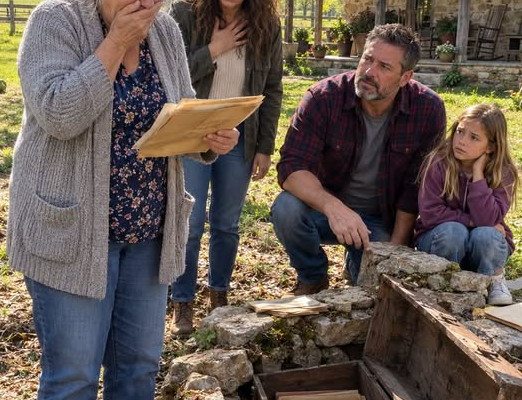
Sophia sat on the floor beside the open trapdoor, carefully stacking the old papers she’d discovered. She was humming softly, completely unaware that she might have just uncovered evidence of a terrible betrayal.
My hands began trembling.
“Mrs. Henrietta?” Carmen whispered. “Are you all right?”
I shook my head.
“I don’t know.”
I lowered my eyes to Randall’s letter.
His handwriting was familiar. The capital letters leaned slightly to the right, just as they had in every birthday card, anniversary note, and grocery list he’d written during our thirty-nine years together.
But the words were unlike anything I’d ever expected from him.
My dearest Henrietta,
If you are reading this, then I have failed to protect you while I was alive. For that, I am sorry.
I knew Andre had become increasingly interested in what would happen to our property after my death. At first, I believed he was simply worried about the future.
Then I discovered what he had been doing behind our backs.
Your son has been taking money from the family business for nearly three years.
I covered my mouth.
Andre?
Our Andre?
The little boy who used to fall asleep on Randall’s chest while they watched baseball?
The teenager who cried when his first dog died?
The young man we’d helped put through college?
I looked at the next paragraph.
When I confronted him, he told me the transfers were temporary loans. He promised to repay everything.
I wanted to believe him.
I was his father.
But the records told a different story.
I felt tears slipping down my cheeks.
Randall continued.
I discovered that Andre had transferred money into accounts controlled by companies he and Melissa established. By the time I understood the full amount, more than four hundred thousand dollars had been diverted.
My heart seemed to stop.
Four hundred thousand dollars.
For months before his death, Randall had been worried about the business.
He’d spent long evenings in his office.
Made calls behind closed doors.
Sometimes he seemed distracted during dinner.
When I asked what was wrong, he told me there were accounting issues.
I believed him.
I believed everything was under control because that was what we’d always done.
Randall handled the business.
I handled the home.
We trusted each other.
But now, reading his letter, I realized he’d been carrying a secret far heavier than I’d imagined.
I consulted an independent attorney and a forensic accountant. The documents are preserved, and copies exist outside this cabin.
I also changed my estate plan.
The will Andre presented to you was signed before I discovered the full extent of what had happened. It was later revoked and replaced.
My final estate documents protect you.
The originals are held by Attorney Evelyn Mercer in New Haven. Her contact information is included in this box.
I stopped reading.
“There’s another will,” I whispered.
Miguel looked at me.
“What?”
I lifted the letter.
“Randall left another will.”
Carmen pressed her hands against her chest.
“Oh, Mrs. Henrietta.”
I shook my head.
“No. You don’t understand.”
My voice cracked.
“I sat across from my own son and his wife. I begged them to explain why Randall would leave me with practically nothing.”
I swallowed.
“They looked me in the eyes and told me it was what my husband wanted.”
Carmen’s expression tightened.
I continued.
“Melissa laughed when she handed me the keys to this place.”
My eyes filled.
“She told me I belonged here.”
For several seconds, nobody spoke.
Then Sophia looked up from her papers.
“Grandma Henrietta?”
I’d told her she could call me Henrietta.
Somewhere during the past two weeks, she’d added Grandma herself.
“Yes, sweetheart?”
She held up a photograph.
“Is this your husband?”
I looked at it.
And my breath caught.
It was Randall.
Much younger.
Standing in front of the cabin with his arm wrapped around my shoulders.
I remembered that day.
June 1987.
We’d just finished repairing the porch.
Andre was only six.
Randall had insisted on taking a photograph because he said we’d look back someday and laugh about how proud we were of a cabin with a crooked roof.
Sophia turned the picture around.
“There are words on the back.”
I took it from her.
In Randall’s handwriting were six words.
The place where we started, Henrietta.
I began crying again.
Because suddenly I remembered something I’d nearly forgotten.
Randall hadn’t bought this cabin as an investment.
We’d purchased it together when we were young and nearly broke.
It was where we spent weekends before we could afford vacations.
Where Andre learned to fish.
Where we celebrated our tenth anniversary with grocery-store cake and a bottle of cheap wine.
Then the business grew.
The house became bigger.
Our lives became more comfortable.
And the cabin slowly disappeared from our daily routines.
But Randall had never forgotten it.
I looked down into the dark opening beneath the floor.
Whatever he’d hidden there wasn’t merely about money.
It was about the life we’d built together.
I took a breath and kept reading.
Henrietta, you may be angry that I did not tell you everything while I was alive.
You have every right to be.
I convinced myself that I could fix the situation quietly and spare you the pain of knowing what Andre had done.
That was a mistake.
I should have trusted you with the truth.
My tears fell onto the paper.
When my health began declining, I became afraid that Andre and Melissa would attempt to control the estate before you could understand what was happening.
I made arrangements to protect the evidence and completed a new will with an independent attorney.
I also established a trust for your benefit and transferred assets into it while I was still legally able to do so.
You were never meant to lose your home.
You were never meant to live in poverty.
And you were certainly never meant to believe I thought you’d lived comfortably long enough.
I made a sound I didn’t recognize.
Something between a sob and a gasp.
Those were Andre’s words.
He’d told me Randall believed I’d lived comfortably long enough.
I’d spent weeks replaying that sentence.
Wondering whether my husband secretly resented the life we’d built.
Whether he’d viewed my contributions as insignificant because I hadn’t worked in his business.
Whether the man I’d loved for thirty-nine years had decided I deserved nothing.
Now I understood.
Those words hadn’t come from Randall.
They’d come from my son.
And somehow, that hurt even more.
Carmen moved closer.
“Mrs. Henrietta, you need to sit down.”
I was already sitting on an overturned wooden crate, but my legs felt weak.
Miguel handed me a bottle of water.
I took a sip.
Then I read the final section.
Inside the metal case beneath the trapdoor are copies of the revised estate documents, financial records, and a recorded statement I made with my attorney.
Please contact Evelyn Mercer immediately.
Do not sign anything else until you have independent legal advice.
Do not confront Andre alone.
And whatever happens, remember this: the life we built was never mine alone.
You were beside me when we had nothing.
You worked, saved, sacrificed, and made our home the place our son grew up feeling safe.
I will never understand how Andre forgot that.
I love you, Henrietta.
I always have.
Your Randall.
I pressed the letter against my chest.
And cried.
For the man I had buried.
For the son I no longer recognized.
For the weeks I’d spent believing my marriage had ended with one final act of rejection.
And for the terrible possibility that Randall had known his own child might betray me.
Carmen held my hand.
Miguel quietly carried the remaining documents inside.
Sophia placed the photograph beside me.
Then she wrapped her little arms around my shoulders.
“Don’t cry, Grandma Henrietta.”
I kissed her forehead.
“I’ll be all right, sweetheart.”
She looked toward the cabin.
“Daddy says broken houses can be fixed.”
I laughed through my tears.
“He’s right.”
She smiled.
“Maybe broken hearts too.”
I looked at that little girl.
Eight years old.
Cold and hungry when I first found her.
Now sitting beside me in a cabin that had somehow connected our lives.
I hugged her tightly.
“Maybe, sweetheart.”
But I knew the next few days would not be easy.
That afternoon, I called Evelyn Mercer.
She answered on the third ring.
“Mercer Law Office.”
I swallowed.
“My name is Henrietta Whitcomb.”
There was a pause.
Then a woman’s voice became very quiet.
“Mrs. Whitcomb?”
“Yes.”
“Are you somewhere safe?”
The question startled me.
“I think so.”
She exhaled.
“Thank goodness.”
I could hear papers moving.
“Mrs. Whitcomb, I have been trying to reach you for weeks.”
My heart began pounding.
“What?”
“Your husband retained me several months before his death. I hold the original signed documents he prepared.”
I closed my eyes.
“Then why wasn’t I told?”
“I sent letters to the address he provided. They were returned. When I contacted the estate attorney listed in the public probate filing, his office told me you were receiving independent advice.”
I felt cold.
Robert Sterling.
Andre’s lawyer.
The man who had pushed the papers across the conference table and told me Randall had left almost everything to my son.
I swallowed.
“I wasn’t receiving independent advice.”
Evelyn became quiet.
Then she said, “Mrs. Whitcomb, I’d like you to come to my office tomorrow. Bring every document you signed and everything you found.”
I looked toward Carmen and Miguel.
Then asked, “Is the will they showed me invalid?”
“That is something we need to establish formally,” Evelyn replied. “But I can tell you this much: I personally supervised the execution of Randall’s later will, and he made his intentions very clear.”
My hands began shaking.
“What intentions?”
She paused.
Then said something I will never forget.
“Mrs. Whitcomb, your husband intended to provide for you for the rest of your life.”
I started crying.
Again.
It seemed I had done little else since Randall died.
But these tears were different.
For the first time, I wasn’t crying because my life had ended.
I was crying because there might still be a way forward.
Before hanging up, Evelyn added one more thing.
“Henrietta, please preserve the materials exactly as you found them. I’ll arrange for secure handling of the originals. We don’t want anyone later arguing that the records were altered.”
I nodded even though she couldn’t see me.
“Of course.”
Then I looked at Miguel.
“Could you take photographs of the hidden compartment before we remove anything else?”
He nodded.
“Already did.”
I stared at him.
He smiled.
“Construction habit. I photograph everything before opening a wall or floor.”
For the first time that day, I laughed.
Randall had hidden a secret beneath an old cabin.
And a homeless carpenter had found it because his little girl noticed the floor sounded funny.
Life was becoming stranger than anything I could have imagined.
The following morning, Carmen drove me to New Haven.
Miguel stayed with Sophia.
I carried Randall’s letter in my handbag.
The metal case and its contents had been carefully documented and secured according to Evelyn’s instructions.
My old Honda rattled all the way down the highway.
Carmen kept glancing toward me.
“Are you nervous?”
I nodded.
“Terrified.”
She smiled gently.
“You’ve already survived the worst part.”
I looked at her.
“Have I?”
She considered that.
Then answered honestly.
“I don’t know. But you’re not alone anymore.”
Those words stayed with me.
Evelyn Mercer’s office occupied the second floor of an old brick building.
She was in her late sixties, with silver hair pulled into a neat bun and glasses hanging from a chain around her neck.
She stood when we entered.
Then walked directly toward me.
“Henrietta.”
I nodded.
She took both my hands.
“Randall spoke about you constantly.”
My eyes filled.
“He did?”
She smiled sadly.
“He was very proud of you.”
That almost broke me.
For weeks, I’d been imagining my husband dying with resentment in his heart.
Now someone who’d spoken with him during his final months was telling me the opposite.
We sat in her office.
Evelyn opened a thick folder.
Then she explained what Randall had arranged.
The will Andre submitted was an older document.
It had been properly signed years earlier, when Randall still trusted Andre to manage the family business and protect me financially.
But three months before Randall died, he executed a later will.
He also amended his trust arrangements and transferred certain investments into a trust intended to support me.
The final documents named me as the primary beneficiary of substantial assets and included provisions for the family home.
Andre was still provided for.
Randall hadn’t disinherited him completely.
But he had sharply limited the control Andre would have over the estate.
And most importantly, he’d appointed an independent fiduciary rather than allowing Andre to manage everything.
I stared at Evelyn.
“Why?”
She looked at me carefully.
“Because your husband had uncovered serious financial irregularities involving your son.”
She opened another folder.
Inside were spreadsheets.
Bank statements.
Company records.
Copies of correspondence between Randall and Andre.
Evelyn pointed to several transactions.
“These were reviewed by an independent forensic accountant.”
I looked at the total.
$428,600.
My hands went cold.
“That’s what Andre took?”
“That’s the amount Randall’s accountant identified as potentially unauthorized or improperly documented at the time of the review.”
I swallowed.
“And Melissa?”
“There are records suggesting that companies associated with her received some of the funds. Whether those transfers were unlawful or recoverable will require further investigation.”
I nodded.
For the first time, I appreciated an attorney who didn’t promise more than she could prove.
Then Evelyn showed me something else.
A copy of a letter.
It had been sent to Robert Sterling’s office shortly before Randall died.
The letter informed Sterling that Randall had retained independent counsel and had executed updated estate documents.
At the bottom was a delivery acknowledgment.
I stared at the signature.
Someone at Sterling’s office had received it.
“Robert knew?” I whispered.
Evelyn folded her hands.
“He had been notified that later estate planning documents existed.”
My chest tightened.
“But he still told me the old will was Randall’s final decision.”
“That is what we’ll need to address with the probate court.”
I closed my eyes.
Evelyn continued.
“The estate has not been finally distributed. That’s important. Your son may be occupying the family home and acting as though everything has already been settled, but the legal process is not finished.”
I looked up.
“So he doesn’t own everything?”
“Not simply because he says he does.”
I started crying.
Carmen squeezed my shoulder.
Then Evelyn said something that made me sit very still.
“Henrietta, did you know you may also have had rights as a surviving spouse regardless of what the earlier will said?”
I shook my head.
“No one explained that to me.”
She nodded grimly.
“That’s why I want to review every document you signed, including any release or waiver. The circumstances of those signatures matter.”
I looked down.
In that sterile conference room three weeks after burying Randall, I’d signed because I thought I had no choice.
Because my son was watching.
Because his wife was smiling.
Because their expensive lawyer had spoken as though everything was already decided.
I had been frightened.
Exhausted.
Grieving.
And completely unprepared.
Evelyn looked at me.
“Henrietta, the fact that you signed something doesn’t automatically answer every legal question. We need to examine what you were told and whether the documents were obtained through misrepresentation.”
I swallowed.
“Can we challenge them?”
“Yes.”
She paused.
“But this will take time.”
I nodded.
“How much?”
“Months, possibly longer, depending on the disputes.”
I looked at Carmen.
She squeezed my hand again.
Then I turned back to Evelyn.
“I don’t care how long it takes.”
My voice trembled.
“I want the truth.”
Evelyn nodded.
“Then that’s where we’ll begin.”
Within a week, the legal notices reached Andre.
My phone rang fourteen times that afternoon.
I didn’t answer.
Then Melissa sent a message.
WHAT HAVE YOU DONE?
I stared at it.
For a moment, I remembered her sitting across from me in Sterling’s conference room.
Her manicured nails.
Her expensive perfume.
The little smile she wore while telling me I’d be better off living simply.
I typed one sentence.
I’ve retained my own attorney. Please direct any estate questions to her.
Then I put the phone down.
The next morning, Andre came to the cabin.
I was helping Carmen hang curtains when we heard a car approaching.
A black SUV stopped near the porch.
My son stepped out.
He wore an expensive wool coat and looked furious.
“Mom!”
I stood in the doorway.
“Hello, Andre.”
He stared at the repaired porch.
Then at the curtains.
Then at Carmen.
“What is going on here?”
I took a breath.
“I’m visiting.”
He frowned.
“Visiting?”
“Yes.”
He looked around.
“Where are your things?”
“Some are at the shelter. Some are in my car.”
His expression changed.
“The shelter?”
I watched his face.
For a moment, I wondered whether he’d show concern.
Whether he’d ask if I was safe.
Whether he’d apologize for leaving me with a cabin that barely had working plumbing.
Instead, he said, “You can’t tell people you’re homeless. Do you have any idea how that makes our family look?”
Something inside me went still.
I looked at him.
“Your concern is how it looks?”
He sighed.
“Mom, don’t start.”
I thought of Randall’s letter.
The financial records.
The old will.
The newer documents.
Then I looked at the man I’d raised.
“Andre, why didn’t you tell me your father changed his will?”
He froze.
Completely.
For a moment, he looked like the boy who used to get caught sneaking cookies before dinner.
Then he recovered.
“What are you talking about?”
I shook my head.
“Don’t.”
“Mom—”
“I know about Evelyn Mercer.”
His face drained.
“And the trust.”
He swallowed.
“And the money transferred out of the business.”
Andre stepped backward.
For several seconds, he said nothing.
Then he looked toward the cabin.
“How did you find those documents?”
I stared at him.
Not what documents?
Not that can’t be true.
His first question was how I’d found them.
That told me more than any confession could have.
I took a breath.
“Your father wanted me to have them.”
Andre shook his head.
“Dad was sick.”
“He obtained independent legal advice.”
“He wasn’t thinking clearly.”
“He had medical evaluations.”
Andre’s expression hardened.
“Mom, you’re getting involved in things you don’t understand.”
The words struck me like something physical.
I’d heard them so many times from him.
From Randall occasionally, when business matters became complicated.
From Robert Sterling.
From Melissa.
You don’t understand.
Leave it to us.
Trust the people who know better.
I looked directly at my son.
“Andre, I may not understand every corporate transaction.”
My voice grew firmer.
“But I understand that you put me in a house with no reliable heat.”
He looked away.
“I understand that you told me my husband thought I deserved nothing.”
His jaw tightened.
“And I understand that you watched me leave the home I raised you in while you knew there were newer estate documents.”
He opened his mouth.
I held up one hand.
“Don’t lie to me again.”
For a moment, I thought he might finally tell the truth.
Then he said, “You were never supposed to find any of this.”
The words came out quietly.
Almost by accident.
I stared at him.
Andre looked horrified by what he’d just said.
Then he began speaking rapidly.
“Mom, listen. Dad was confused. He got suspicious about some business transfers and started listening to people who didn’t understand how things worked.”
I remained silent.
He continued.
“Melissa and I have been trying to keep everything running. The company needs stability.”
“And I needed a home.”
He looked away.
I swallowed.
“Andre, did you know I was staying at a shelter?”
He didn’t answer.
“Did you?”
Finally, he whispered, “Melissa mentioned it.”
I felt my heart break.
My own son knew.
He knew I had nowhere stable to sleep.
And he hadn’t called.
Hadn’t offered help.
Hadn’t even checked whether I had enough money for my medications.
I looked at him for a long time.
Then asked the question I’d been afraid to ask.
“When did you stop caring whether I was okay?”
His face changed.
“Mom.”
I shook my head.
“No, Andre.”
Tears filled my eyes.
“I can understand financial desperation.”
“I can understand making a mistake.”
“I can even understand being frightened of your father’s anger.”
My voice broke.
“But I cannot understand knowing your mother is living in a shelter and deciding that protecting your money matters more.”
For a moment, he looked ashamed.
Then his expression hardened again.
“You always take Dad’s side.”
I stared at him.
Even now.
Even after everything.
He was making himself the victim.
I stepped back.
“You need to leave.”
“Mom—”
“Any further discussion goes through the attorneys.”
Andre stared at me.
Then looked toward Carmen, who had been standing quietly inside.
“And who exactly are these people?”
I felt anger rise.
“People who offered me kindness when my own family wouldn’t.”
His face reddened.
“You’re giving away family property to strangers?”
I took a breath.
“I’m making sure a little girl has somewhere warm to sleep.”
“That’s insane!”
I looked at him.
“No.”
My voice was steady.
“What’s insane is that strangers showed me more compassion in one afternoon than my own son showed me in three months.”
He flinched.
Then turned away.
He walked toward his SUV.
Before getting in, he looked back.
“Mom, you’re going to regret fighting us.”
I felt my knees weaken.
But I kept standing.
“Maybe.”
I took a breath.
“But I already regret trusting you.”
He drove away.
And I stood on that porch until the sound of his car disappeared.
Then Carmen came outside.
She put her arm around my shoulders.
I began crying.
Not because Andre had threatened me.
But because I’d just told my son something I never imagined I’d say.
That I regretted trusting him.
For thirty-six years, I’d loved that boy with everything I had.
And now I didn’t know whether the man he’d become would ever understand what he’d done.
The legal proceedings took eleven months.
There were hearings.
Financial reviews.
Arguments over documents.
Questions about Randall’s mental capacity.
And repeated attempts to delay the estate process.
Andre’s attorneys challenged the later will.
They questioned the trust.
They argued that Randall had become suspicious and confused during his illness.
But Evelyn had prepared carefully.
She had medical records showing Randall was capable of making decisions when he executed the revised documents.
She had independent witnesses.
She had the original signed will.
She had records showing that assets were properly transferred into the trust before Randall died.
And she had the documents discovered beneath the cabin.
The financial audit became especially important.
It showed patterns of transfers from the family business into related companies.
Some were supported by legitimate invoices.
Others were not.
Several had been authorized using signatures that required further investigation.
As the evidence developed, Andre’s legal position became increasingly difficult.
Robert Sterling’s conduct was also reviewed.
The court was informed about the later documents and the way the older will had been presented.
Questions concerning Sterling’s professional responsibilities were referred through the appropriate channels.
I wanted someone to stand up in court and declare the entire family guilty of everything.
But Evelyn reminded me that real legal proceedings rarely end like television dramas.
Different allegations required different evidence.
Some issues belonged in probate court.
Others involved civil claims.
And possible criminal conduct would have to be evaluated separately.
I hated how slowly it moved.
But I learned to value the carefulness.
Because for years, Andre and Melissa had counted on nobody examining anything too closely.
Now people were examining everything.
During those eleven months, my life changed in another way.
I stopped living at the shelter.
Not because I’d recovered my inheritance.
Not yet.
But because Carmen and Miguel refused to let me remain alone.
One afternoon, Carmen called.
“Mrs. Henrietta, please come by for dinner.”
I went.
When I arrived, Sophia opened the door.
“Grandma Henrietta!”
She ran into my arms.
Then she took my hand and led me inside.
The cabin was almost unrecognizable.
But not because someone had spent a fortune renovating it.
Because Miguel had repaired it with patience.
The roof no longer leaked.
The plumbing worked.
The windows closed properly.
The porch steps were sturdy.
Carmen had sewn inexpensive curtains and planted herbs in old containers near the kitchen window.
Sophia had made a paper sign for the front door.
OUR HAPPY CABIN.
I smiled when I saw it.
Then Carmen led me toward the little bedroom.
I stopped.
There was a clean bed.
A folded quilt.
A small lamp.
And Randall’s photograph resting on a bedside table.
I stared at her.
“Carmen?”
She smiled nervously.
“We thought you might like to stay here for a while.”
I shook my head.
“No. This is your home.”
Miguel stepped closer.
“You gave us a roof when we had nowhere to go.”
His voice softened.
“We’re not going to watch you sleep in a shelter while there’s a bedroom here.”
I began crying.
Carmen took my hand.
“Please, Mrs. Henrietta.”
I looked toward Sophia.
She was grinning.
“I helped make the bed!”
I laughed through my tears.
Then she added, “And the floor doesn’t talk anymore!”
That did it.
I laughed so hard I had to sit down.
And that evening, for the first time in weeks, I slept in a real bed.
Under a roof that didn’t leak.
In a room prepared by people who had every reason to be frightened about their own future.
They had almost nothing.
Yet they had made room for me.
That was something Andre and Melissa, surrounded by millions of dollars, had somehow forgotten how to do.
Miguel found steady work with a local construction company.
His supervisor quickly recognized his skills.
Within a few months, he was handling larger renovation projects.
Carmen began working at a daycare center.
She loved the children.
And Sophia started school.
The little girl who had been shivering beneath thin layers of clothing now came home with drawings, spelling tests, and stories about her classmates.
Every afternoon, she’d sit beside me at the kitchen table and tell me everything that happened.
Sometimes I helped with homework.
Sometimes we baked cookies.
Sometimes I simply listened.
And gradually, the cabin began feeling like home again.
Not the home Andre had intended me to disappear into.
A home filled with voices.
Laughter.
The smell of soup.
Shoes left beside the door.
And a little girl who thought I was the best storyteller in Connecticut.
One night, after Sophia went to sleep, Miguel sat beside me on the porch.
“Mrs. Henrietta, can I ask you something?”
“Of course.”
He looked toward the trees.
“Why did you give us the cabin?”
I thought about it.
Then smiled sadly.
“Because you needed it more than I did.”
He shook his head.
“But you needed somewhere to live too.”
I looked down.
“Yes.”
He waited.
Finally, I said, “When Andre took everything, I started believing maybe he was right.”
Miguel frowned.
“About what?”
“That I didn’t deserve much.”
My voice trembled.
“I spent almost forty years building a life, and suddenly my own son was telling me I had no claim to any of it.”
I looked toward the cabin.
“When I saw Sophia shivering, I realized I could still do something good with what little I had left.”
Miguel became quiet.
Then he said something I’ll never forget.
“Mrs. Henrietta, you didn’t have to give us your last home to prove you were a good person.”
I stared at him.
He continued.
“You already were.”
My eyes filled.
Then he added, “We would have been grateful for the soup.”
I laughed through my tears.
He smiled.
“But I’m glad we met.”
I reached for his hand.
“So am I.”
Nine months after we found the documents, Evelyn called with news.
“Henrietta, the court has accepted the later will for probate.”
I sat down.
For a moment, I couldn’t speak.
Evelyn continued.
“The court has also recognized the relevant trust arrangements. There are still accounting and recovery issues to resolve, but your position is no longer what Andre’s original attorney represented to you.”
My eyes filled.
“What does that mean for the house?”
She took a breath.
“It means we can move forward with restoring the rights Randall intended you to have, subject to the remaining estate administration.”
I began crying.
Carmen, who was standing beside the stove, turned around.
“Mrs. Henrietta?”
I covered the phone.
“It’s good news.”
Her face lit up.
Miguel came inside from the porch.
Sophia looked up from her homework.
Then I whispered into the phone, “Thank you, Evelyn.”
She paused.
“Henrietta?”
“Yes?”
“Your husband tried very hard to protect you.”
I closed my eyes.
“I know.”
Then she added gently, “But he also left you something important to do.”
I frowned.
“What?”
“To decide what kind of life you want now.”
That question stayed with me.
Because for months, I’d been fighting to recover what had been taken.
But I hadn’t spent much time imagining what I’d do afterward.
Did I want the mansion back?
The expensive furniture?
The enormous rooms?
The life I’d lived before Randall died?
I wasn’t sure anymore.
A few weeks later, I visited Maple Ridge.
It was the first time I’d been back since Andre and Melissa moved in.
The house looked almost exactly the same.
Tall stone columns.
Beautiful gardens.
A circular driveway.
The large oak tree Randall planted when Andre was twelve.
I stood outside for a long time.
Then Evelyn’s associate met me at the door.
The property was being inspected and accounted for as part of the estate process.
Andre and Melissa were no longer living there.
They had moved out after legal arrangements required them to relinquish control while the dispute was resolved.
I walked inside.
The marble foyer gleamed.
The grandfather clock stood beside the staircase.
The living room smelled faintly of furniture polish.
Everything looked expensive.
Everything looked familiar.
And yet, the house felt strangely empty.
I walked into the dining room.
The enormous table was still there.
I remembered Christmas dinners.
Birthday celebrations.
Andre’s graduation.
Randall’s retirement party.
The evening we celebrated paying off the mortgage.
I sat in Randall’s old chair.
And waited to feel happy.
But all I felt was tired.
For thirty-nine years, that house had been filled with memories.
Some wonderful.
Some painful.
But without Randall, it was just a very large building.
I looked around.
Then whispered, “What am I supposed to do with all this?”
Of course, nobody answered.
But something in me already knew.
I didn’t want to spend the rest of my life surrounded by expensive furniture, waiting for people who no longer cared whether I was lonely.
I wanted something smaller.
Warmer.
Somewhere I could open the door and hear somebody say, “Grandma Henrietta!”
For the first time, I realized that recovering my inheritance didn’t mean I had to return to the life I’d lived before.
It meant I finally had the freedom to choose.
Several months later, the remaining estate disputes were resolved.
The accounting established that Andre had improperly taken substantial funds from the family business.
He agreed to a financial settlement and repayment obligations rather than continue fighting certain civil claims.
The settlement also addressed the estate assets he’d controlled without proper authority.
Robert Sterling’s conduct remained subject to professional review.
I didn’t receive every dollar Randall had once possessed.
Some money had been spent.
Some had been tied up in business obligations.
And legal fees consumed more than I ever wanted to think about.
But I recovered enough to live securely.
Enough to pay for my medical needs.
Enough to stop worrying about whether I could afford groceries.
Enough to make decisions without asking my son for permission.
And when Evelyn reviewed the final accounting with me, she looked up and smiled.
“Henrietta, you have options.”
I stared at the papers.
Options.
Such a small word.
Such an extraordinary thing to have again.
I decided to sell Maple Ridge.
It took time.
I kept some of Randall’s belongings.
His glasses.
His favorite pen.
The old photographs.
A few pieces of furniture that mattered to me.
But I didn’t need the enormous dining table.
Or the expensive carpets.
Or the marble foyer.
I wanted memories.
Not monuments.
With part of my recovered inheritance, I bought a modest two-bedroom cottage just outside Beacon Falls.
It had a small garden.
A sunny kitchen.
And a front porch large enough for two rocking chairs.
Most importantly, it was only ten minutes from the old cabin.
Carmen cried when I told her.
“You’re staying nearby?”
I smiled.
“Of course.”
Sophia nearly knocked me over.
“Does your new house have room for sleepovers?”
I laughed.
“One guest bedroom.”
She gasped.
“That’s perfect!”
And it was.
But there was one more thing I needed to do.
I asked Evelyn to prepare the proper documents transferring ownership of the old cabin to Miguel and Carmen.
Not simply handing them keys.
Not making a promise at the kitchen table.
A legally completed transfer, with the condition of the property, taxes, and future responsibilities explained so they understood exactly what they were accepting.
When I told them, Miguel stared at me.
“Mrs. Henrietta, you don’t have to do that.”
I smiled.
“I know.”
Carmen began crying.
“We already have so much more than we did when we met you.”
I took her hand.
“And now I want you to have the security of knowing this home is truly yours.”
Miguel looked toward the kitchen.
Sophia was sitting at the table making a paper crown for her stuffed bear.
His eyes filled.
“She’ll never forget this.”
I shook my head.
“Neither will I.”
The transfer was completed the following spring.
When Evelyn handed them the documents, Carmen cried so hard that Miguel had to hold her.
Sophia didn’t understand every legal detail.
But she understood one thing.
The cabin was theirs.
She ran outside, lifted her arms toward the sky, and shouted,
“WE HAVE A HOUSE!”
I stood on the porch watching her.
For a moment, I remembered the first day I saw that little girl.
Shivering beside the trees.
Breaking her sandwich into tiny pieces.
Afraid to ask for more.
Now she was running across the yard of a home her parents owned.
And I realized that giving away the cabin had become one of the few decisions I’d made during the worst months of my life that I never once regretted.
There was still one painful matter left.
Andre.
For nearly a year, our only communication had gone through attorneys.
I hadn’t heard his voice since the afternoon he threatened me outside the cabin.
Then, one evening, he appeared at my new cottage.
I was watering the flowers when his car pulled into the driveway.
He stepped out slowly.
No expensive coat.
No confident expression.
Just my thirty-six-year-old son, looking exhausted.
“Mom?”
I set down the watering can.
“Hello, Andre.”
He stood near the car.
“Can we talk?”
I hesitated.
Then nodded toward the porch.
“Out here.”
He understood.
We sat in separate chairs.
For a long time, neither spoke.
Finally, Andre looked toward the garden.
“It’s nice.”
“Thank you.”
He swallowed.
“I heard you sold Maple Ridge.”
“Yes.”
He nodded.
Then looked down at his hands.
“Melissa and I separated.”
I felt a pang of sadness.
Not because I thought Melissa had treated me well.
But because I’d never wanted my son to be unhappy.
“I’m sorry to hear that.”
He gave a bitter little laugh.
“You don’t have to pretend.”
I looked at him.
“I’m not pretending.”
He became quiet.
Then said, “I’ve spent months thinking about what happened.”
I waited.
He rubbed his face.
“I blamed Dad for everything.”
My chest tightened.
“I told myself he never trusted me.”
“He always thought I needed supervision.”
“He never let me make decisions without questioning them.”
I looked toward the yard.
“Andre, he trusted you with a lot.”
“I know.”
His voice broke.
“But I wanted more.”
He stared at his hands.
“I wanted him to think I was as successful as he was.”
I swallowed.
“So you took money?”
He nodded.
“At first, I thought I could put it back before anyone noticed.”
He paused.
“Then the investments failed.”
I closed my eyes.
He continued.
“Melissa kept saying we needed one more chance. One more deal. One more loan.”
His eyes filled.
“And I couldn’t admit I’d messed everything up.”
I looked at him.
“So you decided I should lose my home?”
His face crumpled.
“No.”
I waited.
Then he whispered, “Yes.”
For the first time, he wasn’t trying to make the answer sound better.
He wiped his face.
“I knew the later will existed.”
I felt my chest tighten.
“I know.”
“I told myself it wasn’t valid.”
His voice broke.
“I told myself Dad had become confused.”
He looked up.
“But I knew what he wanted.”
Tears filled my eyes.
“Then why, Andre?”
He began crying.
“Because I thought if everything went to me, I could fix the business and nobody would ever know what I’d done.”
I stared at him.
“And your mother?”
He covered his face.
“I convinced myself you’d manage.”
I felt the words like a physical blow.
I’d manage.
Sixty-two.
Widowed.
Arthritis.
A heart condition.
A broken cabin.
A shelter.
My own son had looked at that future and told himself I’d manage.
I took a long breath.
“Did you know I was sleeping at St. Mary’s?”
He nodded.
“Yes.”
A tear slid down my cheek.
“And you didn’t come?”
His shoulders shook.
“No.”
For several seconds, I couldn’t speak.
Then I said something I’d been carrying for more than a year.
“I would have helped you, Andre.”
He looked up.
“If you’d told me you were in financial trouble, I would have listened.”
I wiped my eyes.
“I might not have agreed to give you money. I might have told you to close the business. I might have insisted we speak with your father together.”
My voice broke.
“But I would never have left you sleeping in a shelter.”
Andre began sobbing.
I let him cry.
Because there was nothing I could say to make that truth easier.
After a while, he whispered, “I’m sorry, Mom.”
I looked at him.
Part of me wanted to reach across the porch and hold him.
He was still my son.
I remembered his tiny hands.
His first steps.
The way he’d called for me when he was sick.
But I also remembered the conference room.
Melissa laughing.
Andre avoiding my eyes.
And the day I discovered he knew I was homeless.
“I hear your apology,” I said.
He looked up hopefully.
“But I can’t pretend everything is okay.”
He nodded slowly.
“I understand.”
“You hurt me in ways I don’t know how to repair.”
Tears rolled down his cheeks.
“I know.”
“And I need time.”
He looked down.
“I’ll give you that.”
I took a breath.
“Then start by keeping the agreements you’ve made. Be honest. Build a life that doesn’t require deceiving someone else.”
He nodded.
“I will.”
I wanted to believe him.
Perhaps someday I would.
But for the first time in my life, I understood that loving my son didn’t require immediately trusting him again.
He stood to leave.
Then stopped near the porch steps.
“Mom?”
“Yes?”
“Did Dad really leave you a letter?”
I looked toward the window.
Inside, Randall’s photograph stood on the mantel.
“Yes.”
Andre swallowed.
“Did he say anything about me?”
I thought about the letter.
About Randall’s disappointment.
His fear.
His love.
Then I answered carefully.
“He said he loved you.”
Andre began crying again.
I continued.
“And he said he hoped you would eventually become a man who understood that having money isn’t the same as having character.”
Andre covered his face.
For a moment, I thought he might collapse.
Then he nodded.
“I hope I can.”
I looked at him.
“So do I.”
He left.
I watched his car disappear down the road.
Then I went inside.
I sat beside Randall’s photograph.
And cried for the son I had loved, the man he’d become, and the relationship I didn’t know whether we’d ever recover.
The next morning, Sophia arrived at my cottage carrying a plastic container.
“Grandma Henrietta!”
I opened the door.
She held it up proudly.
“Mom made you muffins!”
I laughed.
“Did she?”
“Yes!”
She leaned closer.
“And I helped.”
I raised an eyebrow.
“Should I be worried?”
She gasped dramatically.
“No!”
I laughed and hugged her.
Behind her, Carmen stood smiling.
Miguel was carrying a small toolbox.
“Morning, Mrs. Henrietta.”
I looked at the toolbox.
“What’s that for?”
He grinned.
“Your porch step squeaks.”
I shook my head.
“Miguel, I can hire someone.”
“I know.”
He smiled.
“But I’m already here.”
My eyes filled.
That was how they were.
They never made grand promises.
They simply showed up.
If my faucet leaked, Miguel helped me fix it.
If Carmen made too much soup, she brought me a container.
If Sophia had a school project, she came to my kitchen because she insisted my table was the best place to do homework.
And every Sunday, we ate dinner together.
Sometimes at their cabin.
Sometimes at my cottage.
Nothing fancy.
Just food.
Conversation.
Laughter.
And a little girl who had somehow become the granddaughter I hadn’t known I needed.
One evening, about two years after Randall’s death, we gathered at the cabin for Sophia’s tenth birthday.
Miguel had built a picnic table near the trees.
Carmen decorated it with paper flowers.
Sophia requested chocolate cake with strawberries.
I brought candles.
After dinner, Sophia opened her presents.
Then she handed me an envelope.
I laughed.
“Sweetheart, it’s your birthday. Why are you giving me something?”
She grinned.
“Because I made it.”
Inside was a drawing.
The cabin.
The porch.
The woods.
And four people standing in front.
Miguel.
Carmen.
Sophia.
And me.
Above the house, she’d written:
THE FAMILY WHO FOUND EACH OTHER.
I stared at it.
My eyes filled.
Sophia climbed into my lap.
“Do you like it?”
I hugged her tightly.
“I love it.”
She pointed toward the drawing.
“Daddy says this house was almost broken.”
I smiled.
“It was.”
“And he fixed it.”
“Yes.”
She looked up at me.
“Mommy says you helped fix us.”
My throat tightened.
Then she added something that made all three adults start crying.
“But we fixed you too, Grandma Henrietta.”
I held her close.
And for the first time in a very long while, I felt something I hadn’t experienced since Randall died.
Complete peace.
Not because every problem had disappeared.
Andre and I still had a long road ahead.
My heart condition hadn’t magically improved.
I still missed Randall every day.
And sometimes, in the quiet moments, grief caught me by surprise.
But I had a home.
Security.
People who cared whether I ate dinner.
People who noticed when I was tired.
People who didn’t treat my kindness as weakness.
And that was more than I’d dared hope for when I first arrived at the old cabin.
A few weeks later, I visited Randall’s grave.
I brought flowers.
Not expensive ones.
Just the yellow daisies he always bought me when he remembered our anniversary at the last minute.
I knelt carefully beside the headstone.
“Hello, sweetheart.”
The cemetery was quiet.
A light breeze moved through the trees.
I brushed a few fallen leaves from the stone.
Then I told him everything.
About Evelyn.
The later will.
The financial investigation.
The cabin.
Miguel’s repairs.
Carmen’s kindness.
Sophia’s birthday drawing.
And the little cottage I’d bought.
I told him about Andre too.
How he’d apologized.
How I wasn’t ready to forgive everything.
How I still hoped he would become the man we’d tried to raise.
For a while, I simply sat there.
Then I took the old brass key from my handbag.
The one Randall had left beneath his glasses and favorite pen.
The one attached to that tiny slip of paper.
Beacon Falls.
I held it in my palm.
And smiled through my tears.
“Randall, you knew I’d find the cabin.”
My voice trembled.
“But I don’t think you knew what else I’d find.”
I thought about the cold morning when I saw Miguel, Carmen, and Sophia near the tree line.
Three strangers.
Hungry.
Frightened.
With nowhere warm to sleep.
I had been frightened too.
Maybe more than they knew.
I’d lost my husband.
My home.
My financial security.
And almost everything I believed about my family.
Yet when I saw Sophia shivering, I couldn’t turn away.
I gave them soup.
Then I gave them shelter.
Eventually, I gave them the cabin.
At the time, I thought I was surrendering the last thing Randall had left me.
I had no idea that beneath those floorboards was the truth that could help me reclaim my future.
I looked toward his headstone.
“I think you would’ve liked them.”
A tear rolled down my cheek.
“Especially Sophia.”
I laughed softly.
“She asks more questions than you ever did.”
Then I placed my hand against the stone.
“Thank you for trying to protect me.”
I paused.
“But I wish you’d trusted me enough to tell me everything while you were here.”
The words surprised me.
For months, I’d been so grateful for Randall’s hidden documents that I hadn’t allowed myself to feel angry about the secrets.
But love and disappointment can exist together.
Randall had protected evidence.
He’d made legal arrangements.
He’d tried to ensure my future.
Yet he’d also carried problems alone because he thought shielding me was the same as protecting me.
I wished we’d had those conversations together.
I wished he’d told me Andre was struggling.
I wished we’d had the chance to face it as husband and wife.
We couldn’t change any of that now.
But I could learn from it.
I could stop allowing other people to decide what I was capable of understanding.
I could ask questions.
Read documents.
Manage my finances.
And build relationships where honesty mattered more than keeping up appearances.
I sat beside Randall’s grave until the sun began to dip behind the trees.
Then I stood.
Slowly.
Carefully.
And drove home.
Today, I’m sixty-five.
I live in a little cottage outside Beacon Falls.
My arthritis still bothers me on cold mornings.
I take my heart medication faithfully.
And I still think Randall would complain about how much I spend on flowers.
But I’m happy.
Not every minute.
Not every day.
Grief doesn’t disappear simply because life becomes kinder.
Some mornings I wake up and reach toward the empty side of the bed.
Some evenings I see a television program Randall loved and think about calling him into the room.
Then I remember.
And the sadness returns.
But now I have people who notice.
Carmen calls.
Miguel stops by.
Sophia arrives with a new school project or a story she absolutely must tell me.
And sometimes, when my heart feels especially heavy, I drive to the old cabin.
I sit on the porch.
Listen to the birds.
And watch the little girl who once shivered in the cold run laughing through the yard.
The floor no longer talks.
Miguel fixed the loose boards.
The trapdoor remains, but the hidden compartment is empty now.
All the documents were handled through the legal process.
The secret has been brought into the light.
But Sophia still points to that spot whenever somebody new visits.
“That’s where we found Grandma Henrietta’s treasure!” she announces.
I always laugh.
Because people assume she’s talking about money.
The lost inheritance.
The secret will.
The financial records.
And yes, those documents helped restore the security Randall intended for me.
But when I think about the greatest treasure that old cabin gave me, I don’t think about the estate.
I think about a family who had almost nothing and still found room for me.
I think about Miguel standing in the kitchen with his toolbox.
Carmen bringing me soup.
Sophia climbing into my lap.
And a little girl’s drawing of four people standing beside a cabin beneath the words:
THE FAMILY WHO FOUND EACH OTHER.
My son once told me Randall believed I’d lived comfortably long enough.
Melissa laughed and said the broken cabin was where I belonged.
For a while, I believed them.
I believed I was an old woman whose value had ended when her husband’s life did.
I believed there was nothing left for me except a leaking roof, an unreliable stove, and whatever kindness strangers might be willing to offer.
But I was wrong.
I wasn’t worthless.
I wasn’t helpless.
And I wasn’t finished.
I had spent thirty-nine years building a life with Randall.
That life mattered.
My contribution mattered.
And when my son tried to erase it, the truth eventually came to light.
Not because I had powerful connections.
Not because I knew how to fight expensive attorneys.
But because my husband had preserved evidence, an independent lawyer helped me understand my rights, and a little girl noticed that one floorboard sounded different from the rest.
Sometimes I wonder what would have happened if Sophia hadn’t heard that hollow sound.
Would the documents have remained hidden?
Would I have stayed at the shelter?
Would Andre have succeeded in keeping everything?
I don’t know.
And I’ve learned not to build my life around questions I can never answer.
What I do know is this.
I saw a hungry family standing in the cold.
I invited them inside.
And when they had nowhere to go, I offered them the only shelter I thought I had left.
I didn’t know they would uncover Randall’s secret.
I didn’t know they’d help me regain my inheritance.
I didn’t know they’d become the family I needed most.
I simply knew a little girl was cold.
And I had a door I could open.
Last Sunday, Sophia came running into my cottage with a new drawing.
This one showed two houses.
The old cabin.
And my little yellow cottage.
Between them, she’d drawn a winding road covered with flowers.
I smiled.
“What’s this?”
She pointed proudly.
“That’s our road.”
I laughed.
“Your road?”
She nodded.
“The road from our house to yours.”
Then she climbed into my lap.
“Grandma Henrietta, do you know what my teacher said?”
“What?”
“She said family isn’t always the people you were born with.”
I felt my throat tighten.
Sophia continued.
“She said sometimes family is the people who take care of each other.”
I hugged her.
“Your teacher sounds very wise.”
Sophia smiled.
Then asked, “So we’re really family, right?”
I looked at the little girl who had once been shivering beneath a thin jacket.
The child who’d found the hidden trapdoor.
The child who’d helped bring the truth about my husband into the light.
I kissed her forehead.
“Sweetheart, we have been family since the day you walked through that door.”
She smiled.
Then wrapped her arms around my neck.
And in that moment, I understood something I wished I’d known when I sat penniless in that conference room.
The people who inherit your possessions are not always the people who deserve a place in your heart.
And sometimes the family you choose becomes the family that helps you survive.
Andre inherited my trust and nearly destroyed it.
Miguel, Carmen, and Sophia received my last possession and gave me something I hadn’t known I was missing.
A reason to look forward to tomorrow.
I gave them a broken cabin because they needed somewhere to belong.
They helped me rebuild my life because they believed I belonged somewhere too.
And when I look back on everything that happened, I no longer think of that cabin as the place my son sent me to disappear.
I think of it as the place where my life began again.
My son thought he’d left me with nothing.
But the last thing he allowed me to keep turned out to be the place where I found the truth, recovered my future, and discovered a family who loved me without asking what I could give them.
And that was a kind of wealth no one could ever take away.