PART 2 — My Husband Gave His Daughter Our House. Then the Man Who Prepared the Deed Arrived.
“Gary, before you hand your daughter anything else, I think you should explain what took place at the county recorder’s office back in 2015.”
The entire backyard went silent.
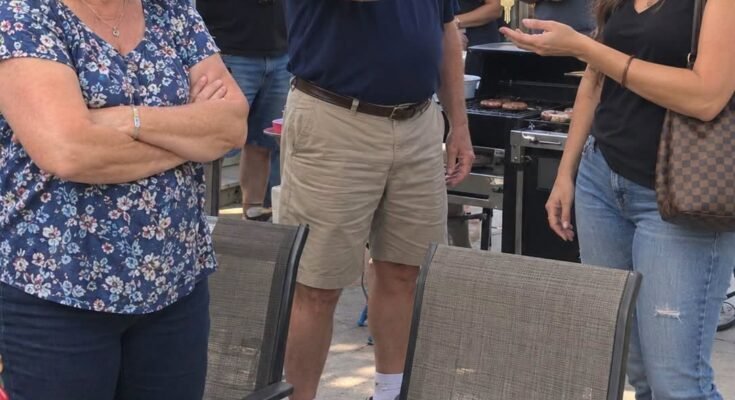
My husband stood beside the barbecue grill, staring at the man who had just stepped out of the white pickup.
His beer bottle slipped from his hand.
It hit the patio and shattered.
Nobody moved.
Brittany looked from her father to our visitor.
“Dad? Who is this?”
The older gentleman adjusted his glasses.
“My name is Walter Bennett. I handled some property documents for your father and Linda eleven years ago.”
Gary’s face had gone pale.
“Walter, this is a family gathering.”
Walter nodded pleasantly.
“I can see that.”
“Then perhaps we should discuss this privately.”
I stepped forward.
“That’s interesting, Gary.”
He looked at me.
“You didn’t think our property arrangements needed to be discussed privately when you announced them to twenty-three people.”
His jaw tightened.
“Linda, don’t start.”
I gave him a small smile.
“I’m not starting anything. I’m asking you to finish the announcement.”
Brittany gripped the keys her father had handed her.
“What announcement?”
Walter looked toward me.
I nodded.
He opened his leather folder and removed a document.
“Brittany, did your father tell you this property was going to be yours?”
She glanced at Gary.
“Yes. He said it’s my inheritance.”
Walter nodded.
“And did he tell you whose name is currently on the recorded deed?”
Brittany frowned.
“His, obviously. It’s his house.”
Walter didn’t answer immediately.
He simply turned the document around.
Then pointed to a name.
LINDA MARIE HARRIS.
My name.
Only my name.
For several seconds, Brittany stared at the paper.
Then she laughed.
“That’s impossible.”
Gary closed his eyes.
Walter continued.
“On June 18, 2015, Gary signed a deed transferring his ownership interest in this property to Linda. It was recorded with Greene County.”
He looked toward my husband.
“Gary, you remember signing those documents, don’t you?”
Gary said nothing.
“Dad?” Brittany demanded.
My husband finally spoke.
“That was a long time ago.”
Walter nodded.
“Eleven years.”
Gary rubbed his forehead.
“It was a financial arrangement.”
“Yes,” Walter replied. “And a legally documented one.”
Brittany’s expression changed.
She looked at me.
“Wait. You’re telling me this is your house?”
I took a breath.
“Yes.”
“Just yours?”
“That’s what the current deed says.”
She turned toward Gary.
“But you told me—”
“I know what I told you,” he snapped.
I looked around.
The guests who had been applauding only minutes earlier were suddenly studying their shoes, paper plates, and half-eaten hamburgers.
My sister-in-law, Carol, slowly lowered her plastic cup.
Gary’s brother Frank cleared his throat.
“Well, I suppose we should let Linda explain.”
That was the first sensible thing anyone had said all afternoon.
I looked toward Walter.
“Thank you for coming.”
He nodded.
“Of course.”
Then I turned toward the people gathered in my backyard.
“I think there’s something everyone needs to understand.”
My voice remained calm.
“This house has been my home for twenty-eight years.”
I looked toward the wooden porch Gary and I had painted together one summer.
“The mortgage payments came out of our household income. Repairs, taxes, insurance, maintenance. We handled those responsibilities over decades.”
I swallowed.
“But in 2015, something happened that changed how we arranged ownership.”
Gary immediately interrupted.
“Linda, that’s private.”
I looked at him.
“So was my future living arrangement until you decided to announce it over hamburgers.”
He fell silent.
Brittany looked increasingly confused.
“What happened in 2015?”
I took a breath.
“Your father gave you forty-two thousand dollars.”
Her expression froze.
The guests became quiet again.
I continued.
“You wanted to open a boutique. You said you’d found the perfect location and needed help with the lease, inventory, and renovation.”
Brittany swallowed.
“That was between Dad and me.”
“No, Brittany.”
I shook my head.
“It became my business when the money came out of the savings Gary and I had spent years building.”
Gary looked away.
I remembered that year so clearly.
I was fifty years old.
Working full-time at the dental office.
Coming home with aching feet and a bag full of insurance paperwork I’d volunteered to organize for the dentist.
Gary was still driving delivery trucks.
We had been saving for retirement.
Our mortgage balance was finally becoming manageable.
And I believed we were doing well.
Then I opened our savings statement.
Forty-two thousand dollars was gone.
At first, I thought there had been an error.
Then Gary told me he’d given the money to Brittany.
He called it an investment.
A chance for his daughter to build something.
He said the boutique would succeed.
He said we would get the money back.
He said I was being unreasonable when I became upset.
The boutique closed eighteen months later.
We never received the money back.
But that wasn’t the worst part.
The worst part was discovering that Gary had started discussing a home-equity loan to help Brittany with additional business expenses.
Without telling me.
I had spent seventeen years helping pay for that house.
And suddenly, my husband was treating the roof over our heads like another financial resource he could offer his daughter.
I looked toward Brittany.
“Your father wanted to borrow against the house to keep your business running.”
Her mouth opened.
Then closed.
“I didn’t know that.”
I believed her.
She had always known her father gave generously.
But I doubted she’d understood how close he had come to risking our retirement security.
I turned toward Gary.
“And when I refused, you told me I was choosing money over family.”
His face reddened.
“Linda, I was trying to help my child.”
“I know.”
My voice softened.
“But you were using assets we’d built together, and you weren’t asking me.”
Walter stepped forward.
“That’s when Gary and Linda came to my office.”
He glanced at Brittany.
“They wanted to resolve a serious financial disagreement.”
Gary looked at the ground.
I continued.
“My mother had passed away the year before. She left me an inheritance.”
My voice tightened.
“It wasn’t a fortune. But it was enough to make a substantial payment toward our remaining mortgage.”
I looked around our backyard.
“I agreed to use that inheritance to help secure our home, but only if Gary stopped treating the property as something he could risk or promise away without my consent.”
Walter nodded.
“The two of them obtained legal advice and agreed on a property arrangement. Gary voluntarily transferred his ownership interest to Linda. The deed was properly executed and recorded.”
He closed the folder.
“The home remained subject to any applicable mortgage obligations, but the title was transferred.”
Brittany stared at her father.
“You signed the house over to Linda?”
Gary swallowed.
“Yes.”
“When?”
“2015.”
She looked down at the keys in her hand.
Then whispered, “Why didn’t you tell me?”
Gary said nothing.
And that silence told me something important.
He hadn’t forgotten.
He knew exactly what he had signed.
He simply assumed that if he made another promise loudly enough, I would be too embarrassed to challenge him.
After all, that had worked for years.
Then Brittany said something that made my stomach tighten.
“But Dad, I’ve already told my landlord I’m moving out.”
I stared at her.
“What?”
She looked at me.
“My lease ends next month.”
The backyard seemed to shift beneath my feet.
Gary had announced the house would eventually belong to his daughter.
But apparently, he hadn’t told everyone the entire plan.
“Brittany,” I said carefully, “are you planning to move in here?”
She hesitated.
Then looked toward Gary.
He wouldn’t meet her eyes.
I felt cold.
“Gary?”
My husband exhaled.
“We were going to talk about it.”
I almost laughed.
“When?”
He said nothing.
“Before or after she arrived with her furniture?”
Carol made a small sound behind me.
Brittany’s face turned red.
“Dad said you two didn’t need all this space anymore.”
I stared at her.
Three bedrooms.
A kitchen.
A living room.
One little guest room I used for sewing.
The place where I had raised a family, hosted Christmas dinners, and spent nearly three decades building a life.
Apparently, at sixty-one, I no longer needed the space I’d worked to pay for.
“What exactly did Gary promise you?” I asked.
Brittany shifted her weight.
“He said I could have the house.”
“Yes, we heard that part.”
She looked uncomfortable.
“And that you two could eventually move somewhere smaller.”
I turned toward my husband.
“Somewhere smaller?”
Gary tried to smile.
“Linda, we’ve talked about downsizing.”
“No, Gary.”
My voice was steady.
“You’ve talked about downsizing.”
He looked irritated.
“It’s just practical.”
“Then perhaps you should have asked whether I wanted to move.”
He opened his mouth.
I continued.
“Did you tell Brittany I had agreed?”
Silence.
“Gary?”
Finally, he whispered, “I told her you’d understand.”
I looked at him.
For thirty-one years, I had listened to those words.
Linda will understand.
When Brittany needed money.
When Gary invited relatives to stay without checking with me.
When he lent our truck to his nephew.
When he promised to pay for expenses we hadn’t budgeted.
I would understand.
And when I didn’t, he acted as though my disappointment was the real problem.
I looked down at the keys in Brittany’s hand.
Then asked quietly, “Did he tell you I could still visit?”
She stared at me.
Her face reddened.
“I didn’t mean it like that.”
“How did you mean it?”
She swallowed.
“I just wanted you to know you would always be welcome.”
I felt something inside my chest tighten.
Welcome.
In my own home.
A place I had spent almost three decades maintaining.
A place where I had scrubbed floors, painted walls, replaced broken appliances, and worked extra shifts to afford repairs.
And now my stepdaughter was assuring me I could visit.
I looked at her.
“Brittany, do you understand how that sounded?”
Her eyes filled.
She didn’t answer.
Walter quietly closed his folder.
“I think I’ve provided the information Linda asked me to bring.”
He looked at Gary.
“And just to be clear, handing someone keys does not give them ownership. Any future transfer would require the proper legal steps and the authority of the owner.”
Gary nodded miserably.
Walter then turned toward me.
“Linda, if you have questions about your current rights or any future planning, please speak with your attorney. This document establishes the recorded title, but any broader marital property questions deserve proper legal advice.”
I appreciated that.
Walter wasn’t there to threaten my husband or humiliate my stepdaughter.
He was there to make sure facts weren’t replaced by assumptions.
He shook my hand.
Then returned to his pickup.
As he drove away, the entire backyard remained silent.
Finally, Frank stood.
“Well,” he said awkwardly, “I think we should give these two some privacy.”
For once, Gary didn’t argue.
The barbecue ended twenty minutes later.
Relatives gathered their children.
Collected purses.
Returned borrowed serving dishes.
Some hugged me.
Others avoided eye contact.
Carol squeezed my shoulder.
“Linda, I’m sorry.”
I nodded.
“Thank you.”
Brittany stayed behind.
She stood near the patio table staring at the keys.
Then she walked toward me.
“Linda?”
“Yes?”
“Can we talk?”
I looked toward Gary.
He was sitting alone beside the grill.
The broken beer bottle had been cleaned up.
His face looked exhausted.
“Not tonight, Brittany.”
She swallowed.
“But—”
“I’ve spent the afternoon having my future announced to twenty-three people without my consent. I need a little time before discussing it.”
Her eyes filled.
Then she nodded.
“Okay.”
She placed the keys on the table.
And left.
When the last car disappeared down the driveway, Gary finally approached me.
For several seconds, neither of us spoke.
Then he said, “You really embarrassed me today.”
I stared at him.
Of all the things he could have said.
That was what he chose.
“You embarrassed yourself, Gary.”
He shook his head.
“You brought Walter here in front of everybody.”
“Because you announced that our home would belong to Brittany in front of everybody.”
He looked away.
“I was trying to give my daughter some security.”
I took a breath.
“And what about mine?”
He looked at me.
“What?”
“My security, Gary.”
I felt my voice shaking.
“Have you thought about what happens to me if you die?”
He frowned.
“Of course.”
“Then why did you tell Brittany she’d get the house?”
He hesitated.
“She’s my only child.”
I stared at him.
There it was.
The truth beneath all the explanations.
Brittany was his daughter.
His blood.
His responsibility.
And somewhere in Gary’s mind, that meant she deserved more consideration than the woman who had spent nearly three decades beside him.
I nodded slowly.
“And what am I?”
His face changed.
“Linda.”
“No. Answer me.”
I looked straight into his eyes.
“What am I to you?”
“My wife.”
I swallowed.
“Then why did you treat me like a temporary guest in my own marriage?”
He had no answer.
For a moment, I waited.
Hoping.
Even then.
Hoping he’d finally understand.
Instead, he said, “Brittany’s going through a hard time.”
I closed my eyes.
“So am I, Gary.”
He looked surprised.
I almost laughed.
Of course he was surprised.
I’d spent years making sure he never had to see how tired I was.
I handled the budget.
The repairs.
The insurance renewals.
The medical appointments.
The family birthdays.
The holiday meals.
Even after retiring from the dental office, I seemed to have an endless list of things everyone expected me to manage.
I’d become so good at taking care of our life that Gary apparently believed our life maintained itself.
I looked toward the house.
“I’m tired.”
He stepped closer.
“Linda—”
“No.”
I raised one hand.
“I don’t mean physically.”
My eyes filled.
“I’m tired of being told family means I should give whatever somebody else wants.”
“That’s not fair.”
I looked at him.
“Neither was today.”
He lowered his eyes.
For the first time, he seemed to have nothing left to say.
That night, Gary slept in the guest room.
Not because I ordered him there.
Because he took one look at my face and understood I didn’t want him beside me.
I lay awake until nearly three in the morning.
Listening to the house settle.
The refrigerator humming.
A truck passing on the road.
The familiar sounds of a home I’d lived in for twenty-eight years.
And I kept thinking about one sentence.
You can still come visit whenever you like.
I thought of every mortgage payment.
Every repair.
Every Christmas morning.
The year Gary broke his ankle and I handled everything while he recovered.
The summer our air conditioner failed and I worked overtime to help replace it.
The years we both worried about retirement.
And suddenly, I realized that Brittany hadn’t invented the idea that the house was hers.
Gary had taught her that.
He had spent years speaking about our assets as though they were his decisions to make.
And I had allowed it because challenging him always created an argument.
The next morning, I called my attorney.
Her name was Susan Miller.
She’d helped me with estate planning after my mother died.
When I explained what had happened, she listened carefully.
Then she said, “Linda, we need to review your entire estate plan.”
I agreed.
We went through the deed.
The mortgage history.
Our retirement accounts.
The existing wills.
Everything.
Susan explained that the deed showed me as the sole titled owner, but that marriage and estate law could raise additional questions if we separated or if either of us died. She recommended addressing those issues carefully rather than relying on assumptions.
That was exactly what I wanted.
No threats.
No surprises.
Just an accurate understanding of what belonged to whom and what each of us had the legal right to decide.
Then I asked something that surprised even me.
“Susan, how do I make sure nobody moves into my home without my permission?”
She paused.
“Has your husband invited someone to move in?”
“Yes.”
“Has anyone moved in yet?”
“No.”
“Then let’s address it before that happens.”
We discussed practical steps.
I made it clear to Gary in writing that I did not consent to Brittany moving into the property.
I also arranged to have the spare keys accounted for and told him that no copies were to be distributed without agreement.
I wasn’t trying to make my husband homeless.
I wasn’t trying to punish his daughter.
I was making sure the home didn’t become the subject of another unilateral decision.
That afternoon, Brittany called.
I answered.
“Hello.”
“Linda.”
Her voice sounded smaller than usual.
“Can I come over?”
I hesitated.
“Why?”
“I want to talk without Dad.”
I considered it.
Then said, “Tomorrow afternoon.”
She arrived at two.
No expensive handbag.
No dramatic entrance.
Just jeans, a plain sweater, and an expression I hadn’t seen on her before.
Uncertainty.
We sat at the kitchen table.
The same table where she’d done homework when she was nine.
The same table where I’d helped her fill out college applications.
The same table where we’d eaten birthday cake and wrapped Christmas gifts for years.
Brittany looked around.
Then said quietly, “I didn’t know about the deed.”
“I believe you.”
She looked down.
“But I knew you hadn’t agreed to give me the house.”
That surprised me.
I waited.
She continued.
“Dad kept saying he could convince you.”
My throat tightened.
“And you went along with it.”
She nodded.
“Yes.”
I took a breath.
“Why?”
She stared at her hands.
“Because I wanted it.”
The honesty startled me.
Brittany continued.
“My apartment is getting expensive. I’m tired of renting. My friends are buying houses, and I feel like everybody’s moving forward except me.”
She looked toward the window.
“Dad said this place would be mine eventually.”
I nodded.
“And you thought that meant you could move in now.”
“Yes.”
She wiped her face.
“I didn’t think much about what would happen to you.”
I let the silence sit between us.
Then she looked up.
“I know that sounds terrible.”
“It does.”
Her eyes filled.
I continued.
“Brittany, I’ve loved you since you were nine.”
She began crying.
“I know.”
“I helped you with school.”
“Drove you to appointments.”
“Made birthday cakes.”
“Sat through dance recitals.”
I swallowed.
“I never expected you to call me Mom.”
“I know.”
“And I never asked you to forget your mother.”
She shook her head.
“You didn’t.”
“But I thought that after twenty-nine years of knowing me, you would at least understand that this is my home too.”
She covered her mouth.
I took a breath.
“Then you stood in my backyard and told me I could visit.”
Brittany began sobbing.
“I know.”
“Do you understand how much that hurt?”
She nodded.
“I do now.”
For a long time, neither of us spoke.
Then she whispered, “I’m sorry.”
I looked at her.
Not because I wanted to punish her.
Because I needed to know whether she understood what she was apologizing for.
“Are you sorry because you’re not getting the house?”
She shook her head.
“No.”
“Or because you treated me as though I didn’t belong in it?”
Her face crumpled.
“The second one.”
I wanted to believe her.
Part of me did.
But trust doesn’t return simply because someone finally says the right thing.
I took a breath.
“Brittany, I want you to have a stable life.”
She nodded.
“But I cannot provide it by giving you mine.”
She wiped her cheeks.
“I understand.”
“Your dad may choose to help you with money or assets that are his to give. That’s between the two of you.”
I paused.
“But he cannot promise you something I own.”
Brittany nodded again.
Then she surprised me.
“Would you help me understand how to buy a place of my own?”
I stared at her.
“What?”
She looked embarrassed.
“I don’t mean give me money.”
She quickly shook her head.
“I just mean the process.”
I studied her.
For years, Brittany had treated homeownership like something her father would eventually hand her.
Now she was asking how to earn it.
That was different.
So I said, “I can explain what I know.”
She smiled through her tears.
“Thank you.”
We spent the next hour discussing budgets.
Savings.
Credit scores.
Closing costs.
Emergency funds.
Things she’d never paid much attention to because Gary had always promised to take care of them.
When she left, she hugged me.
I hugged her back.
But I didn’t offer her the house.
And she didn’t ask.
That felt like progress.
Gary, however, remained angry.
For nearly two weeks, he barely spoke to me.
He watched television.
Ate dinner quietly.
Went to the hardware store.
And acted as though I had destroyed something precious.
One evening, I finally asked him what he was so upset about.
He looked at me.
“You made me look like a fool.”
I stared at him.
“Gary, you made a promise about property you knew was in my name.”
He sighed.
“Brittany was excited.”
“And that mattered more than whether I agreed?”
He looked away.
I shook my head.
“Gary, I need you to understand something.”
He said nothing.
“I wasn’t angry because you love your daughter.”
“I wasn’t angry because you want to leave her something.”
“I was angry because you decided my future without asking me.”
His face tightened.
“We’ve been married twenty-eight years.”
“Exactly.”
My voice cracked.
“Twenty-eight years, Gary. And you still thought you could make that decision alone.”
He stared at me.
Then quietly asked, “What do you want me to do?”
For a moment, I almost gave him a list.
Apologize.
Change.
Respect me.
Stop making promises.
But then I realized I’d spent our entire marriage telling Gary what needed to be done.
I was tired of managing his conscience too.
So I answered differently.
“I want you to think about why you believed this was acceptable.”
He looked confused.
I continued.
“And when you understand that, I’d like you to tell me.”
Then I went upstairs.
Three days later, Gary packed a suitcase.
He stood in the bedroom doorway.
“I’m going to stay with Frank for a while.”
I looked up.
“Okay.”
He seemed surprised.
“You’re not going to stop me?”
I shook my head.
“No.”
He looked down.
“I thought maybe we needed some space.”
“I think we do.”
His eyes filled.
Then he left.
For the first time in almost three decades, I was alone in the house.
The silence felt strange.
I made coffee for one.
Cooked dinner for one.
Watched television without hearing Gary complain about the volume.
At first, I felt guilty.
Then lonely.
Then something unexpected.
Peaceful.
One morning, I sat on the wooden porch with a cup of coffee and watched sunlight move through the trees.
And I realized something that frightened me.
I had been living in that house for twenty-eight years.
But I couldn’t remember the last time I’d felt completely at ease inside it.
There had always been another problem.
Another demand.
Another family disagreement I was expected to smooth over.
Now, for the first time, the house was quiet.
I could hear the birds.
The wind moving through the leaves.
The little creak in the porch boards that Gary always promised to repair.
I smiled.
Then cried.
Because I loved my husband.
I really did.
But I had forgotten how much I missed feeling like an equal partner.
A month passed.
Gary called occasionally.
At first, he talked about practical things.
Mail.
Insurance.
The truck.
Then one evening, he asked if we could meet.
I agreed.
We chose a little diner outside Springfield.
Gary arrived early.
When I walked in, he stood.
That small gesture surprised me.
For years, he’d barely looked up when I entered a room.
We sat across from each other.
For several minutes, he studied his coffee.
Then he said, “I’ve been talking to someone.”
I frowned.
“Who?”
“A counselor.”
I didn’t answer.
He continued.
“Frank suggested it.”
That surprised me even more.
Frank wasn’t exactly known for emotional conversations.
Gary gave a sad little laugh.
“He said I was going to lose my marriage because I was too stubborn to admit when I was wrong.”
I almost smiled.
“That sounds like Frank.”
Gary nodded.
Then his expression became serious.
“I’ve been thinking about what happened at the barbecue.”
I waited.
He swallowed.
“I knew the house was in your name.”
My chest tightened.
“I know.”
“I never forgot signing the deed.”
“Then why did you promise it to Brittany?”
He looked down.
“Because I thought you’d eventually agree.”
I said nothing.
He continued.
“You always did before.”
There it was.
The truth.
Not a misunderstanding.
Not confusion about the property records.
Not a forgotten document.
He had simply become accustomed to my giving in.
Gary wiped his face.
“I’ve spent years treating your patience like permission.”
My eyes filled.
He continued.
“When Brittany needed help, I wanted to be the kind of father who could give it.”
“I know.”
“And instead of telling her what I could actually afford, I kept promising more.”
He paused.
“I did it because I couldn’t stand disappointing her.”
I looked at him.
“So you disappointed me instead.”
His face crumpled.
“Yes.”
We sat quietly.
Then he whispered, “I’m sorry, Linda.”
I wanted to reach across the table.
Part of me did.
But I stayed still.
He continued.
“I had no right to make you feel like a guest in our marriage.”
My throat tightened.
“I know.”
“And I had no right to promise Brittany your home.”
He looked directly at me.
“I’ve told her that.”
I blinked.
“What?”
“I called her.”
His voice shook.
“I told her I was wrong. I told her the house was not mine to give away.”
I stared at him.
He continued.
“And I told her she needs to stop expecting us to solve every financial problem.”
For a moment, I couldn’t speak.
That had never happened before.
Gary had spent decades rescuing Brittany from consequences.
Now he was finally acknowledging that his promises had hurt both of us.
I took a breath.
“Thank you.”
He nodded.
Then asked quietly, “Do you think we can fix this?”
I looked at him.
Twenty-eight years.
So many ordinary memories.
Christmas mornings.
Road trips.
Long evenings watching television.
The years when Gary drove fourteen-hour shifts and I packed sandwiches because restaurant meals were too expensive.
The times we worried about bills.
The times we laughed until our stomachs hurt.
The house wasn’t our entire marriage.
But what had happened inside it revealed a problem we’d ignored for years.
“I don’t know, Gary.”
His face fell.
I continued.
“I need more than an apology.”
He nodded.
“I understand.”
“I need to know you see me as an equal.”
“I do.”
I shook my head.
“Then you have to show it.”
He wiped his eyes.
“I will.”
I wanted to believe him.
But this time, I decided to watch what he did rather than make a decision based only on what he promised.
Over the following months, Gary continued counseling.
He met with an attorney to review his own estate planning.
He stopped making financial commitments to Brittany without discussing how those commitments affected our shared expenses.
He also apologized to the relatives who had been at the barbecue.
Not through me.
Directly.
He told them he’d made an announcement without my knowledge or consent.
He told them the property belonged to me according to the recorded deed.
And he admitted he’d been wrong.
Carol called me afterward.
“Linda, I almost fell out of my chair.”
I laughed.
“Why?”
“Gary told the entire family he was wrong.”
I smiled.
“Apparently miracles happen in Missouri.”
We both laughed.
But I felt something loosen in my chest.
Because Gary had finally begun taking responsibility without expecting me to do the explaining.
Brittany changed too.
She renewed her apartment lease for another year.
Started putting money into a savings account.
And took a first-time homebuyer workshop.
One afternoon, she called me.
“Linda, guess what?”
“What?”
“I’ve saved my first five thousand dollars.”
I smiled.
“That’s wonderful.”
She laughed.
“It doesn’t sound like much.”
“It’s a beginning.”
She became quiet.
Then said, “I think I finally understand why you were so upset.”
I waited.
“I’ve worked extra shifts and skipped things I wanted just to save that money.”
I nodded.
“And?”
“And if somebody walked in and decided they could give it away to someone else, I’d be furious.”
I felt my throat tighten.
“Yes.”
She whispered, “I’m really sorry.”
I smiled sadly.
“I know.”
A year after the barbecue, Gary and I began spending more time together.
Slowly.
A dinner.
A walk.
An afternoon working in the yard.
Sometimes we talked about our marriage.
Sometimes we simply enjoyed each other’s company.
He didn’t move back immediately.
And I didn’t promise that he would.
But something was changing.
He began asking instead of assuming.
Would I like him to come over Saturday?
Would I mind if he repaired the porch?
Would I be comfortable having Brittany visit for dinner?
For years, I’d thought those questions were unnecessary between husband and wife.
Now I understood how much respect they contained.
One spring afternoon, Gary arrived carrying lumber.
He looked toward the porch.
“Thought I’d finally fix those loose boards.”
I raised an eyebrow.
“Are you asking permission?”
He smiled.
“Yes, ma’am.”
I laughed.
“Permission granted.”
We spent the afternoon working together.
He removed the damaged boards.
I handed him tools.
We argued good-naturedly about measurements.
And when we finished, we sat on the steps drinking lemonade.
Gary looked toward the yard.
“Your dad would’ve loved this porch.”
I smiled.
“He did.”
My father had helped us build it in 2002.
He’d spent three weekends working alongside Gary.
I remembered how proud he’d been when we finished.
Gary looked down.
“I’ve been thinking about what home really means.”
I waited.
He continued.
“I thought leaving Brittany the house would prove I was a good father.”
I looked at him.
“But I forgot that being a good husband meant respecting the woman who helped make this place a home.”
My eyes filled.
He turned toward me.
“Linda, I don’t need to own this house to belong here.”
I stared at him.
“I need to be someone you want here.”
For a long moment, I couldn’t speak.
Then I reached for his hand.
He squeezed it gently.
We sat together until the sun began setting.
No grand promises.
No dramatic declarations.
Just two people who had spent decades together finally learning how to speak honestly.
That summer, after many difficult conversations and months of consistent effort, Gary moved back home.
We reviewed our finances together.
Updated our estate plans with independent legal advice.
And made sure we both understood what would happen to our assets when either of us died.
Brittany would inherit from her father according to the arrangements he could legally make.
My home would remain subject to my own decisions and any applicable legal rights.
Nobody was promised something that didn’t belong to the person making the promise.
More importantly, nobody was surprised.
For the first time, our family understood that love and property were not the same thing.
One could be shared freely.
The other required consent.
Two years after the barbecue, Brittany bought a small townhouse.
Two bedrooms.
A little kitchen.
A tiny fenced backyard.
Nothing luxurious.
But it was hers.
She invited Gary and me over the day she received the keys.
When we arrived, she stood on the front steps holding a small metal ring.
Her face glowed with pride.
“Look!”
She lifted the keys.
Gary smiled.
“Homeowner!”
Brittany laughed.
“Can you believe it?”
I hugged her.
“I’m proud of you.”
Her eyes filled.
Then she whispered something that surprised me.
“Linda, I owe you an apology for one more thing.”
I looked at her.
“What?”
She glanced toward her front door.
“When Dad handed me those keys at the barbecue, I thought it meant he loved me enough to give me a house.”
I waited.
She continued.
“But standing here today, I realize something.”
She looked down at the keys.
“These mean more because I earned them.”
I smiled.
“Yes, they do.”
Then she took my hand.
“And I understand why you didn’t want anyone taking yours.”
I started crying.
Brittany hugged me tightly.
For a moment, she felt like the nine-year-old girl who used to sit at my kitchen table asking for help with math homework.
Then she laughed.
“Okay, enough crying. I made dinner.”
Gary looked suspicious.
“You cooked?”
She rolled her eyes.
“Yes, Dad.”
“Should we be worried?”
“Only if you complain.”
We laughed together.
And for the first time in years, I felt something simple and good between the three of us.
Not obligation.
Not resentment.
Not a competition over who deserved what.
Just family.
Last summer, Gary hosted another backyard barbecue.
He asked me first.
We invited twelve people.
Not twenty-three.
Just a few relatives and close friends.
The weather was beautiful.
Children played beneath the trees.
Burgers sizzled on the grill.
And I made my usual potato salad.
Halfway through the afternoon, Gary tapped his spoon against his glass.
For one terrible second, my stomach tightened.
He saw my expression.
Then smiled gently.
“Don’t worry, Linda. No property announcements.”
Everyone laughed.
So did I.
Then Gary cleared his throat.
“I just wanted to say something.”
He looked around the table.
“A few years ago, I stood right here and made a terrible mistake.”
The laughter faded.
He continued.
“I promised my daughter something that wasn’t mine to promise.”
He turned toward me.
“And I embarrassed my wife in her own home.”
My eyes filled.
Gary swallowed.
“I thought I was being generous.”
He shook his head.
“But generosity doesn’t count when you’re giving away something that belongs to someone else.”
The backyard went quiet.
Then he smiled at Brittany.
“I’m proud of my daughter for buying her own place.”
Brittany smiled through tears.
“And I’m grateful to Linda for teaching both of us something we should’ve understood a long time ago.”
He looked at me.
“That loving your family doesn’t mean making decisions for them.”
I wiped my cheeks.
Gary lifted his glass.
“To Linda.”
Everyone raised their drinks.
But this time, nobody was applauding because someone had been promised my home.
They were celebrating the woman who had worked so hard to build it.
And I realized something.
I had spent years believing that if I defended what belonged to me, my family would fall apart.
Instead, the opposite had happened.
When I finally stopped allowing everyone to make decisions for me, the relationships that mattered had room to become healthier.
It didn’t happen overnight.
There were arguments.
Tears.
Difficult conversations.
Months of separation.
And many moments when I wondered whether I should simply give up.
But I had learned something at sixty-one that I wished I’d understood at thirty-one.
Being a loving wife does not mean surrendering your voice.
Being a caring stepmother does not mean giving away your future.
And keeping peace in a family does not require allowing other people to treat your home as something they can divide without your permission.
Today, I’m sixty-four.
Gary and I still live in our little ranch house outside Springfield.
The porch boards no longer creak.
The oak trees are taller.
The kitchen cabinets could probably use replacing.
But I’m in no hurry.
I like our home the way it is.
Brittany visits often.
She brings groceries sometimes.
Helps with yard work.
And always calls before coming over.
That last part still makes me smile.
Because years ago, she stood in my backyard holding keys to a house she believed was hers.
Now she has keys to a home she purchased herself.
And she understands the difference.
Sometimes, when people hear what happened, they ask whether I regret calling Walter that afternoon.
I don’t.
I regret that things had to reach that point.
I regret that my husband thought he could make such a major decision without me.
I regret that Brittany spent years believing her father’s promises were more important than my consent.
But I don’t regret standing up for myself.
That phone call didn’t destroy my family.
It forced us to confront something we’d been avoiding.
A house is not a gift you can give simply because you want someone else to have it.
Behind every deed are years of work.
Payments.
Sacrifices.
Repairs.
Memories.
And people whose lives are tied to those walls.
Gary had looked at our home and seen something he could leave his daughter.
Brittany had looked at it and seen a future she wouldn’t have to pay for.
But I looked at it and remembered every year we spent building a life.
Every extra shift.
Every mortgage payment.
Every repair we couldn’t afford until we’d saved enough.
Every birthday, Christmas, and ordinary Sunday morning.
I remembered the years I’d spent turning a simple three-bedroom ranch into somewhere we could grow old peacefully.
And I wasn’t willing to have that erased by a speech beside the barbecue grill.
The most important thing I did that afternoon wasn’t calling Walter.
It wasn’t producing the deed.
It wasn’t proving my husband wrong in front of twenty-three relatives.
It was finally refusing to remain silent while someone else made decisions about my future.
For decades, I’d been the person who kept things running.
The woman who remembered appointments.
Paid bills.
Organized celebrations.
Smoothed over disagreements.
And quietly made sacrifices because somebody had to.
But that day, standing beside the potato salad while my husband handed his daughter keys to my house, I realized something.
I had spent so much time making sure everyone else had a place to belong that I’d almost forgotten to protect my own.
So I went inside.
Picked up the phone.
And made sure the truth was heard.
Years later, when Gary and I sit on the porch in the evening, he sometimes reaches over and takes my hand.
One night, he looked at the house and said, “We really built something good here, didn’t we?”
I smiled.
“Yes, we did.”
He squeezed my fingers.
Then he added, “I’m glad you didn’t let me give it away.”
I looked at him.
And for once, there was nothing left to argue about.
Because he finally understood.
The house was never just a building.
It was the life I’d helped create.
And the person who had spent twenty-eight years building that life deserved a say in what happened to it.
Not because I was angry.
Not because I wanted control over my family.
But because my future mattered too.
And after sixty-one years of putting everyone else’s needs ahead of my own, I had finally learned that protecting what I’d earned wasn’t selfish.
It was self-respect.