Part One — The Door That Locked Twice
My parents flew to Paris for sixty-eight days to celebrate my brother’s graduation, leaving me paralyzed and dangerously ill in a filthy storage room.
Before leaving, my mother ordered the housekeeper to hide my medication, shut off the water and electricity in that part of the house, and lock the door from the outside.
My name is Una Barrett.
And the last time I saw my mother smile before she left for Paris, she was watching someone drag me toward a room I might not leave alive.
My legs had stopped working properly.
For months, an autoimmune neurological condition had been attacking the nerves controlling them. Treatment had slowed the damage, but missing it could mean losing more function.
That morning, my knees gave out in the hallway.
Rosie, our longtime housekeeper, caught me beneath the arms.
Not to help me back to bed.
To drag me farther down the hall.
“Please,” I whispered. “I need my medicine.”
Through the kitchen doorway, I could see the refrigerator standing open.
The medication that was supposed to be kept cold was gone.
Thousands of dollars’ worth of treatment.
More importantly, the treatment my specialist had warned me not to simply stop without medical guidance.
“Rosie, please.”
Her face twisted.
For one second, she looked as frightened as I felt.
Then she glanced toward the driveway.
“Your mother gave me instructions.”
She pushed open the storage room beside the laundry area.
The smell hit first.
Mildew.
Wet cardboard.
Old paint.
Something rotten behind the shelving.
Then I heard movement.
Tiny claws scraping across the concrete.
Rats.
“No.”
Rosie began crying.
“I’m sorry.”
“Then don’t do it.”
She couldn’t look at me.
She lowered me onto an old folded blanket.
Outside, my mother, Sheila Barrett, stood beside the Mercedes in an ivory suit and enormous sunglasses.
“Mom!”
She didn’t turn.
“Please look at me!”
My stepfather, Tony, loaded another suitcase into the trunk.
My mother checked the time.
“Rosie,” she called, “we’re already late.”
“Mom, I can’t walk!”
She finally glanced toward the doorway.
Not with fear.
Not concern.
Irritation.
“Jordan’s graduation is important, Una. For once, this family is not rearranging everything around another one of your episodes.”
“I’m sick.”
“You are always sick.”
The words landed harder than I expected.
Tony shut the trunk.
My mother called toward Rosie:
“You know what to do.”
Then she climbed into the car.
I heard the storage-room door slam.
The key turned once.
Then twice.
Seconds later, the light went out.
The small ventilation fan stopped.
A few moments after that, pipes shuddered somewhere behind the wall.
I crawled toward the door, dragging legs that barely responded.
“ROSIE!”
Nothing.
I struck the wood with the side of my fist.
“PLEASE!”
My phone was gone.
My medication was gone.
There was no accessible water in the room.
Outside, tires rolled across gravel.
My mother and stepfather were leaving for Paris.
Sixty-eight days.
The heat rose quickly.
Southern Louisiana humidity has weight.
By afternoon, the storage room felt less like a room than a sealed container.
I lay flat against the concrete because it was cooler than the air.
I thought of my younger brother Jordan drinking champagne somewhere over the Atlantic.
For most of my life, I had told myself our mother loved us differently because we needed different things.
Jordan was healthy.
Athletic.
Easy.
I had specialists, infusions, mobility aids, insurance fights, fatigue.
My illness entered every family plan before I did.
Eventually, my mother stopped hiding her resentment.
“You know what your treatment costs?”
She asked me that once when I was nineteen.
As if I had ordered the disease from a catalog.
What I hadn’t understood until that locked room was how far resentment had gone.
By midnight, thirst hurt.
By the next afternoon, fear had become something duller.
Then, after dark, I heard metal move.
The deadbolt scraped.
The door opened.
Rosie stood there.
Behind her was her thirty-year-old son, Marcus.
He had a phone in one hand.
Not food.
Not secret supplies.
A phone.
“Don’t touch anything yet,” he said.
I stared at him.
“What?”
“I called 911.”
Rosie began sobbing.
My first instinct was panic.
“My mother—”
“Your mother isn’t here,” Marcus said. “And you need a hospital.”
Rosie knelt beside me.
“I did what she told me because I was afraid I’d lose my job and the apartment she lets me use. She told me she’d ruin Marcus too if I caused trouble.”
Her voice shook.
“But I locked that door.”
She looked directly at me.
“I did that. I’m not going to pretend I didn’t.”
Sirens appeared outside minutes later.
The paramedics photographed nothing.
That wasn’t their job.
Police did.
They documented the locked door, the disabled utilities, the condition of the room, and the absence of the medication before anything was disturbed more than necessary.
One paramedic crouched beside me.
“Una, we’re going to move you now. All right?”
I started crying.
Not because moving hurt.
Because he asked.
After nearly two days of other people deciding what happened to my body, four ordinary words nearly broke me.
All right?
I nodded.
And for the first time since the door locked, somebody carried me somewhere I actually wanted to go.
━━━━━━━━━━━━━━━━━━━━
Part Two — What My Mother Thought Sixty-Eight Days Would Buy
I spent the next several days in the hospital.
The doctors did not tell me I would simply walk again because I restarted treatment.
There was no miracle.
My neurological condition was still real.
So was the damage caused by dehydration, heat, stress, immobility, and interrupted care.
Treatment resumed under medical supervision.
Then came rehabilitation.
Standing between parallel bars.
Learning what strength remained.
Learning where sensation had changed.
Celebrating movements so small they would have embarrassed me before.
A toe lifting.
A knee holding.
Ten seconds upright.
Meanwhile, the rest of my mother’s plan began coming apart.
Rosie gave investigators the messages Sheila had sent before leaving.
One read:
Put Una in the utility room. She’ll make drama if she has access to the house.
Another:
Take the medical cooler out of the refrigerator and lock it in the garage cabinet. Tony says no one is paying another cent until she learns gratitude.
There were also instructions to disable utilities in the rear service wing.
Rosie had obeyed enough of them that her own conduct was investigated separately.
She did not become innocent because she came back.
But she cooperated.
And she told the truth.
Then my attorney found the reason the timing mattered.
My late biological father had created a trust before he died.
Tony had been allowed to manage substantial family assets while Jordan and I were young, subject to oversight.
My share was scheduled to come under independent administration when I turned twenty-five.
My twenty-fifth birthday was fifty-three days into my family’s Paris trip.
If I died before my interest fully vested, part of what remained could pass under contingent provisions to other family beneficiaries, including Jordan.
That did not prove my mother had tried to kill me for money.
Intent would have to be established with actual evidence.
But it gave investigators and the probate court a reason to look far more carefully at what Tony had been doing with my father’s estate.
What they found was ugly.
Transfers labeled as education expenses that funded Jordan’s luxury apartment.
Payments from trust-controlled accounts toward personal properties.
Medical reimbursements that had been received but never credited back where they belonged.
My lawyer filed for emergency relief.
An independent fiduciary was appointed to protect the disputed assets while the court reviewed the accounting.
Tony’s access was restricted.
The company board my father had once chaired opened its own investigation after learning that trust-controlled shares and company expenses might have been mishandled.
Nobody handed me an empire overnight.
Nobody marched into a courtroom and declared me queen of the family fortune.
Real consequences arrived in boring documents.
Preservation orders.
Accountings.
Board minutes.
Bank records.
Temporary restrictions.
Lawyers arguing over commas.
But by the time my mother and Tony boarded their return flight on day sixty-eight, the world they believed they still controlled had already changed.
And so had I.
I was walking short distances with a cane.
Badly.
Slowly.
But upright.
━━━━━━━━━━━━━━━━━━━━
Part Three — What They Found Behind the Door
My mother returned home wearing an ivory blouse.
I remember that because it looked almost identical to the suit she’d worn when she left.
Tony came behind her complaining about luggage.
Jordan was with them.
He had graduated.
Paris photographs later showed rooftop restaurants, champagne, museums, river cruises, and my mother smiling beneath the Eiffel Tower.
Jordan had not known what they’d done to me.
That mattered.
He knew I was ill.
He knew Mom resented my treatment.
But they told him I had chosen to stay home because I was “having another flare.”
When investigators finally contacted him directly, his first reaction was disbelief.
His second was vomiting in a hotel bathroom.
He returned with them because he wanted answers too.
When the Mercedes stopped outside the house, two vehicles were already waiting.
One belonged to my attorney.
The other belonged to the court-appointed property representative who had been inventorying records connected to the trust.
My mother entered calling:
“Rosie?”
Nobody answered.
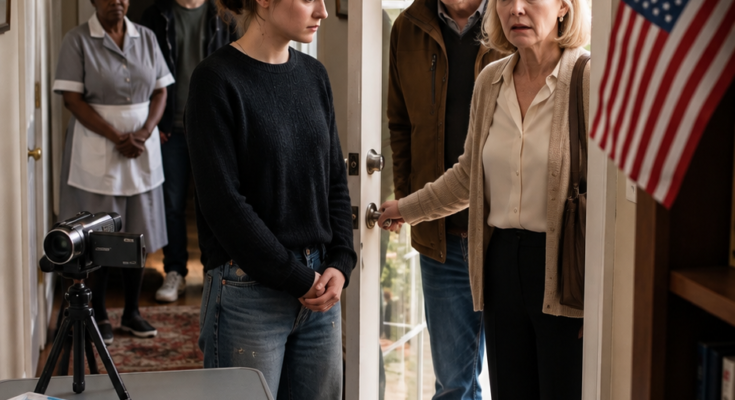
Then she saw me.
I was standing in the foyer.
Not alone.
Not magically healed.
One hand held a cane.
My left leg still dragged slightly when I was tired.
My doctors had warned that some deficits might remain permanently.
But I was alive.
My mother’s suitcase slipped from her hand.
Tony stopped behind her.
Jordan whispered:
“Una.”
My mother went completely white.
For several seconds, she simply stared at my legs.
Then at my face.
“You’re…”
She couldn’t finish.
I could.
“Alive?”
Her mouth opened.
Tony recovered first.
“What the hell is going on in my house?”
My attorney spoke before I could.
“The ownership and trust interests concerning this residence are under court review. You have been provided notice through counsel.”
Tony’s face reddened.
“This is ridiculous.”
He turned toward me.
“What have you done?”
There it was.
Even then.
Not:
What happened to you?
Not:
Are you all right?
What had I done?
I looked at my mother.
“You left me behind a locked door without access to water or medically necessary care.”
She immediately shook her head.
“That is not what happened.”
“We have your messages.”
Her face changed.
“Rosie misunderstood.”
“She didn’t misunderstand the deadbolt.”
“I was trying to stop you from destroying yourself!”
“By hiding my treatment?”
“You were dependent on it.”
I stared at her.
“Yes, Mom. That’s what medically necessary treatment means.”
Jordan made a sound behind her.
She turned.
“Don’t.”
He looked horrified.
“You actually locked her in there?”
“Jordan, you don’t understand.”
“No. I really don’t.”
Mother stepped toward him.
“This trip was for you.”
He backed away.
“Don’t put this on me.”
That may have been the first time the golden child refused the crown.
Tony pointed at me.
“Whatever lawyers you’ve hired, you’re not taking this company.”
“I don’t want to steal your company.”
“It is my company.”
“No,” I said. “That’s what the accounting is going to determine.”
Then I said the sentence I had practiced for weeks.
“You didn’t lose control because I survived. You lost control because people finally looked at what you were doing.”
For once, Tony had nothing to say.
The legal cases took years, not minutes.
Prosecutors reviewed the confinement, deprivation of care, financial conduct, witness statements, messages, and other evidence. The criminal allegations were handled separately from the estate litigation.
Rosie’s role was not erased because she eventually opened the door. She admitted what she had done and accepted consequences arising from it while continuing to cooperate.
Tony’s financial conduct was examined through audits and court proceedings.
The company’s independent directors removed him from operational authority while their investigation continued.
Some transactions were legitimate.
Others were not.
That distinction mattered.
I didn’t want revenge disguised as accounting.
I wanted facts.
My mother spent months insisting she had only meant to “teach me responsibility.”
Eventually, under questioning, that language stopped working.
People kept asking the simplest question:
What responsible lesson requires locking a disabled person in a room without water or access to prescribed treatment?
She never found an answer.
Jordan and I had our own difficult conversation.
He sat beside my hospital bed after returning from Europe and said:
“I should have known.”
“No.”
“Mom talked about you like you were draining everything.”
“You heard that.”
“I laughed sometimes.”
That hurt.
He didn’t ask me to tell him it was okay.
Instead he said:
“I’m sorry.”
Then, after a long silence:
“I don’t want any money that came out of your share.”
Our lawyers eventually determined what belonged where.
Jordan returned funds where appropriate and cooperated with the accounting.
I did not require him to become poor to prove he loved me.
Guilt wasn’t restitution.
Facts were.
My health improved, but not into the triumphant ending people like to imagine.
I still receive treatment.
I still have days when my legs feel heavy.
Sometimes I use a cane.
Sometimes I don’t.
I never again measured my victory by whether I could walk into a room.
That would have meant accepting my mother’s original belief—that I was worth more when my body behaved conveniently.
What mattered was choice.
Access to my own doctors.
Control over my finances.
The ability to close a door from the inside and know nobody else held the key.
I eventually sold the big Louisiana house.
Before I did, I walked through it one last time with Marcus.
Rosie had moved away by then.
We stopped outside the old storage room.
The deadbolt had been removed during the investigation.
Two pale holes remained in the wood where the hardware had been.
Marcus touched one.
“You want me to take the whole door off?”
I thought about it.
Then shook my head.
“No.”
“Why?”
“Because doors aren’t the problem.”
I closed it.
Then opened it again.
From my side.
That mattered more than destroying it.
For years, my mother had treated illness as evidence that I couldn’t be trusted with my own life.
She thought money made Tony powerful.
She thought sickness made me powerless.
She thought locking a door could decide the future.
But when they came home after sixty-eight days, the thing that left them speechless wasn’t simply that I was standing.
It was that the decisions were no longer theirs.
I had survived.
Professionals had listened.
Records had been preserved.
The court had looked at the money.
The board had looked at the company.
Jordan had looked at what had been done in his name.
And I had finally looked at my family without confusing their control for care.
My mother once believed the most frightening thing she could do was lock me inside a room.
She was wrong.
The most frightening thing for her was what happened after somebody finally opened the door.