Part One — The File My Mother Had Signed
My mother looked at the page in the officer’s hand as though she had spent two years praying nobody would ever see it again.
“Mom,” I said. “What did you sign?”
She didn’t answer.
Mark did.
“This is ridiculous. That was years ago.”
The paramedic turned toward him.
“So you do remember me.”
Mark’s face tightened.
My mother whispered:
“Emily, please. Eli needs you right now.”
It was the oldest trick in our family.
When the truth became uncomfortable, Mom suddenly became concerned about something else.
“No,” I said. “You don’t get to redirect this.”
The officer looked more closely at the paperwork.
The page carrying Mom’s signature was attached to an emergency protection order from two years earlier.
Later I learned exactly what it was.
My mother had signed a sworn statement during an investigation involving Mark’s former girlfriend, Leanne, and her seven-year-old son, Caleb.
Mark had been living under his middle name and his father’s surname at the time.
Marcus Hale.
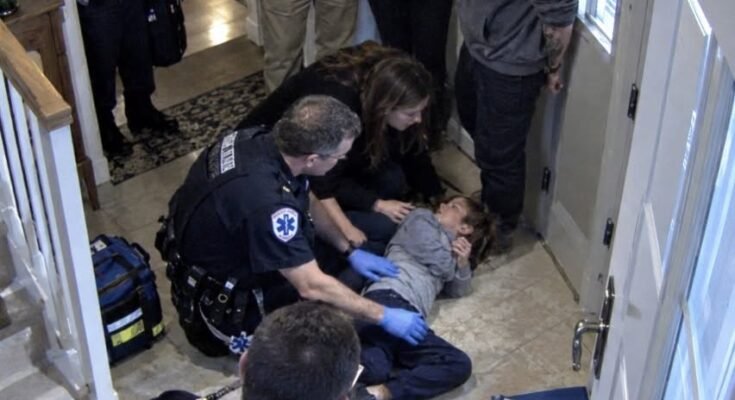
The paramedic, Daniel Ruiz, had responded when Caleb was taken to the hospital.
That was why he remembered the tattoo.
A jagged black compass wrapped around Mark’s wrist.
Daniel looked at me.
“I treated that little boy.”
My stomach turned.
“For what?”
He hesitated.
The police officer stopped him.
“Let’s not get into details here.”
That was right.
Eli was still lying ten feet away.
This was not the place for adults to reconstruct another child’s trauma.
My mother finally spoke.
“It wasn’t what you think.”
I laughed once.
“What do I think?”
“Mark lost his temper.”
“On a seven-year-old?”
“He didn’t mean to seriously hurt him.”
The hallway seemed to shrink.
I looked at Dad.
“You knew?”
He stared past me.
That was yes.
“You both knew.”
My mother began crying.
“We were trying to help your brother.”
I stared at her.
“You signed something saying he wasn’t safe around a child.”
“It was temporary.”
“And then you let him babysit mine?”
“We were here.”
I looked down at Eli.
Bruised jaw.
Red wrist.
Barely able to take a full breath.
“You were here.”
That sentence landed harder than shouting ever could.
The officer closed the blue folder.
“Ma’am, we’re going to need to preserve these documents.”
“Take them.”
Mark stepped forward.
“No. Those are private family papers.”
The officer blocked him.
“Stay back.”
“They belong to me.”
“No,” I said.
“They were in my office.”
Mark looked at me with pure hatred.
Then the medic called my name.
Eli’s breathing was getting worse.
Everything else stopped mattering.
I rode in the ambulance with him.
At the hospital, imaging showed two badly bruised ribs but, thank God, no collapsed lung and no internal bleeding.
The doctor examined the mark on his wrist.
A hospital social worker arrived.
Then a detective.
They did not make Eli tell the story over and over.
They asked only what was needed for immediate safety and arranged for a trained child interviewer later.
When I was finally alone beside his bed, Eli opened his eyes.
“Mom?”
“I’m here.”
“Am I in trouble?”
My heart broke.
“No.”
“Grandpa said police would take me away if I lied.”
I went cold.
“What lie?”
Eli’s eyes filled.
“That Uncle Mark hit me.”
I had to force myself not to ask anything else.
“Sweetheart, you don’t have to explain it to me right now.”
“But I didn’t lie.”
“I believe you.”
His whole body relaxed.
That was when I remembered the camera.
I opened the cloud recording.
The footage began forty minutes before I came home.
Mark entered my office.
Dad stood in the hallway.
Mom was behind him.
Mark pulled open my desk drawer.
Dad said:
“Your grandfather shouldn’t have kept copies.”
Mark answered:
“If Emily finds that file, she’ll start digging.”
My hands went numb.
Then Eli appeared.
He had apparently been looking for his tablet charger.
“What are you doing in Mom’s office?”
Mark turned.
“Go upstairs.”
“Mom says nobody goes in there.”
I watched my nine-year-old son do exactly what I had taught him.
He told an adult a rule.
Mark walked toward him.
Eli backed away.
Then Mark grabbed his wrist.
The camera did not capture every angle, but it captured enough.
The shove.
Eli striking the hallway wall.
Mark grabbing him again when he tried to pull free.
Dad saying:
“That’s enough.”
Not before.
After.
Mom saying:
“Mark, stop before he gets hurt.”
Not:
Don’t touch him.
Before he gets hurt.
As if what had already happened did not count.
Then Eli fell.
And neither of my parents went to him.
They stood there.
My mother picked up her tea.
My father said:
“He’ll get up when he stops feeling sorry for himself.”
I stopped the video.
Then I vomited into the hospital sink.
For twenty years I had wondered whether my childhood memories were exaggerated.
That recording answered a question I had never wanted answered.
My parents had not failed to notice what Mark was capable of.
They had noticed.
They had simply decided protecting him was more important.
━━━━━━━━━━━━━━━━━━━━
Part Two — What Grandpa Had Tried to Leave Me
The blue folder contained far more than a deed.
My grandfather had been the only adult in our family who ever openly challenged Mark.
When Grandpa died eighteen months earlier, he left me the small house Eli and I lived in.
The deed was recorded properly.
Mark could not simply steal the paper and take the property.
But Grandpa had also kept copies of documents my parents desperately wanted forgotten.
The protection-order records.
My mother’s sworn statement.
Correspondence from an attorney.
And a handwritten letter addressed to me.
The detective eventually returned a copy.
Grandpa had written:
Emily, I hope this file is unnecessary. But your parents have spent too many years confusing protecting Mark with loving him. If they ever ask you to leave Eli alone with him, the answer must be no.
I couldn’t breathe when I read that.
Because Grandpa had warned me.
I just hadn’t received the warning.
The letter had been written before his death.
My father admitted later that he found it while helping clean out Grandpa’s study.
He put everything into the blue folder.
Then hid it in a locked cabinet at his own house.
Months later, after an argument between Dad and Mark, Dad apparently became nervous and gave the folder to me with other property documents.
He never told me what was inside.
I placed it in my office without reading every page.
Mark knew.
That was why he had come looking for it.
Not for the deed.
For the history.
The camera also showed my parents knew exactly what he was searching for.
That fact changed everything.
The assault on Eli was no longer something they could describe as discipline that “got out of hand.”
Mark had been caught searching through private records connected to his prior violence.
When a child confronted him, he reacted exactly as Grandpa had feared.
And my parents did what they had always done.
They minimized.
Then they tried to control the story.
━━━━━━━━━━━━━━━━━━━━
Part Three — “Family Loyalty”
The legal process took months.
There was no instant courtroom scene where the camera footage solved everything in ten minutes.
Investigators verified the older case.
The documents.
The alias.
The prior child-protection records.
The security video.
Eli’s injuries.
His later forensic interview.
My parents’ statements.
Mark’s changing explanations.
At first, he said Eli fell.
Then he claimed he restrained him because Eli attacked him.
Then he called it discipline.
The recording made those explanations difficult to reconcile.
He faced consequences for what investigators and prosecutors could prove.
My parents were not charged simply for being terrible grandparents.
But their conduct had consequences too.
They lost unsupervised access to Eli.
I stopped allowing them into my home.
My father called that cruel.
My mother called it punishment.
I called it information.
They had shown me what they would do when forced to choose between my child’s safety and Mark’s comfort.
I believed them.
The first months afterward were harder on Eli than I expected.
He became frightened when adults raised their voices.
He stopped closing his bedroom door.
If I was five minutes late picking him up, he called twice.
His therapist helped him understand that none of those reactions meant he was weak.
His body had learned danger.
It needed time to learn safety again.
The hardest question came one night while I was tucking him in.
“Mom?”
“Yeah?”
“Why did Grandma say I deserved it?”
I sat beside him.
“She was wrong.”
“But she’s a grandma.”
“I know.”
“Grandmas are supposed to know stuff.”
I almost cried.
“Adults can be wrong about very important things.”
He thought about that.
“Did she love Uncle Mark more than me?”
There was no answer that wouldn’t hurt.
So I chose one that was true.
“I think Grandma spent so many years protecting Uncle Mark from consequences that she stopped understanding what protection was supposed to mean.”
Eli stared at the blanket.
“That doesn’t answer me.”
He was right.
Children often notice when adults hide inside complicated language.
So I tried again.
“When it mattered, she chose him instead of keeping you safe.”
His eyes filled.
“I’m sorry.”
“Did I make her choose?”
“No.”
“Then why are you sorry?”
He shrugged.
That broke me.
He had inherited the family reflex.
Someone hurt him, and somehow he felt responsible for the discomfort afterward.
I held him.
“You never have to apologize because another person behaved badly.”
It became a sentence we repeated for years.
My relationship with my parents changed permanently.
Mom apologized eventually.
Her first attempts were awful.
“We were doing the best we could.”
“Mark has always been troubled.”
“You don’t know what it is like to fear losing a son.”
Finally, nearly two years later, she said something different.
“I saw what he did to you when you were young.”
I went completely still.
She continued.
“I kept telling myself siblings fight. Then it got worse, and by that point admitting it would mean admitting I’d failed to stop it earlier.”
Tears ran down her face.
“So every time Mark hurt someone, I needed it to be less serious than it was.”
That was the first apology that sounded like accountability.
I asked:
“What about Caleb?”
She looked down.
“I knew enough.”
“And you still let Mark around Eli.”
“Yes.”
I closed my eyes.
“Why?”
“Because I wanted to believe the protection order had scared him straight.”
“No.”
I shook my head.
“You wanted to believe it because the alternative required you to change your relationship with him.”
She nodded.
That mattered.
But forgiveness did not restore access.
Mom saw Eli only when he wanted to see her and only under conditions that made him comfortable.
Dad never reached the same point.
He remained convinced that “family loyalty” should have kept me from involving police.
Years later, I finally answered him.
“You taught me family loyalty meant protecting relatives from consequences.”
He looked annoyed.
“What else is it supposed to mean?”
“Protecting the person who’s being hurt.”
We did not speak for almost a year after that.
I don’t regret saying it.
Mark’s earlier victim, Caleb, remained mostly private.
I learned enough through the legal process to know he was safe and living with his mother.
I never contacted him.
He was not a missing piece I was entitled to collect for my own closure.
His story belonged to him.
Daniel, the paramedic, became someone Eli remembered for a different reason.
Years later, Eli told me:
“He was the first adult there who asked before touching me.”
I had forgotten that.
Daniel had said:
“I’m going to check your ribs. Is that okay?”
Small sentence.
Huge difference.
One adult had used force and called it discipline.
Another had authority, training, and a frightened child in front of him—and still asked permission.
Eli noticed.
Children notice more than we think.
The little camera above my bookshelf stayed there for years.
I almost removed it after the case ended.
Every time I looked at it, I remembered the footage.
Then one afternoon, Eli asked:
“Does that camera still work?”
“Yes.”
“Good.”
“Why?”
He shrugged.
“It means the house remembers.”
I knew what he meant.
For most of my childhood, my family survived by arguing over memory.
Mark didn’t shove you that hard.
You were dramatic.
That isn’t what happened.
You’re remembering wrong.
The camera didn’t create the truth.
It simply made denial harder.
When Eli turned sixteen, I finally showed him Grandpa’s letter.
Not the court documents.
Not the old photographs.
Just the letter.
He read it twice.
Then stopped at the sentence:
If they ever ask you to leave Eli alone with him, the answer must be no.
He looked at me.
“Grandpa knew?”
“Yes.”
“Why didn’t he tell you himself?”
“He died before he could.”
Eli folded the letter carefully.
Then said:
“He was trying.”
“Yes.”
That distinction mattered too.
Grandpa wasn’t a secret hero who had solved everything.
He had seen a danger and tried to leave a warning.
The warning arrived late.
But once it arrived, I finally stopped arguing with what my family had spent decades teaching me not to see.
My brother had hurt my son.
My parents watched.
The worst secret wasn’t the tattoo.
It wasn’t the alias.
It wasn’t even the old protection order.
The secret was that my parents had known who Mark was for years.
They simply kept hoping the next person he hurt would be easier to silence than he was to confront.
My son wasn’t.
Neither was I anymore.
For most of my life, my family taught me that a locked door meant something should stay hidden.
Grandpa taught me something different.
Check what is behind it.
Save the evidence.
And if the truth finally opens the door, don’t help anyone close it again.