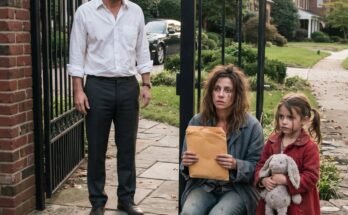

Part One — The Box Daniel Told Her to Hide
A few years ago, I lost my husband and daughter in a car accident.
After that, I was completely alone.
My life did not fall apart all at once. It happened quietly. I stopped answering friends. Stopped cooking real meals. Stopped opening the curtains in the morning because daylight seemed insulting when the two people I loved most were no longer there to see it.
But bills still arrived.
The electric company did not care that I was grieving.
Neither did the mortgage company.
So eventually I took a job as a housekeeper at a local hospital.
I worked evenings mostly. I changed trash bags, wiped rails, mopped floors, cleaned rooms after families left carrying either flowers or plastic bags full of belongings.
Most people barely noticed me.
I preferred it that way.
For almost two years, invisibility felt easier than being known.
Then Daniel was admitted.
He had terminal cancer.
And every afternoon, a little girl sat beside his bed.
Her name was Lily.
She was six.
The first thing I noticed was her hair.
Not because it looked exactly like my daughter’s.
It didn’t.
But because nobody was taking care of it.
Some mornings Lily arrived before school with the back of her hair tangled from sleep. Daniel would sit upright as far as his body allowed, hold a little pink brush, and attempt to braid it.
His hands shook badly.
The braid usually leaned sideways.
Lily always told him it looked beautiful.
Then she’d eat toast from his breakfast tray because he wasn’t hungry anyway.
I watched that for several days before I finally broke one of my own rules and became involved.
“Would you like some help?”
Daniel looked embarrassed.
“With the hair or my dignity?”
“Hair first.”
He smiled.
That was how it started.
I braided Lily’s hair.
Then, with Daniel’s permission, I walked her to the cafeteria and bought her breakfast.
Later, when he was too sick to arrange transportation, I drove her to school after making sure hospital staff and the social worker knew exactly what we were doing.
Daniel and Lily had almost nobody.
His wife had died giving birth to Lily. His parents were gone. He had one older brother in another state, but they had not been close in years and the brother was dealing with serious health problems of his own.
A hospital social worker was already helping Daniel make plans for Lily.
That detail mattered.
Because despite what happened later, Daniel was not simply trying to hand his child to the first kind woman who entered his room.
There were background checks.
Conversations.
Legal paperwork.
Questions I found painfully intrusive until I remembered who they were protecting.
Lily.
During those weeks, I started spending time in Daniel’s room even when I wasn’t cleaning it.
Sometimes we drank tea.
Sometimes Lily colored on the rolling table while Daniel and I talked.
He knew about my husband.
Eventually he asked about my daughter.
Her name was Sophie.
She had been eight.
For a long time, I could not say her name without feeling as though I were falling down a staircase.
Daniel never told me I should “move on.”
He never said everything happened for a reason.
One evening, after I told him Sophie had loved strawberries but hated strawberry-flavored medicine because “fake strawberries are liars,” Daniel laughed so hard he started coughing.
When he recovered, he said, “I think I would’ve liked her.”
I cried in the supply closet afterward.
Not because he had hurt me.
Because he had spoken about Sophie as though she were still a person instead of a tragedy everyone needed to avoid mentioning.
Around Daniel and Lily, I began smiling again.
That frightened me.
Grief had made pain feel loyal.
Happiness felt suspicious.
Then one afternoon, while Lily was at school, Daniel asked me to sit down.
He took my hand.
“Please marry me.”
My legs went numb.
“What?”
“I know how insane that sounds.”
“Daniel, we barely know each other.”
“I know.”
“You are dying.”
“I know that too.”
I pulled my hand away.
He looked toward the window.
“I’m not asking you because I need a nurse.”
“Then why?”
“Because I love you.”
I stared at him.
“And because Lily loves you.”
My eyes filled immediately.
Daniel continued.
“I’ve been working with the social worker and an attorney. Marriage alone won’t magically make you Lily’s guardian. There are legal steps. I’ve started them. My brother has agreed. Lily has been spoken to separately. Everybody is making sure this isn’t just a dying man’s panic.”
That sounded like Daniel.
Even proposing marriage, he had prepared a file.
“If you say no,” he continued, “I won’t be angry. And Lily will still have a plan.”
“What plan?”
“A temporary guardian through someone we trust until everything is settled.”
“So you don’t need me.”
He smiled.
“No.”
That answer changed everything.
“I want you.”
I looked at him.
Daniel squeezed my hand.
“And I think maybe you need us too.”
That part made me angry.
“Don’t tell me what I need.”
“You’re right.”
He nodded immediately.
“I’m sorry.”
Then he said, “So forget that part. Just answer one question.”
“What?”
“If I weren’t dying, would you want more time with me?”
I didn’t answer quickly enough.
He smiled.
“That’s what I thought.”
We married ten days later.
Small hospital ceremony.
I wore a simple white sundress.
Lily wore yellow because she said white made her look “like a napkin.”
Daniel wore a button-down shirt over his hospital clothes.
The chaplain performed the ceremony after confirming, several times, that Daniel was mentally clear and knew exactly what he was doing.
Lily stood beside him holding a bouquet someone from the nurses’ station had put together.
Afterward she wrapped both arms around me.
“I’m glad Daddy won’t be alone.”
I held her so tightly I almost couldn’t breathe.
Two weeks later, Daniel died.
I was with him.
So was Lily.
The final hours were quiet.
At one point, Daniel looked at me and whispered, “Don’t make her take care of you.”
I frowned.
“What?”
“Lily. Don’t make her responsible for your sadness.”
Then he looked toward our little girl asleep in the chair.
“And don’t make yourself responsible for fixing hers.”
Those were some of the last clear words he said.
After his death, the legal arrangements Daniel had put in motion continued through the proper process. With the agreement of the remaining family and court oversight where required, I became Lily’s permanent guardian.
Daniel left the house in trust for Lily’s benefit, with provisions allowing us to live there while I raised her. There was life insurance and some savings, enough to create stability but not some fairy-tale fortune.
I kept working.
Not full-time at first.
But I kept working.
I needed Lily to know that her father had not “bought” her a new mother.
And I needed to know it too.
The first year was harder than I expected.
Lily grieved loudly sometimes.
Other times not at all.
She had nightmares.
She got angry when I packed her lunches differently from Daniel.
Once she screamed, “You’re not my mom!”
I went into the bathroom and cried.
Then I came back and said, “You’re right. I’m not.”
She stared at me.
“I’m me. And I’m still here.”
That became our phrase.
I’m still here.
A year after Daniel died, on the anniversary of his death, Lily came into my bedroom carrying a small wooden box.
She set it on the bed.
“Dad told me to give this to you today.”
My whole body went cold.
“What?”
“He gave it to me before he died.”
“You’ve had this for a year?”
She nodded proudly.
“Miss Carla kept it.”
Carla had been the hospital social worker.
That explained how a seven-year-old had successfully hidden anything for twelve months.
“When did he tell you?”
“Before you got married.”
I looked at the box.
There was an envelope taped to the lid.
My name was written across it.
Underneath:
ONLY AFTER ONE YEAR. NO CHEATING.
I laughed through my tears.
That was Daniel.
I opened the envelope.
The first line made me stop breathing.
If you are reading this, then you stayed.
━━━━━━━━━━━━━━━━━━━━
Part Two — What Daniel Had Asked Lily Before He Asked Me
Daniel’s letter was not romantic.
Not at first.
It began with instructions.
Before anything else, ask Lily if she gave you this willingly.
I looked at her.
“Did you?”
She rolled her eyes.
“Dad said you’d ask.”
“Answer.”
“Yes.”
“Do you know what’s inside?”
“No. Miss Carla said I wasn’t allowed to open it.”
Daniel had planned even that.
I continued reading.
I need you to know something I didn’t tell you before the wedding because I didn’t want it to influence your answer. I asked Lily first.
I looked at her.
She was suddenly very interested in the hem of her shirt.
The letter continued.
I did not ask her, “Do you want her to be your new mommy?” I would never put that on a six-year-old. I asked whether she felt safe with you, whether she wanted you in her life, and whether she would want you to remain even if I wasn’t here.
She said yes.
My vision blurred.
Then she asked me something I wasn’t prepared for.
She said, “Will she stay if I get mad at her?”
I put down the letter.
Lily had started crying.
I moved closer.
“Do you remember asking that?”
She nodded.
“Why?”
She shrugged.
Then whispered, “Because people leave when things are bad.”
That sentence broke something in me.
Her mother had died the day she was born.
Her father was dying.
Every important relationship in her life had taught her, through no fault of anyone involved, that love could disappear.
I pulled her against me.
“I got mad at you last week because you drew on the bathroom cabinet.”
“You were really mad.”
“I was.”
“You stayed.”
“Yes.”
She leaned into me.
After a while, I kept reading.
Daniel wrote:
I knew you had lost a daughter. I also knew there was a danger in asking you to raise mine. People will tell you Lily is a gift sent to replace what you lost. Don’t believe them.
I stopped.
Sophie is not replaceable.
I began sobbing.
Lily had heard Sophie’s name many times.
She put her hand over mine.
Daniel continued:
And Lily should never grow up believing her job is to heal the place Sophie left behind. She is not medicine for your grief. She is Lily.
That was the line I needed most.
Even more than I loved you.
Because Daniel had seen the danger before I did.
He had known how easily love and grief could become tangled until a child felt responsible for keeping an adult whole.
At the bottom of the box was a second envelope.
This one was addressed to Lily.
FOR WHEN YOU’RE OLDER. NOT TODAY.
She frowned.
“How much older?”
I smiled.
“Nice try.”
There was one more thing in the box.
A key.
And a note.
Hall closet. Top shelf. Gray metal box. Now you can open it.
Of course Daniel had turned grief into a treasure hunt.
We found the metal box.
Inside were years of letters.
Birthday letters for Lily.
One for seven.
Eight.
Nine.
Ten.
All the way to eighteen.
Not instructions for her life.
Not speeches about who she should become.
Little things.
Stories about her mother.
Stories about Daniel.
Memories she might otherwise lose.
One envelope was addressed to me.
FOR THE DAY YOU THINK YOU’RE FAILING HER.
I almost opened it.
Then stopped.
Lily said, “You’re not failing me today.”
I laughed.
“No?”
“No. Maybe save it.”
So I did.
━━━━━━━━━━━━━━━━━━━━
Part Three — The Daughter Nobody Replaced
The years after Daniel’s box were not perfect.
That matters.
Love did not make grief easy.
Being chosen did not automatically make us a normal family.
For a while, Lily tested every promise I made.
If I said I would pick her up at four, she became anxious at 3:55.
If I left town overnight for work, she asked three times exactly when I was coming back.
Once, when she was nine, I was delayed by a car accident on the highway.
Not mine.
Traffic.
I called immediately.
Lily still panicked.
By the time I arrived, she was sitting on the front steps with Carla, who had remained in our lives.
Lily ran toward me crying.
“You said five!”
“I know.”
“You said five!”
“I know.”
I didn’t say, I called.
I didn’t say, It wasn’t my fault.
Both were true.
Neither was what she needed first.
I hugged her.
“I’m sorry you were scared.”
Then, when she calmed down, we talked about delays and emergencies and how somebody coming late is different from somebody disappearing.
That distinction took years to settle inside her.
It took years inside me too.
I had my own fear.
Every cough made me think of Daniel.
Every school bus on a rainy road made me think of Sophie.
When Lily turned eight—the age Sophie had been when she died—I became almost unbearable.
I checked locks twice.
Called the school too often.
Wanted to drive Lily everywhere.
One evening she finally said:
“You act like something bad is always going to happen.”
I froze.
She was eight years old.
Sophie’s age forever.
And I was slowly making Lily live inside an accident that had happened before she knew me.
That night, I opened the envelope Daniel had labeled:
FOR THE DAY YOU THINK YOU’RE FAILING HER.
It read:
You probably are failing at something. Congratulations. You’re parenting.
I laughed immediately.
Then:
If you’re scared, tell the truth about being scared. But don’t ask Lily to make your fear disappear by becoming smaller, safer, quieter, or less alive.
I closed my eyes.
You cannot love someone enough to make the world harmless.
Love her anyway.
I carried that letter to therapy the next week.
That was the year I finally stopped treating therapy as something I had completed after the accident.
Grief is not a course you graduate from.
Sometimes a new stage of life teaches it a new language.
I learned to let Lily ride her bicycle around the block.
Then farther.
I learned not to text her every ten minutes when she went to a friend’s house.
I learned the hardest thing a parent learns.
Love is not surveillance.
When Lily was twelve, she asked me something while we were making spaghetti.
“Do you ever wish Sophie was here instead of me?”
The spoon slipped from my hand.
“What?”
She stared at the sauce.
“I know you loved her first.”
I turned off the stove.
Then I sat beside her.
“Sophie being alive would not require you to disappear.”
She looked at me.
“I wish she were here.”
“You do?”
“Yes.”
“Even though then maybe you wouldn’t have met Dad?”
I hadn’t expected that.
“No.”
I thought carefully.
“I wish nobody had died.”
She nodded.
“So do I.”
That became one of the most honest conversations we ever had.
We didn’t pretend our family had formed through beautiful circumstances.
It hadn’t.
Three people died.
My husband.
My daughter.
Daniel.
There was nothing beautiful about those deaths.
What became beautiful was what the people left behind eventually chose to do with one another.
At thirteen, Lily read Daniel’s letter for that birthday.
He wrote about the first time she cut her own hair at four and blamed the scissors.
At fourteen, his letter warned her that he had been terrible at algebra and therefore any bad math grade was “genetically suspicious.”
At fifteen, there was a photograph of Daniel holding her as a newborn.
He looked terrified.
On the back he had written:
Your mother died bringing you here. That is part of your story. It is not a debt you owe her. Live because you’re alive, not because you think you have to make her death worth something.
Lily cried for hours after that.
Then she asked me:
“Did Dad feel guilty?”
“Yes.”
“For surviving?”
“I think so.”
“Like you?”
I looked at her.
“Yes.”
She nodded.
“Everybody in this family needs therapy.”
I laughed.
“Extensively.”
By sixteen, Lily was taller than me.
She became interested in photography.
Then theater.
Then photography again because theater had “too many personalities.”
She fell in love for the first time.
Got her heart broken.
I hated a seventeen-year-old boy with an intensity that embarrassed me.
Lily found that hilarious.
“You can’t murder Tyler.”
“I am aware.”
“You keep saying that suspiciously.”
When she graduated high school, Daniel’s final birthday letter had already been opened, but the last envelope in the metal box remained.
FOR GRADUATION.
Inside was a note for both of us.
We read it sitting at the kitchen table.
Lily—if you made it to graduation, excellent work. I assume there were several unnecessary arguments about homework.
She laughed.
The woman beside you may have spent years wondering whether she earned the right to call herself your mother.
I stopped breathing.
Lily looked at me.
Daniel continued:
She doesn’t decide that. Neither do I. You do.
I couldn’t keep reading.
Lily took the letter.
She finished aloud.
Whatever you call her, I hope she stayed.
And if she did, remember she stayed because she loved you, not because I asked her to complete a job.
Love is not an assignment.
Dad
Lily folded the paper.
Then she looked at me.
“You know I’ve been calling you Mom for years.”
“I know.”
“Then why are you crying?”
“Because your father was annoying.”
“Accurate.”
She hugged me.
That summer, before college, Lily asked whether she could change something legally.
I became nervous immediately.
“What?”
“My name.”
My chest tightened.
She had Daniel’s last name.
I thought she wanted mine.
I was wrong.
She wanted to add it.
Not replace her father’s.
Add mine.
“I want both.”
I cried again.
She said this was becoming a problem.
We completed the process when she was old enough to make the decision herself.
No dramatic adoption story.
No erasing Daniel.
Her father remained her father.
I remained the woman who stayed.
There was room for both.
Lily is twenty-three now.
She works at a children’s hospital.
Not the one where I met Daniel.
But close enough that the first time I visited, the smell of disinfectant took me backward twenty years.
She is not a doctor.
She is not a nurse.
She works in child-life services, helping frightened children understand procedures and giving siblings something to do besides stare at hospital walls.
She says it is because somebody once braided her hair in a hospital room and made the place feel less frightening.
I tell her she remembers too much.
She says I remember everything wrong.
Some arguments never end.
The wooden box still exists.
Most of the letters are gone from it now, moved into a binder because the paper became fragile.
Inside the box are different things.
Daniel’s wedding ring.
A photograph of the three of us from the hospital ceremony.
One of Sophie.
One of my first husband.
A yellow ribbon from Lily’s wedding bouquet—
Yes.
She got married last year.
Before the ceremony, she handed me another box.
For one horrible second, I thought Daniel had somehow planned even that.
He had not.
This box was from Lily.
Inside was a note.
You taught me something Dad couldn’t put in a letter.
I looked at her.
“What?”
She smiled.
“People can leave and still have loved you.”
That hurt.
Then she continued.
“And people can stay without replacing the ones who left.”
I held her face in both hands.
For years, people told me Lily had saved me.
I stopped correcting them eventually because most meant well.
But it isn’t true.
A child should never be assigned responsibility for saving an adult.
Lily did not replace Sophie.
Daniel did not replace my husband.
And I did not replace Lily’s parents.
We carried each other’s absences.
That is different.
Daniel once asked me to marry him because he loved me and because he needed to know his daughter would have someone after he was gone.
For years, I thought the greatest thing he entrusted me with was Lily.
It wasn’t.
Lily was never something for one adult to hand to another.
She was a person who eventually chose me too.
The greatest thing Daniel entrusted me with was the understanding that love does not have to erase what came before it.
A year after he died, Lily handed me a box and said her father told her to give it to me that day.
Inside, Daniel had left letters, memories, and instructions.
But the most important thing was one sentence:
If you are reading this, then you stayed.
At the time, I thought he meant I had stayed for Lily.
Now I understand he meant something larger.
I stayed in life.
After the accident.
After Sophie.
After my husband.
After Daniel.
I stayed long enough to love another child without pretending she was the one I lost.
Long enough to laugh again without calling it betrayal.
Long enough to discover that grief and love do not compete for the same space.
And whenever Lily hugs me now and calls me Mom, I know something Daniel understood before I did.
Family is not always the people life lets you keep.
Sometimes it is the people who find one another after terrible loss and quietly decide:
I’m still here.