Part One — The Turquoise Cover-Up
Nora disappeared during our family vacation in North Carolina.
She was sixteen.
One minute she was beside me complaining that the sand was too hot, and forty minutes later I was screaming her name into a crowd of strangers while lifeguards searched the water.
For three days, we barely slept.
Police checked parking lots, rental houses, bus stations, security cameras, hospitals. Volunteers walked miles of beach. Divers searched the water even though there was no evidence she had gone in.
Someone reported seeing a girl who looked like Nora getting into a gray SUV.
Another person swore she had seen her near an ice-cream stand.
Neither lead went anywhere.
Her phone was found beneath a bench near a public restroom.
Her sandals were gone.
So was Nora.
After a week, we returned home without her.
That sentence still feels impossible to write.
You are not supposed to return from a family vacation with one fewer child.
For the first year, I barely functioned. Every unknown number made my heart race. Every girl with long brown hair in a grocery store made me stop breathing.
My husband, Daniel, coped differently.
He needed facts.
Police reports.
Timelines.
Maps.
He kept a binder on the dining-room table containing everything investigators had collected.
I kept Nora’s bedroom exactly as she left it.
Her purple blanket.
The half-empty perfume bottle on her dresser.
The sewing machine my mother had given her.
Nora loved making clothes.
Not professionally.
Not perfectly.
But obsessively.
Skirts.
Bags.
Scarves.
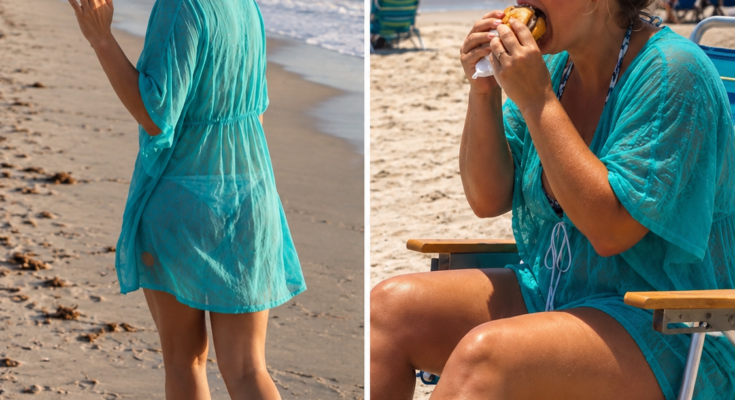
One summer she decided store-bought swimsuit cover-ups were “boring,” so she bought a piece of turquoise fabric and spent two days turning it into something that looked surprisingly good.
She stitched a tiny N inside the right pocket.
She did that with almost everything she made.
“Future fashion empire,” she used to say.
Eight years passed.
People stopped asking as often.
The posters disappeared from store windows.
Detectives changed.
Tips slowed.
Friends who had once called weekly began sending messages only on Nora’s birthday.
Life continued, which felt offensive.
Daniel and I nearly divorced during the fourth year.
Not because we stopped loving each other.
Because grief had turned us into two people living inside different emergencies.
He wanted to move.
I refused because what if Nora came home?
He wanted to repaint her room.
I accused him of giving up.
He accused me of waiting for a sixteen-year-old who, if she was alive, would no longer be sixteen.
He was right.
I hated him for being right.
Eventually we learned how to stay married without pretending we grieved the same way.
Then, on the eighth anniversary of Nora’s disappearance, I went back to North Carolina.
Alone.
Daniel offered to come.
I told him I needed to do this myself.
I walked the same stretch of beach where I last saw her.
The hotels had changed.
The boardwalk had new businesses.
The ice-cream stand was gone.
I stood near the public restroom where police found Nora’s phone and tried to remember her face that afternoon without remembering everything that came after.
Then a woman walked past me.
She was perhaps fifty.
Sunglasses.
Straw hat.
Turquoise cover-up.
My heart stopped.
I knew that fabric.
I knew the uneven hem.
I knew the little hand-sewn bead near the neckline because Nora had accidentally melted the first one with an iron and replaced it with one slightly too large.
I followed the woman.
“Excuse me.”
She turned.
“I’m sorry. Your cover-up. Where did you get it?”
She looked startled.
“A little resale shop.”
“Here?”
“Yes.”
“Please. Which one?”
She gave me the name.
I almost left before remembering the pocket.
“Can I ask you something strange?”
She laughed nervously. “Stranger than chasing me down the beach because of my clothes?”
“Inside the right pocket. Is there a letter stitched there?”
Her expression changed.
She reached inside.
Her fingers moved along the lining.
Then she looked at me.
“An N.”
My knees nearly gave out.
I had photographs of that cover-up in Nora’s room.
Nora wearing it on our back porch.
Nora holding up the crooked hem and laughing.
There could not be another one.
“Who sold it to the shop?”
“I don’t know.”
“Please.”
She touched my arm.
“Are you okay?”
“No.”
That was the truth.
She walked with me.
The shop was four blocks inland, squeezed between a surf store and a place selling handmade candles.
A bell rang when we entered.
The woman behind the counter looked up.
I put both hands on the glass display case because they were shaking too badly to leave at my sides.
“This cover-up.”
The customer stepped forward.
“I bought it here about three weeks ago.”
The employee examined it.
“Oh, yes. That came from Maren.”
Everything inside me stopped.
“Who is Maren?”
“A young woman who brings things in sometimes. Clothes mostly. Handmade stuff.”
“How old?”
The employee studied me now.
“Mid-twenties maybe.”
My mouth went dry.
“What does she look like?”
“Brown hair. About your height. Why?”
I opened my phone.
My fingers missed the screen twice before I found Nora’s photograph.
Not the age-progression photo.
My favorite one.
Nora at sixteen, standing beside our car with sunglasses pushed into her hair.
The employee stared at it.
Then back at me.
“She looks like her.”
I nearly collapsed.
“Where is she?”
“I don’t know exactly.”
“Please think.”
“She works nearby sometimes. At a bakery, I think. Or used to.”
I called the detective assigned to Nora’s case before leaving the store.
I had made desperate calls before.
Hundreds of them.
This was the first time in eight years I could say:
“I found something that belonged to her.”
The detective told me not to confront anyone if I located the woman.
I promised.
Then I broke that promise within twenty minutes.
Because as I stepped outside the shop, I saw a young woman across the street carrying a brown paper bag.
She had long brown hair.
She turned slightly.
And there was a small white scar beneath her chin.
Nora got that scar when she was nine after falling off her bicycle.
I forgot how to breathe.
“Nora.”
The woman stopped.
Not because I shouted.
I barely made a sound.
But she stopped.
Then slowly turned toward me.
For eight years, I had imagined that moment.
I imagined running.
Screaming.
Throwing my arms around her.
Instead, neither of us moved.
The young woman stared at me.
Her face went completely pale.
Then she whispered one word.
“Mom?”
━━━━━━━━━━━━━━━━━━━━
Part Two — The Girl Who Had Been Told We Stopped Looking
I crossed the street, but I stopped several feet from her.
I wanted to grab her.
I didn’t.
“Nora?”
She began crying.
Then she nodded.
I don’t remember deciding to move.
Suddenly she was in my arms.
She smelled like bread flour and coconut shampoo.
Not the perfume from her old bedroom.
Not the sixteen-year-old girl I remembered.
A grown woman.
My daughter.
Alive.
The police arrived soon afterward.
Daniel drove through the night.
Identification was confirmed properly; later DNA removed any remaining doubt.
But the question that had consumed eight years of my life had an answer.
Nora had survived.
The rest was harder.
At sixteen, after separating from us near the beach, Nora had been approached by a woman who claimed I had been injured and sent her to bring Nora to a nearby parking lot.
Nora followed.
A man was waiting.
What happened afterward took investigators months to untangle, and Nora did not tell us everything at once.
I stopped asking for every detail.
I learned quickly that finding someone does not mean you are entitled to every terrible thing they survived.
She had been moved repeatedly and controlled through fear, threats, isolation, and lies.
The most effective lie was simple.
They told her we had stopped searching.
Later, when she was older and had opportunities to leave, shame did some of the work fear had once done.
“What was I supposed to say?” she whispered to me. “Hi, Mom. Sorry it took me six years to figure out how to come home?”
I took her hand.
“You were supposed to survive.”
She cried.
“So that’s what you did.”
Eventually she escaped the people controlling her and started building a quiet life under the name Maren.
She had considered contacting us many times.
Then backed out.
She had even searched my name online.
That revelation hurt.
Not because she hadn’t called.
Because she had been close enough to us emotionally to look, yet still believed returning required an explanation she could not give.
The turquoise cover-up had been inside a box of belongings she carried through nearly every move.
A few weeks before I arrived, she finally gave it away.
“Why?”
She looked at me.
“I was trying to stop being sixteen.”
That was when I understood.
I had preserved her sixteen-year-old bedroom.
She had been trying desperately to escape the sixteen-year-old version of herself.
Neither of us had known how to move forward.
We had simply moved in opposite directions.
━━━━━━━━━━━━━━━━━━━━
Part Three — The Room I Finally Changed
Daniel arrived at two in the morning.
Nora was asleep by then.
I met him in the hotel hallway.
He took one look at my face.
“It’s her?”
I nodded.
He leaned against the wall.
For eight years, I had watched my husband remain composed through police interviews, false tips, anniversaries, arguments, and nights when I fell apart.
That night, his knees buckled.
I sat beside him on the hallway carpet.
For several minutes, neither of us could speak.
Then he whispered, “Can I see her?”
“When she wakes up.”
He looked at me.
Not offended.
Just surprised.
“She asked for time.”
Daniel closed his eyes.
Then nodded.
“Okay.”
That became one of the first things we learned.
Nora was alive.
She was not restored to us.
Those were different things.
We did not get our sixteen-year-old daughter back.
We met our twenty-four-year-old daughter.
She had preferences we didn’t know.
Habits we hadn’t witnessed forming.
Foods she hated now.
Music she loved.
A tattoo of a tiny moth behind her shoulder.
She drank coffee black, which Daniel considered a personal betrayal because everybody in our family used too much cream.
There were also things she could not tolerate.
Locked doors.
People standing behind her unexpectedly.
Unknown numbers.
Being asked where she had been.
Especially that question.
For the first few months, our family existed in cautious pieces.
Breakfast.
Short walks.
One conversation at a time.
Nora chose to remain in North Carolina initially rather than move home.
I struggled with that.
After eight years, every cell in my body wanted her under my roof.
But wanting to protect somebody can turn into another form of control if you are not careful.
Her therapist eventually helped me understand that.
“You’ve spent eight years wanting to bring your daughter home,” she told me. “Nora has spent eight years having other people decide where she goes. Those needs are going to collide.”
That sentence probably saved us from making terrible mistakes.
So Nora chose.
She rented a small apartment.
We helped when she asked.
Not before.
Daniel fixed a cabinet because she requested it.
I helped buy curtains because she invited me.
The first time she did not answer my call for four hours, I nearly drove across town.
I didn’t.
When she called later, she said, “Mom, I was working.”
“I know.”
“Did you panic?”
“No.”
“You’re lying.”
“Yes.”
She laughed.
That laugh.
Older.
Deeper.
But still hers.
I cried after we hung up.
The investigation continued in the background.
There were arrests and legal proceedings connected to what had happened to Nora and potentially to others, but she chose not to make those events the center of her recovery.
Neither did we.
For years, the missing-person case had defined her publicly.
Posters.
News segments.
Age-progressed photographs.
MISSING SINCE AGE 16.
Nora hated seeing them after she returned.
“I feel like I’m looking at somebody who died.”
One evening, she asked me to take the old posters down from my house.
I had kept one in my office.
I hesitated.
She noticed.
“You don’t have to throw them away.”
“No.”
I looked at the photograph.
Sixteen-year-old Nora smiling beneath the word MISSING.
Then I removed it.
“What should I put there?”
She thought.
“A picture where I look terrible.”
“Why?”
“Because normal families display embarrassing pictures.”
So I framed one of her eating a giant sandwich with mustard on her cheek.
She approved.
A year after we found her, Nora agreed to visit our house.
She had not been back since before the vacation.
Daniel spent three days cleaning as though the president were coming.
I changed nothing in her bedroom.
That was my mistake.
Nora stood in the doorway and froze.
The purple blanket.
The perfume.
The school photographs.
The sewing machine.
Everything exactly as she left it at sixteen.
I expected her to cry from happiness.
Instead she walked away.
I found her outside on the porch.
“I’m sorry.”
She shook her head.
“It’s like you buried me alive in there.”
That hurt.
I knew she hadn’t meant it cruelly.
Still.
I sat beside her.
“I thought keeping it the same meant I believed you’d come home.”
“I know.”
She looked toward the house.
“But I came home and I’m twenty-five.”
I nodded.
“What do you want me to do with it?”
She looked surprised.
“You’re asking?”
“Yes.”
That mattered too.
The next morning, Nora walked into the room with a cardboard box.
We did it together.
She kept the sewing machine.
Kept three books.
Threw out old makeup.
Laughed at clothes she could no longer believe she’d worn.
Then she found the empty hanger where the turquoise cover-up used to hang.
We both stopped.
“I forgot you kept a hanger for it.”
“I kept everything.”
“I know.”
She touched it.
“Mom?”
“Yes?”
“You can let sixteen-year-old me go.”
My eyes filled immediately.
“I don’t know how.”
She put her arms around me.
“You found me.”
I cried against her shoulder.
She whispered, “You don’t have to keep looking anymore.”
That was the sentence I had needed.
Not I’m home.
Not everything is okay.
Everything wasn’t okay.
Some things never would be.
But I could stop searching.
We repainted the room.
Nora chose a soft green.
Not because she planned to move back.
Because she wanted a room in our house that belonged to who she was now.
She stayed there at Christmas.
The first night, I walked past around midnight and saw the door partly open.
For eight years, I had imagined seeing her sleeping in that bed again.
The reality was different.
There was a laptop on the desk.
Her adult clothes hung in the closet.
A coffee cup sat beside the sewing machine.
Nora was awake, reading.
She caught me staring.
“Mom.”
“Sorry.”
“You’re doing the thing.”
“What thing?”
“Checking whether I’m still here.”
I felt embarrassed.
Then she smiled.
“I’m still here.”
I nodded.
“Good night.”
“Good night.”
I walked away.
That was harder than standing there.
And healthier.
Two years after we found Nora, she began sewing again.
At first, only simple things.
Tote bags.
Pillowcases.
Then dresses.
One afternoon, a package arrived at my house.
Inside was a turquoise scarf.
The stitching wasn’t perfect.
In one corner, almost invisible, was a tiny N.
There was a note.
For Mom. Since apparently turquoise keeps finding us.
I wore it until summer made that impossible.
Nora is twenty-eight now.
She no longer uses the name Maren, though she kept it as a middle name.
She says the woman who survived those years deserves somewhere to exist in her name too.
I understand that.
She works with textiles and alterations.
Not a fashion empire.
At least not yet.
Daniel still makes that joke.
We still have difficult days.
Birthdays.
The anniversary of her disappearance.
Unexpected memories.
Questions with no clean answers.
But our family stopped measuring recovery by whether we could become who we were before.
We can’t.
That family ended on a beach years ago.
What we built afterward is different.
Not lesser.
Different.
Sometimes people hear our story and call the turquoise cover-up a miracle.
I understand why.
The odds of returning to that beach on the right afternoon, seeing the right stranger, recognizing one handmade garment after eight years—it feels impossible.
But I think about something else.
That cover-up had traveled with Nora through years I knew nothing about.
She kept it when she had almost nothing from home.
Then, finally, she gave it away.
Perhaps that was not the universe leading me to her.
Perhaps it was simply chance.
Chance is enough.
Because hope does not have to predict the future to keep a person moving through it.
For eight years, I kept Nora’s room unchanged because I thought hope meant refusing to accept a world without her.
Now I understand hope differently.
Hope is not pretending nothing has changed.
It is leaving room for the possibility that something can change again.
The last time I visited North Carolina, Nora came with me.
We walked the same beach together.
For a while, neither of us spoke.
Then she took off her shoes and carried them in one hand.
I watched her walk toward the water.
For one second, my body reacted before my mind did.
My heart raced.
Every old instinct screamed:
Don’t let her out of your sight.
Nora turned.
She must have seen my face.
“Mom?”
“I’m okay.”
She raised one eyebrow.
I laughed.
“I’m trying to be.”
She walked back, took my hand, and pulled me toward the water.
We stood there while the waves reached our ankles.
Eight years earlier, I had left that beach without my daughter.
For years, I believed returning with her would somehow close the story.
It didn’t.
There are some stories you don’t close.
You learn how to carry them without letting them carry you.
Nora squeezed my hand.
Then she pointed down the beach.
“Want to walk?”
I looked at her.
Twenty-eight years old.
Alive.
Changed.
Mine, but never mine to possess.
“Yes.”
So we walked.
And for the first time in more than a decade, when my daughter moved a few steps ahead of me, I did not run after her.
I let her go ahead.
Because this time, I knew she was choosing where she wanted to go.