Part One — “I Remember This Dog”
I adopted Tucker three weeks ago. He had spent six years in the shelter. Nobody wanted him, and nobody would tell me exactly why. His kennel card only said SPECIAL NEEDS PLACEMENT, and every time I asked what that meant, the woman at the desk suddenly became very interested in paperwork.
I’m seventy-one years old. My wife, Helen, died two years ago, and since then I had gotten too good at living without needing anybody. I ate toast over the sink. I watched the evening news without really listening. Some mornings, I stayed in bed until ten because there wasn’t anything waiting for me on the other side of the bedroom door. I didn’t need a perfect dog. I needed a reason to get up, and Tucker needed anything at all. That felt like a fair trade.
He was a big shepherd mix, maybe seventy pounds, with a graying muzzle even though the shelter estimated he was only eight. One ear stood straight up while the other folded over at the tip. He never barked when people walked past his kennel. He just sat at the back wall and watched them leave. When I crouched outside his gate, he looked at me for almost a minute before slowly putting one paw against the bars.
“That one?” the volunteer asked.
“That one.”
She looked surprised. “You know he’s been here a long time.”
“I’ve been alone a long time too.”
That was apparently enough paperwork for both of us.
At home, Tucker was polite in a way that made me sad. He never climbed on furniture. Never begged. Never touched a toy unless I placed it directly in front of him. The first night, I put a brand-new bed beside mine. He ignored it and slept pressed against the bedroom door, as though he needed to know where the exit was.
Then I started noticing the strange things. He would not walk between parked trucks. If somebody jingled a belt buckle, his body flattened instantly. He hated raised voices, even on television. At mealtime, he ate lying down with his body curved around the bowl, one front leg hooked protectively across it. If I accidentally came too close while he ate, he stopped chewing and stared at me—not angry, just waiting for something bad.
I learned quickly. I gave him space. I stopped watching police shows because apparently every television detective in America has to shout. I started leaving a lamp on in the hallway at night because Tucker seemed calmer when he could see every doorway. Slowly, he began following me from room to room.
Three weeks after I adopted him, I took him for his first veterinary checkup. I expected arthritis, maybe dental work, maybe a lecture about his weight. Instead, the moment we entered the exam room, Tucker changed.
His breathing became fast. He backed into the corner. When the veterinarian approached with a stethoscope, he squeezed himself between my knees. “Easy, boy,” I said. “Nobody’s hurting you.”
The veterinarian was a woman around fifty-five named Dr. Rebecca Hall. She didn’t force anything. She sat on the floor first and tossed treats toward him. It took nearly twenty minutes before Tucker allowed her to touch his shoulders. Then she began gently feeling along his ribs.
Her face changed.
She moved the fur aside near his left flank and stared at something for a long time.
“What?” I asked.
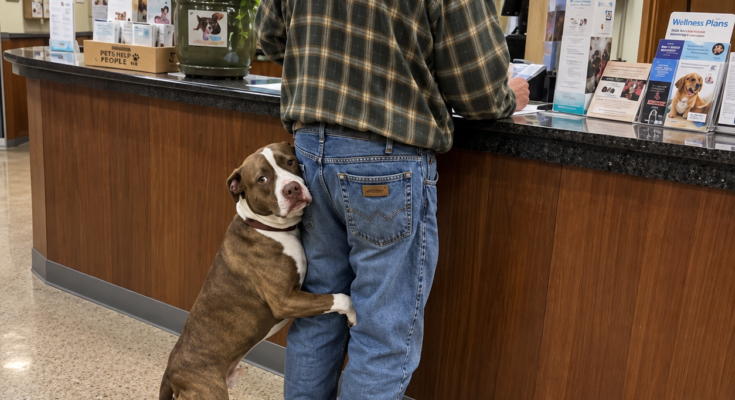
She didn’t answer immediately. She checked his right hip, then one hind leg. Tucker suddenly turned and wrapped both front paws around my shin. His claws caught my jeans. He pressed his chest against my leg and would not let go.
Dr. Hall stopped examining him.
“Has anyone told you his history?”
“The shelter said he was found. That’s all.”
She sat down on the little rolling stool so she was eye level with me. That’s when I knew it was bad. People only sit down for the bad ones.
“I’ve been a veterinarian for twenty-two years,” she said. “I remember this dog.”
I looked at Tucker.
“You’ve treated him?”
“Six years ago.”
She pointed carefully beneath the fur. Once she showed me, I could see them—small pale lines hidden under his coat. Old scars. Too many of them.
Dr. Hall took a breath. “He was brought into the county emergency clinic after a cruelty seizure. There were several dogs on the property. Tucker was one of the worst cases.”
My stomach turned.
“What happened to him?”
“I can tell you what his medical records showed. I can’t tell you every detail of what happened before that because nobody knows every detail.”
I nodded.
“He had two healed rib fractures and another that was fresh. His left hind leg had been broken previously and never treated properly. He was underweight, dehydrated, and had a wound around his neck consistent with having been restrained for long periods.”
My hand went automatically to Tucker’s head.
He flinched at first.
Then leaned into me.
“Why was he in the shelter six years?”
Dr. Hall’s expression tightened. “The cruelty case took time. Then placement became difficult. He wasn’t aggressive in the way people usually mean that word, but he was terrified. Certain men frightened him. Trucks frightened him. Anything resembling a strap or belt frightened him. Potential adopters would meet him, see him shut down, and choose an easier dog.”
“Six years?”
She nodded.
“He improved with shelter staff, but shelters are difficult places for a dog with chronic fear. Noise. Doors. Constant strangers. People coming and going.”
I looked down at Tucker’s paws locked around my leg.
“And nobody told me?”
“They should have told you enough to prepare you. I can’t explain why they didn’t.”
I was angry for about ten seconds. Then Tucker trembled against me, and anger suddenly seemed like something I could deal with later.
“What do I do?”
Dr. Hall looked at me.
“Do you mean today?”
“No. I mean with him.”
Her face softened.
“Don’t try to make him forget.”
That wasn’t the answer I expected.
“Then what?”
“Give him enough safe experiences that the old ones stop being the only thing his body remembers.”
I looked down at Tucker.
He was still holding my leg.
“So I shouldn’t make him let go?”
“No.”
She smiled slightly.
“Right now, you’re the place he decided was safe.”
That sentence nearly broke me.
Because two years after Helen died, I had adopted a dog because I wanted a reason to get out of bed.
I had not understood that somewhere during those first three weeks, Tucker had decided he needed me for exactly the same reason.
━━━━━━━━━━━━━━━━━━━━
Part Two — The Things Tucker Remembered
Dr. Hall gave me the name of a trainer who specialized in fearful dogs. His name was Marcus Reed, and the first thing he told me was, “We’re not fixing Tucker.”
I didn’t like that sentence.
“He’s not broken,” Marcus explained. “He learned things that kept him alive. Our job is to teach him that he doesn’t need all of those rules anymore.”
That changed how I saw almost everything Tucker did. Curling around his food wasn’t bad behavior. At some point, guarding food with his body may have meant getting to eat. Sleeping by the door wasn’t stubbornness. Knowing where the exit was probably once mattered. Refusing to walk between trucks wasn’t irrational if trucks had once predicted something frightening.
So we went slowly. Very slowly.
For the first month, I stopped trying to make Tucker walk past the pickup parked at the end of my street. We crossed the road instead. Marcus taught me that avoiding one frightening thing temporarily wasn’t “letting the fear win.” Sometimes trust came before training.
I fed Tucker in the quiet corner of the kitchen and walked away. After two weeks, I could sit across the room while he ate. A month later, he ate standing up for the first time.
I nearly called Marcus to announce it like Tucker had been accepted to Harvard.
“You realize most people don’t celebrate a dog standing at a food bowl,” Marcus said.
“Most people are underachievers.”
Tucker also discovered toys.
The first was a faded tennis ball I found beneath my porch. I rolled it accidentally while sweeping. Tucker stared at it as if it might explode. Then he touched it with one paw. The ball moved. He jumped backward.
Five minutes later, he touched it again.
By dinner, he was carrying it around the house.
That night, he brought it into my bedroom and dropped it beside Helen’s old slippers.
I hadn’t moved those slippers in two years.
I sat on the edge of the bed and stared at them.
Tucker looked at me.
“Don’t start.”
He tilted his head.
“You’re a dog. You don’t get to psychoanalyze me.”
He picked up the tennis ball and put it in my lap.
I laughed for the first time that day.
That became our routine. Every morning at seven, Tucker woke me by touching his nose to my hand. We walked around the block. I made coffee. He ate breakfast. Then we sat on the porch, two old creatures pretending we had important business watching squirrels.
People noticed me outside again.
My neighbor June started waving.
The mail carrier learned Tucker’s name.
A boy down the street named Eli asked if he could throw the tennis ball. Tucker hid behind me the first three times. On the fourth visit, he let Eli roll it.
A month later, Tucker brought the ball to him first.
That tiny act mattered more to me than anyone else understood.
Then one Saturday, everything went backward.
A utility crew parked a large white truck across from my house. One worker climbed down wearing a heavy tool belt. The metal buckle snapped against the truck door.
Tucker collapsed.
Not sat down.
Collapsed.
His belly hit the pavement, his legs folded beneath him, and he began trying to crawl backward while still attached to the leash.
I crouched beside him.
“Tucker. It’s me.”
He couldn’t hear me.
His eyes were somewhere else.
For one awful minute, the dog I had lived with for three months disappeared, and whatever had happened six years earlier took his place.
I eventually got him inside.
He hid behind the couch for nearly four hours.
I sat on the floor nearby but didn’t touch him.
At some point, I started crying.
Not because he had failed.
Because I had believed we were past this.
Marcus came over that evening.
“He’s back at the beginning,” I said.
“No.”
“He hasn’t come out.”
“That doesn’t mean he’s back at the beginning.”
Marcus sat beside me.
“Three months ago, how long would he have hidden?”
“I don’t know.”
“Maybe all night. Maybe longer. Today he had a severe fear response and came home with you. That’s not nothing.”
“He doesn’t trust me enough.”
Marcus shook his head.
“Daniel, he trusted you enough to be frightened beside you.”
That sentence stayed with me.
Twenty minutes later, Tucker crawled from behind the couch.
He didn’t come to Marcus.
He came to me.
He placed his head on my knee.
No paws around my leg this time.
Just his head.
I rested one hand against his neck.
“Okay,” I whispered. “We can have bad days.”
It wasn’t really about Tucker anymore.
After Helen died, my children kept telling me grief wasn’t a straight line. I hated hearing that because it sounded like something printed on a sympathy card by somebody who had never lost anyone.
Then I watched Tucker recover from fear.
Forward.
Backward.
Forward again.
A noise could ruin an afternoon without erasing three good months.
Maybe people worked that way too.
Six months after Tucker came home, I finally packed Helen’s slippers into a box.
I didn’t throw them away.
I wasn’t ready.
But I moved them out of the bedroom.
Tucker watched from the doorway.
“You happy?”
He wagged his tail.
“Traitor.”
Then I took him for a walk.
━━━━━━━━━━━━━━━━━━━━
Part Three — The Day He Wouldn’t Leave Me
Tucker had been with me eleven months when he saved my life.
I don’t use that phrase lightly.
It happened on a Thursday morning. We had already walked, and I was standing in the kitchen making coffee when I felt something strange in my chest. Not sharp pain. Pressure. Then dizziness.
I remember putting one hand on the counter.
Then nothing.
When I opened my eyes, I was on the kitchen floor.
Tucker was standing over me.
He was barking.
I had heard him bark maybe six times in the entire year I had known him.
“Tucker.”
My voice barely came out.
He stopped barking and immediately grabbed my sleeve with his teeth.
Not biting.
Pulling.
“Easy.”
He pulled again.
Then ran toward the front door.
Back to me.
Front door.
Back to me.
I couldn’t stand.
My phone was on the kitchen table.
Too far.
So I did something that felt ridiculous.
“Go get June.”
June lived next door.
Tucker stared at me.
“June. Go.”
He didn’t know what that meant.
Of course he didn’t.
Then someone knocked.
My mail carrier had heard Tucker barking through the front window. When nobody answered, she called June. June had my spare key because Helen insisted years earlier that somebody should have one.
The paramedics said later that I had an abnormal heart rhythm that needed immediate treatment. Whether Tucker’s barking changed the outcome, nobody could say for certain.
I know only that without him making enough noise to attract attention, I might have stayed on that floor much longer.
I spent two nights in the hospital.
June took care of Tucker.
According to her, he spent almost the entire time beside my front door.
When I came home, June walked him outside before I even got out of my daughter’s car.
Tucker saw me.
He froze.
Then ran.
My daughter dropped the bag she was carrying because Tucker hit my legs so hard she thought he might knock me over.
He wrapped his front legs around my shin exactly the way he had in Dr. Hall’s office almost a year earlier.
And he would not let go.
I stood there holding the porch railing with one hand and his collar with the other.
“I’m here.”
His whole body shook.
“I’m here, buddy.”
I understood then.
The first time Tucker held my leg, I thought he was afraid of the veterinarian.
Maybe he was.
But now I understood something else.
Tucker had spent his life watching people disappear.
Whatever happened before the shelter, somebody had failed him.
Then he spent six years watching people walk down that kennel aisle, pause, look, and leave with another dog.
I had become the first person who took him through the door and came back.
Then one morning, an ambulance took me away.
As far as Tucker knew, the pattern had started again.
I crouched as much as my doctor would have approved and put both hands around his face.
“You’re stuck with me.”
He licked my chin.
My daughter started crying.
“You know,” she said, “for a man who said he didn’t want another responsibility, you two are pretty dramatic.”
“Go home.”
She laughed.
Two weeks later, I took Tucker back to Dr. Hall.
He walked into the clinic slowly but didn’t panic.
When we entered the exam room, he immediately pressed himself against my leg.
But he didn’t wrap his paws around me.
Dr. Hall smiled.
“That’s different.”
“He’s showing off.”
She examined him. Tucker tolerated almost everything, though he still objected strongly to having his nails touched.
At the end, Dr. Hall sat on the same stool she’d used during our first appointment.
“Do you remember what I told you?”
“About giving him safe experiences?”
She nodded.
“You did.”
I looked at Tucker.
“No. We did.”
Dr. Hall smiled.
A few months later, the shelter asked if they could photograph Tucker for an adoption campaign featuring long-term residents.
I agreed on one condition.
“No sad kennel picture.”
They photographed him in my backyard instead.
Tucker was lying on the grass with his tennis ball between his paws. I was sitting behind him in an old lawn chair.
The shelter posted:
TUCKER — ADOPTED AFTER 6 YEARS
Underneath, they wrote about patience, senior adopters, and giving fearful dogs time.
A woman commented:
Who rescued who?
I hate that phrase.
People put it on bumper stickers.
But I understood what she meant.
Tucker needed a home.
I needed something harder to admit.
I needed to be needed again without being allowed to disappear inside that need.
Helen had been my reason for getting up for forty-three years.
When she died, I thought the loving part of my life was finished.
Tucker disagreed.
He needed breakfast at seven whether I was grieving or not.
He needed walks when it rained.
He needed patience on bad days.
He needed someone who wouldn’t punish him for remembering things he could not explain.
And in return, he gave me structure, noise, company, and eventually the courage to stop treating my own grief like something I should have gotten over by now.
Tucker is ten now.
His muzzle is whiter.
He sleeps more.
He has arthritis medication and an orthopedic bed that cost more than my first television.
He still doesn’t like parked trucks.
He probably never will.
He still flinches occasionally at metal buckles.
But now, after the flinch, he looks at me.
That’s the change.
He doesn’t need the whole world to feel safe.
He just needs to know where safety is.
Sometimes people ask why nobody adopted him for six years.
I used to answer with the shelter explanation.
Trauma.
Fear.
Special needs.
Now I say something different.
“He was waiting for someone slow enough.”
Because that is what Tucker needed.
Not a perfect owner.
Not someone who could erase his past.
Just an old man with nowhere urgent to be.
A man willing to stand fifty feet from a parked truck until Tucker decided he could take one more step.
And maybe that’s what I needed too.
Someone who didn’t expect me to stop missing Helen because two years had passed.
Someone willing to sit quietly beside me until I was ready to move.
The first day at the veterinarian, Tucker wrapped himself around my leg because he was terrified I might leave him.
Almost a year later, he did it again because he was terrified I had already left.
Both times, I told him the same thing.
“I’m here.”
These days, I understand those may be the two most important words either of us ever needed.