Part One — The Daughter Who Stayed
“Linda didn’t give up six years of her life for nothing.”
My brother said it ten minutes after we buried our father.
We were standing in Dad’s Ohio living room while relatives carried in casseroles, coffee, and paper plates. My black funeral dress still smelled faintly of the flowers from the graveside.
My brother, Michael, leaned toward two cousins and lowered his voice just enough to pretend he wasn’t trying to be heard.
“She knew there’d be a payday eventually.”
I heard every word.
I didn’t answer.
By then, I was too tired to defend six years to someone who had visited eleven times.
Dad had been seventy-nine when the doctor first told us his memory problems weren’t normal aging.
At first, they were small things.
He put the milk in a cupboard. He called me by my mother’s name once, then laughed until tears filled his eyes. He drove to the hardware store he had visited for forty years and couldn’t remember how to get home.
Mom had been gone three years.
Dad lived alone in the little white house where Michael and I grew up, the one with the porch swing that squeaked whenever the wind blew.
I was fifty-two then. I had a job I liked, a small apartment, friends, and a life that finally felt settled.
Then Dad called me one evening.
“Linda,” he said, trying hard to sound normal, “I think I’m becoming somebody I don’t recognize.”
Three weeks later, I gave notice at work.
I packed my clothes into six cardboard boxes and moved back into my childhood bedroom.
Michael lived less than two hours away.
He was successful, busy, and always “in the middle of something.”
He called regularly.
Sometimes.
Visited at Christmas.
Usually.
But whenever Dad needed something, Michael’s questions came quickly.
“Why was the grocery bill $143?”
“Does he really need someone fixing the porch railing?”
“Why are those absorbent pads so expensive?”
“Did you save the receipt?”
I saved every receipt.
Not because Dad asked.
Because Michael did.
I kept them in a shoebox under the kitchen counter.
Meanwhile, Dad forgot how to button his shirts.
Then how to use the television remote.
Then what month it was.
Then that Mom had died.
That was the hardest one.
Sometimes he would wake from a nap and ask when she was coming home.
At first, I told him the truth.
“Mom died three years ago, Dad.”
And every time, I watched him lose her again.
Eventually, I stopped.
“She’s not here right now,” I would say. “How about some coffee?”
He would nod.
“Coffee sounds good.”
There were nights when I slept two hours.
Mornings when I changed sheets before sunrise.
Afternoons when Dad accused me of stealing his wallet, only for us to find it inside the freezer beside a bag of peas.
Once, he became frightened because he didn’t recognize me.
He backed against the hallway wall.
“Who are you? What are you doing in my house?”
I went into the kitchen, cried quietly for three minutes, washed my face, and returned holding his old high school yearbook.
I showed him a photograph of me from senior year.
He stared for a long time.
Then his face softened.
“That’s my girl.”
“Yes, Dad.”
For five minutes, I had him back.
Michael never saw much of that.
He saw bank statements.
Repairs.
Bills.
Numbers.
And I suppose numbers are easier to look at than your father sitting at the kitchen table asking where his mother is.
Dad died six years after I moved in.
Quietly.
At home.
I was holding his hand.
Two days after the funeral, Michael and I sat down with Dad’s longtime attorney, Mr. Hayes.
Michael took Dad’s chair at the head of the dining room table.
That bothered me more than I expected.
Mr. Hayes went through the estate.
There was no great fortune.
Some savings.
A few investments.
Dad’s truck.
Tools.
Furniture.
The paid-off house.
Then Mr. Hayes stopped.
“There is something your father specifically asked me to show both of you.”
He reached into a cardboard box.
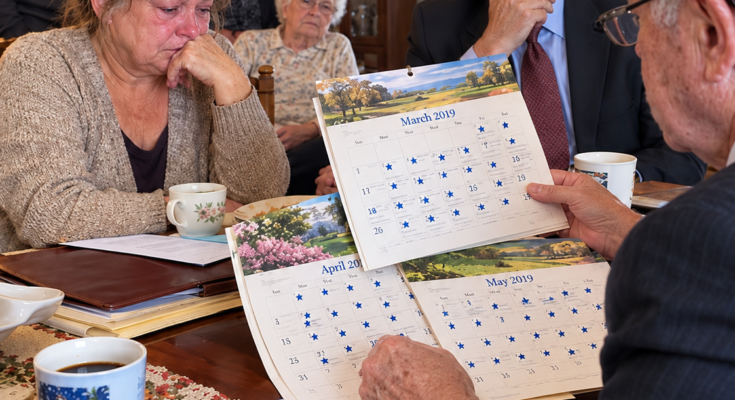
And pulled out six cheap wall calendars.
I recognized them immediately.
Dad had always kept one beside the refrigerator.
Michael frowned.
“What are those?”
Mr. Hayes opened the first calendar.
Tiny blue stars filled almost every square.
January.
February.
March.
One blue star after another.
“What does that mean?” Michael asked.
Mr. Hayes looked at me.
Then at him.
“Your father began marking these when his memory first started failing.”
My throat tightened.
“He told me a blue star meant Linda was there that night.”
Mr. Hayes turned page after page.
Blue star.
Blue star.
Blue star.
Hundreds of them.
Then he placed his finger on the final calendar.
“Two thousand one hundred and ninety nights.”
The room became completely silent.
━━━━━━━━━━━━━━━━━━━━
Part Two — The Nights Nobody Saw
Michael stared at the calendars.
For once, he didn’t ask a question about money.
Mr. Hayes reached into his folder and removed a yellow legal pad.
“Your father asked me to keep another record while he was still able to reliably tell me when family had visited.”
Michael shifted in Dad’s chair.
Mr. Hayes looked down.
“Linda lived here.”
Then he looked at my brother.
“You visited eleven times.”
Michael’s face changed.
Not dramatically.
He simply stared at the table.
For years, he had reduced Dad’s care to receipts and bank balances.
Now Dad had reduced those same years to something even simpler.
Nights.
2,190 of mine.
Eleven visits of his.
Mr. Hayes continued with the will.
Dad divided most of his savings evenly between us.
His tools went to Michael because, when they were younger, the two of them had spent years rebuilding engines and repairing things together.
Then came the house.
“The house goes to Linda.”
Michael looked up immediately.
“What?”
Mr. Hayes raised one hand.
“There’s a letter.”
He slid an envelope toward me.
My name was written across the front in Dad’s shaky handwriting.
I opened it.
The first sentence broke me.
Linda, if I forget to thank you, please remember that I meant to.
I covered my mouth.
Dad had written the letter shortly after his diagnosis, when he still understood what was coming.
He wrote that he knew there might be a day when he wouldn’t recognize me.
A day when he might accuse me of things I hadn’t done.
A day when I would have to become the parent in a relationship where I was still the daughter.
Then came the line I still keep framed beside my bed.
The house is Linda’s because a house belongs to the person who kept it a home.
I lowered the letter.
Michael stood up and walked toward the window.
For a long time, he said nothing.
Then he turned around.
His eyes were wet.
“I thought you were staying because you wanted the house.”
I folded Dad’s letter carefully.
“I stayed because he was Dad.”
Michael looked at the calendars.
“I should have been here more.”
I didn’t say anything.
He already knew.
That afternoon, after Mr. Hayes left, Michael remained at the table.
Most of the relatives had gone.
The casseroles were stacked in the refrigerator.
Paper plates filled the trash.
Dad’s chair sat empty again.
Michael reached down and picked up one of the calendars.
“I called him more than eleven times.”
“I know.”
“I checked in.”
“I know.”
“I had work. The kids. Karen’s mother was sick too.”
“I know.”
He looked frustrated.
“You keep saying that.”
“Because it’s true.”
“Then why do I feel like you’re judging me?”
I looked at him.
“I’m not.”
That surprised him.
I continued.
“I was angry for years. I wanted you to come more. I wanted one weekend where I could sleep without listening for Dad getting out of bed.”
Michael looked down.
“But Dad is gone now.”
My voice cracked.
“I don’t want to spend whatever relationship we have left turning his illness into a scoreboard.”
He rubbed his face.
“I made you save receipts.”
That almost made me laugh.
“Yes.”
“Every stupid receipt.”
“Yes.”
“Why didn’t you tell me to go to hell?”
“I was busy.”
For the first time since Dad died, we both laughed.
Then Michael became serious.
“I think asking about money made me feel involved.”
That sentence stayed with me.
“What do you mean?”
“If I asked about bills and repairs, I could tell myself I was helping manage things.”
He stared at the calendar.
“But mostly I was managing my guilt.”
I had never heard my brother speak that honestly.
Then he said something else.
“I was afraid of Dad.”
I frowned.
“Afraid?”
“Not of him.”
His voice softened.
“Of seeing what was happening to him.”
Michael told me that after one visit, Dad had mistaken him for our uncle.
Later that night, Michael sat in his car and cried.
He began making excuses after that.
Work.
Traffic.
Children.
Anything easier than sitting in front of the man who had taught him everything and watching him disappear.
“I kept thinking I’d come when he had a better day.”
I closed my eyes.
“With dementia, you can wait forever for a better day.”
“I know that now.”
So did I.
That evening, after Michael left, I wandered into the kitchen.
For six years, my life had been organized around that room.
Medication at eight.
Breakfast at nine.
Laundry before lunch.
Check the doors before bed.
Suddenly, there was nothing to do.
I opened the cabinet beneath the counter.
The old shoebox of receipts was still there.
Six years of proof.
Groceries.
Medicine.
Plumbing repairs.
Sheets.
Safety rails.
Adult briefs.
I carried the box to the dining table.
Then I looked at Dad’s calendars.
The receipts suddenly seemed ridiculous.
They proved what things cost.
The calendars proved what mattered.
So I threw the receipts away.
━━━━━━━━━━━━━━━━━━━━
Part Three — What Caregiving Leaves Behind
The first few months after Dad died were harder than I expected.
Everyone assumed I would feel relieved.
And part of me did.
No alarms at two in the morning.
No medication schedule.
No fear that I would wake up and find the front door open.
But relief and grief can live in the same body.
So can freedom and emptiness.
For six years, Dad needed me every day.
Then suddenly, nobody did.
I would wake at three in the morning because I thought I heard him moving down the hallway.
Sometimes I still caught myself buying his favorite cereal.
Once, I put two cups on the counter before remembering there was nobody waiting for coffee.
People talk a lot about how exhausting caregiving is.
They talk less about what happens when it ends.
You don’t simply get your old life back.
That life is gone too.
One Sunday afternoon, Michael showed up carrying a cardboard box.
“What’s that?”
“Dad’s tools.”
“He left those to you.”
“I know.”
He opened the box.
Inside was Dad’s old hammer.
A set of wrenches.
Two screwdrivers with cracked red handles.
Michael picked up the hammer.
“He taught me how to use this when I was eight.”
I smiled.
“He taught me too.”
“No, he told you girls shouldn’t swing hammers.”
“That’s why Mom taught me.”
Michael laughed.
Then he became quiet.
“I want to fix the porch.”
“What?”
“The railing.”
The same railing he had once questioned spending money on.
I almost said something sarcastic.
Instead, I handed him the key to the shed.
For the next four Saturdays, Michael came over.
We repaired the porch.
Then the loose kitchen cabinet.
Then the basement stairs.
There was no dramatic reconciliation.
We just worked.
Sometimes we talked about Dad.
Sometimes we didn’t.
One afternoon, Michael found a pencil mark behind the pantry door.
Our childhood heights were written there.
LINDA — 9
MICHAEL — 12
Dad had dated each one.
Michael ran his fingers over the marks.
“He measured us every birthday.”
“I remember.”
“He remembered everything.”
“Until he didn’t.”
We stood there quietly.
Then Michael said:
“Maybe that’s why the calendars mattered.”
I looked at him.
“He knew he was losing memories, so he started leaving evidence.”
That was exactly it.
The blue stars were Dad’s way of saying:
I noticed.
Even when he eventually couldn’t tell me.
Even when his mind could no longer hold my name.
At some point before the disease took too much, he had known.
And he had wanted me to know that he knew.
A year after Dad died, I started volunteering two afternoons a week with a local caregiver support program.
At first, I only helped with paperwork.
Then one day, a woman named Denise came in.
She was fifty-four.
Her husband had early-onset dementia.
She looked exhausted.
“I love him,” she said, “but sometimes I hate my life.”
Then she immediately covered her mouth.
“I shouldn’t say that.”
“Yes,” I told her. “You should.”
She stared at me.
“You can love someone and still hate what the illness is doing to both of you.”
She began crying.
I sat beside her.
I did not tell her to be strong.
Caregivers hear that too much.
I told her to accept help.
To sleep when somebody offered to sit with him.
To keep records because exhaustion destroys memory.
To stop feeling guilty every time she became frustrated.
And most importantly, I told her this:
“Being needed is not the same thing as being the only person allowed to help.”
That was something I wished I had understood sooner.
A few months later, Michael began volunteering too.
Not as a caregiver.
He handled home repairs for families caring for older relatives.
Grab bars.
Loose railings.
Ramps.
Small things.
The first time I saw him installing a safety rail for an elderly man with dementia, I almost cried.
Afterward, I told him:
“Dad would like this.”
Michael nodded.
“I hope so.”
Then he added:
“I spent six years checking what care cost.”
He tightened one final screw.
“I’m trying to learn what it was worth.”
Years passed.
I kept Dad’s house.
Not because it was valuable.
Because, eventually, I wanted it.
At first, I worried keeping it would make Michael think his old suspicion had been correct.
Then I realized I did not need to organize my life around preventing someone else’s misunderstanding.
Dad left me the house.
I accepted it.
I painted my childhood bedroom.
Changed the kitchen curtains.
Turned Dad’s room into a small reading room.
But I left one thing exactly where it had always been.
A calendar beside the refrigerator.
Every January, I hang a new one.
I don’t mark blue stars.
But on the anniversary of Dad’s death, I take down the final calendar he used.
I turn to one page.
There, beside an uneven blue star, Dad had written four words:
Linda made soup today.
That’s all.
Not:
Linda sacrificed her career.
Not:
Linda gave up six years.
Not:
Linda deserves a house.
Just:
Linda made soup today.
For a long time, I thought that sentence was too small to represent what those years had been.
Now I think it might be perfect.
Because caregiving is mostly small things.
One bowl of soup.
One clean shirt.
One repeated answer.
One hand held through another frightened night.
Very few of those moments look important while they’re happening.
But eventually, a life becomes made of them.
My brother once called me “just a caregiver.”
He doesn’t anymore.
But even if he did, I don’t think the word would insult me now.
There is no “just” in helping someone remain themselves for as long as they can.
No “just” in staying when recognition disappears.
No “just” in loving a person who may eventually forget your name.
Dad lost many things in those final years.
Words.
Dates.
Faces.
The road home.
But before the illness took those things, he left six calendars behind.
Two thousand one hundred and ninety blue stars.
Proof that even while his memory was disappearing, somewhere inside him he understood one thing clearly.
I was there.
And in the end, being there was never about earning the house.
It was about making sure the man who had once taken care of me did not have to face the last difficult part of his life alone.