Part One — Twenty Extra Chairs
My mother-in-law had always treated every holiday like it belonged to her, even when I was the one hosting it in my own home.
Her name was Barbara.
She would arrive hours early.
Criticize the decorations.
Move the serving dishes.
Rearrange my dining table.
Then announce to anyone within hearing distance:
“My son would never celebrate properly if I didn’t help.”
My husband, Mark, always laughed it off.
“Just let her have this one day.”
The problem was that Barbara wanted every day she entered my house to become her day.
At first, she invited one or two relatives to holidays without asking me.
Then three.
Then five.
Whenever I objected, she smiled.
“I didn’t think you’d mind.”
Last Thanksgiving, I found her leading six people through our upstairs bedrooms while explaining which room she thought should eventually become a nursery.
When I confronted her, Barbara looked genuinely amused.
“You’re acting like a guest in your own home.”
That sentence stayed with me.
So this year, I planned Thanksgiving carefully.
Fourteen guests.
Fourteen chairs.
Fourteen place settings.
Enough turkey, stuffing, potatoes, vegetables, rolls, and pie for everyone with leftovers.
Then, two days before Thanksgiving, Mark’s cousin Daniel called.
“So where are all the extra people supposed to sit?”
I frowned.
“What extra people?”
There was a pause.
“Barbara said she invited almost twenty more people because your house is the biggest.”
Twenty.
She had not called me.
Hadn’t texted.
Hadn’t even mentioned it.
That evening, I asked Mark.
He rubbed the back of his neck.
“Mom mentioned something about inviting a few people.”
“A few?”
“I didn’t realize it was twenty.”
“And you didn’t think to tell me?”
“I thought she’d already talked to you.”
There it was again.
Barbara did whatever she wanted.
Mark assumed I would absorb the consequences.
Normally, I would have argued.
Instead, I smiled.
“It’s fine.”
Mark looked suspicious.
“Really?”
“Really.”
Then I made one small change to Thanksgiving.
I changed it from a dinner I was hosting…
into a dinner Barbara was co-hosting.
Without telling her.
The next morning, I contacted every unexpected guest whose number I could get.
I was careful not to embarrass anyone.
I simply said:
“Barbara told me she’s invited you for Thanksgiving. We’re turning the larger gathering into a potluck so there’s enough for everyone. Would you mind bringing one dish?”
Nobody objected.
In fact, most sounded delighted.
One offered macaroni and cheese.
Another brought sweet potatoes.
Someone volunteered another turkey.
Others offered salads, bread, pies, vegetables, drinks, and appetizers.
Then I printed one simple card.
Thanksgiving afternoon, cars began filling our driveway.
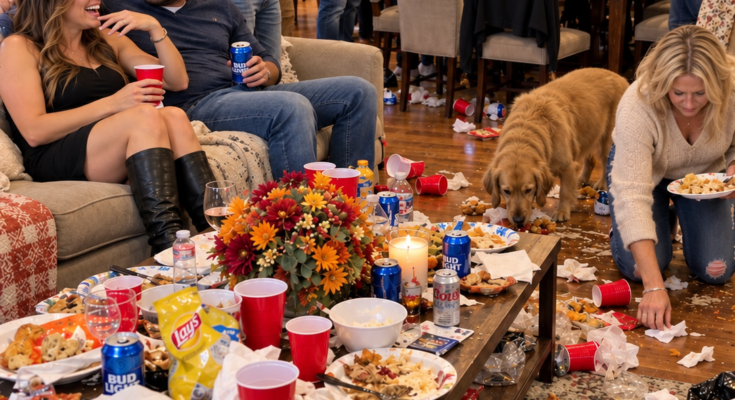
People came through the door carrying casserole dishes, desserts, bottles of wine, and foil-covered trays.
Barbara arrived last.
She looked around proudly.
“See?” she announced. “I knew this house was big enough for everyone.”
Then she removed her coat and walked toward the dining room.
She stopped.
In the center of the room stood a large sign.
WELCOME TO THANKSGIVING
HOSTED BY CLAIRE & BARBARA
Underneath it was a list.
Thirty-four names.
And beside each name was the dish that person had brought.
At the very bottom was one final line.
BARBARA — TURKEY, GRAVY & HOSTING THE 20 GUESTS SHE INVITED
Barbara stared at it.
Then slowly turned toward me.
“Oh my God.”
Her face went red.
“What did you do?”
I smiled.
“I let everyone know you were helping host.”
The room became very quiet.
━━━━━━━━━━━━━━━━━━━━
Part Two — The Holiday She Couldn’t Hand Me
Barbara walked toward the sign as if she hoped the words might disappear if she got close enough.
“You called people?”
“Of course.”
“Without asking me?”
I almost laughed.
The irony was spectacular.
“Yes, Barbara.”
Her mouth opened.
Nothing came out.
One of her cousins, Linda, looked between us.
“I thought Barbara had cleared all this with you.”
“No.”
Linda’s expression changed.
“You didn’t know we were coming?”
“Not until Tuesday.”
Barbara immediately interrupted.
“Oh, don’t make this dramatic. Claire loves entertaining.”
I looked at her.
“I enjoy hosting people I invite.”
Nobody spoke.
Then Daniel raised his hand slightly.
“For what it’s worth, I probably should’ve realized something was strange when Aunt Barbara said not to bother Claire because she’d complain at first.”
Barbara’s head snapped toward him.
“You didn’t need to repeat that.”
Mark looked at his mother.
“You said that?”
Barbara sighed.
“I knew Claire would make a fuss about numbers.”
“A fuss?” I asked.
“Twenty people, Barbara.”
“This house can accommodate them.”
“The house isn’t cooking.”
A few people tried unsuccessfully not to laugh.
Barbara glared at me.
“You’re humiliating me.”
“No.”
I lowered my voice.
“I made sure everyone you invited would still have a Thanksgiving dinner.”
I pointed toward the buffet.
“Your guests brought food. I added more tables. Mark rented extra chairs this morning.”
Mark gave me a startled look.
He had, although I hadn’t explained exactly why until afterward.
“Nobody is being sent home. Nobody is being embarrassed.”
I paused.
“But I’m not pretending you asked my permission.”
Barbara stared at me.
“You could’ve just cooked more.”
There it was.
The entire problem in five words.
“You could’ve just cooked more.”
More food.
More cleaning.
More shopping.
More preparation.
More money.
More work.
All because someone else had decided my time belonged to them.
I looked directly at her.
“Why didn’t you cook more?”
Barbara blinked.
“What?”
“They’re your guests.”
“This isn’t my house.”
“Exactly.”
Silence.
For years, I’d been trying to explain boundaries to Barbara.
That one word finally did it.
Exactly.
This wasn’t her house.
She couldn’t keep using my kitchen, my money, and my labor to perform generosity for people she invited.
Mark stepped beside me.
For once, he didn’t say:
“Just let her have the day.”
Instead, he looked at his mother.
“Mom, Claire’s right.”
Barbara looked genuinely wounded.
“Mark.”
“You should’ve asked.”
“I was trying to bring the family together.”
“And you could’ve done that by asking us first.”
Barbara looked around the room.
Most people suddenly became very interested in arranging dishes.
Then Linda spoke.
“Barbara, if Claire didn’t know twenty of us were coming, that’s not fair.”
Another relative nodded.
“You told us she wanted a big gathering.”
Barbara turned toward me.
I could see anger in her face.
But underneath it was something else.
Embarrassment.
Not because I had insulted her.
Because everyone could finally see what she had been doing.
She had been using my willingness to avoid conflict as permission.
Then something unexpected happened.
My daughter, Emma, walked in carrying a stack of napkins.
She was twelve.
She looked at the board.
“Grandma, you forgot your turkey.”
Barbara looked confused.
Emma pointed toward the bottom.
“Mom put turkey next to your name.”
I almost smiled.
Barbara hadn’t brought one.
Of course she hadn’t.
She had expected me to provide everything.
Then Uncle Robert called from the kitchen.
“I’ve got an extra smoked turkey in my truck.”
Everybody stared at him.
He shrugged.
“I always bring emergency meat.”
That broke the tension.
People laughed.
Even I laughed.
And after nearly twenty years of family holidays, Barbara did something I had never seen her do.
She took off her jewelry, rolled up her sleeves, and asked:
“What needs to be done?”
━━━━━━━━━━━━━━━━━━━━
Part Three — The Difference Between Helping and Taking Over
Thanksgiving did not collapse.
In fact, it became one of the best holidays we’d ever had.
Once people understood the situation, everyone helped.
Tables were pushed together.
Children carried napkins.
The teenagers refilled drinks.
Two uncles carved turkeys.
Linda organized the desserts.
Someone discovered we didn’t have enough serving spoons and came back from next door carrying six.
Nobody cared that the plates didn’t match.
Nobody cared that half the chairs were folding chairs.
Nobody cared that we ate almost forty minutes later than planned.
People talked.
Laughed.
Passed food.
There was more than enough.
And for the first time, I wasn’t trapped in the kitchen while Barbara entertained everyone in my living room.
She was beside me washing dishes.
At one point, I handed her a towel.
She dried a serving platter quietly.
Then she said:
“You planned that sign to embarrass me.”
I stopped rinsing a bowl.
“No.”
She looked at me skeptically.
“I planned the sign because I knew if I didn’t make it clear you invited them, you would spend the entire day letting everyone believe I had arranged all of this.”
Barbara said nothing.
I continued.
“And next year, you’d invite thirty.”
That almost made her smile.
Almost.
“You really think I’m that bad?”
“I think you’ve gotten used to me not saying no.”
That wiped the almost-smile away.
She looked toward the dining room.
Mark was laughing with his cousins.
Emma was sitting on the floor with three younger children.
The unexpected guests seemed perfectly happy.
Barbara lowered her voice.
“I just want people to feel welcome.”
“I know.”
“Then what’s wrong with inviting family?”
“Nothing.”
I dried my hands.
“But making someone else responsible for your invitation isn’t hospitality.”
Barbara looked at me.
“It’s delegation.”
That time, she actually laughed.
It wasn’t a warm laugh.
But it was a start.
Later that evening, after most people left, Mark and I stood in the kitchen surrounded by dishes.
He looked exhausted.
“I owe you an apology.”
I handed him a container of leftovers.
“For today?”
“For about fifteen years.”
I raised an eyebrow.
He leaned against the counter.
“Every time Mom crossed a line, I told you to ignore it because dealing with her reaction was harder.”
I didn’t answer.
He continued.
“I kept calling it keeping the peace.”
“It wasn’t peace for me.”
“I know.”
That mattered.
Not enough to erase anything.
But enough to begin changing it.
The next morning, Barbara called.
I expected anger.
Instead, she said:
“I was rude to you last year.”
I almost checked whether I had answered the correct phone.
“What?”
“The thing I said about you acting like a guest in your own house.”
She paused.
“I shouldn’t have said that.”
“No.”
“I suppose yesterday you made your point.”
“I wasn’t trying to win.”
“I know.”
Another pause.
Then she added:
“But that sign was obnoxious.”
I laughed.
“It was a little obnoxious.”
“A little?”
“Fine. Medium obnoxious.”
She laughed too.
That was the first honest conversation we’d had in years.
Things didn’t magically become perfect after that Thanksgiving.
Barbara was still Barbara.
At Christmas, she tried moving my centerpiece.
I moved it back.
She stared at me.
I stared at her.
Then she left it alone.
Progress.
The following Easter, she called three weeks ahead.
“I’m thinking about inviting your husband’s cousins.”
“How many?”
“Six.”
“Okay.”
Then she said something I never expected.
“Would that be too many?”
I smiled.
“No. Six is fine.”
“And I’ll bring the ham.”
“Now you’re learning.”
“Don’t get smug.”
The following Thanksgiving, I received a message from Barbara in October.
How many people are YOU inviting?
I replied:
Fourteen.
Three dots appeared.
Then:
May I invite Linda and Robert?
I stared at the word may longer than necessary.
Then I wrote:
Absolutely.
That year, Barbara arrived carrying a turkey she’d cooked herself.
She handed it to me at the door.
“I brought enough for six extra people.”
I looked behind her.
There was nobody there.
“Who are the six?”
“Nobody.”
She smiled.
“I thought leftovers might be nice.”
I hugged her.
That surprised both of us.
Years later, when I think about that Thanksgiving, I don’t remember the sign as much as I remember what happened afterward.
For years, I thought setting a boundary meant starting a fight.
So I kept avoiding them.
I smiled when I was angry.
Cooked when I was exhausted.
Made room when nobody asked whether I had any room left to give.
And every time I did, I taught people something.
I taught them that my silence meant yes.
Barbara wasn’t the only person responsible for that pattern.
Mark enabled it.
And eventually, so did I.
That Thanksgiving changed because I finally stopped hoping someone would notice I was overwhelmed and started telling them what I would and would not do.
The surprising part was that nobody went hungry.
Nobody’s holiday was ruined.
The family didn’t fall apart.
People simply adjusted.
That’s what healthy boundaries often look like.
Not slammed doors.
Not revenge.
Not making people suffer.
Just making responsibility land where it belongs.
Barbara invited twenty extra guests because she assumed I would handle everything.
Instead, those guests brought food, pulled up chairs, washed dishes, and helped create a Thanksgiving bigger than anything I could have managed alone.
And somewhere between the extra turkey and the mismatched plates, my mother-in-law finally learned the difference between opening someone else’s home…
and being invited into it.