Part 1: The Reading
“Take your time,” Caleb said. “I’m not going anywhere.”
Bernice Kessler stared at the sentence in front of her. She knew every word. That was the frustrating part. For thirty-eight years, Bernice had worked around books. She had read stories to toddlers, helped nervous teenagers find research sources, and recommended mysteries to widowers who came to the library because their houses had become too quiet. Words had always been her safe place.
Then, at 64, a stroke changed the rules. Her mind still knew what she wanted to say. Her mouth sometimes didn’t cooperate.
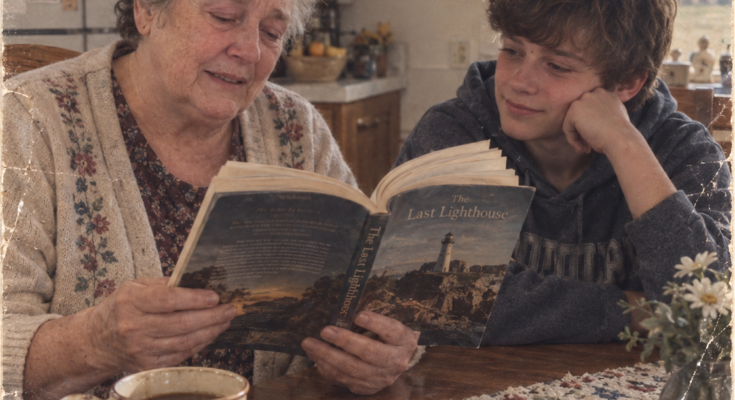
That Wednesday afternoon, Bernice sat at her kitchen table in a small Kansas town, one hand resting beside a chipped mug of tea. Across from her sat Caleb, the 15-year-old boy from two houses down. Bernice pointed at the paragraph. “The captain… opened the…” She stopped. Her cheeks flushed.
Caleb didn’t finish the sentence for her. He just waited.
Bernice tried again. “The captain opened the… c-cabin door.”
“There you go,” Caleb said.
She smiled. “Don’t celebrate yet. There are four pages left.”
That was how Wednesdays began.
Caleb had first shown up because his mother asked if Bernice needed help carrying groceries. Bernice had known him since he was a little boy riding a bicycle too fast down the sidewalk. Lately, though, he had become quieter. Taller. Always wearing the same faded sweatshirt. Always looking as though someone had interrupted a thought he wasn’t ready to explain.
One afternoon, he saw Bernice struggling through a newspaper article. “You want me to help?” he asked. Bernice hated the question. Not because of Caleb. Because six months earlier, she had been the person everyone else asked for help. Still, she nodded.
The next Wednesday, he returned with an old adventure novel Bernice had given him years ago. “You said this was good,” he told her. “It is good.” “You remember it?” “Of course I remember it.” “Then read it to me.”
Bernice laughed. “I’m not very good at reading aloud anymore.” Caleb shrugged. “I’m not very good at listening. Sounds fair.”
So she read. Slowly. Painfully at first. Sometimes one sentence took several tries. Sometimes Bernice stumbled over an ordinary word she had probably spoken ten thousand times in her life. Caleb never rushed her. When she became frustrated, he would tap the page and say, “That sentence isn’t going anywhere.”
They developed a system. Bernice read one page. Caleb read the next. If she got tired, he took over. If he got distracted, she nudged him back to the story. And whenever the villain appeared, Bernice accidentally gave him a ridiculous high-pitched voice. The first time it happened, Caleb laughed so hard he nearly fell out of his chair.
Bernice tried to look offended. “This is a very dangerous man.” “He sounds like somebody’s aunt.” After that, she used the voice on purpose.
Wednesday became their day. Sometimes they sat at Bernice’s kitchen table. Sometimes on the porch when the Kansas evenings were warm. Sometimes Caleb arrived carrying two sodas from the corner market. Sometimes Bernice had grilled cheese waiting.
What neither of them said was that the book had stopped being the important part.
What would you do if a simple reading session became the most important part of your week? The answer will warm your heart. Keep reading to find out what happens next. 👇
I know you’re curious to see what happens next, so please be patient and continue reading in the comments below. Thank you for understanding the inconvenience. Please leave a “YES” below and give us a Like to get the full story. 👇to part 2.
—
Part 2: The Truth
Caleb’s parents had recently separated. His father had moved across town. His mother was working extra hours. Some weeks Caleb stayed with one parent. Some weeks the other. Dinner schedules changed. Weekend plans changed. Boxes appeared in hallways. Arguments happened behind closed doors.
Nobody meant to make him feel unsettled. But he did.
Wednesday was different. Wednesday was always 4:30. Wednesday was always Bernice. Wednesday was always the old wooden table, two bookmarks, and the same adventure waiting exactly where they had left it.
As Bernice grew stronger, her reading improved. Words came more smoothly. Her pauses became shorter. One afternoon, she read nearly an entire page without stumbling. She looked up, surprised. Caleb grinned. “See?”
Bernice smiled. But something strange began happening as they neared the final chapters. Caleb forgot his copy. The first time, Bernice didn’t think much of it. They shared hers. The next Wednesday, he forgot it again. Then he claimed he had homework and needed to leave early. Another week, he spent twenty minutes getting snacks before they opened the book.
Bernice began to wonder if he had grown tired of the routine. Teenagers changed quickly. She knew that. Maybe spending Wednesday afternoons reading an old adventure novel with a 64-year-old librarian wasn’t exactly exciting anymore.
So one evening, Bernice closed the book with only two chapters remaining. “You don’t have to keep coming, Caleb.”
He looked at her. “What?”
“You’ve helped me more than you know.” She tapped the cover. “I can finish this myself now.”
Caleb said nothing. Bernice smiled, though it hurt a little. “You should be with your friends.”
Still silence. Then Caleb stared down at his hands. “If we finish it, what happens?”
Bernice frowned. “We pick another book, I suppose.”
“You never said that.”
“Well, I assumed—”
“I thought this was because you needed help reading.”
Bernice studied him. Caleb swallowed. “If you can read fine again, you won’t need me.”
The room went quiet. And suddenly Bernice understood all the forgotten books. The missing bookmark. The slow trips for snacks. The excuses. He wasn’t bored. He was trying to keep the story from ending.
What would you do if you discovered the person you were helping needed you more than you knew? The answer will break your heart. Keep reading to find out what happens next. 👇
I know you’re curious to see what happens next, so please be patient and continue reading in the comments below. Thank you for understanding the inconvenience. Please leave a “YES” below and give us a Like to get the full story. 👇to part 3.
—
Part 3: The Reckoning
Caleb’s voice became softer. “My dad moved out in March.”
Bernice nodded. “I know.”
“My mom keeps saying everything will settle down eventually.” He picked at the edge of the book. “But everything keeps changing.”
Bernice waited.
“I’m at Dad’s some weekends. Mom works late sometimes. We don’t even eat dinner at the same time anymore.” He looked around her kitchen. “But Wednesdays are always here.”
Bernice felt her throat tighten. Caleb gave an embarrassed laugh. “That sounds stupid.”
“No,” Bernice said. The word came out clearly. Strongly. “It doesn’t.”
She stood and walked toward the bookcase covering nearly an entire wall of her living room. Mysteries. Westerns. History. Old classics. Children’s books she had saved from her library days. Hundreds of stories.
Bernice ran her hand across the shelves. Then she turned toward Caleb. “Pick our next one.”
He looked at her. “What?”
“We have two chapters left.” She pointed at the shelves. “So you’d better choose what comes after.”
Caleb stood slowly. For almost ten minutes, he examined every row. Finally, he pulled out a thick mystery novel. “This one?”
Bernice smiled. “That one will take months.”
“Good.”
They finished the adventure book the following Wednesday. Bernice read the final page. Perfectly. Not one stumble. When she closed the cover, Caleb smiled. Neither of them said anything about her progress. Caleb simply placed the mystery novel between them. “Chapter one?”
Bernice opened it. “Chapter one.”
Months passed. Winter came to Kansas. Bernice kept improving. Soon she could read entire chapters without difficulty. Technically, she no longer needed practice. But Caleb kept coming. Some Wednesdays he read. Some Wednesdays she did. Sometimes they barely made it through three pages because Caleb needed to talk about school. Or his father. Or his mother. Or the girl he liked but refused to admit he liked.
Bernice listened. And sometimes Bernice talked too. About being afraid after the stroke. About how strange it felt to lose something she had taken for granted her entire life. About how lonely a house could become when nobody needed anything from you anymore.
They stopped pretending the arrangement was one-sided.
A year after their first Wednesday together, Bernice found the old adventure novel on the shelf. Inside was Caleb’s original bookmark. On the back, in his messy handwriting, he had written: “Best book I never wanted to finish.”
Bernice sat down at her kitchen table and cried. Not because she was sad. Because she was grateful. Grateful for the boy who had shown up when she needed him most. Grateful for the words that had come back to her, slowly, painfully, but surely. Grateful for the friendship that had grown out of a simple act of kindness.
She placed the bookmark back inside the book and returned it to the shelf. Then she picked up the mystery novel. It was almost finished. Only three chapters left.
She smiled. It was time to choose another one.
Caleb still comes every Wednesday. He’s in college now, studying literature. He wants to be a librarian, he says. Or a teacher. Or a writer. He hasn’t decided yet. But he knows one thing for certain.
He will always come back on Wednesdays.
Because some stories are too important to end. Some friendships are too strong to fade. And some people—like Bernice—are too precious to ever be forgotten.
The bookcase still stands in her living room. Hundreds of stories. Hundreds of worlds. And on the shelf, right at eye level, sits the old adventure novel. Inside is a bookmark. On the back is a message.
“Best book I never wanted to finish.”
Every time Bernice looks at it, she remembers. She remembers the boy who waited for her. She remembers the words that came back. She remembers the Wednesday afternoons that saved them both.
And she knows, with absolute certainty, that the best chapters are the ones you never see coming.
The End. ❤️