Part 1: The Confrontation
The wealthy homeowner called the neighborhood board to ban my work van from our street, but everything changed when he saw the receipt inside my battered toolbox.
I laid my heavy steel wrench on the grass and wiped my hands on an old rag, trying to keep my breathing steady. Mr. Vance was standing on his manicured lawn with his arms crossed over his chest. He was wearing a spotless golf polo, and his eyes narrowed as he looked from my rust-spotted white van to the open hood of my old Ford.
“This is a restricted subdivision, Jeremy,” Mr. Vance said, his voice carrying clearly across the quiet cul-de-sac. “We have guidelines about commercial vehicles parked overnight. You’ve been here three times this week, and frankly, some of the neighbors are uncomfortable. We don’t want our property values slipping.”
I swallowed the lump in my throat and adjusted my collar. I had washed my uniform in the sink of a gas station rest stop at five o’clock that morning, air-drying it against the van’s heater vents on the drive over. I made sure my boots were brushed and my hair was neatly combed.
No one could know. No one could know that three months ago, after my small plumbing company went under following my wife’s cancer treatments, I lost the house. No one could know that the back of my work van was now my bedroom, folded neatly between stacks of copper pipe and plastic bins of brass fittings. Every night, I parked behind the 24-hour supermarket on the edge of town, listening to the hum of the delivery trucks until I fell asleep.
“I’m sorry for the inconvenience, Mr. Vance,” I said quietly, keeping my voice respectful. “I was just finishing up a job down the street for Mrs. Gable. Her main line was backed up.”
Mr. Vance scoffed, taking a step closer. “Mrs. Gable is eighty-two years old and lives on a fixed income. I saw you carrying a brand-new water heater into her garage yesterday afternoon. She told me you charged her four hundred dollars for the whole job. A new unit alone costs twice that.”
He stepped up to the open side door of my van, pointing an accusing finger at my chest. “You’re using sub-standard parts on an old woman, or you’re pulling some kind of scam to get inside her house,” he said, his voice rising so the neighbors across the street could hear. “I know how guys like you operate when business gets slow. You take advantage of people who don’t know any better.”
A few doors down, Mrs. Gable’s front door opened slowly. She leaned heavily on her wooden walker, peering out at us from her porch with wide, worried eyes.
I took a deep breath. My hands were shaking, but not from anger. It was the bone-deep weariness of a man who had worked fourteen-hour days for thirty years only to end up with nothing left to lose except his dignity.
“I don’t scam people, sir,” I said softly.
“Then show me the invoice,” Mr. Vance demanded, reaching toward my truck. “Show me what you actually put in her house. Because if you’re taking advantage of a widow on this street, I’m calling the sheriff and having your vehicle towed today.”
Without saying a word, I turned to the back of my van. I pulled out my heavy, scuffed steel toolbox—the one my dad had given me when I started my apprenticeship at nineteen.
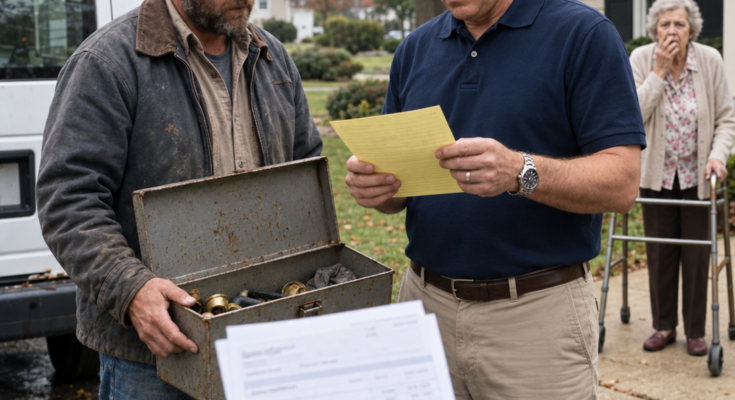
I popped the heavy metal latches and lifted the top tray. Beneath a row of pipe wrenches lay a thin yellow folder. I pulled out a fresh receipt from the supply house down in town and handed it to Mr. Vance.
He snatched the paper from my hand, ready to read me the riot act. But as his eyes scanned the printed lines, his forehead creased. The total at the bottom of the supply house invoice was $1,140.00. It was paid in full. Printed right above the total was the payment method: *Cash.*
Attached to the back of the invoice was the handwritten ticket I had given Mrs. Gable. It showed a total of $400.00, marked *Paid in Monthly Installments – $20/month.*
Mr. Vance blinked, looking from the paper to my face, his confidence suddenly faltering. “This… this says you paid eleven hundred dollars out of your own pocket yesterday morning.”
“Mrs. Gable didn’t have running water for four days,” I said quietly, keeping my eyes fixed on his. “Her main valve froze and cracked last week, and she was carrying gallon jugs of water from her neighbor’s garden hose into her kitchen because she was too proud to ask anyone for help. She was afraid if the city found out, they’d declare her home unfit and move her into a facility.”
I took the paper back gently and placed it back into my toolbox. “She offered me her late husband’s pocket watch to pay for the repair,” I continued, my voice trembling just a little. “I told her I didn’t need a watch. I told her the parts were left over from another job and that four hundred dollars paid over two years would cover it just fine.”
Mr. Vance stood frozen on the sidewalk. He looked at the grease on my hands, then at the neatly folded sleeping bag tucked behind the pipe racks in the back of my van, which he was seeing clearly for the first time. He didn’t say anything about property values. He didn’t say anything about the sheriff.
“You’re sleeping in here, aren’t you?” he asked, his voice barely above a whisper.
“I work hard, I pay my debts, and I fix people’s pipes,” I replied, closing the heavy lid of my toolbox with a solid click. “I’ll be off your street in five minutes, Mr. Vance.”
I closed the side doors of the van and climbed into the driver’s seat. When I looked in the rearview mirror as I pulled away, Mr. Vance was still standing on the curb, staring down at his spotless shoes.
I didn’t expect anything to come of it. I drove back to the supermarket parking lot that night, cooked a hot dog on a small camp stove, and went to sleep wondering how I was going to pay my vehicle insurance at the end of the month.
The next morning at six o’clock, my work phone rang. It was a man named David from two streets over. He asked if I could come take a look at his water pressure. When I arrived, he didn’t ask for an estimate. He handed me a cup of hot coffee and a hot breakfast biscuit wrapped in foil.
What happened next would change everything. Keep reading to find out what happens next. 👇
I know you’re curious to see what happens next, so please be patient and continue reading in the comments below. Thank you for understanding the inconvenience. Please leave a “YES” below and give us a Like to get the full story. 👇to part 2.
—
Part 2: The Ripple
David didn’t just want his water pressure checked. He wanted to talk. Over coffee, he told me he had heard what happened with Mr. Vance. The whole neighborhood had heard. Mrs. Gable had told everyone how I fixed her pipes for free. How I refused her husband’s watch. How I told her the parts were leftovers from another job.
“I run a small construction company,” David said. “I don’t have a full-time plumber. I’ve been looking for someone reliable. Someone honest.”
He offered me a contract. Steady work. Fair pay. And a small storage unit behind his office where I could park my van at night—legally, safely, off the street.
I almost cried into my coffee. Instead, I shook his hand and said thank you.
By the end of the week, three more homeowners had called. By the end of the month, I had enough work to hire an apprentice. By the end of the year, I had saved enough to rent a small apartment.
Mr. Vance never apologized. But he also never called the neighborhood board again. And one morning, I found an envelope taped to my van. Inside was a check for $1,140 and a note that said, “For Mrs. Gable’s water heater. I should have helped her myself.”
What happened next would change everything. Keep reading to find out what happens next. 👇
I know you’re curious to see what happens next, so please be patient and continue reading in the comments below. Thank you for understanding the inconvenience. Please leave a “YES” below and give us a Like to get the full story. 👇to part 3.
—
Part 3: The Reckoning
I didn’t cash the check. Instead, I drove to Mr. Vance’s house and knocked on his door. He answered looking uncomfortable, like a man who had spent three days rehearsing an apology and still didn’t know how to deliver it.
“I can’t take this,” I said, holding out the envelope.
“It’s not charity,” he said quickly. “It’s repayment. I accused you of something you didn’t do. I tried to get you banned from the neighborhood. I owe you more than money.”
“You owe me nothing,” I said. “But if you want to make it right, there’s something else you can do.”
He looked at me warily. “What?”
“Mrs. Gable needs a new roof. The leaks are getting worse. She can’t afford it. And I know you have a roofing crew that works on your properties.”
Mr. Vance was silent for a long moment. Then he nodded slowly. “I’ll make a call.”
The next week, a crew showed up at Mrs. Gable’s house. They replaced her roof, fixed her gutters, and repaired the rotting fascia boards on her porch. When she tried to pay them, they told her it was covered by a community improvement fund. There was no such fund. Mr. Vance had paid for everything out of his own pocket.
Mrs. Gable never found out who did it. But I knew. And Mr. Vance knew I knew.
He never became my friend. We never sat on his porch and drank lemonade. But something shifted between us. He started waving when I drove past. He started referring work to me. And when the neighborhood board tried to pass a new rule banning commercial vehicles from the subdivision, Mr. Vance was the first one to speak against it.
“He’s a working man,” he told the board. “He’s not hurting anyone. And he’s done more for this community than most of us.”
That was the closest he ever came to an apology. It was enough.
I paid forward every kindness. When I finally got back on my feet, I started a small fund for tradespeople who were struggling. I helped a mechanic who lost his shop to a fire. I helped a carpenter who was sleeping in his truck. I helped a young woman who was trying to start her own plumbing business. I told them what David told me: “You’re not alone. You’re not invisible. And you’re not done yet.”
Mr. Vance and I never talked about that day again. But I think about it often. I think about the way he looked at my toolbox. The way he saw the sleeping bag. The way his confidence crumbled when he realized he had judged me wrong.
I learned something from that day. I learned that everyone has a story. Everyone has a struggle. Everyone has a reason for the things they do. And sometimes, the only way to change someone’s mind is to show them the truth—not with anger, but with dignity.
I kept my father’s toolbox. It’s still scuffed. Still heavy. Still filled with the tools of my trade. But now, it’s also filled with something else. A receipt. A reminder. And a lesson I will never forget.
The End.