Part One: The Hallway
I would not hold my granddaughter the day she was born. My son married at nineteen, against everything I’d said, and I stood in the hospital hallway with my arms at my sides like a man waiting on a bus. No excuse. Pride, plain and ugly, and his wife saw it from the bed.
They moved to Ohio that fall.
Seventeen years now. I know my granddaughter’s face from the Christmas cards my wife thinks she hides from me. Sarah. She has her mother’s eyes and my son’s stubborn chin. In every photograph, she is smiling at someone just outside the frame.
I stopped being invited to things. I stopped being told about things. My wife still sends birthday cards. She signs both our names, but Sarah knows the handwriting by now.
I told myself it didn’t matter. I told myself I had my reasons.
Those reasons got thinner every year.
Last month an envelope came addressed to me alone. No return address. Just my name in careful blue ink.
Inside was a school assignment. A single sheet of paper with questions printed in neat rows. At the top, in the same careful handwriting, she had written:
*Interview a grandparent about his life.*
I read it four times.
She could have picked her other grandpa, the one she actually knows. The one who showed up at her birthdays and watched her soccer games and taught her how to ride a bike. The one who had earned the right to sit across from her and answer questions about his life.
But she picked me.
The second paragraph started, “I picked you because my dad always says…”
—
Part Two: The Answer
“…that you were the smartest man he ever knew.”
I sat down in my kitchen chair and read the rest of her letter through tears I didn’t try to stop.
She wrote about her father. How he talked about me when he thought no one was listening. How he still kept a pocketknife I had given him when he was twelve. How he told her stories about the farm where he grew up, about the way I could fix anything, about the summer I taught him to drive on a dirt road while my wife shouted at us from the porch.
She wrote that she had always wanted to meet me.
She wrote that she knew about the hospital. Her mother had told her, gently, when Sarah asked why she had never seen her grandfather.
She wrote: “Dad says you were wrong. But he also says people can change. And he says he forgives you. I don’t know if I do yet. But I would like to try.”
I read that sentence ten times.
My son had forgiven me.
I hadn’t even asked him to.
That night, I called my wife into the kitchen and showed her the letter. She read it slowly, one hand covering her mouth. When she finished, she looked at me the way she hadn’t in years.
“You should write back,” she said.
“I don’t know what to say.”
“Tell her the truth.”
So I did.
I wrote about the hospital. About the pride that kept my arms at my sides. About how wrong I had been. About how I had spent seventeen years regretting a moment I couldn’t take back.
I wrote that I would understand if she never wanted to meet me.
But I also wrote that I would like to try.
I mailed the letter the next morning. It was nine handwritten pages long.
Two weeks later, a small envelope arrived. Sarah’s blue handwriting.
Inside was a single sentence:
*Can we start with coffee? Just you and me.*
—
Part Three: The Coffee
I drove to Ohio on a Tuesday morning.
Six hours. My hands didn’t stop shaking the whole way.
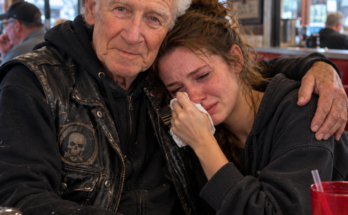
She picked a diner near her school. Small place. Red booths. Coffee that smelled like it had been sitting since dawn.
She was already there when I walked in.
Seventeen years old. Tall. Her mother’s eyes. My son’s chin. She stood up when she saw me and just looked at me for a long moment.
“I wasn’t sure you’d come,” she said.
“I wasn’t sure you’d want me to.”
She sat down. I sat across from her.
For a while, we didn’t say anything. Just looked at each other. Two strangers with the same blood.
“I brought the assignment,” she said finally, pulling out a crumpled sheet of paper. “I still need to interview you.”
“Okay.”
She asked me about my childhood. About my parents. About the farm. About how I met my wife. About what I did for work. About what I was proud of. About what I regretted.
I answered everything. Honestly. No excuses. No pride.
When she got to the last question, she hesitated.
“What do you want people to remember about you?”
I thought about it for a long time.
“That I learned,” I said. “Late. Too late for some things. But I learned.”
She wrote that down.
Then she looked up at me.
“My dad wants to see you,” she said. “He’s outside.”
I turned toward the window.
My son was standing on the sidewalk, hands in his pockets, looking at the diner like he wasn’t sure he should come in.
Seventeen years.
I stood up. I walked outside.
He was taller than me now. Gray at his temples. The boy I remembered was gone.
“Dad,” he said.
That one word broke me.
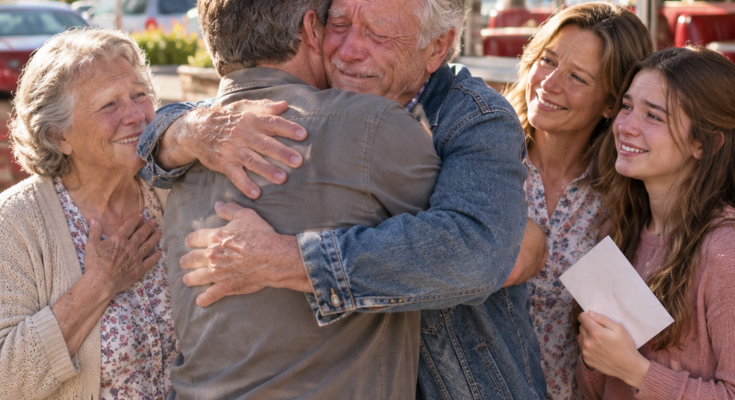
I opened my arms, and he walked into them.
We stood on the sidewalk for a long time. People walked past. Cars drove by. Neither of us let go.
“I’m sorry,” I said into his shoulder. “I’m so sorry.”
“I know,” he said. “I know.”
When we finally stepped back, Sarah was standing in the doorway, watching us.
She was crying. And smiling.
“You’re right, Dad,” she said to my son. “People can change.”
That was three months ago.
Now I drive to Ohio every other weekend. Sarah and I have coffee at the same diner. Sometimes my son comes. Sometimes his wife does. Sometimes we just sit and talk about nothing important.
Seventeen years is a long time to wait for a second chance.
But it’s not too long.
And when Sarah sends me her next school assignment—a family history project—I know exactly what I’ll write.
I’ll write about a man who stood in a hospital hallway with his arms at his sides.
And about a granddaughter who reached out anyway.
And about a son who forgave him before he ever asked.
That’s the story.
That’s the one worth telling.
—