Part One: The Ring
The fluorescent lights of the Texarkana gas station hummed softly in the midnight quiet, casting a pale glow over the empty pumps. Outside, an old sedan rolled to a stop, its engine sputtering on the very last drops of fuel.
A middle-aged woman stepped out, her eyes red, her shoulders bent under a weight the world couldn’t see. She walked into the station, held out a small gold band, and asked if eighteen dollars of gas was worth her late husband’s wedding ring.
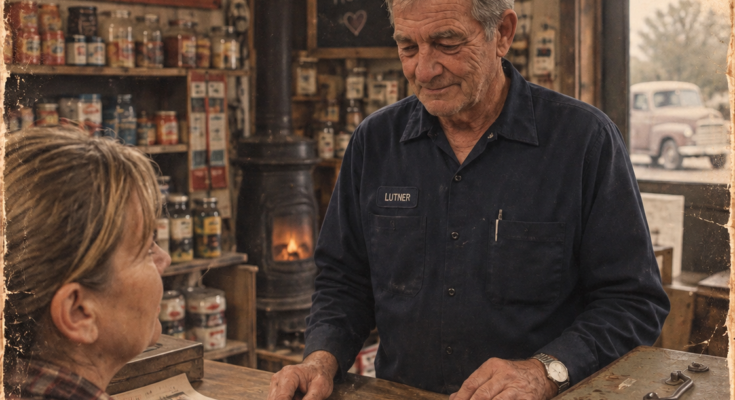
Luther Briggs did not ask for her story. He simply looked at the ring, looked at her face, and nodded.
“I’ll hang onto it for you, ma’am,” he said softly, his voice thick with the quiet grace of a man who knew what it felt like to lose everything. “You just get home safe tonight.”
At sixty-two, Luther knew the heavy taste of rock bottom. Three years earlier, a ruined economy and a string of bad luck had wiped out his small construction business. The bank took his house, his credit collapsed, and he found himself starting over from absolute zero.
Now, he worked the graveyard shift at the station five nights a week. His knees pained him every time he stood, and his home was a small, drafty room at the budget motel down the highway. But Luther never complained. He just worked.
Over the months, the night shift revealed a side of town most people ignored. It was the shift of desperate parents, exhausted nurses, third-shift factory workers, and folks driving on prayers and bald tires.
When someone pulled up with a dead tank and an empty wallet, they’d often come inside embarrassed, offering watches, tools, or cheap jewelry just to get enough fuel to make it to work the next morning.
Most night clerks would have turned them away. Luther didn’t.
Behind the register sat an old metal toolbox. Every time someone left an item as collateral, Luther placed it inside a small brown envelope, wrote the person’s name, phone number, and the exact gas amount on the front, and locked it away.
He never sold a single piece. He never charged interest. And when people finally scraped together the money weeks or even months later, Luther would hand back their keepsakes with a gentle smile.
Sometimes, if he saw a baby seat in the back of the car, he’d fill the tank using his own tips and leave the envelope blank.
The woman with the gold ring returned six weeks later. She walked up to the counter, her eyes brimming with tears, and laid a crumpled twenty-dollar bill on the register.
“I brought the money, Mr. Luther,” she whispered. “Thank you for keeping it safe.”
Luther unlocked the metal toolbox, found the small brown envelope, and slid the ring back across the glass counter. But he pushed the twenty-dollar bill right back to her side.
“You keep that,” Luther said softly. “A memory like that shouldn’t have a price tag on it.”
The woman pressed the ring against her chest and wept right there by the rack of road maps. She didn’t say much, but in a town of three thousand people, quiet kindness doesn’t stay secret for long.
—
Part Two: The Envelopes
Word spread slowly, the way good news used to spread—over porch railings, in church pews, and across kitchen tables. People began to realize that the tired old man working the graveyard shift had been quietly keeping their community afloat, one envelope at a time.
The tow truck driver, Marcus, was the first to understand the full scope of it. He’d been buying coffee from Luther every morning for two years. He’d never noticed the toolbox. He’d never asked why Luther always seemed to have a kind word for everyone, even at 4 a.m.
Then one morning, a young mother came in to reclaim a locket she’d left three months earlier. Luther pulled the envelope from the box, handed her the locket, and refused her money.
“I got a little extra that week,” he said. “Don’t worry about it.”
Marcus watched the woman walk out crying. He looked at Luther, who was already refilling the coffee pot, and something clicked.
“How many envelopes you got in that box?” Marcus asked.
Luther shrugged. “Lost count.”
“Can I see?”
Luther hesitated. Then he opened the toolbox.
Inside were dozens of envelopes. Some were yellowed with age. Some had names Marcus recognized—neighbors, friends, people he’d known his whole life. Each one told a story of a night when someone had nothing and Luther had given them something anyway.
“You never sold any of this?” Marcus asked.
“Wasn’t mine to sell.”
Marcus went home that morning and couldn’t sleep. He kept thinking about Luther’s drafty motel room, his aching knees, his quiet voice. He kept thinking about all those envelopes.
He didn’t know it yet, but the town was about to return the favor.
—
Part Three: The Home
A year later, Luther fell ill with a severe chest cold and missed four shifts in a row. When he didn’t show up, Marcus got worried and drove out to the motel.
What he found broke his heart. Luther was shivering in a tiny, freezing room, struggling to pay the daily rate because he couldn’t work.
That evening, Marcus posted a simple picture of the old metal toolbox on a local community page, along with the story of the eighteen-dollar wedding ring.
Within forty-eight hours, the town did what good people do.
Factory workers pitched in five-dollar bills. Farmers brought envelopes of cash. The woman whose ring Luther had saved wrote a check for everything she had saved that month.
By the end of the week, the small town had raised enough money to pay for a comfortable one-bedroom apartment for Luther, along with two years of prepaid rent, fresh groceries, and a warm armchair for his tired knees.
When they handed him the keys in the gas station parking lot, the tough old construction worker lowered his head and cried into his weathered hands.
“I didn’t do it for this,” Luther whispered, his voice trembling. “I just knew what it felt like to be stuck.”
Marcus clapped him on the shoulder, smiling through his own tears.
“You kept our dignity safe when we were down, Luther. It’s just our turn to make sure you have a home.”
Luther moved into the apartment that weekend. Marcus helped him carry his few belongings—a duffel bag, a coffee mug, and the old metal toolbox.
“You’re taking this?” Marcus asked.
Luther nodded.
“Figure I might need it.”
He kept working the night shift for another year. He still kept envelopes in the toolbox. He still refused to sell a single item. He still filled tanks for people who couldn’t pay and never mentioned it.
But now, when he went home at the end of his shift, he went to a place with heat and a chair that didn’t hurt his knees. And on Sundays, Marcus brought coffee, and they sat together and talked about nothing important at all.
The toolbox sits on a shelf in Luther’s new apartment now. He doesn’t open it much anymore. But sometimes, when the light hits it just right, he thinks about all those envelopes—all those people—all those nights when a small kindness made the difference between giving up and getting home.
Real wealth isn’t measured by what you keep in your pockets, but by what you hold safe for others when they have nothing left.
—