Part One
“Don’t go yet,” Lucinda Webb said, reaching for the empty chair beside her. “You haven’t heard about the yellow ones.”
I had already picked up my change. My truck was running, and a carton of milk was getting warm on the passenger seat.
But something in the way she straightened that chair made me turn off the engine.
Three days earlier, I had stood in the grocery aisle and listened while two neighbors discussed her roadside stand.
“Five dollars for a little bag of tomatoes,” one said. “You can get them cheaper right here.”
“She’s selling the farm,” the other answered. “Probably trying to squeeze every last dollar out of it.”
I didn’t say anything. That’s the part I wish I could change.
Lucinda was seventy. She and her husband, Everett, had worked the same piece of ground outside our little Missouri town for forty-three years. He had been gone fourteen months. The farm was scheduled to change hands before the first frost.
I knew those facts the way you know things about people you don’t actually check on. Somebody mentions them, you shake your head, and you keep loading your groceries.
That Saturday, I stopped because my wife wanted tomatoes for sandwiches.
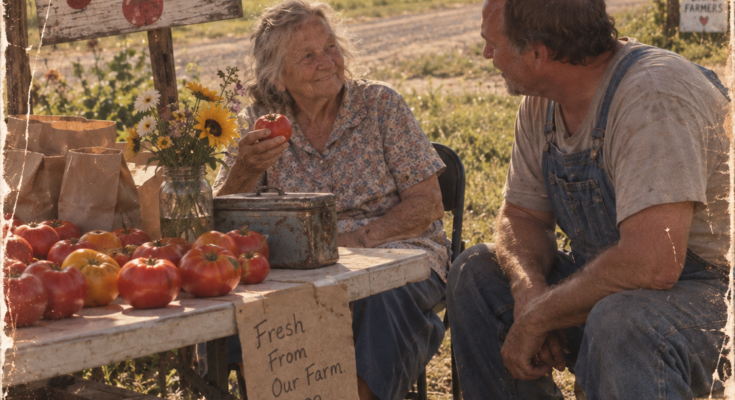
Lucinda sat beneath a faded patio umbrella beside a folding table. There were brown paper bags, an old kitchen scale, and a coffee can with a plastic lid. Propped against the table was a wooden sign.
TOMATOES — $5 A BAG.
The white paint had cracked into little squares. One corner was dark where rain had soaked into the wood.
I handed her a five, and she chose a bag for me. Then she asked whether I liked yellow tomatoes.
“Don’t think I’ve ever had one.”
“Well,” she said, pulling out the chair, “Everett would’ve considered that an emergency.”
That was when I almost left.
Instead, I sat.
She took a yellow tomato from a shallow basket and held it in her palm. Her hands were bent at the knuckles, with dirt caught along one thumbnail.
“He planted these nearest the house,” she said. “Claimed they needed watching. Really, he liked stealing one on his way back from the shed.”
She told me he carried a saltshaker in his shirt pocket every August. Once, it opened while she was washing his work clothes, and he insisted the machine had never smelled fresher.
I laughed. She smiled down at the tomato before putting it in my bag.
Then she showed me the big pink ones, which split if the rain came too fast, and the small red ones her granddaughter used to eat before they reached the kitchen.
“Everett planted more of those every year,” she said. “Never admitted who they were for.”
A breeze lifted the edge of the tablecloth. Somewhere behind the barn, a loose piece of metal tapped steadily against a post.
We talked for twenty minutes. Mostly she talked, but she asked about my wife’s knee and remembered which house we lived in.
When I finally stood, she opened the coffee can and counted out four dollars and fifty cents.
“You gave me too much change.”
“No. Fifty cents is plenty.”
I pointed at the sign.
She looked at it for a moment, then pressed the money into my hand.
“You sat awhile.”
I didn’t know what to do with that.
“Lucinda, you don’t have to give me a discount for talking.”
“I know.” She folded the top of my bag carefully. “I wanted to.”
On my way home, I passed a neighbor walking his dog and pulled over to offer him a tomato.
“You paid her five dollars?” he asked.
“Fifty cents.”
He nodded. “My sister said the same thing. Went over there Tuesday, stayed half an hour, came home with tomatoes for practically nothing.”
Then he chuckled.
“Guess she needs to make up her mind.”
I looked at the bag beside me.
“I think she’s having a hard time,” I said.
—
Part Two
The following Thursday, I stopped again. This time, I brought two cold lemonades and left my engine off.
Lucinda’s daughter, Beth, was carrying boxes out of the house. One was marked KITCHEN in thick black letters.
Lucinda watched her disappear through the front door.
“She found me a nice apartment,” she said. “No stairs. Little balcony.”
“That sounds good.”
“It is good.”
She smoothed the tablecloth with both hands.
“I just don’t know what you do on a balcony at six in the morning.”
I asked about the sign.
“Were tomatoes five dollars last summer, too?”
“Oh, that sign’s years old. We used bigger bags then.”
She rubbed a flake of paint between her finger and thumb.
“Everett made it in the kitchen during a thunderstorm. Got paint on my table. I fussed at him, and he told me someday I’d appreciate owning an original.”
She smiled, but it didn’t last.
“I brought everything out here this summer, and that was the sign we had.”
“You could paint a new price.”
“I suppose.”
She looked toward the house.
“But he made that one.”
I glanced at the coffee can. There couldn’t have been enough money in it to fill my truck’s gas tank.
Still, I had nearly believed she was out here trying to save a farm five dollars at a time.
Beth came back for another box. She saw us looking at the sign and rested her hands on her hips.
“Mom, people can’t tell what you’re charging.”
“They can ask.”
“Some won’t.”
Lucinda lowered her eyes.
After a moment, she said, “I’ve noticed.”
Beth sat on the other side of her. She didn’t mention the packing or remind her mother how much was left to do.
“What if we keep Dad’s sign,” she asked, “and put a smaller board underneath?”
Lucinda considered that.
“Could you fit a whole sentence?”
—
Part Three
The next morning, there were two signs.
Everett’s stayed exactly where it was.
Beneath it, on a clean scrap of wood, Beth had written:
TODAY’S TOMATOES: 50¢ A BAG.
COMPANY WELCOME. NO PURCHASE NEEDED.
I wish I could say the whole town showed up. It didn’t.
But a woman walking home stopped and sat down. A man brought back a jar Lucinda had given his wife years earlier, with two oatmeal cookies inside.
I brought my wife on Sunday.
She and Lucinda spent forty minutes discussing whether a tomato sandwich needed anything beyond salt, pepper, and mayonnaise. Neither changed the other’s mind.
Before we left, my wife asked what Lucinda was doing the following Sunday afternoon.
“Packing, probably.”
“Come eat with us. Around four.”
“Oh, you don’t need to—”
“I’m making meatloaf. There’ll be plenty.”
Lucinda glanced at me, checking.
“We’d like you there,” I said.
She arrived at ten minutes to four carrying six tomatoes and a dish towel she was afraid we might mistake for a gift.
“I’ll need that back,” she told my wife. “It’s a good one.”
By the second Sunday, she knew which kitchen drawer held the forks. By the fourth, she was telling me I had cut the tomatoes too thin.
The farm sold in October.
Everett’s sign hangs on Lucinda’s balcony now, above two pots she intends to plant in the spring.
She still misses the place. Sometimes at supper she starts a sentence with “When I get home,” and has to stop for a moment.
We let her finish in her own time.
Last Sunday, she stayed to dry the dishes. As she handed me a plate, she said, “I didn’t think anybody would have room for me once I left that road.”
I told her she could leave her good dish towel at our house.
There would always be another Sunday.
Sometimes the kindest thing you can give someone is a place they’re expected back.