PART 1 — THE NOTE
For months, Thaddeus Cole ordered things he clearly did not need.
Flashlights.
Reading glasses.
Pens.
Cheap tools.
I delivered every package to his little house on Elm Street.
At first, I always knocked.
Thad was eighty-two and lived alone after his wife died. He kept cold water for me in summer and butterscotch candies beside the door.
We talked about old cars, bad weather and the woman he still missed every day.
Then holiday season arrived.
My company began timing every stop.
Two minutes per delivery.
No delays.
No unnecessary conversation.
So I stopped knocking.
I placed the boxes behind his planter, photographed them and hurried away.
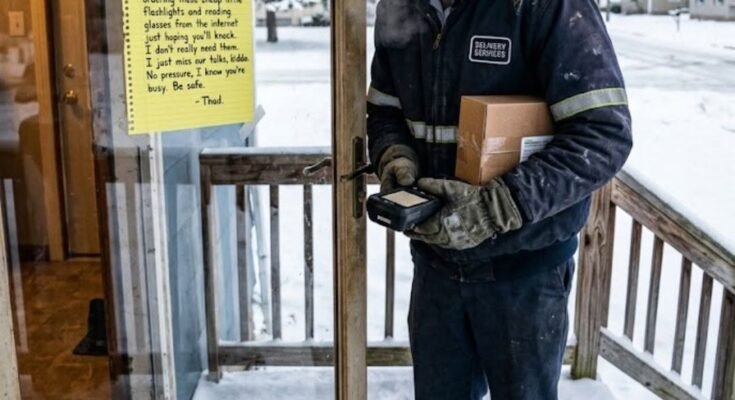
One freezing afternoon, I found a yellow note taped inside his storm door.
Kaelen,
I keep ordering these cheap flashlights because I hope you’ll knock. I don’t need them. I just miss our talks.
No pressure. I know you’re busy.
—Thad
I stared at the tiny box in my hand.
He had not been ordering products.
He had been ordering a visitor.
My scanner beeped, warning me to move.
I ignored it and knocked.
Thad opened the door wearing a wool cardigan.
“Well,” he said, smiling, “I thought you’d forgotten how to use your knuckles.”
“I’m sorry.”
He looked at the package.
“More reading glasses.”
“You don’t need them?”
“I own eleven pairs.”
I laughed and stayed for coffee.
After that, I stopped every weekday at 12:15.
The packages stopped arriving.
Three weeks later, I pulled up and found his porch empty.
Yesterday’s medication was still outside.
Through the window, I saw a chair overturned and a broken mug on the floor.
I entered and found Thad collapsed beside the kitchen table.
One side of his face drooped.
His words were slurred.
I called an ambulance and held his hand.
“Don’t leave,” he whispered.
“I’m staying.”
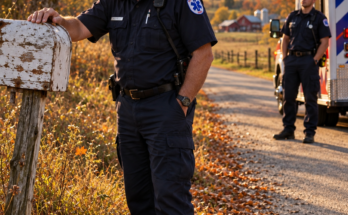
A paramedic later told me I had found him early enough to save his life.
Thad had been expecting lunch.
PART 2 — THE SON
At the hospital, I called Thad’s emergency contact.
His son, Michael, arrived three hours later.
When he entered the room, Thad turned his head away.
They had not spoken in four years.
After Thad’s wife died, Michael wanted him to sell the house and move closer.
Thad refused.
One argument became months of silence.
Then years.
“I told myself he wanted to be alone,” Michael admitted.
“He didn’t,” I said.
Thad remained hospitalized for nine days.
Michael came every day.
When Thad returned home, his son repaired the porch railing, filled the refrigerator and began visiting every Sunday.
Michael’s teenage daughter, Emily, started coming too.
At first, she barely spoke.
Then Thad taught her how to repair an old radio.
Soon, the dining table no longer had only one used chair.
Photographs returned to the refrigerator.
The house finally sounded alive again.
One afternoon, Michael found the yellow note Thad had written me.
He read it twice.
“You asked a delivery driver to stay,” he said, “but you wouldn’t call your own son?”
Thad looked at him.
“I called.”
Michael froze.
“You sent me to voicemail,” Thad continued. “Seven times.”
Michael’s eyes filled.
“I deleted them without listening because I wanted you to call again.”
“I stopped because I thought you wanted me gone.”
Both men had spent four years waiting for the other to return first.
Michael crossed the room.
Thad held out his hand.
His son took it.
Neither apologized perfectly.
But neither let go.
PART 3 — THE LAST DELIVERY
Three years later, Thad was eighty-five.
He still wore pressed shirts.
He still criticized my delivery truck.
And he still kept coffee waiting at 12:15.
One winter morning, Michael called before sunrise.
Thad had died peacefully in his sleep.
At the funeral, Michael handed me a sealed envelope.
Inside was the yellow note, carefully preserved beneath glass.
There was also one final letter.
Kaelen,
You once believed stopping made you bad at your job. It made you human.
Do not let people praise you so much that you forget you ignored me first. That part matters too. Kindness is noticing when you’ve become careless and choosing to return.
Call your grandfather.
Knock before people have to ask.
And eat lunch sitting down.
—Thad
At the bottom, he had added:
The coffee was never good. You were simply cold.
I laughed and cried at the same time.
Thad’s house did not remain empty.
A local organization turned it into temporary housing for older adults who had nowhere safe to go.
The first resident was a seventy-eight-year-old widow named Louise.
I delivered her first package.
I placed it on the porch, photographed it and almost walked away.
Then I stopped.
I knocked.
Louise opened the door.
“You must be Kaelen.”
“How do you know?”
She pointed toward Thad’s framed yellow note hanging in the hallway.
“He left instructions.”
I glanced at the package.
“What did you order?”
“A flashlight.”
“Do you need it?”
She smiled and opened the door wider.
“No. But I have coffee.”
Years earlier, I thought my job was moving boxes as quickly as possible.
Thad taught me that a person could stand inches from another human being and see only an address.
The most valuable thing I ever delivered had no barcode or tracking number.
I stopped.
I knocked.
And I stayed long enough for a lonely man to know the world had not forgotten where he lived.
THE OLD MAN KEPT ORDERING PACKAGES HE DIDN’T NEED—THEN I FOUND HIS NOTE