Part 1: The Surrender
A penniless farmer surrendered his only dog to a crying officer, but the secret inside his dropped metal box caused a convoy to shut down the town.
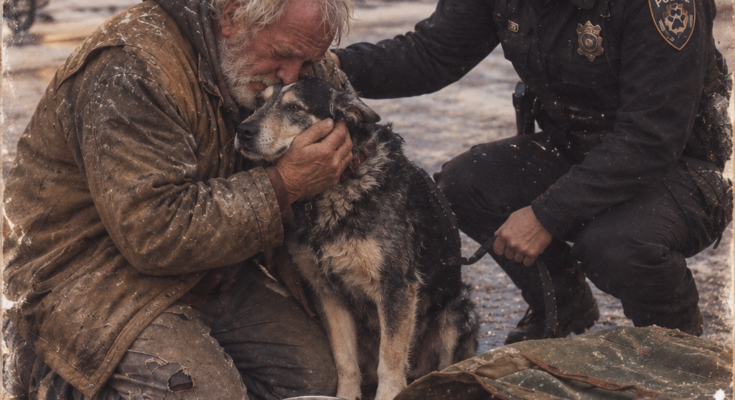
The canvas loop tightened around Scout’s neck, and the old cattle dog dropped his belly to the freezing asphalt. He let out a terrified, high-pitched whimper.
Arthur dropped to his bare, bruised knees in the diner parking lot. He wrapped his dirt-stained hands around the dog’s head, trying to shield him from the animal control officer’s grip.
“You have to let go, sir,” the young officer said, his voice shaking. “You can’t afford the tags, and you’re living in a truck. I have to take him.”
I watched the whole thing from behind the diner counter. The town had passed a strict new ordinance about unlicensed pets, and Arthur was the first target.
The officer pulled the leash harder. Arthur’s grip slipped.
As the old man scrambled to hold onto his best friend, his canvas duffel bag tipped over. It hit the ground hard, and a rusted tin box spilled open across the concrete.
It wasn’t money. The wind caught a stack of faded photographs and blew them right to my feet.
A man stepping out of the diner picked up a heavy, solid brass medallion attached to a thick blue ribbon. He wiped the dirt off it and gasped.
“Farmer of the Decade,” he read aloud.
I looked down at the photos. They showed Arthur, twenty years younger, standing proudly in front of endless fields of golden wheat.
Standing beside him in the picture was a much younger Scout, looking up at his owner with pure adoration.
Arthur wasn’t just a drifter. He used to be the agricultural backbone of our entire county.
He used to feed half the state before historic droughts and ruthless bank foreclosures took his land and his equipment. The only thing they couldn’t take was his dog.
The crowd outside the diner realized exactly who they were looking at. The mood shifted from pity to pure outrage.
“Let the dog go!” a woman screamed.
People closed in, yelling, pointing fingers, and pulling out their phones to record. The young officer backed up against his white van, looking completely panicked.
The situation was seconds away from turning violent.
Then, Arthur did the unthinkable.
He struggled to his feet, his knees bleeding through his torn jeans. He stepped right between the angry crowd and the terrified young officer.
“Back down!” Arthur yelled, his voice cracking. “Put your phones away. He is just doing his job.”
The crowd went silent.
“He’s following the rules written on a piece of paper downtown,” Arthur said. “A piece of paper took my farm, and now a piece of paper takes my dog. Don’t blame this kid for a broken world.”
Arthur turned around and knelt back down on the cold asphalt. He looked his dog right in the eyes and took off his frayed, handmade collar.
“Be a good boy,” Arthur whispered, kissing the top of the dog’s head. “Go with the man. He’ll give you a warm bed.”
The officer wiped a tear from his own cheek. He gently guided Scout into the back of the van and shut the heavy metal doors.
As the van drove away, Arthur just stood there in the parking lot, holding an empty piece of rope.
I couldn’t just go back to pouring coffee. I took out my phone and wrote down exactly what I had witnessed.
I wrote about the blue ribbons on the concrete, the old photos, and a man who had lost his entire world yet still defended the officer taking away his last reason to live.
I posted the story to a local community board.
By the time my shift ended, my phone was frozen from the notifications. The post had been shared thousands of times.
People were furious and heartbroken. But most importantly, they remembered Arthur.
They remembered the man who used to donate massive shipments of grain to local food pantries during the hardest winters.
Two mornings later, Arthur was sitting on the wooden bench outside the diner. He looked incredibly small, like a man waiting to fade away.
I walked out to bring him a cup of coffee. But before I could hand it to him, the ground started to shake.
It started as a low rumble, like thunder rolling across the open plains.
Arthur looked up. I looked toward the highway.
Then I saw what was coming down the main road—and why every driver was headed straight for Arthur. There had to be thirty trucks, and none of us understood yet what they had come to do.
—
Part 2: The Convoy
The first truck was a grain hauler. Long. Silver. The kind that normally carries fifty thousand pounds of wheat. It pulled into the diner parking lot and stopped directly in front of Arthur.
The second truck was a cattle truck. The third was a flatbed. The fourth was a pickup with a horse trailer attached.
By the time the tenth truck arrived, the parking lot was full. By the time the twentieth arrived, they were parked along both sides of Main Street. By the time the thirtieth arrived, the entire town had come out to watch.
Arthur stood up. He was still holding the empty rope. His hands were shaking.
“What is this?” he whispered.
The driver of the first truck—a big man with a gray beard and a John Deere cap—climbed down from his cab.
“Mr. Mueller,” he said. “My name is Hank. I farm four hundred acres over in Colby County. You don’t know me. But my father knew you.”
Arthur stared at him.
“Your father?”
“Earl Jenkins. He passed five years ago. But he never forgot what you did for him.”
Arthur shook his head.
“I don’t—”
“In 1987, my father’s barn burned down. He lost everything. His hay. His equipment. His seed for the next season. You showed up at our door three days later with a truck full of grain and a check for ten thousand dollars. You said, ‘Pay me back when you can.’ He never got the chance.”
Hank reached into his pocket and pulled out a folded piece of paper.
“He wrote this before he died. He said if I ever saw you again, I was supposed to give it to you.”
Arthur took the paper. His hands were trembling so badly he could barely unfold it.
*”Arthur,*
*I never forgot. I never will. You saved my family. You saved my farm. You saved my life.*
*I know things have been hard for you. I know you lost everything. But you didn’t lose us. You didn’t lose the people you helped.*
*We remember. We all remember.*
*When you need us, we’ll be there.*
*Your friend,*
*Earl”*
Arthur read the letter three times. Then he looked up at Hank.
“I don’t understand. Why are you here?”
Hank smiled.
“Because you need us.”
—
The other drivers were climbing down from their trucks now. Farmers. Ranchers. Men and women in work boots and flannel shirts. They gathered around Arthur in a loose circle.
A woman stepped forward. She was in her sixties, with silver hair and kind eyes.
“Mr. Mueller, my name is Sarah. My husband and I run a small dairy farm over in Ridgeway. You probably don’t remember us. But you helped us during the drought of ’92. You gave us hay when we had nothing. You gave us hope when we had none.”
Arthur was crying now.
“I don’t—I don’t remember—”
“You don’t have to remember. We remember for you.”
Another man stepped forward. Younger. Maybe forty.
“Mr. Mueller, my name is David. My grandfather was a farmer. He died when I was a kid. But he used to tell me stories about you. About how you fed half the county during the hard winters. About how you never asked for anything in return.”
He paused.
“I’m not a farmer. I’m a lawyer. But I’m here because my grandfather would have wanted me to be.”
Arthur looked around the circle.
“Why?” he asked. “Why are you all here?”
Hank stepped forward.
“Because we heard what happened. We heard about the ordinance. We heard about Scout. And we decided we weren’t going to let it happen.”
He reached into his truck and pulled out a box. A big box. He set it on the ground in front of Arthur.
“We took up a collection. Every farmer in five counties. We raised enough money to pay your fines. To buy you a place. To get Scout back.”
Arthur stared at the box.
“You can’t—”
“We can. And we did.”
—
The young animal control officer was still standing beside his van. He had watched the entire scene unfold. His face was pale.
Hank walked over to him.
“Son, what’s your name?”
“Tyler.”
“Tyler, we’re not here to cause trouble. We’re here to help Mr. Mueller. He’s a good man. He’s had a hard life. And he deserves better than what he’s gotten.”
Tyler nodded.
“I know. I didn’t want to take his dog. I had to.”
“I understand. You were doing your job. Nobody blames you.”
Tyler looked at Arthur.
“I can call my supervisor. I can see if we can release the dog into your custody. If the fines are paid.”
Hank nodded.
“They’re paid. We’ve already taken care of it.”
Tyler pulled out his radio and stepped away.
Ten minutes later, he came back.
“Your dog is at the shelter. You can pick him up tomorrow morning.”
Arthur started to cry.
“Thank you,” he whispered. “Thank you.”
Tyler nodded.
“I’m sorry for what you went through, sir. You didn’t deserve it.”
—
Part 3: The Reunion
The next morning, Arthur stood outside the animal shelter.
He was wearing clean clothes. New boots. A warm coat. The farmers had taken care of everything.
The shelter door opened. A woman walked out with Scout on a leash.
The old cattle dog saw Arthur and started pulling. Whining. Wagging his tail so hard his whole body shook.
Arthur knelt down.
“Hey, boy,” he whispered. “Hey, Scout.”
Scout broke free and ran to him. He jumped into Arthur’s arms. He licked his face. He whimpered with joy.
Arthur held him tight.
“I missed you,” he whispered. “I missed you so much.”
Scout licked his tears.
—
The town threw a party that night.
Not a big party. Just a gathering. In the diner parking lot. With coffee and pie and sandwiches.
The farmers stayed. All thirty of them. They told stories. They laughed. They cried.
Arthur sat in the middle of it all, Scout at his feet, and listened.
He heard about the lives he had touched. The farms he had saved. The families he had helped.
He heard about the winters he had kept people warm. The droughts he had survived. The storms he had weathered.
He heard about the man he had been.
And for the first time in years, he believed it.
—
It’s been a year now.
Arthur lives in a small house on the edge of town. The farmers bought it for him. It has a porch. A garden. A big backyard for Scout.
He doesn’t farm anymore. His body can’t take it. But he helps. He visits the farms. He shares advice. He tells stories.
The farmers call him “the Professor.” He laughs at that.
“I’m just an old man with a dog,” he says.
But Scout knows better.
Scout knows that Arthur is a hero.
Scout knows that Arthur saved lives.
Scout knows that Arthur is loved.
And every night, when Arthur sits on the porch and watches the sunset, Scout climbs into his lap and licks his face.
Just to remind him.
—
The End