I thought my cat was having a secret romance through the neighbor’s window until I learned who was really waiting there.
The first time I caught Razzle doing it, I almost dropped my laundry basket.
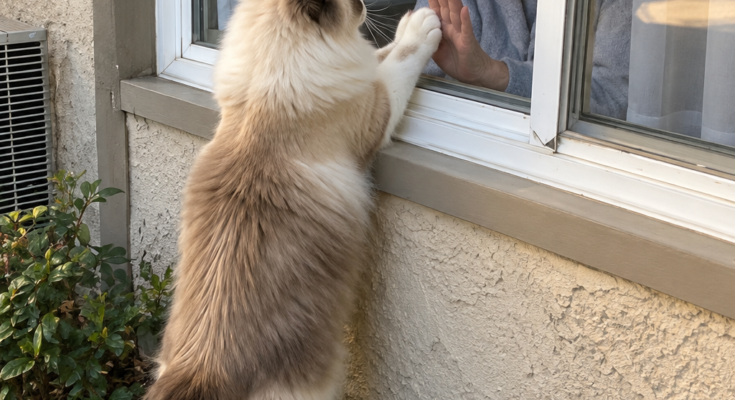
There he was, my big fluffy Ragdoll, standing on his back legs outside my neighbor’s window like he was in the final scene of some old love story. His front paws were pressed flat against the glass. His blue eyes were wide. His little pink nose was almost touching the pane.
From where I stood in the apartment courtyard, it looked like another paw was touching his from the inside.
I squinted.
“No way,” I whispered.
Razzle didn’t even look back.
This cat, who acted like walking from the couch to the food bowl was a full day’s work, had somehow dragged his soft, dramatic body all the way to Mrs. Harlan’s ground-floor window. And now he was holding paws with somebody.
I walked closer, trying not to laugh.
“Razzle,” I called.
He turned his head slowly, gave me a look that clearly said, “Please respect my privacy,” then turned right back to the window.
I had raised a soap opera actor with whiskers.
At first, I thought there was another cat inside. Maybe Mrs. Harlan had one I’d never seen. Maybe Razzle had a secret girlfriend. Maybe he had been sneaking out for months, promising some fancy indoor cat that one day he’d break her out and they’d run away together behind the dumpsters.
I stood there like an idiot, holding a basket of towels, watching my neutered cat act like he had a complicated romantic past.
After about five minutes, he finally dropped back down and came waddling over to me like nothing had happened.
“Sir,” I said, “you are unemployed and fixed. What exactly was that?”
He blinked at me.
The next day, he did it again. Same window. Same time. Same dramatic little paw against the glass. This time I looked harder.
There wasn’t another cat. Behind the thin white curtain, I saw a shape. Not fur. Not ears. A hand. An old woman’s hand. Mrs. Harlan.
I didn’t know much about her. She lived alone in the apartment next to mine. She was small, quiet, and always wore a pale blue sweater, even when it was warm out. I’d seen her carry grocery bags one at a time because they looked too heavy. I’d waved at her maybe three times in two years. That was it.
That’s how people live now, I guess. Ten steps from each other, sharing walls, sharing parking spaces, hearing each other’s microwaves beep through the drywall, but still strangers.
Razzle apparently knew her better than I did.
For four days, I watched him go to that window. He didn’t scratch. He didn’t meow. He just stood there and placed both paws on the glass. And every time, that small wrinkled hand came up from the other side.
On Friday, I got embarrassed. I thought maybe he was bothering her. So I opened my door and called him back.
“Razzle, come on. Leave that poor woman alone.”
He looked over his shoulder, annoyed as usual, but before he moved, Mrs. Harlan’s curtain shifted. A piece of notebook paper was taped to the inside of the window. Then I read the shaky words—and suddenly, this wasn’t funny anymore.
*Please don’t call him away too soon.*
I stood there frozen. The words were written in thin, trembling letters. The paper was wrinkled, like she had pressed it against the glass many times, trying to make sure it stayed. I looked at Razzle. He looked at me. Then he turned back to the window and pressed his paws against the glass again.
The hand returned. The fingers spread. Razzle pressed closer.
I didn’t call him away. I walked back inside and sat on my couch and felt something heavy settle in my chest.
I didn’t know Mrs. Harlan. I had lived next to her for two years. I had never knocked on her door. I had never asked if she needed anything. I had never even learned her first name.
But my cat had.
The next morning, I baked muffins. I’m not a baker. The muffins were dense and slightly burnt. But I put them on a plate and walked next door and knocked.
No answer.
I knocked again.
A voice came through the door, thin and tired. “Who is it?”
“It’s your neighbor,” I said. “From next door. I brought muffins. And I wanted to ask about my cat.”
A long pause. Then the sound of slow footsteps. The door opened a few inches. Mrs. Harlan peered out. She was smaller than I remembered. Her pale blue sweater hung loose on her shoulders. Her eyes were cloudy but sharp.
“Your cat,” she repeated.
“Razzle,” I said. “The fluffy one. He’s been visiting your window.”
Her face changed. Something softened. Something broke. “He’s yours?”
“Yes. I’m sorry if he’s been bothering you.”
She opened the door wider. “Bothering me?” She laughed, but it was a sad laugh, like a cough. “He’s the only reason I get out of bed.”
I didn’t know what to say.
She stepped back and gestured for me to come in. I walked into a small, dim apartment that smelled like old books and tea. The furniture was neat but dusty. A walker sat by the couch. A hospital bed was pushed against the far wall. A television played game shows with the volume off.
“I had a stroke,” she said quietly. “Six months ago. Left side doesn’t work so well anymore. My daughter lives in Oregon. She calls on Sundays. The nurse comes Tuesdays and Thursdays. The rest of the time, it’s just me.”
She lowered herself into a chair by the window. The same window. She pointed to a small stool beside it.
“That’s where I sit,” she said. “Every day. I watch the courtyard. I watch people come and go. Nobody looks up. Nobody waves. I’m like a ghost in my own apartment.”
I sat on the couch. I felt small.
“Then one day,” she continued, “this big fluffy cat showed up. Stood right there on his back legs and put his paws on the glass. Looked me right in the eye. Like he knew me.”
She smiled. It was the first real smile I had seen on her face.
“I put my hand up,” she said. “And he stayed. He didn’t run. He didn’t scratch. He just stayed. Every day after that, same time. I started to wait for him. I started to get up. I started to eat breakfast so I’d have the strength to walk to the window.”
I looked at Razzle, who had followed me in and was now curled at her feet. He purred like a motor.
“He’s not a cat,” she said. “He’s a reason.”
I felt tears in my eyes. I blinked them back.
“Why didn’t you tell me?” I asked. “Why didn’t you knock on my door?”
She looked at me with those cloudy eyes. “I didn’t want to be a burden. I didn’t want you to feel obligated. People are busy. People have lives. I didn’t want to be the old woman who needs things.”
I thought about all the times I had walked past her door. All the times I had heard her television through the wall. All the times I had thought, *I should check on her*, and then didn’t. I thought about how easy it is to be a good person in theory and how hard it is in practice.
“You’re not a burden,” I said. “You’re my neighbor.”
She reached out and took my hand. Her grip was weak but warm. “Thank you for the muffins,” she said.
I laughed. “They’re terrible.”
“I know,” she said. “I can smell them. But you brought them. That’s what matters.”
That was the beginning.
I started visiting Mrs. Harlan every morning. I brought coffee. I brought crosswords. I brought my laptop and showed her how to video call her daughter. She cried the first time she saw her granddaughter’s face on the screen.
Razzle came with me. He sat by the window. He sat on her lap. He followed her from room to room, a fluffy shadow. She called him her gentleman caller. She said he was better than any man she had ever known.
Her daughter flew in for a visit a month later. She cried when she saw how much better her mother looked. She thanked me. She thanked Razzle. She said she was sorry she had been so far away.
“You’re not far,” Mrs. Harlan told her. “You’re just busy. And that’s okay.”
I heard the forgiveness in her voice and I thought about all the people I had let become strangers. The friends I had stopped calling. The family I only saw on holidays. The neighbors I had never met.
One night, I sat with Mrs. Harlan on her couch. We watched an old movie. Razzle slept between us. She told me about her husband, who had died ten years ago. She told me about her garden, which she missed more than anything. She told me about the stroke, and how scared she had been, and how she had thought about giving up.
“I don’t know if I would have made it,” she said. “If he hadn’t come.”
She meant Razzle. But she also meant me.
“You would have,” I said. “You’re stronger than you think.”
“No,” she said. “I’m not. That’s why we need each other.”
I looked at Razzle. He opened one blue eye, yawned, and went back to sleep. He had no idea what he had done. He was just a cat. But he had done more for this woman than I had in two years of living ten feet away.
He had taught me that connection isn’t something that happens to you. It’s something you choose. It’s a knock on a door. It’s a plate of terrible muffins. It’s a cat on a windowsill, refusing to give up on someone who needed him.
Mrs. Harlan got better. Slowly. She started walking more. She started cooking again. She planted a small garden on her patio—tomatoes, basil, one stubborn sunflower. She gave me a tomato one day. It was the best tomato I had ever tasted.
“From my garden,” she said proudly.
I took it home and ate it over the sink, and I cried.
Razzle still visits her window. But now he doesn’t have to stand on his back legs. She leaves the door open. He walks in like he owns the place. He curls up on her lap while she watches her game shows. He keeps her company while she waits for the nurse. He is still her reason.
But now she has more than one.
I learned something from that cat. I learned that loneliness is a quiet thing. It doesn’t announce itself. It sits behind windows and waves at neighbors who don’t look up. It waits for someone to knock. It waits for a plate of burnt muffins. It waits for a fat fluffy cat to press his paws against the glass and say, *I see you. I’m here. Don’t give up.*
Razzle wasn’t having a secret romance. He was having a secret friendship. With a woman who needed him. And he brought me into it, whether I wanted to be or not.
I’m glad he did.
Last week, Mrs. Harlan gave me a key to her apartment. “For emergencies,” she said. “And for coffee. You don’t have to knock anymore.”
I put the key on my keychain, next to mine. It feels right there. Like it was always supposed to be there.
Razzle sat on the windowsill between us, purring. He looked at me with those blue eyes, and I swear he was smiling.
“You did this,” I told him.
He blinked.
“You’re the reason.”
He yawned.
But I knew he understood. Cats always understand. They just don’t feel the need to explain.