PART 1 — THE NOTE
One week before our wedding, Robert disappeared.
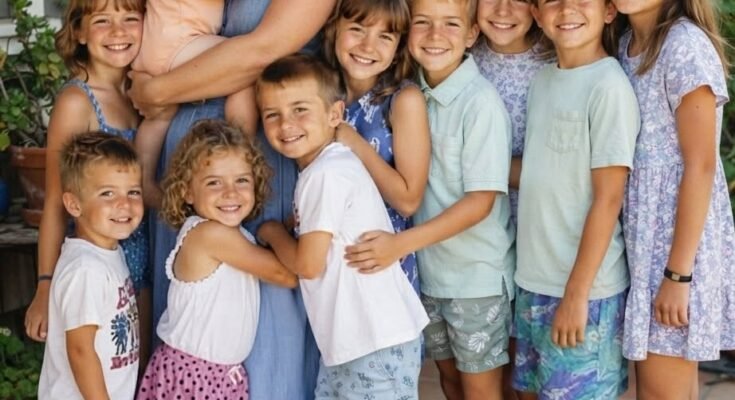
He left ten children behind.
The youngest was three. The oldest was fourteen.
On the kitchen table, I found a note:
I’m sorry. I can’t do this anymore.
My relatives told me to call social services.
“They aren’t your responsibility,” my mother said.
But the children had already lost their mother.
I could not let them lose their home too.
So I stayed.
The adoption process took years, but eventually all ten became legally mine.
I worked two jobs.
We wore donated clothes, shared bedrooms and ate more casseroles than anyone should.
There were difficult years.
But there was also laughter.
Graduations.
Weddings.
Grandchildren.
Thirty years later, all ten still came to my house every Sunday.
During one of those dinners, someone knocked.
An older man stood outside holding a cream-colored envelope.
“My name is Jonathan Reed,” he said. “I was Robert’s attorney.”
The room went silent.
“Robert died last week. Delivering this was his final request.”
After he left, I opened the envelope with all ten children gathered around me.
The first line made my hands shake.
Anna, I never wrote the note you found.
PART 2 — WHAT REALLY HAPPENED
Robert explained that the night he vanished, his older brother, Malcolm, asked him to meet privately.
The children had inherited money from their late mother.
Malcolm wanted Robert to let him control the trust.
Robert refused.
On his way home, his car was forced off the road.
He survived, but suffered a severe brain injury.
For months, he could not remember his name.
Malcolm placed him in a private care facility under a false identity.
Then he forged the note and told everyone Robert had run away.
Malcolm expected the children to enter foster care.
Once separated, he planned to apply for control of their inheritance.
He had not expected me to keep them together.
When I began the adoption process, the court locked the trust until each child became an adult.
Malcolm never touched the money.
Robert slowly recovered fragments of his memory.
But Malcolm told him I had abandoned the children and moved away.
He even showed Robert a false newspaper article claiming several of them had died in a house fire.
Robert believed him.
Years later, after Malcolm died, Robert found a box hidden inside his brother’s office.
Inside were the original trust documents, my address and a copy of the forged note.
He finally learned the truth.
“Why didn’t he come here?” one of the children asked.
I continued reading.
Robert had found us only eight months earlier.
By then, he had terminal cancer.
He wrote:
I wanted to knock on your door. But I saw photographs of the family Anna built. I was afraid appearing at the end of my life would only reopen wounds I had not earned the right to touch.
Then the envelope produced one final surprise.
A flash drive contained medical records, police evidence and a recorded confession Malcolm had made before his death.
Robert had not abandoned us.
He had been erased.
PART 3 — HIS LAST WISH
The final page was addressed to the children.
I do not ask you to call me Dad. Anna earned that place every day I was gone.
My last wish is only that you know I did not choose to leave you.
Several of the children cried.
Others were angry.
My oldest son, Daniel, stared at the floor.
“He should have come when he found us.”
“Yes,” I said.
The truth explained Robert’s absence.
It did not erase it.
Jonathan returned the next morning.
Robert had left behind a modest home and the money Malcolm had never managed to steal.
Everything was divided equally among the ten children.
But there was one condition.
No one had to accept it.
No one had to forgive him.
A week later, we visited Robert’s grave.
Some of the children brought flowers.
Some remained in their cars.
I placed the old note beside his headstone.
For thirty years, I had believed those seven words:
I’m sorry. I can’t do this anymore.
Now I knew they had never belonged to him.
I did not know whether Robert and I would have been happy.
I did not know whether our marriage would have lasted.
But I finally knew he had not looked at ten frightened children and chosen to disappear.
Before we left, my youngest daughter slipped her hand into mine.
“Were you ever sorry you stayed?”
I looked at the ten adults standing around me.
At their spouses.
At their children running between the trees.
“Not once.”
Robert’s final wish gave them the truth.
But his disappearance had given me something neither of us expected.
A family.
Not because I was forced to keep them.
Because every day for thirty years, I chose to stay.
MY FIANCÉ DISAPPEARED AND LEFT ME WITH HIS TEN CHILDREN—THIRTY YEARS LATER, HIS LAWYER BROUGHT ME A LETTER