He had learned years ago that hungry people already carried enough embarrassment.
Then life handed him another lesson.
His daughter had fallen on hard times, and suddenly Marcus was raising his two grandchildren, eight-year-old Kayla and six-year-old Jordan, in the apartment above the store.
His mornings started before sunrise.
He packed lunches.
Found missing socks.
Signed school papers.
Opened the store.
Worked twelve hours.
Helped with homework behind the counter.
Then closed up and started all over again.
Money was tight.
Sleep was tighter.
But Marcus still kept that microwave on.
“Why do you let them hang around?” one regular customer asked him.
Marcus glanced toward a skinny seventeen-year-old named Devon, who was heating a container of rice while pretending not to listen.
“Because it’s cold outside.”
“They scare customers.”
“They haven’t done anything.”
“They’re always in here.”
Marcus smiled.
“So are you.”
The customer didn’t laugh.
People saw teenagers in hoodies and assumed the worst.
Marcus saw other things.
He saw Devon carefully splitting one microwave meal with his younger brother.
He saw sixteen-year-old Isaiah pretending he wasn’t hungry until Marcus “accidentally” made two hot dogs instead of one.
He saw a girl named Tiana sit by the window until her mother finished a late shift because she didn’t want to walk home alone.
Marcus never announced his kindness.
He didn’t call it charity.
He just kept the lights bright, the microwave clean, and the coffee hot.
“Everybody needs somewhere they can stand for ten minutes without being told to leave,” he once told Kayla.
She didn’t understand.
Not then.
The Tuesday everything changed was bitterly cold.
A thin sleet tapped against the windows while Marcus stood behind the counter sorting receipts.
His hands had been shaky all afternoon.
He’d barely eaten.
His doctor had warned him to take better care of himself because of his diabetes, but taking care of yourself sounds simple until two children need dinner, the freezer starts making a terrible noise, and somebody calls in sick.
Around seven, Devon and Isaiah came inside.
Tiana followed a few minutes later.
“Mr. Marcus?”
Marcus looked up.
The room tilted.
He grabbed the counter.
“You okay?” Devon asked.
Marcus tried to answer.
Instead, his knees gave way.
He disappeared behind the register.
For one stunned second, nobody moved.
Then the teenagers did.
Devon vaulted around the counter.
“Call 911!”
Isaiah grabbed the store phone while Tiana ran to the door.
“Mr. Marcus! Can you hear me?”
Marcus was conscious, but barely responding.
Devon knew Marcus kept emergency information taped inside a cabinet because Marcus had once shown him where it was.
Isaiah spoke quickly to the dispatcher.
Tiana locked the front door so nobody would wander in and distract them.
Another boy ran upstairs to get Kayla and Jordan.
When the children came down crying, Tiana knelt beside them.
“Your grandpa’s getting help,” she said. “We’re staying right here.”
And they did.
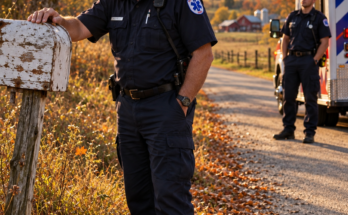
They stayed when the ambulance arrived.
They stayed while paramedics worked.
They stayed while Marcus’s daughter was contacted.
They stayed when Kayla started shaking and Devon gave her his sweatshirt.
They stayed until a family member finally arrived to take the children.
Marcus spent several days recovering.
When he came home, the store was closed.
But there were notes taped across the metal security gate.
GET WELL, MR. MARCUS.
WE NEED YOU.
MICROWAVE CREW MISSES YOU.
One note was written on the back of a school worksheet.
Another had been folded from notebook paper.
Kayla had saved every one.
Marcus read them at the kitchen table and covered his face with both hands.
He had spent years worrying that he wasn’t doing enough.
Enough for his daughter.
Enough for his grandchildren.
Enough to keep his little store alive.
He never realized how much those kids had noticed.
Two weeks later, Marcus reopened.
The microwave was still there.
The teenagers were still there.
And, unfortunately, so were the complaints.
One afternoon a customer pointed toward Devon and Isaiah.
“I can’t believe you’re still letting them hang around after everything. You’re never going to learn, Marcus. You keep treating every kid who walks in here like some charity case.”
Marcus opened his mouth.
But Devon spoke first.
He wasn’t loud.
He didn’t sound angry.
He just looked at the man and said something Marcus would remember for the rest of his life.
“You saw kids hanging around.”
The store went quiet.
Devon nodded toward the microwave.
“He saw kids who didn’t have a kitchen.”
Nobody said anything.
Marcus looked away because his eyes were suddenly wet.
The truth was, some of those teenagers had apartments.
Some had houses.
But that didn’t always mean there was food waiting.
It didn’t always mean there was an adult home.
It didn’t always mean the electricity was on.
Sometimes the convenience store microwave was the only warm meal they knew they could count on.
And Marcus had never made them explain why.
Months later, Devon graduated high school.
He showed up at the store wearing a borrowed shirt and tie.
Marcus stood outside with Kayla and Jordan and took pictures like a proud father.
Before leaving, Devon handed Marcus a small wrapped box.
Inside was a brand-new microwave.
Marcus laughed.
“What’s this for?”
Devon grinned.
“Old one sounds like it’s about to explode.”
Then his expression softened.
“Besides, somebody’s got to keep it on.”
Marcus looked through the store window.
At the scratched floor.
The coffee machine.
The narrow aisles.
The little table where teenagers had eaten hundreds of cheap meals.
Most people would never call a convenience store beautiful.
But Marcus finally understood something.
A place becomes more than a building when people know they are safe there.
Sometimes changing a life doesn’t require a big donation, a perfect speech, or your name on a plaque.
Sometimes it’s a chair by the window.
A hot cup of coffee.
A door left open.
Or an old microwave you never turn off.
The world sees people by where they stand. Kindness sees them by what they might be carrying.