
PART 1 — The Glass of Water
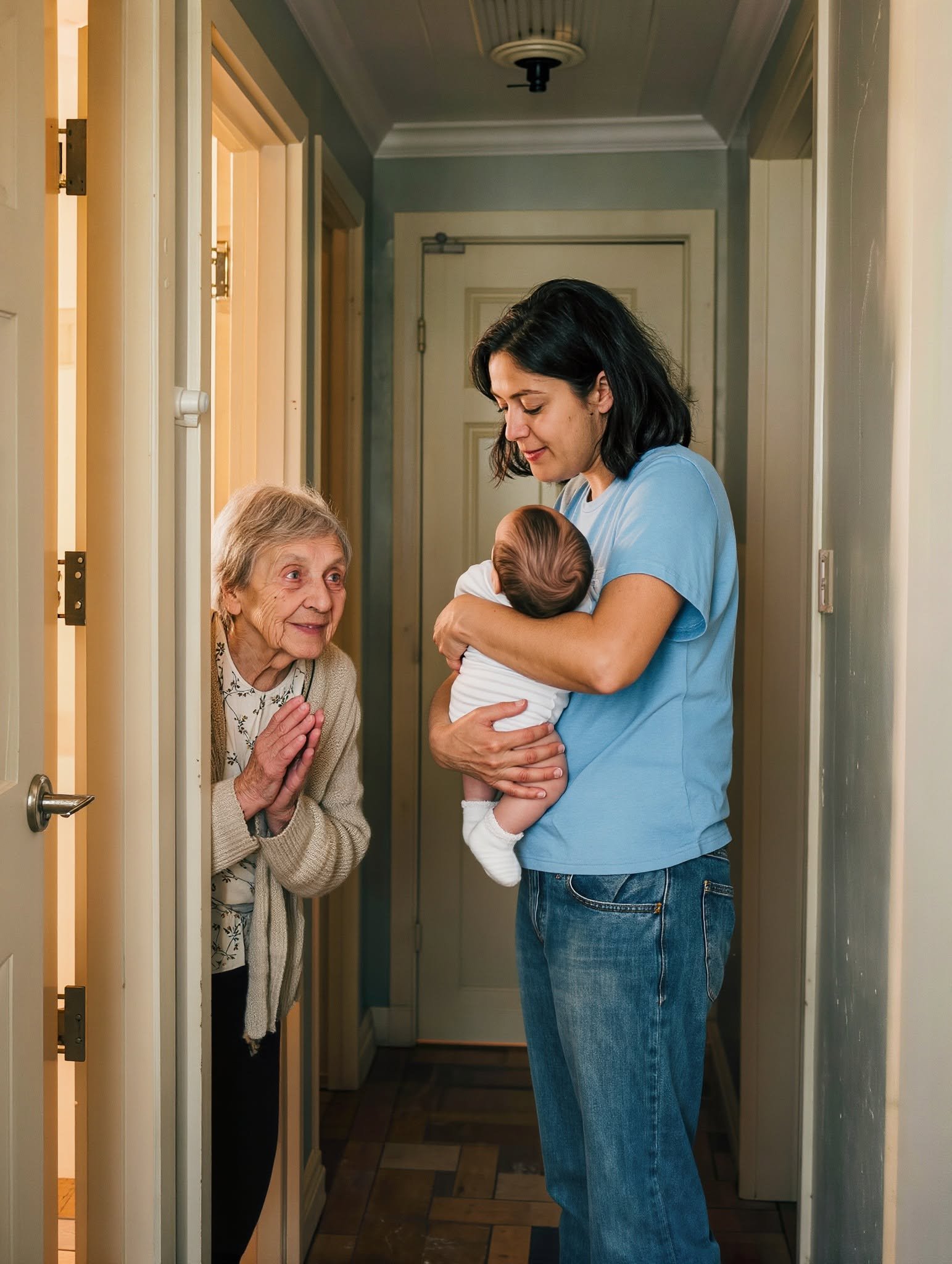
“Good afternoon. I’m sorry to bother you, but do you have a glass of water?”
Silence followed.
Then the deadbolt clicked.
The door opened two inches.
A woman in her seventies looked at me through the narrow gap.
Her eyes were red.
Her gray hair had been pulled into a loose knot.
She glanced at my six-month-old son balanced against my hip.
Then she looked back at me.
“Water?” she asked.
“Yes.”
I forced an embarrassed smile.
“Our pipes are acting strange.”
She knew I was lying.
I knew she knew.
The kitchen sink inside my half of the duplex worked perfectly.
I had knocked because I heard her crying through the wall every night.
Not ordinary crying.
The quiet kind people use when they believe no one is listening.
I was a single mother who earned a living making videos from home.
My son, Oliver, and I had moved into the duplex four months earlier.
The walls were thin enough to hear cabinets closing and televisions changing channels.
At eleven every night, the woman next door turned off her television.
A few minutes later, the crying began.
I considered calling adult protective services.
Then a police wellness check.
Both choices felt like sending strangers to ask questions she might not be ready to answer.
So I picked up my baby and knocked.
The woman disappeared into her apartment.
She returned carrying a paper cup filled with tap water.
“There.”
“Thank you.”
I took one sip.
Then I stood awkwardly in the hallway until she began closing the door.
“My name is Rebecca.”
She paused.
“Eleanor.”
The door shut.
That was the beginning of my ridiculous plan.
The following afternoon, I returned.
“Could I borrow some coffee?”
Eleanor stared at the grocery bag hanging from my wrist.
Coffee beans were clearly visible through the plastic.
“You already bought coffee.”
“That’s decaf.”
She looked at me for several seconds.
Then she handed me a scoop from a dented metal tin.
The next day, I asked whether the mail carrier had arrived.
The day after that, I needed a garbage bag.
Then an egg.
Then advice about removing a tomato-sauce stain.
Eleanor always opened the door.
Sometimes only a few inches.
Sometimes wide enough for Oliver to reach toward her.
We never discussed the crying.
We became two lonely neighbors pretending household supplies were a reason to remain alive in someone else’s day.
The plan worked for almost five weeks.
Then a rainy Tuesday ruined it.
I knocked while balancing Oliver and an empty grocery bag.
The door flew open.
“Stop it!”
I froze.
Eleanor stood in the hallway wearing an old blue robe.
Her hands were shaking.
“You think I’m stupid?”
“No.”
“You drive a new SUV. You order groceries to your door. You make videos about organizing your house.”
I stared at her.
She had been watching my channel.
“You do not need coffee, eggs or garbage bags.”
Her voice rose.
“I am seventy-four years old. I am not a charity project.”
“You’re not.”
“Then leave me alone.”
She slammed the door.
Oliver blinked at the sudden noise.
I stood in the hallway for several seconds.
Then I returned home.
For one month, I did not knock.
I stopped asking for sugar.
Stopped inventing problems.
Stopped waiting beside her door.
But every night, after putting Oliver to sleep, I pressed one ear against the cold drywall.
Sometimes I heard the television.
Sometimes dishes.
Sometimes nothing.
The silence frightened me more than the crying.
Then, on a Saturday morning, my doorbell rang.
Eleanor stood outside holding an apple pie.
Her eyes were red again.
“The pharmacist told me,” she said.
“Told you what?”
“That you paid for my blood-pressure medicine.”
I shifted Oliver higher against my shoulder.
“The payment was declined.”
Eleanor’s mouth tightened.
“You told them not to mention your name.”
“Yes.”
“Why would you do that?”
“Because you would have refused.”
“That is my right.”
“I know.”
She held the pie more tightly.
“Then why?”
I looked down.
“Because if you knew, you might never open the door again.”
Eleanor’s expression changed.
“And I needed you to open the door.”
For several seconds, neither of us spoke.
Then Oliver sneezed.
A line of spit-up ran down his chin and onto my shirt.
Eleanor stared at it.
I stared at it.
We both began laughing.
The laughter became crying before either of us noticed.
I invited her inside.
She brought the pie.
Her name was Eleanor Walsh.
Her husband, Thomas, had died four years earlier.
Her daughter, Marissa, lived in California and called twice a year.
The apartment consumed most of Eleanor’s pension.
She skipped medication near the end of each month.
Some days, she ate toast for dinner.
“I had a full life once,” she said.
“What does that mean?”
“A house. A husband. People calling.”
She looked around my kitchen.
“Then everyone became busy.”
That evening, we ate pie while Oliver slept in his high chair.
When Eleanor returned to her apartment, she stopped at the door.
“Rebecca?”
“Yes?”
“I knew your pipes were not broken.”
“I know.”
“The coffee excuse was insulting.”
“I panicked.”
“The garbage bag was worse.”
“I was running out of ideas.”
She almost smiled.
“Good night.”
The crying did not stop completely.
But after that night, Eleanor no longer had to do it alone.
PART 2 — The Spare Bedroom
Eleanor began joining us for dinner twice a week.
Then three times.
Soon, she stopped pretending the visits were accidental.
She brought soup.
I made pasta.
Oliver threw food onto the floor while Eleanor sang old country songs badly enough to make him laugh.
He watched her as though she had invented music.
Eleanor had spent forty years working as an elementary-school secretary.
She remembered every child’s birthday.
Every teacher’s allergy.
Every parent who arrived late.
After retirement, those skills had nowhere to go.
Now she organized Oliver’s medical records.
Corrected my grocery lists.
And left handwritten reminders beside the coffee maker.
Buy diapers.
Call the pediatrician.
Stop editing videos at two in the morning.
I did not mind.
No one had worried about me in years.
My family lived two states away.
They called when they wanted updates about Oliver.
They rarely asked how I was managing alone.
When I mentioned Eleanor, my older sister became suspicious.
“You let a stranger around the baby?”
“She lives next door.”
“That does not make her safe.”
“She has been safer than most people I know.”
My mother was less subtle.
“You always collect broken people.”
I ended the call.
Eleanor was not broken.
She was lonely.
There was a difference.
One evening, I noticed an envelope beside her plate.
It carried the property-management logo.
The rent would increase by three hundred dollars.
Eleanor folded the notice quickly.
“I can manage.”
“How?”
“I will cancel cable.”
“You already use an antenna.”
“I can reduce groceries.”
“You eat toast four nights a week.”
Her face tightened.
“I am not moving into a facility.”
“I didn’t say that.”
“You were thinking it.”
“No.”
I pointed toward the hallway.
“My spare bedroom is empty.”
Eleanor stopped moving.
“Cancel your lease.”
She stared at me.
“Rebecca.”
“You already spend most evenings here.”
“That is different.”
“You watch Oliver when I shower. I make sure you take your medication. We split groceries without admitting it.”
“I am seventy-four.”
“I noticed.”
“You are thirty-two.”
“I noticed that too.”
“What if we drive each other crazy?”
“Then I’ll knock on your bedroom door, ask for water, you’ll yell at me and we’ll eat pie.”
She looked toward Oliver.
He was asleep against her shoulder.
“What about the cat?”
“What cat?”
Eleanor avoided my eyes.
A large orange animal entered the kitchen from the back hallway.
I stared.
“How long has he been coming through the connecting laundry room?”
“Two weeks.”
“You hid a cat in my house?”
“He likes Oliver.”
The cat jumped onto the empty chair.
Eleanor wiped her eyes with a napkin.
“His name is Walter.”
“Of course it is.”
She moved in six weeks later.
My family called it reckless.
My sister sent articles about elder scams.
My mother asked whether Eleanor had changed her will.
I stopped discussing it with them.
Eleanor’s belongings fit into twelve boxes.
Photographs.
Books.
A sewing machine.
Thomas’s ashes.
Walter required three carriers because he refused to cooperate.
The first night, Eleanor stood inside the spare bedroom surrounded by boxes.
“You can still change your mind,” she said.
“So can you.”
“I have nowhere else to go.”
The words slipped out before she could stop them.
I placed Oliver in his crib.
“You do now.”
Her rent money stayed in her account.
She offered to pay me each month.
I refused.
She began buying groceries instead.
Then she added herself to the utility bill without telling me.
We argued for twenty minutes.
That was our first real fight.
Our second involved her giving Oliver ice cream before breakfast.
Our third happened after she collapsed in the kitchen.
I found her on the floor beside the refrigerator.
Her face had turned gray.
I called an ambulance.
At the hospital, doctors discovered an irregular heartbeat and severe dehydration.
Eleanor had stopped taking one of her medications.
“Why?” I asked.
She looked toward the wall.
“The copay increased.”
“You had money.”
“I did not want to become expensive.”
The sentence made me angry.
Not at her.
At every person who had taught her that needing care made her a burden.
“You live with us,” I said.
“That does not make you responsible for everything.”
“No. Caring about you does.”
She looked at me.
“You have a child.”
“So?”
“You cannot build your life around an old woman.”
“I’m not.”
I pulled the chair closer.
“I’m building it around people who show up.”
Eleanor began crying.
This time, she did not turn away.
Her daughter arrived the following afternoon.
Marissa entered the hospital room carrying a leather purse and an expression that suggested the trip had inconvenienced her.
She hugged Eleanor quickly.
Then she looked at me.
“You must be Rebecca.”
“Yes.”
“My mother says she lives with you.”
“She does.”
Marissa lowered her voice.
“How much is she paying?”
“Nothing.”
Her eyes narrowed.
“Then what do you want?”
Eleanor heard.
“Marissa.”
“I’m protecting you.”
“You call twice a year.”
“That isn’t fair.”
“You missed Thomas’s funeral.”
“I had work.”
“You missed my surgery.”
“I had the children.”
“You did not know I had moved until the hospital called.”
Marissa’s face changed.
She looked at me again.
“Families are complicated.”
“Yes,” I said. “But emergency contacts usually know the address.”
She left before visiting hours ended.
Eleanor stared at the door.
“She used to love sitting beside me while I sewed.”
“She may still love you.”
“Then why does she make it look so much like obligation?”
I had no answer.
After Eleanor returned home, she became quieter.
Not depressed.
Watchful.
One afternoon, she placed a folder on the kitchen table.
“What is this?”
“My paperwork.”
Medical directives.
Insurance information.
A modest savings account.
Her will.
My name appeared beside healthcare proxy.
I looked at her.
“You have a daughter.”
“I know.”
“She will be furious.”
“She is already furious.”
“Eleanor, I can help you without taking her place.”
“You are not taking anyone’s place.”
She touched the folder.
“You are accepting the place she left empty.”
I did not sign immediately.
We spoke with an attorney.
Then a social worker.
Then Marissa.
She accused me of manipulating a vulnerable woman.
Eleanor answered before I could.
“Rebecca did not ask for this.”
“Then why her?”
“Because when I cried through the wall, she knocked.”
Marissa looked away.
The documents were signed two weeks later.
That night, Eleanor sat in her rocking chair with Oliver asleep against her chest.
He had begun calling her something that sounded like “Gammy.”
She pretended not to understand.
Then he said it again.
“Grammy.”
Eleanor closed her eyes.
For the first time since I met her, the tears on her face did not come from loneliness.
PART 3 — The Family We Chose
Eleanor lived with us for two years before the first serious diagnosis.
Heart failure.
Manageable, the doctor said.
Then less manageable.
Medication helped.
So did physical therapy.
But the stairs became difficult.
I converted the dining room into a bedroom because Eleanor refused to leave the house.
“I am not taking your dining room.”
“We eat on the couch.”
“You own a table.”
“Oliver uses it for crayons.”
She moved downstairs.
Walter slept beside her bed.
Oliver climbed beneath her blankets every morning and demanded songs.
By then, my online work had grown.
A video about multigenerational living brought more attention than I expected.
Most responses were kind.
Some were not.
People accused me of exploiting Eleanor for content.
Others assumed she was free childcare.
One commenter wrote:
Wait until she becomes a burden.
I deleted the comment.
Eleanor asked why.
“You looked angry.”
“It was nothing.”
She took the phone from me and read the message.
Then she laughed.
“What?”
“I have been called worse by better people.”
Still, I stopped filming inside the house without asking her first.
I never used her illness for content.
The story belonged to us before it belonged to anyone watching.
My family visited once.
My mother walked through the house inspecting the medical equipment.
My sister watched Eleanor feed Oliver lunch.
“She really does live here,” she whispered.
“What did you think?”
“That this was one of your phases.”
Eleanor looked up.
“I heard that.”
My sister flushed.
Dinner became uncomfortable.
My mother asked whether Eleanor planned to leave the house to me.
I placed my fork down.
“Mom.”
“What? Someone has to ask practical questions.”
Eleanor wiped Oliver’s face.
“I do not own the house.”
My mother smiled tightly.
“Then perhaps Rebecca should consider whether this arrangement is sustainable.”
Eleanor looked at her.
“Rebecca considered it when she heard me crying through a wall.”
My mother became silent.
After they left, I apologized.
Eleanor shook her head.
“You did not raise them.”
“No. But I invited them.”
“They were useful.”
“How?”
“They reminded me that blood relatives can be strangers too.”
Her health declined the following winter.
She slept more.
A portable oxygen machine appeared beside her bed.
Oliver was almost three.
He understood that Grammy became tired.
He brought her books.
Blankets.
Plastic cups of imaginary tea.
One evening, Eleanor asked me to sit beside her.
“There is something I need you to promise.”
“I’m not promising before hearing it.”
“Do not let Oliver remember me only as sick.”
“He won’t.”
“Tell him about the pie.”
“I will.”
“The coffee?”
“You insulted my coffee strategy.”
“It was terrible.”
“What else?”
She thought for a moment.
“Tell him I had a large life.”
“I know.”
“No.”
Her voice became firm.
“Tell him because old people are always reduced to their ending.”
I took her hand.
“I’ll tell him everything.”
Eleanor died at home three months later.
Quietly.
Walter lay beside her feet.
I sat on one side of the bed.
Oliver sat on the other, holding her fingers.
A hospice nurse had explained that Grammy could still hear him.
He sang the country song Eleanor always used at bedtime.
He forgot most of the words.
She died before he finished.
Marissa arrived the next morning.
She stood inside the room staring at her mother’s empty bed.
“I should have come sooner,” she said.
I did not answer.
There are apologies that belong to the dead.
The living cannot accept them on someone else’s behalf.
Eleanor’s funeral was small.
Former neighbors attended.
Two teachers from the school where she had worked.
The corner pharmacist.
Several people I had never met.
One man brought a box of letters Eleanor had written to children whose parents forgot school events.
“She made sure nobody went home alone,” he told me.
That was the life she wanted Oliver to remember.
Not the oxygen machine.
The woman who noticed who had been forgotten.
Marissa asked to speak with me after the service.
“I thought you wanted her money.”
“She did not have much.”
“I know that now.”
She looked toward Oliver.
“He called her Grammy.”
“Yes.”
“That should have been my children.”
The words carried grief.
Not accusation.
“You can still tell them about her.”
“I barely know what to say.”
I opened my purse and removed a small notebook.
Eleanor had written stories during her final months.
Childhood memories.
Her wedding.
Thomas.
Her first job.
Her daughter learning to read.
I handed it to Marissa.
“She wanted them to know she had a large life.”
Marissa began crying.
This time, I touched her shoulder.
Not because the past was repaired.
Because grief does not need permission.
Eleanor left Walter to me.
Her sewing machine went to Marissa.
Her savings paid for the funeral and a small education account for Oliver.
She left me one thing.
The paper cup from the first day we met.
She had washed it.
Dried it.
Kept it in a box.
A note was folded inside.
You never needed water.
I never needed coffee.
We both needed someone to keep knocking.
I placed the cup on a shelf beside her photograph.
For months, I continued hearing her.
A floorboard.
The rocking chair.
A country song from another apartment.
Sometimes, after putting Oliver to bed, I walked toward the room that had once been hers.
I would raise my hand to knock.
Then remember.
One evening, Oliver found me standing there.
“Is Grammy coming back?”
“No.”
“Where did she go?”
I crouched beside him.
“Somewhere we cannot visit yet.”
He thought about that.
“Does she have water?”
I began laughing before the tears arrived.
“I think so.”
He took my hand.
“We should get pie.”
So we did.
Years later, people still asked why I let a seventy-four-year-old stranger move into my spare bedroom.
They expected a dramatic answer.
A moral.
Something about kindness.
The truth was less noble.
I was lonely too.
I had a baby, a house and thousands of people watching my videos.
But some nights, no one would have noticed if I disappeared behind a closed door.
Eleanor noticed.
She watched Oliver when I was tired.
She reminded me to eat.
She sat beside me when single motherhood became too heavy to explain.
I gave her a room.
She gave us a family.
The crying through the wall did not force me to save her.
It forced me to admit that neither of us should have been alone.
And sometimes, when the house becomes too quiet, Oliver and I bake an apple pie.
We place one slice beside Eleanor’s photograph.
Then I lift the paper cup from the shelf and say:
“Eleanor, do you have any water?”
In my memory, she smiles from the rocking chair.
“You have a sink in the kitchen, sweetheart.”
“I know,” I answer.
“But I like yours better.”