
Call someone a “roadman” in London and many young British people immediately understand the stereotype.
Tracksuit.
Puffer jacket.
Cross-body bag.
Urban slang.
Hanging around “on road.”
Perhaps drill or grime music.
And, depending on who is using the term, an association with trouble, gangs, drugs or street crime.
But travel across Europe and the word itself quickly disappears.
France has caillera.
Italy has maranza.
Spain has cani.
Russia and parts of the former Soviet world have gopnik.
Poland traditionally has dresiarz.
Scotland has ned.
Turkey has the slang term keko, although its meaning and cultural baggage are different again.
At first glance these can look like simple translations of one another.
They aren’t.
What they actually reveal is something much more interesting: almost every society develops its own slang for recognizable youth stereotypes, but each term reflects a different local history.
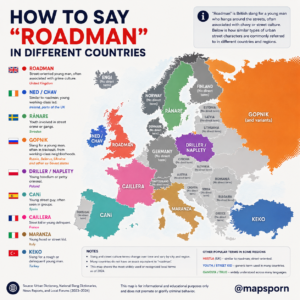
What Does “Roadman” Actually Mean in Britain?
Modern British slang uses roadman for a young man associated with urban street culture.
Cambridge describes the slang meaning as someone, usually a young man, who spends considerable time on the streets and may cause trouble or become involved with drugs. Collins similarly describes a young member of a street group or gang, sometimes associated with drug dealing. (Cambridge Dictionary)
But contemporary usage is broader than literal criminal involvement.
“Roadman” can describe a whole aesthetic:
- Tracksuits
- Technical jackets
- Trainers
- Puffer coats
- Cross-body bags
- Particular slang
- Drill and grime influences
- An urban street persona
Someone can even jokingly be called a roadman simply because of how he dresses.
So automatically defining every roadman as a criminal would be misleading.
The word can describe identity, fashion, speech or stereotype, depending on context.
Where Did the Word Come From?
The modern usage is associated especially with British urban speech and Multicultural London English.
The expression “on road” refers broadly to being active in street life.
Over time, roadman developed into a recognizable youth-cultural label.
Its mainstream popularity expanded alongside grime, UK drill, social media and London streetwear.
Today even people completely outside the original subculture recognize the look.
That is exactly why other countries’ slang gets compared with it.
But those comparisons are approximate.
Scotland: “Ned”
Scotland already had its own word long before “roadman” became fashionable:
ned.
Cambridge specifically labels ned as Scottish English, describing a young person associated with rude and sometimes violent or criminal behavior. Collins similarly describes a Scottish ned as a hooligan or a young working-class person stereotypically associated with casual sports clothing. (Cambridge Dictionary)
That makes ned one of the closest British parallels to roadman.
But the cultural stereotype is older and distinct.
Neds became strongly associated with:
- Tracksuits
- Housing schemes
- Anti-social behavior
- Street groups
- Scottish working-class youth stereotypes
The word can be strongly derogatory.
What about Ireland?
This is where the infographic needs a correction.
Ned is not primarily an Irish term.
It is specifically Scottish.
Irish slang has its own regional words, and they vary considerably between Dublin, Belfast and other areas.
So Ireland should probably be marked “no single national equivalent” rather than being grouped under ned/chav.
England: “Chav” Is Related—but Different
Another famous British term is:
chav.
It became hugely popular during the 2000s.
The stereotype typically involved:
- Branded sportswear
- Tracksuits
- Baseball caps
- Flashy jewelry
- Working-class background
- Anti-social behavior
But chav and roadman are not interchangeable.
A chav is primarily a social stereotype associated with taste, class and behavior.
Roadman carries a stronger association with contemporary urban street culture, London-influenced language, grime/drill aesthetics and sometimes gangs.
The two stereotypes overlap.
They are not identical.
France: “Caillera”
France offers one of the strongest comparisons:
caillera.
The word comes from verlan, the French slang tradition in which sounds or syllables are reversed.
Caillera comes from racaille, a derogatory word roughly meaning riffraff or scum.
French dictionaries describe caillera as a slang term associated with young people from urban peripheral neighborhoods, street culture and sometimes delinquent or confrontational behavior. (Wiktionnaire)
That makes it quite close to some uses of roadman.
But it carries particularly French cultural associations.
France’s banlieues—large suburban districts surrounding cities such as Paris, Lyon and Marseille—developed their own music, fashion and language.
French rap helped spread vocabulary originating in these communities into national youth culture.
Like roadman, caillera can therefore refer to more than literal criminality.
It can evoke:
street identity,
neighborhood culture,
clothing,
attitude,
and speech.
But it is often pejorative, so using it casually to label real people can be insulting.
Italy: “Maranza”
One of Europe’s most interesting recent slang words is:
maranza.
The term has exploded in visibility among Italian youth, especially through social media.
Italy’s Accademia della Crusca describes maranza as a young person belonging to street-oriented groups characterized by conspicuous clothing, particular musical tastes, coarse language and swaggering behavior. Its modern revival has been strongly associated with younger people and social media. (Accademia della Crusca)
Treccani gives a similar description, emphasizing noisy street groups, flashy branded clothing and a tendency toward provocative behavior. (Treccani)
Typical modern stereotypes include:
- Tracksuits
- Nike or designer sportswear
- Cross-body bags
- Trap music
- Groups hanging around public spaces
- Loud or confrontational behavior
That makes maranza one of the closest present-day Italian cultural parallels to Britain’s roadman stereotype.
But again:
Maranza does not literally mean roadman.
It is its own Italian youth-cultural label.
Interestingly, the word existed decades ago but experienced a major revival around the early 2020s through TikTok and contemporary street culture. (Accademia della Crusca)
Spain: “Cani”
Spain has another recognizable youth stereotype:
cani.
The term was especially prominent during the 1990s and 2000s.
Spanish-language references describe a stereotypical cani as an urban youth associated with tracksuits, caps, flashy jewelry, aggressive behavior and perceived poor taste or lack of education. (Wikcionario)
The stereotype often included:
- Tracksuits
- Modified cars or scooters
- Loud music
- Gold jewelry
- Sportswear
- Neighborhood street culture
Spain also has the related feminine stereotype choni.
Cani therefore resembles the British chav at least as much as it resembles the modern roadman.
And it is another good reminder that these comparisons depend heavily on generation.
A young Spaniard in 2026 may use different terminology from someone describing youth culture in 2005.
Slang ages quickly.
Poland: “Dresiarz”
For Poland, I would replace the infographic’s “driller / naplety” with the much better established:
dresiarz.
The word comes from dres, meaning tracksuit.
The dresiarz stereotype emerged strongly during the 1990s and became associated with young urban men from housing estates, sports clothing, aggression, hooliganism and anti-social behavior.
Academic literature discussing Polish and Russian slang explicitly identifies Polish dresiarze as an analogue of Russian gopniki. (Krakow University Repository)
That’s an unusually strong cross-cultural comparison.
The stereotype often evokes:
- Tracksuits
- Apartment-block neighborhoods
- Football culture
- Tough-guy behavior
- Working-class youth
- Street groups
In that sense, the Polish dresiarz, Russian gopnik and older British chav/ned stereotypes share substantial visual territory.
But each emerged under different social conditions.
Russia: “Gopnik”
Probably the most internationally recognizable term after roadman is:
gopnik.
The stereotype became especially famous outside Russia through internet memes.
A stereotypical gopnik is depicted wearing:
- Adidas-style tracksuits
- Flat caps
- Leather jackets
- Trainers
and famously squatting outside Soviet-era apartment blocks.
But beneath the meme lies a genuine post-Soviet youth stereotype.
The term historically referred to young urban people associated with working-class districts, petty crime, street violence and delinquent subcultures in Russia and some other former Soviet republics. (Wikipedia)
The stereotype became particularly visible during the social and economic disruption following the collapse of the Soviet Union.
So gopnik is not merely the Russian word for roadman.
It carries memories of:
Soviet housing estates,
1990s economic hardship,
post-Soviet street culture,
and a very specific fashion stereotype.
By the 21st century, much of the imagery has also become ironic and meme-driven. (Wikipedia)
Sweden: “Rånare” Is Not a Good Equivalent
The Swedish portion of the infographic should probably be revised.
Rånare is simply the Swedish word for a robber or mugger.
Cambridge’s Swedish-English dictionary translates it directly as robber, burglar, hijacker or mugger depending on context. (Cambridge Dictionary)
That makes it fundamentally different from roadman.
A roadman does not necessarily commit robbery.
And a Swedish robber is obviously not necessarily part of a particular youth fashion subculture.
So Sweden is another country where the most accurate label may simply be:
“No exact equivalent.”
This is better than forcing every country into a neat one-word category.
Turkey: “Keko”
Turkey has the slang term:
keko.
But this one requires particular caution.
The word has Kurdish origins, where related forms can mean something like “brother” or an address to a man. In Turkish slang it developed derogatory meanings associated with a person viewed as uncultured, unsophisticated, rough or socially undesirable. Academic research on Turkish slang documents this semantic shift. (Axsis)
Modern informal usage can evoke a stereotype involving:
- Young men
- Street behavior
- Flashy fashion
- Aggressive mannerisms
- Perceived lack of sophistication
That creates some overlap with roadman.
But because the word also has ethnic and class-related history, it should not be presented as a harmless translation.
Context matters enormously.
Germany: Why “No Direct Term” May Be the Best Answer
The infographic leaves Germany without a direct equivalent.
That is actually useful.
Not every culture has to possess an exact word for the same social stereotype.
German certainly has words for:
hooligans,
thugs,
street youths,
gang members,
and particular youth subcultures.
New social-media labels also appear regularly.
But forcing one of them to mean exactly what roadman means in Britain would create false equivalence.
Slang is local by nature.
Its meaning depends on:
- Music
- Clothing
- Neighborhood
- Social class
- Ethnicity
- Generation
- City
- Context
There does not need to be a German “roadman.”
Why Tracksuits Keep Appearing Everywhere
One of the funniest features of these stereotypes is how often the same clothing appears.
Britain’s roadman?
Tracksuit.
Russian gopnik?
Tracksuit.
Polish dresiarz?
The name literally derives from tracksuit.
Italian maranza?
Often sportswear.
Spanish cani?
Again, frequently tracksuits.
Why?
Partly because sportswear became universal urban youth clothing.
It is:
comfortable,
relatively affordable,
strongly connected with football,
linked with hip-hop and street music,
and highly visible through brands such as Adidas and Nike.
Eventually clothes become social symbols.
A tracksuit is just clothing.
But stereotypes attach meanings to it.
The same item can suggest an athlete, rapper, football fan, teenager or supposed troublemaker depending on who is looking at it.
Music Plays an Equally Important Role
The soundtracks also differ by country.
British roadman culture is strongly connected in the public imagination with:
grime and drill.
Italian maranza culture is often associated with:
trap and contemporary rap.
Russian gopnik internet culture became associated internationally with:
hardbass.
French street culture has enormously influential:
French rap.
Music helps create vocabulary.
Rappers take local slang into songs.
Songs carry it across cities.
TikTok spreads it nationally.
Then international audiences pick it up.
A neighborhood word can become globally recognizable surprisingly quickly.
These Words Often Carry Class Prejudice
This is perhaps the most important warning when using the map.
Many of these terms do not neutrally describe fashion.
They can contain assumptions about:
- Poverty
- Education
- Working-class backgrounds
- Immigrant neighborhoods
- Criminality
Calling somebody a chav, ned, cani, caillera, maranza or keko may be insulting.
Sometimes young people reclaim the terminology and use it jokingly among themselves.
Sometimes outsiders use it contemptuously.
The speaker, setting and tone can completely change the meaning.
So these words are best studied as cultural slang, not labels to casually apply to strangers.
Why There Can Never Be a Perfect “Roadman Map”
This is the central problem with the infographic.
Slang does not respect national borders.
London slang differs from Glasgow slang.
Dublin differs from Belfast.
Paris differs from Marseille.
Milan differs from Naples.
Madrid differs from Seville.
A word popular with teenagers may sound outdated ten years later.
Another can explode overnight because of TikTok.
And two terms that look similar from the outside can carry completely different associations locally.
A scientifically accurate legend would therefore say:
Approximate local slang or stereotypes with some overlap with Britain’s “roadman”; meanings are not equivalent and vary by region and generation.
That sentence is less catchy.
But it is much more accurate.
A Better Version of the Map
If I were updating the infographic, I would use something like:
United Kingdom — Roadman / Chav
Scotland — Ned
France — Caillera
Italy — Maranza
Spain — Cani
Poland — Dresiarz
Russia / parts of former USSR — Gopnik
Turkey — Keko (context-sensitive)
And for many other countries:
No widely established direct equivalent.
For Sweden specifically, I would remove rånare, because it simply means robber. (Cambridge Dictionary)
For Ireland, I would not use Scottish ned as a national label. (Cambridge Dictionary)
That makes the graphic less perfectly colorful—but far more defensible.
The Bigger Story Hidden in the Slang
What makes these terms interesting is not figuring out which country’s teenagers are the “most roadman.”
It is how societies independently create similar stereotypes.
Take:
Britain’s roadman.
France’s caillera.
Italy’s maranza.
Poland’s dresiarz.
Russia’s gopnik.
Spain’s cani.
All developed in different languages.
Yet outsiders frequently describe them using surprisingly similar imagery:
Young men.
Urban neighborhoods.
Sportswear.
Street music.
Groups of friends.
A reputation—fair or unfair—for causing trouble.
That tells us something about how modern youth culture spreads.
Global brands become local uniforms.
Music crosses borders.
Neighborhood identities develop their own vocabulary.
Social media accelerates everything.
And within a few years, a completely ordinary word can become shorthand for an entire social stereotype.
There isn’t really a universal word for “roadman.”
There are dozens of local stories that merely look similar from far away.
Accuracy & Language Note
The terms in the infographic are slang, stereotypes and sometimes insults rather than direct translations. Roadman is documented British slang for a young person associated with urban street culture and sometimes trouble or drug activity. Ned is specifically Scottish; caillera is French verlan derived from racaille; maranza is a contemporary Italian youth/street-culture label; Spanish cani is a related but older urban stereotype; and Polish dresiarz is a well-established comparison with the Russian gopnik stereotype. Swedish rånare, however, simply means robber and should not be presented as Sweden’s equivalent. (Cambridge Dictionary)