Part 1: The Empty Account
My brother stole my ATM card on a Thursday. I did not know it when I woke up that morning in my parents’ house in Columbus, Ohio, pulled on my blue scrub top, and rushed to the hospital for my shift. I was a respiratory therapist, and that week had been brutal—double shifts, too many patients, not enough sleep. I came home after nine that night with sore feet, a pounding headache, and exactly one plan: shower, microwave leftovers, and fall into bed.
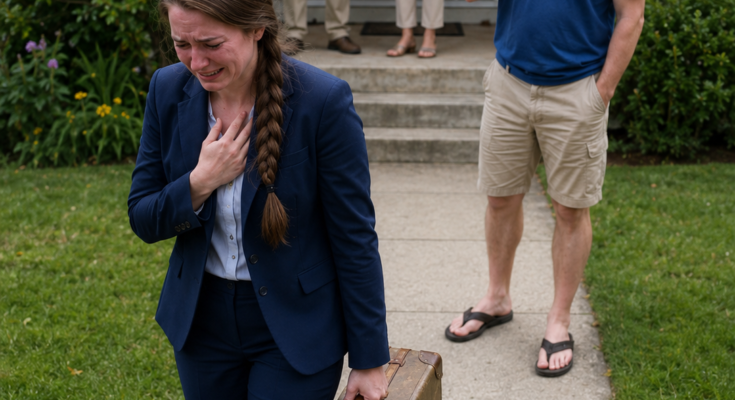
Instead, I found my suitcase sitting by the front door. At first I thought my mother had been cleaning and moved it from the hallway closet. Then I saw that it was packed. My clothes were folded inside. My laptop charger had been shoved into a side pocket. My toiletries were zipped into a plastic bag. It was not packing. It was removal.
I heard laughter from the kitchen. My older brother, Jason, was sitting at the table with my parents, drinking beer from one of Dad’s glass mugs like they were celebrating something. My mother looked up first and smiled in a way that made my stomach tighten.
“Oh, you’re home,” she said casually. “What is my suitcase doing by the door?” Jason leaned back in his chair, smug and loose, a man already enjoying a victory. “Your work is finished,” he said. “We got what we wanted. Don’t look back at us now.”
I stared at him. “What are you talking about?” Dad chuckled. Actually chuckled. “Don’t act confused.” Then Jason pulled my ATM card from his pocket and tossed it onto the table.
For a second, I couldn’t breathe. “You stole my card?” “Borrowed,” he said. “And emptied the account.” I lunged for the card, but he got there first, pinning it under his palm. “Relax. It’s family money anyway.” “No, it isn’t.” Mom laughed softly, like I was a child throwing a tantrum. “It was a good decision. You’ve been hoarding money while living under this roof.”
The room went cold around me. “How much did you take?” Jason gave a lazy shrug. “Everything.”
I snatched my phone from my bag with shaking hands, opened the banking app, and felt the blood drain from my face. Savings: $0.43. Checking: $12.11. The transfer history showed cash withdrawals, one after another, from two ATMs across town. Then a wire transfer. He had drained nearly $38,000.
“That was my money for graduate school,” I whispered. Jason stood up. He was taller than me, broader, and he knew it. “Not anymore.” “Give it back.” “No.” Dad rose too, crossing his arms. “You’ve been staying here for almost two years. Bills, food, utilities. Your mother and I decided this balanced things out.”
“Balanced things out?” My voice cracked. “You never asked me for rent.” Mom shrugged. “We shouldn’t have had to.”
I looked from one face to another and saw no shame. Not even discomfort. Only relief—relief that they had taken what they wanted and no longer had to pretend I mattered. Jason grabbed the suitcase, opened the front door, and shoved it onto the porch. Cold March wind rushed in. “You can go now,” he said. “And don’t come crawling back.” My parents laughed behind him.
Part 2: The Call
What they did not know—what none of them knew—was that the account Jason had emptied was not really mine to spend freely at all. Most of that money had been placed there under a court-controlled arrangement after my aunt’s death, and every withdrawal was tracked. And by the time Jason kicked me out of that house, the bank’s fraud department had already started calling.
I stood on the porch with my suitcase in the cold March wind, staring at the closed door. My phone buzzed in my hand. It was the bank. I answered, my voice trembling. “Hello?”
“Ms. Carter, this is the fraud department at First National Bank. We’ve detected unusual activity on your account. Multiple withdrawals and a wire transfer have been flagged. Were these transactions authorized?”
“No,” I whispered. “They were stolen. My brother took my card.”
The voice on the other end was calm but firm. “I need to confirm your identity and ask you a few questions. This is a serious matter, and we’ll need to file a police report.”
The pieces started falling into place. My aunt had left me the money before she died, but it was tied to a specific purpose: education. The court had approved the arrangement, and unauthorized withdrawals could trigger an investigation. Jason hadn’t just stolen from me. He had stolen from a legal trust.
I heard the door open behind me. Jason was standing in the doorway, smirking. “Still here? I told you to leave.” “The bank is calling,” I said. “They’ve flagged the withdrawals.” His smirk vanished. “What are you talking about?”
“Every single transaction is being traced. And since you stole my card, that means you’ve committed bank fraud.” Jason’s face went pale. “You’re lying.” “I’m not.” I held up my phone so he could see the call screen. “The bank knows everything. And the police are going to know everything too.”
My parents appeared behind him, their expressions shifting from smug to nervous. “What’s going on?” Dad demanded. “Your son is going to jail,” I said. “For stealing $38,000 from a court-controlled account.” Mom’s face went white. “That money was supposed to be for—” “Graduate school,” I said. “And for covering medical expenses when you both fall ill. But I guess you decided you didn’t need that backup plan.”
I turned and walked away from the house, dragging my suitcase behind me. Behind me, I heard arguing. Jason’s voice. My mother’s voice. My father’s voice.
And then Jason shouted, “Wait!”
I didn’t wait.
Part 3: The Reckoning
I went to a friend’s house that night. She let me stay on her couch. I called the bank again, confirmed the fraud claim, and gave them the names and addresses of everyone involved. I also contacted a lawyer.
The next morning, Jason was arrested. He stood in my parents’ living room in handcuffs, screaming at me through the window as the police led him away. My parents stood in the driveway, arguing with the officers, but they couldn’t stop it. The evidence was clear. The ATM footage showed his face. The wire transfer was traced to his account. The bank records matched his story.
By the time the dust settled, Jason was facing charges of fraud and theft. He pleaded guilty and was sentenced to eighteen months in prison. My parents tried to bail him out, but they didn’t have enough money. They had spent most of what Jason took on a new car and a weekend trip to Florida. The rest was already gone.
I filed a civil suit to recover the money, but it took years. Most of it was never recovered. But that wasn’t what mattered most. What mattered was that my parents—people who had been supposed to love me—had shown me who they really were. And I had believed them.
I moved out of Ohio. I got a new job, a new apartment, a new life. I didn’t speak to my parents for a long time. And when I did, it was brief, cold, and businesslike. They had chosen Jason. They had chosen themselves. They had chosen greed over love.
I still went to graduate school. I had to take out loans. I had to work extra shifts. But I did it. I earned my degree. I became a specialist in my field. I built a career and a future that no one could take away from me.
Years later, Jason was released from prison. He came to me, hat in hand, asking for forgiveness. I looked at him, the brother who had stolen everything and laughed while I left.
“I forgive you,” I said. “But I don’t trust you. And I don’t want you in my life.”
He understood. Or at least, he accepted it.
My parents divorced. The guilt, the shame, the financial stress—it broke them. My mother wrote me a letter once, apologizing. I read it, then threw it away. Some things can’t be unbroken with words.
I still struggle with what happened. I still think about that night—the suitcase, the laughter, the cold wind. But I also think about the moment I realized that I was stronger than I knew. I had survived the worst betrayal of my life and come out the other side.
And I had learned something important: the people who are supposed to love you sometimes won’t. And when they don’t, you have to love yourself enough to walk away.
I walk away. Every single time.
Now, I have a family of my own—friends who chose me, a career I built, a life I’m proud of. And every time I feel the urge to go back, I remember that night on the porch. And I keep walking forward.
Because I deserve better. And so do you. ❤️