Part 1: The Twelfth Family
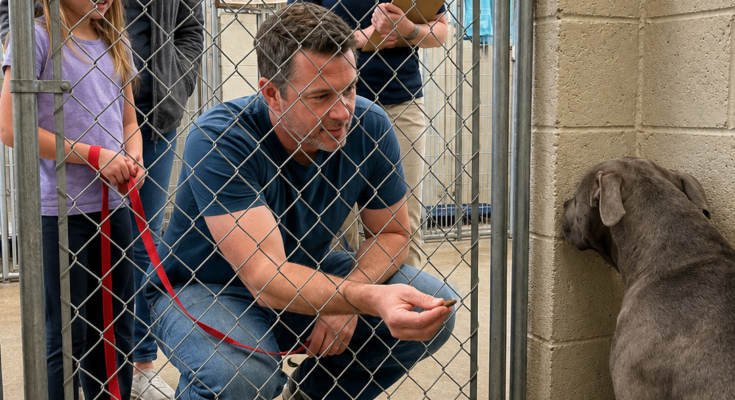
The twelfth family stood outside Hazel’s kennel calling her name, but I watched her press her face closer to the wall until they finally chose another dog.
She didn’t bark. She didn’t growl. She didn’t bare her teeth at the little girl holding a red leash in the adoption hallway. Instead, Hazel did something that hurt me even worse. She made herself disappear while standing right in front of us.
The shelter smelled like bleach, damp towels, and chicken-flavored treats stored behind the front desk. Dogs barked down the row. Nails clicked against concrete. Stainless-steel bowls rattled whenever someone walked past. But Kennel 18 stayed still.
Hazel, a four-year-old Pit Bull with blue-gray fur, kept her face pressed against the cinder block wall. The family had driven nearly forty miles to meet her. I stood nearby with my clipboard against my chest while the father crouched beside the gate with a treat between two fingers. His wife stood behind him in a fleece jacket, holding their eight-year-old daughter’s hand.
Hazel’s profile said she was gentle, house-trained, and happiest with a rope toy. I had written those words myself. Every one of them was true. Just not when anyone was watching.
“Come here, sweetheart,” the father whispered. Hazel stayed in the corner.
The little girl looked at me and asked, “Doesn’t she like us?”
I tried to explain why a dog who had already been rejected so many times seemed to reject herself before anyone else could. “She just needs some time,” I said.
They gave her four minutes. Then the little girl noticed a yellow Lab two kennels down, bouncing against the door like the world had never hurt him.
Ten minutes later, I watched that Labrador walk out of the shelter wearing their new red leash. I stood in the hallway as the family left. Hazel heard them go. She never turned around.
My name is Megan Foster, and at the time, I was the behavior coordinator at Mid-South Animal Rescue in Memphis, Tennessee. I had worked with scared dogs, neglected dogs, and dogs who had learned that fear was the only way to survive. But Hazel was different.
She trusted me. On quiet mornings, before visitors arrived, she would bring me her frayed green rope toy and wait for me to grab the other end. Her amber eyes softened when the building was calm. Sometimes she would press her shoulder against my leg and stay there as if she finally believed she was safe.
Then a stranger would walk in. The toy would drop. Her tail would stop. And Hazel would go straight to the wall.
Part 2: The Discovery
The first family called her shy. The fourth thought she didn’t like men. The seventh brought another dog for a meet-and-greet, but Hazel wouldn’t even look at him. By the twelfth family, I noticed some volunteers quietly steering visitors away from Kennel 18. I understood why. It was easier than watching another family choose someone else.
That night, after the Labrador left with his new family, I carried Hazel’s untouched treat into her kennel. “They seemed nice,” I told her. Hazel looked at me. Then she picked up her green rope toy and dropped it at my feet.
The change was instant. The dog who had seemed completely empty only minutes earlier lowered her front legs, lifted her back end, and waited for me to pull. I grabbed the rope. Hazel shook her head so hard her ears slapped against her cheeks. For a few seconds, she looked happy.
Then the metal door near reception clicked shut. Hazel froze. The rope fell from her mouth. I watched her walk straight back to the wall.
That moment stayed with me. I couldn’t stop thinking about it. At 10:17 that night, long after I had gone home, I opened the shelter camera system on my computer and pulled up Kennel 18. What I saw changed everything I thought I knew about Hazel.
When no one was choosing her, Hazel wasn’t broken. She was playing. I watched her roll onto her back. She ran crooked circles around her bed. She wagged at the dog beside her kennel. She stretched out across the concrete like she didn’t have a fear in the world. And then every morning, when people started walking through those doors again, she became the same frightened dog.
I pulled up her records. Three returns. Adopted. Returned after eleven days. Adopted. Returned after three months. Adopted. Returned after seventeen days.
I stared at those records for a long time. Then I finally understood. Hazel wasn’t avoiding a home. She was avoiding the moment when that home disappeared. She had learned that being chosen didn’t mean staying chosen.
Part 3: The Truth
The next morning, I changed her adoption post. I stopped writing that she was simply waiting for her forever family. I wrote the truth:
*She isn’t cold. She’s careful. She’s not rejecting families. She’s protecting herself from being returned again. Hazel has been adopted and returned three times. Not because she is aggressive. Not because she is destructive. Because she takes time to trust. And in a world that expects instant love, she has learned that opening her heart means risking it being broken again.*
Then I posted it.
At 7:48 that evening, my phone rang. I answered, expecting another shelter question. Instead, I heard a woman on the other end breathing so hard she could barely speak. She lived hundreds of miles away. She told me she had seen Hazel’s picture. Then she whispered three words that made me sit up.
“That’s my dog.”
Before I could respond, she opened a box on the table beside her. And from inside it, she pulled out an old green rope toy she had kept for years. The same frayed green rope toy Hazel carried everywhere. The same toy she dropped at my feet every morning.
“Her name is Daisy,” the woman said, her voice trembling. “She was my dog for five years. I lost her in a fire. I thought she died. I’ve been searching for her ever since.”
I stared at the phone. “She’s been here for months. She’s been adopted and returned three times. She doesn’t trust anyone.”
“That’s because she trusted me,” the woman said. “And then I disappeared.”
I told her to come as fast as she could. Two days later, a woman walked through the shelter doors. She was older than I expected, with gray-streaked hair and tired eyes. She carried the green rope toy in one hand.
I led her to Kennel 18. Hazel was in her corner, facing the wall. The woman knelt down and said, “Daisy.”
Hazel’s ears moved. Her body tensed. She turned slowly, her amber eyes wide. Then she saw the rope toy. And she started shaking.
“Daisy,” the woman said again, her voice breaking. “I’m here, baby. I’m right here.”
Hazel let out a sound I had never heard before—a high, broken cry that came from somewhere deep inside her. She lunged forward and crashed into the woman’s arms, licking her face, her hands, her hair. The woman was crying, laughing, holding the dog like she would never let go.
I stood in the doorway, tears streaming down my face. This wasn’t just a dog and her owner. This was a reunion that had been waiting for months—maybe years—to happen.
The woman explained everything. A house fire had separated them. She had searched everywhere, but there was so much destruction. She had assumed the worst. And Hazel had been too traumatized to explain. She had been returned three times because she was waiting for someone who never came.
Until now.
I helped them fill out the adoption paperwork. This time, I didn’t worry about whether Hazel would be returned. The woman had already held her once. She would never let her go again.
Before they left, I knelt down and scratched behind Hazel’s ears. “You’re going home, girl. For real this time.”
Hazel looked at me. Then she gave a tiny wag of her tail. She leaned into the woman’s leg and stayed there. And for the first time in months, her whole body relaxed.
I still think about Hazel sometimes. I think about all the families who walked past her kennel. I think about the volunteers who gave up on her. I think about the little girl who chose the Lab instead. And I think about the moment I realized that Hazel wasn’t broken. She was just waiting for the right person to come back.
Sometimes, the dogs who seem the hardest to love are the ones who have loved the hardest. They’ve been hurt. They’ve been left behind. They’ve learned that trust is dangerous. And they need someone to prove them wrong.
Hazel found her someone. And I learned that the best adoptions aren’t always the ones that happen quickly. Sometimes they’re the ones that wait for years—for the person who refuses to give up.
I still have the green rope toy in my office. It reminds me that every dog has a story. And sometimes, the chapters that break our hearts are the ones that lead to the happiest endings of all. ❤️