Part 1: The Lie
“Gideon, that driveway isn’t on your route.”
Gideon Mercer kept both hands on the snowplow wheel and stared through the windshield at the white road ahead. “I know.”
His coworker pointed toward the narrow driveway disappearing between snow-covered pine trees. “Then why do you always turn in there?”
Gideon shrugged. “County added it.”
That was a lie. For six winters, Gideon had been telling the same lie. He was 62, with stiff knees, cracked hands, and the kind of face that looked permanently windburned after thirty years of Maine winters. Every storm, he drove a county plow along nearly forty miles of rural roads before most people had poured their first cup of coffee. His official route ended at the main road. But whenever the snow piled deep enough, Gideon turned his yellow plow into one particular driveway and cleared it all the way to the small gray house at the end. Then he backed out, turned around, and cleared it again.
The woman who lived there was named Rachel. She was raising her 11-year-old son, Evan, by herself. Evan used a wheelchair. Rachel had once tried shoveling the driveway during a January storm because the snowblower wouldn’t start. Gideon had seen her from the road. She was pushing heavy snow aside one shovel at a time, stopping every few minutes to catch her breath. Behind her, Evan sat near the front window watching.
Gideon pulled over. Rachel looked embarrassed when he stepped down from the plow. “I’m fine,” she called. Gideon looked at the driveway. Then at the two-foot snowbank blocking the road. Then back at Rachel. “Sure you are.” She laughed despite herself. “I can’t pay you.” “Good,” Gideon said. “County already pays me.”
Before Rachel could argue, Gideon climbed back into the plow. Ten minutes later, the driveway was clean. Rachel stood beside the mailbox with tears in her eyes. “You didn’t have to do that.” Gideon lowered the window. “Actually, they added your driveway to my route.” Rachel blinked. “The county did?” “Yep.”
That lie bought her dignity. And Gideon decided dignity was sometimes worth bending the truth for.
After that, every major snowfall, the plow came. Sometimes at 4:30 in the morning. Sometimes before midnight. Rachel would wake to the scraping sound of metal against pavement and see Gideon’s flashing lights moving slowly down the driveway. He always made two passes. The first cleared enough for a car. The second widened the path so Evan’s wheelchair ramp van could get through safely.
Part 2: The Storm
What Rachel didn’t know was that Gideon’s own life had become harder every winter. His wife, Linda, had begun forgetting things. At first, it was little stuff. Where she put her keys. Whether she had turned off the stove. Which day the trash truck came. Then she forgot the name of the grocery store they had used for twenty years. One morning she looked at Gideon across their kitchen table and asked when her husband would be home.
Gideon went into the bathroom, closed the door, and stood there for five minutes. Then he came back out smiling. “I’m right here, Lin.” Some days she knew him. Some days she didn’t. But every morning before a storm shift, Gideon still set out her coffee mug, her pills, and a note in thick black marker: “GIDEON IS PLOWING. YOU ARE SAFE. HE WILL BE HOME SOON.”
A neighbor checked on Linda while he worked. Gideon hated needing help. Maybe that was why he understood Rachel so well. Pride is funny. The people carrying the heaviest loads are often the least comfortable asking anyone to lift a corner.
Then came the February storm. Nearly three feet of snow was expected. Gideon prepared the plow the night before. He laid out Linda’s breakfast. He put firewood beside the stove. He kissed her forehead. At 2:17 a.m., he woke to the sound of something falling. Linda was on the hallway floor. She was awake, frightened, and confused.
Gideon called for help. By sunrise, he was sitting beside her in a hospital room while snow buried the county roads outside. For the first time in years, Gideon missed his route.
Rachel noticed. At 7:30 that morning, her driveway still hadn’t been plowed. She called the county garage. A dispatcher answered. Rachel gave her address and said, “I think something happened to Mr. Mercer. He always does our driveway.” There was a pause. Then the dispatcher said, “Ma’am, your driveway isn’t on the county route.”
Rachel thought she’d heard wrong. “Yes, it is.” “No, ma’am.” “He’s been clearing it for six years.” Another pause. Then the dispatcher understood. And Rachel understood too. Gideon had never been ordered to help her. Nobody had added the driveway. Nobody had paid him extra. For six winters, an exhausted man with troubles of his own had simply decided that a boy in a wheelchair and his mother should never wake up trapped by snow.
Part 3: The Return
Rachel sat down at her kitchen table. Then she called three people. Those people called others. Word traveled the way it still does in small towns when something matters. The mechanic heard. Then the retired teacher. Then two volunteer firefighters. Then a farmer with a plow attachment. Then the hardware store owner. Then Gideon’s coworkers.
Linda remained in the hospital for several days. When Gideon finally brought her home, the storm had passed. He turned onto his road expecting to find his own long driveway buried beneath frozen snow. Instead, he hit the brakes. Pickup trucks lined both sides of the road. Red ones. Blue ones. Old rusty ones with chains in the beds. Newer ones with plow blades attached. Nearly twenty in all.
Men and women were shoveling around his porch. Someone was clearing the roof edge. Two teenagers were stacking firewood beneath the overhang. A carpenter was replacing the loose porch step Gideon had been promising to fix for three years. Someone else had salted the walkway.
Gideon sat behind the wheel without moving. Linda looked out the window. “Are we having a party?” Gideon swallowed hard. “I think maybe we are.”
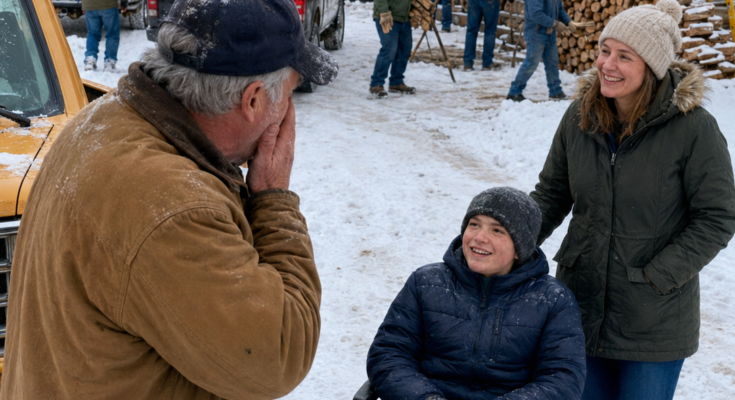
Rachel walked toward his truck. Evan was beside her in his wheelchair, bundled beneath a thick blue blanket. Gideon stepped out. He stared around at everyone. “What is all this?”
Rachel smiled. “County added your house to our route.”
Gideon laughed once. Then his face crumpled. He turned away quickly, wiping his eyes with the back of his glove. Nobody teased him. Nobody needed to.
Evan rolled closer. “My mom says you lied to us.” Gideon looked embarrassed. “Yeah. I guess I did.” Evan grinned. “It was a pretty good lie.”
That evening, Gideon’s house was warmer than it had been in months. There was enough firewood stacked for weeks. The porch no longer wobbled. The driveway was cleaner than Gideon had ever plowed it himself. And on the kitchen counter sat casseroles, soup, bread, coffee, and a handwritten schedule of neighbors volunteering to check on Linda.
Gideon stared at the list. “I didn’t ask for this.” Rachel stood beside him. “I know.” That was exactly the point.
For years, Gideon believed he was simply clearing snow. He never saw the invisible thing he was building. Trust. Gratitude. Community. A memory in one little boy’s heart of what a good man looked like.
The kind of kindness that expects no applause has a strange way of traveling. It moves quietly from one driveway to another. One family to another. One generation to another. And sometimes, when the person who spent years clearing the road for everyone else finally gets stuck himself, he discovers something beautiful. People remembered the way home.
The roads we quietly clear for others are often the same roads that bring kindness back to our own door.
That night, Gideon sat on his repaired porch, looking out at the driveway that twenty trucks had cleared. Linda was inside, sleeping peacefully. Evan and Rachel had been the last to leave. Before they drove away, Evan had rolled up to Gideon and handed him a small drawing. It was a yellow plow truck, with a big smile on the front grille. Underneath, in shaky handwriting, it said: “Thank you for clearing the way.”
Gideon folded the drawing carefully and tucked it into his jacket pocket. He had spent his life clearing roads for strangers. But that night, he realized he had also been clearing a path to something he never expected.
He had built a community. One driveway at a time.
And they had come back for him. ❤️