Part 1: The Dead Zone
“My screen just went black! This is literally the worst day of my life!” a teenager groaned from the back rows.
Maura gripped the oversized steering wheel of the heavy yellow school bus, pumping the brakes as the engine gave a violent, metallic shudder. The massive vehicle coasted to a slow, pathetic stop right in the bottom of a snowy hollow. It was the worst possible place to break down. Surrounded by steep, icy hills in rural Ohio, it was a notorious cellular dead zone.
For Maura, a 68-year-old widow who had driven this exact route for twelve years, the silence that normally filled her bus was a daily heartbreak. Forty kids sat behind her every single morning, and she hadn’t heard a real, genuine conversation in years. They were always glued to glowing screens. Headphones in, thumbs scrolling rapidly, completely isolated in their own digital worlds.
Since her husband passed away three years ago, Maura frequently went days without anyone asking her how she was doing. She felt like a ghost in her own life, just a pair of invisible hands steering kids to school.
But now, the bus was dead. And the panic was immediate.
“No bars! I have zero bars!” a girl in the middle row panicked, holding her device desperately up to the frosty window.
“The mobile hotspot is down too,” a boy chimed in, genuine distress in his voice. “What are we supposed to do?”
Maura grabbed the two-way radio mounted to the dashboard. Unlike their modern cell phones, the old-school dispatch radio still caught a faint signal. “Dispatch, this is Bus 42. Engine sputtered out in the hollow. Send the tow and a backup bus,” Maura said calmly.
She turned around to face the sea of frantic, wide-eyed teenagers. “Rescue is on the way, folks. It’s going to be about forty-five minutes.”
Forty-five minutes without the internet. You would have thought she had just announced the end of the world. The groans echoed through the cabin. Kids were squirming in their green vinyl seats, staring at blank screens, entirely unsure of how to exist in the quiet.
Maura watched them from the oversized rearview mirror. Her heart ached a little for them. They simply didn’t know how to just be together without a digital distraction.
She reached down into her bulky canvas tote bag. At the very bottom, beneath her thermos and extra winter gloves, was a worn, faded cardboard box. It was her late husband’s favorite road-trip trivia game. They used to play it on long drives across the country, back when their miles were measured in laughter instead of GPS coordinates.
Part 2: The Trivia Master
Maura stood up and walked down the narrow aisle. She stopped at the third row, right next to Kael. Kael was a quiet sixteen-year-old who always kept his dark hood pulled up and his eyes glued to the floor. He had never spoken a word to Maura, other than a mumbled, reluctant nod on the very first day of school.
She tapped his shoulder. He jumped slightly, looking up at her with a mix of confusion and standard teenage defiance.
“Since the internet is broken,” Maura said, her voice steady and warm, “I need a trivia master. You look like a guy who knows random facts.”
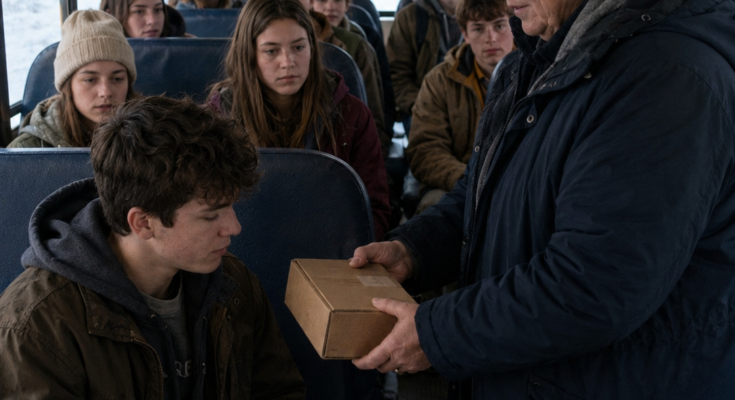
She held out the dusty box. Kael stared at it like it was an alien artifact.
“I’m not doing that,” he muttered, shrinking back into his heavy winter coat.
“Just one card,” Maura challenged, offering a gentle, knowing smile. “If it’s terrible, I’ll take them back and we can all go back to staring at the ceiling in misery.”
A girl sitting across the aisle leaned over. “Just read it, Kael. I’m literally dying of boredom.”
Kael sighed dramatically, taking the box with extreme reluctance. He pulled out a yellowed card, squinting at the faded print.
“Alright,” Kael said, his voice cracking slightly. “What is the only mammal capable of true flight?”
Silence hung heavily in the cold air of the bus.
“A flying squirrel!” a freshman shouted confidently from the back.
“Squirrels glide, idiot, they don’t fly,” an older boy shot back immediately. “It’s a bat.”
Kael looked at the back of the card. A tiny, almost imperceptible smirk tugged at the corner of his mouth. “He’s right. It’s a bat.”
“Give me another one!” the freshman demanded, leaning entirely out of his seat.
Kael pulled another card. “Which planet in our solar system has the most moons?”
Suddenly, the dead-silent bus erupted into a chaotic, passionate debate. Voices bounced off the metal ceiling. Kids who had never spoken a single word to each other were suddenly arguing fiercely over Jupiter and Saturn.
Maura walked back to the driver’s seat and sat down. She didn’t look at her phone. She just closed her eyes for a second, letting the beautiful, messy noise wash over her.
For the next forty minutes, Kael was the undisputed king of Bus 42. He fired off questions about geography, ancient history, and ridiculous pop culture from the 1980s. When the teenagers didn’t know an answer, they started shouting questions up to the front.
“Hey, Miss Maura!” Kael called out loudly over the noise. “Who won the baseball championship in 1985?”
“The Kansas City team,” she shouted back without missing a single beat. “And it went to seven grueling games!”
The entire bus cheered. For the first time in three agonizingly long years, Maura wasn’t just a ghost. She was part of the group. She was finally seen.
Part 3: The Friendship
By the time the flashing yellow lights of the backup bus appeared over the crest of the snowy hill, a very strange thing happened. Nobody rushed to get up.
“Aw, man,” Kael said, looking somewhat disappointedly at the remaining stack of cards. “We still had the whole science category left.”
Maura stood up and faced the kids, her heart feeling fuller than it had in a long time. “Keep the box, Kael. We’ve got a long drive on Friday mornings.”
The transition to the new bus was incredibly loud. Kids were chatting, laughing, and arguing over the answers they had gotten wrong just moments before. As Kael stepped off the broken-down bus, he paused right by Maura’s seat. He pulled his hood down, looked her right in the eye, and smiled warmly.
“Thanks, Miss Maura. See you tomorrow.”
Maura’s eyes welled up with happy, unexpected tears. It was the absolute best thing she had heard in years.
That sudden breakdown happened six months ago. Today, the entire dynamic on Bus 42 is completely different. Every single Friday is officially “Trivia Day.” When the kids step onto the bus, their phones immediately go right into their backpacks. They argue, they laugh, and they learn about the world. But more importantly, they learn about each other.
Maura isn’t just a silent driver to them anymore. She’s a referee, a teammate, and a cherished friend. The generational gap didn’t need a massive bridge to be crossed. It just needed a little bit of forced silence, an old dusty box of cards, and someone willing to make the first move.
Kael became a regular visitor to Maura’s seat. He’d sit in the front row on Fridays, holding the box of cards, ready to lead the bus through another round of trivia. He had found his voice. And Maura had found her purpose again.
“What’s the capital of Mongolia?” he asked one Friday, the bus humming with anticipation.
“Ulaanbaatar!” a freshman shouted.
“Correct! New question: Who painted the Sistine Chapel?”
“Michelangelo!”
The bus erupted in cheers. Maura smiled, watching the kids in her mirror. They were connected now. They were a community. And it had all started because of a broken-down bus and a box of dusty cards.
A few months later, the school held an assembly to recognize community members who had made a difference. Kael stood on stage, holding a microphone.
“I want to thank Miss Maura,” he said, his voice steady and clear. “She didn’t have to do anything. She could have just sat there and waited for the tow truck. But she saw us. She saw a bunch of kids who didn’t know how to talk to each other. And she gave us a reason to connect. She changed everything for me. And I think for a lot of us.”
The auditorium erupted in applause. Maura sat in the back row, tears streaming down her face. She had never expected recognition. She had only wanted to fill a quiet bus with noise.
After the assembly, Kael ran up to her and hugged her. “Thanks, Miss Maura. For everything.”
“No, Kael,” she said. “Thank you. You reminded me that I’m still here. That I still matter.”
They started a tradition. Every Friday, the bus was filled with laughter. And every Friday, Maura felt less like a ghost and more like a part of something real.
The old box of trivia cards is still on the bus. It’s worn and faded, but it’s also cherished. It’s a reminder that connection doesn’t require technology. It just requires a little effort, a little courage, and someone willing to take the first step.
Maura plans to keep driving until she’s seventy-five. She’s not ready to give up her front-row seat to the best show in town.
And as she watches the sunrise through the windshield on a cold Ohio morning, she knows one thing for sure: she’s exactly where she’s supposed to be. ❤️