
Part 1: The Can of Soup
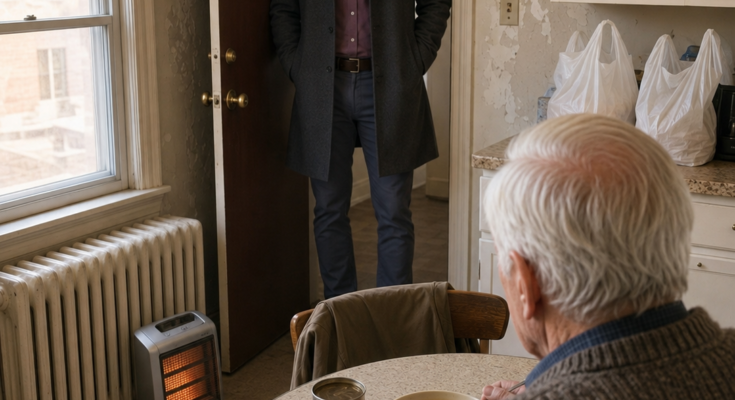
The can of soup sat on my kitchen table like a confession. Tomato. Store brand. The label was peeling at the edges. I had been staring at it for twenty minutes, trying to convince myself it would be enough for dinner.
Then I heard footsteps in the hallway. Heavy. Confident. The kind of footsteps that belonged to someone who had never worried about how they would eat tomorrow.
The door opened, and Jared stepped inside. He was wearing a suit that cost more than my monthly rent. His shoes were polished. His watch was expensive. And he looked at my apartment the way people look at a museum exhibit—curious, but distant.
“Dad, it’s freezing in here,” he said. “Why isn’t the heat on?”
“The radiator’s been acting up. Landlord says he’ll fix it soon.”
“Soon,” Jared repeated. He noticed the can of soup on the table. “What’s this?”
“Dinner.”
“That’s it? Just soup?”
“I’m not hungry.”
He didn’t believe me. I could see it in his eyes. But he didn’t push. Instead, he asked the question that would change everything.
“Dad, are you satisfied with the $8,000 Lauren sends you every month?”
I stared at him. The apartment seemed to shrink around me.
“Son, Lauren doesn’t send me anything. I’ve been relying on the church food pantry just to get through the week.”
Jared went completely still. His face, which had been casual and relaxed, hardened into something I had never seen before. Confusion. Anger. Disbelief.
“That’s impossible. She’s been sending money to you for years. She showed me the bank statements. $8,000 a month. I’ve seen the deposits.”
“I don’t know what to tell you,” I said. “I’ve never seen a dime.”
Then the apartment door opened. Lauren walked in, holding a shopping bag, a forced smile on her face. She froze when she saw Jared’s expression.
“Dad, what are you doing here?” she asked. Then she saw the can of soup. “What’s that?”
“Tomato soup,” I said. “From the food pantry.”
Her smile faltered. “The food pantry? Why would you need—”
“Lauren,” Jared interrupted, his voice cold. “Where is the $8,000 you’ve been sending Dad every month?”
Lauren’s face went white. For a moment, she looked like a deer caught in headlights. Then she recovered, forcing a laugh.
“Jared, what are you talking about? I’ve been sending that money faithfully. He must have forgotten. He’s old. He gets confused.”
I felt something snap inside me. “I may be old, Lauren, but I’m not confused. I’ve never received a single penny from you. I’ve been living on whatever I can get from the church pantry and my Social Security check. You want proof? Check my bank statements. Check my accounts. There’s nothing there.”
Jared’s jaw tightened. “Lauren, I want to see the receipts. I want to see the bank statements. And I want to see them now.”
Part 2: The Confession
Lauren’s face shifted through several expressions—panic, desperation, then a cold, defiant calm. “I don’t have the statements with me,” she said. “I’ll bring them later.”
Jared didn’t move. “Bring them now. Call your bank. I want to see the transfers.”
“Jared, you’re making a scene,” Lauren said. “This isn’t the time or place.”
“Dad is eating soup from a food pantry,” Jared said, his voice rising. “He’s living in a freezing apartment with a broken radiator. And you’re telling me you’ve been sending him $8,000 a month? Where is that money, Lauren?”
The silence in the room was deafening.
Lauren looked at me, then at Jared. Her mask of composure finally cracked. “Fine,” she said. “You want to know the truth? I kept the money. All of it. Every single deposit.”
Jared stared at her as if she had just revealed herself to be a stranger.
“Why?” he asked.
Lauren laughed, a bitter, hollow sound. “Because I deserve it. I’ve been the one running your company while you take all the credit. I’ve been the one managing your schedule, your meetings, your employees. And what do I get? Nothing. No appreciation. No recognition. So I took what I was owed.”
“Owed?” Jared’s voice was barely a whisper. “You stole from Dad. You let him starve while you took money that was meant to keep him alive.”
“He would have spent it on junk anyway,” Lauren said dismissively. “Look at this place. He’s clearly not capable of managing his own finances.”
I felt a surge of anger unlike anything I had experienced in years. “I managed my own finances for forty years, Lauren. I managed yours too, when you were struggling with credit card debt in your twenties. I helped you get back on your feet. And this is how you repay me?”
Lauren looked away. “You don’t understand—”
“Oh, I understand perfectly,” I said. “You saw an opportunity to take advantage of your father’s generosity and your brother’s trust. And you took it. You stole from your own family.”
Jared stepped forward. “Lauren, you’re fired. Effective immediately. I’ll have security escort you out of the building. And I’m calling the police. This is theft. This is fraud. And I’m going to make sure you pay for it.”
Part 3: The Reckoning
Lauren’s eyes widened with fear. “Jared, you can’t do this. I’m your sister. I helped build your company. I’ve been loyal to you for years.”
“You stole from our father,” Jared said, his voice cold and final. “There’s no loyalty in that. There’s only greed.”
Lauren looked at me, pleading. “Dad, please. Talk to him. Don’t let him do this.”
I looked at my daughter—the woman I had raised, supported, and loved. The woman who had let me eat soup from a food pantry while she lived in luxury. The woman who had stolen from me and felt entitled to do so.
“I can’t help you, Lauren,” I said quietly. “You made this choice. Now you have to face the consequences.”
She stormed out of the apartment, slamming the door behind her. Jared stood in the silence, his hands trembling with anger.
“I can’t believe she did this,” he said. “I trusted her. I trusted her with my company, with my finances, with my family. And she betrayed all of us.”
I sat down heavily in my kitchen chair. “I should have known. I should have asked questions. I should have checked the bank statements.”
“You didn’t know,” Jared said. “None of us knew. She hid it. She lied. This isn’t your fault.”
Jared called the police that afternoon. Lauren was arrested and charged with theft and fraud. The investigation revealed that she had been diverting funds from multiple accounts—not just the $8,000 meant for me, but also from Jared’s company. Over the years, she had stolen nearly $500,000.
Jared moved me out of the apartment that same week. He found me a warm, comfortable home near his own. He set up automatic deposits into my account. He visited me every weekend. And he apologized, over and over, for not noticing sooner.
“I should have checked on you, Dad,” he said. “I should have made sure you were okay.”
“I didn’t want to be a burden,” I said. “I thought I could manage on my own.”
“You’re not a burden,” he said. “You never were. And I’m never going to let you be alone again.”
Lauren served time in prison. When she was released, she tried to reach out. I didn’t answer her calls. Some betrayals cut too deep to be easily forgiven.
Jared and I rebuilt our relationship. We spent time together—real time. We talked about my life, his life, the years we had lost. He made sure I never had to worry about money again.
I still think about that can of soup sometimes. It sits in my pantry now as a reminder—not of the hunger, but of the love that saved me. My son saved me. And I learned that pride is a poor substitute for connection.
Sometimes, the hardest thing to do is ask for help. But the people who truly love you will always be there to catch you when you fall.
And that’s the greatest gift of all. ❤️