
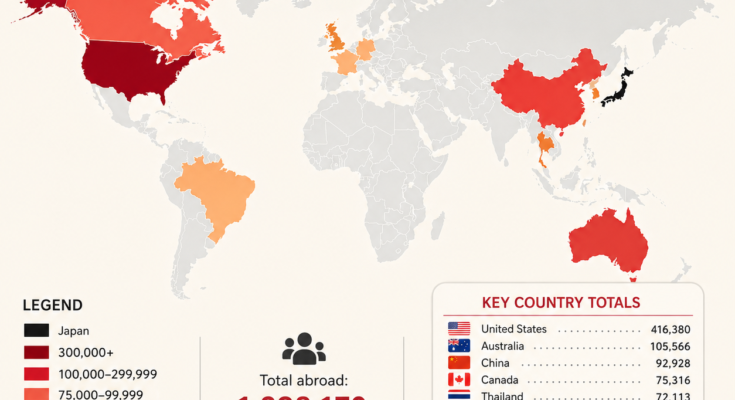
Nearly 1.3 million Japanese citizens live outside Japan, but they are far from evenly spread around the world.
According to Japan’s Ministry of Foreign Affairs, an estimated 1,298,170 Japanese nationals were living overseas as of October 1, 2025.
More than 416,000 were living in the United States alone, making America by far the largest destination. Australia ranked second with more than 105,000 Japanese residents, followed by China with nearly 93,000.
The rest of the top ten stretches across North America, Asia, Europe and South America, revealing a surprisingly global pattern of Japanese migration.
But this map tells more than a story about where Japanese people move.
It also shows how the geography of Japanese life overseas is changing.
What Does “Japanese Citizens Abroad” Actually Mean?
Before looking at the individual countries, there is an important distinction to understand.
These figures do not represent everyone in the world with Japanese ancestry.
Japan’s Ministry of Foreign Affairs counts Japanese nationals who are residing outside Japan. Dual nationals who hold Japanese nationality can be included, but someone of Japanese ancestry who holds only another country’s citizenship generally would not be counted.
Short-term tourists are excluded.
The statistics cover people residing overseas for three months or longer, including both long-term residents and permanent residents.
MOFA bases the estimates primarily on residence notifications submitted to Japanese embassies, consulates and other overseas missions. Because some people may not submit or update their registrations, the figures should be understood as official estimates rather than a perfect census.
The 2025 survey counted 1,298,170 Japanese nationals overseas. Of those:
709,684 were long-term residents, meaning they were living abroad for a defined period.
588,486 were permanent residents, meaning they were living in the country without a fixed end date.
Permanent residents increased by 1.4% from the previous year, while long-term residents declined slightly.
That difference provides an interesting clue about how Japanese migration is changing.
The Top 10 Countries for Japanese Citizens Abroad
The 2025 ranking is:
- United States — 416,380
- Australia — 105,566
- China — 92,928
- Canada — 75,316
- Thailand — 72,113
- United Kingdom — 62,270
- Brazil — 49,037
- Germany — 44,648
- South Korea — 44,471
- France — 36,023
Together, these ten countries contain approximately 77% of all Japanese nationals living overseas.
The concentration becomes even more remarkable at the top.
The United States, Australia and China alone account for roughly 47% of the entire overseas Japanese population.
1. United States — 416,380
The United States dominates the map.
With 416,380 Japanese nationals, America is home to nearly one-third of all Japanese citizens living outside Japan.
MOFA puts the U.S. share at 32.1% of the worldwide total.
Several factors explain the country’s enormous lead.
Japan and the United States have exceptionally deep economic, educational and political ties. Japanese companies have major investments across the country in industries such as automobiles, electronics, finance, technology and manufacturing.
That brings Japanese executives, engineers, researchers and their families to American cities.
But the population goes far beyond temporary corporate assignments.
The United States also contains a substantial number of Japanese citizens who have settled permanently.
Major Japanese communities are found in California, Hawaii, New York and other metropolitan regions.
In fact, greater Los Angeles alone had 63,972 Japanese residents in the 2025 statistics, making it the largest overseas urban concentration of Japanese nationals anywhere in the world.
The New York metropolitan area ranked third globally with 38,251.
So while the U.S. is geographically enormous, a significant share of its Japanese population is concentrated around a handful of major economic centers.
2. Australia — 105,566
Australia ranks second with 105,566 Japanese nationals.
This is one of the most interesting developments in the ranking because Australia now sits ahead of China.
The Japanese population in Australia includes permanent migrants, professionals, families, students and people working under various temporary residency arrangements.
Sydney has one of the world’s largest Japanese communities outside Japan.
The 2025 statistics counted 31,673 Japanese residents in the Sydney metropolitan area, placing it among the ten largest overseas Japanese urban populations.
Australia’s attraction is easy to understand.
Japan and Australia have strong economic relations, relatively convenient air connections and extensive tourism, education and business links.
Major Australian cities also offer the type of international lifestyle that attracts both Japanese professionals and families looking for long-term residence.
Australia’s rise to second place illustrates an important shift in Japanese migration: destinations traditionally associated with permanent migration are becoming increasingly significant.
3. China — 92,928
China remains one of the largest centers of Japanese life abroad, with 92,928 Japanese nationals in 2025.
For decades, China’s rapid industrial development attracted enormous Japanese corporate investment.
Japanese automobile manufacturers, electronics companies, trading houses, retailers and other businesses established operations in major Chinese cities.
Shanghai became particularly important.
MOFA counted 31,733 Japanese residents in Shanghai, making it the fifth-largest overseas Japanese urban population in the world.
However, China’s Japanese population has been declining.
The 2024 total was approximately 97,500, meaning the number fell again in 2025.
This reflects a wider shift involving corporate restructuring, changing investment strategies and fewer long-term Japanese business assignments in China.
China is therefore still one of the most important destinations—but its position relative to countries such as Australia has changed.
4. Canada — 75,316
Canada ranks fourth with 75,316 Japanese nationals.
Japanese residents are concentrated particularly around Vancouver and Toronto.
Greater Vancouver alone had 28,090 Japanese residents, making it one of the world’s largest overseas Japanese urban centers.
Canada attracts both temporary and permanent residents.
Education, employment, immigration pathways and quality-of-life considerations all contribute to its popularity.
Its geographic proximity to Japan across the Pacific also strengthens economic and cultural connections, particularly on Canada’s west coast.
The contrast between Canada and China is especially interesting.
China’s Japanese community has historically been strongly linked to corporate assignments, whereas Canada’s population contains a substantial long-term and permanent-settlement component.
5. Thailand — 72,113
Thailand may be one of the biggest surprises on the map.
With 72,113 Japanese nationals, it ranks fifth worldwide.
The explanation is strongly connected to economics.
Thailand has been one of Southeast Asia’s most important bases for Japanese industry for decades.
Japanese companies have invested heavily in:
- Automobile manufacturing
- Automotive components
- Electronics
- Machinery
- Finance
- Retail
- Logistics
That corporate presence created one of Asia’s largest Japanese expatriate communities.
Bangkok is especially important.
The Thai capital had 51,297 Japanese residents in 2025, making it the second-largest overseas Japanese urban community in the world, behind only Los Angeles.
That means Bangkok has more Japanese residents than many entire countries.
It also explains why parts of Bangkok contain Japanese supermarkets, schools, restaurants, clinics and businesses designed specifically for Japanese residents.
6. United Kingdom — 62,270
The United Kingdom had 62,270 Japanese nationals in 2025.
London dominates the country’s Japanese population.
Greater London contained approximately 30,515 Japanese residents, placing it among the largest overseas Japanese urban communities.
Britain has long been one of Japan’s most important European economic partners.
Japanese banks, automobile manufacturers, trading companies, technology firms and other corporations have established major operations in the UK.
London’s position as a global financial center also makes it a natural hub for Japanese professionals.
Students and permanent migrants add another layer to the community.
7. Brazil — 49,037
Brazil’s appearance in seventh place requires an important explanation.
Brazil is famous for having the largest population of people of Japanese ancestry outside Japan, with a Japanese-Brazilian community numbering well into the millions under broad ancestry estimates.
But the MOFA figure shown here is only 49,037.
Why the enormous difference?
Because this map counts Japanese nationals, not everyone of Japanese descent.
A Brazilian citizen whose grandparents migrated from Japan but who does not hold Japanese nationality is not included simply because of Japanese ancestry.
This makes Brazil an excellent demonstration of the difference between a diaspora map and a citizens-abroad map.
Brazil’s historic Japanese community began growing significantly after organized Japanese migration in the early 20th century.
Today, most descendants are Brazilian citizens, while a much smaller population retains or holds Japanese nationality.
8. Germany — 44,648
Germany has the largest Japanese-national population in continental Europe among the countries shown in the top ten, with 44,648 residents.
The relationship is strongly connected to industry and trade.
Germany and Japan are both major manufacturing economies with important automobile, machinery, chemical and technology sectors.
Düsseldorf is particularly famous for its Japanese community.
The city and surrounding region have developed Japanese schools, restaurants, supermarkets and cultural institutions over decades of Japanese corporate presence.
Japanese residents can also be found in cities such as Frankfurt, Munich, Berlin and Hamburg.
9. South Korea — 44,471
South Korea ranks ninth with 44,471 Japanese nationals.
Geographic proximity makes the country unique among the top destinations.
Flights between Japan and South Korea are short and frequent, and the two countries maintain enormous tourism, business and cultural connections despite periodically difficult political relations.
Japanese residents include businesspeople, students, spouses in international marriages and long-term residents.
Seoul naturally accounts for a large share of the population.
The presence of more than 44,000 Japanese citizens in South Korea demonstrates just how extensive everyday connections between the two neighboring societies have become.
10. France — 36,023
France completes the top ten with 36,023 Japanese nationals.
Paris dominates Japanese life in France.
The country has long attracted Japanese residents through fashion, art, cuisine, education, tourism, business and international institutions.
Japanese companies also maintain significant operations in France.
The community is smaller than those in Britain or Germany, but France remains one of the principal European destinations for Japanese citizens.
North America Is the Largest Region
Looking beyond individual countries reveals another pattern.
North America contains 491,701 Japanese nationals, representing 37.9% of the worldwide total.
Asia ranks second with 347,333, or 26.8%.
Western Europe follows with 215,695, representing 16.6%.
Together, these three regions account for approximately 81% of all Japanese nationals abroad.
So despite Japanese communities being found around the globe, overseas residence remains heavily concentrated in three broad economic regions.
The World’s Biggest Japanese Communities Are Highly Urban
Country totals only tell half the story.
Japanese residents overseas are particularly concentrated in major global cities.
The five largest urban concentrations in the official 2025 statistics were:
Los Angeles metropolitan area — 63,972
Bangkok — 51,297
New York metropolitan area — 38,251
Singapore — 33,397
Shanghai — 31,733
Sydney, London, Vancouver, Honolulu and Hong Kong complete the top ten.
These cities reveal several different types of Japanese migration.
Los Angeles and Vancouver have strong permanent communities.
Bangkok and Shanghai have historically attracted large numbers of corporate expatriates.
Singapore functions as a major Asian business hub.
Honolulu has unusually deep historical and cultural connections with Japan.
The overseas Japanese population is therefore not just international—it is strongly metropolitan.
Nearly 1.3 Million Abroad, but the Total Is Below Its 2019 Peak
The 2025 figure of 1,298,170 may sound enormous, but Japan has previously had more citizens overseas.
The number reached 1,410,356 in 2019.
It then dropped sharply during and after the COVID-19 pandemic:
2020 — 1,357,724
2021 — 1,344,900
2022 — 1,308,515
2023 — 1,293,565
2024 — 1,293,097
2025 — 1,298,170
The latest figure therefore represents a small recovery, but the overseas population remains well below its pre-pandemic peak.
But Permanent Settlement Keeps Growing
There is an even more interesting trend underneath the total.
In 2019, Japan recorded:
891,473 long-term residents and 518,883 permanent residents overseas.
By 2025, that had shifted to:
709,684 long-term residents and 588,486 permanent residents.
So while temporary or fixed-term overseas residence has declined substantially, permanent residence has continued increasing.
Between 2024 and 2025 alone, permanent residents increased by 8,102 people, or 1.4%.
This suggests that the geography of Japanese people abroad is gradually becoming less dominated by temporary corporate assignments and increasingly influenced by people making their lives permanently outside Japan.
Why Do Japanese Citizens Move Overseas?
There is no single reason.
The map combines several very different migration patterns.
The Japanese population in Thailand and China has strong connections with Japanese corporate investment.
The communities in the United States, Canada and Australia contain large numbers of permanent residents alongside professionals and students.
European countries such as Britain, Germany and France combine corporate assignments with education, research and permanent settlement.
Brazil reflects a much older migration relationship involving one of the world’s great Japanese-descended communities.
And South Korea reflects the enormous movement of people between two neighboring East Asian economies.
That is why simply describing all 1.3 million people as “Japanese expatriates” misses an important part of the story.
Some will return to Japan after several years.
Others have built permanent lives abroad.
What This Map Does Not Show
There are several limitations worth remembering.
First, these are estimates rather than a global census.
Japan’s Ministry of Foreign Affairs uses residence notifications as an important source, and not every Japanese citizen necessarily submits or updates one.
Second, short-term travelers staying less than three months are excluded.
That means millions of Japanese tourists, temporary business travelers and short-term students are not represented.
Third, the statistics should not be confused with ethnic Japanese populations.
Someone can be Japanese-American, Japanese-Brazilian or Japanese-Canadian by ancestry without holding Japanese citizenship and therefore not appear in these totals.
Conversely, dual nationals who retain Japanese nationality may be counted.
A Different Map of Japan
Japan is often viewed as one of the world’s most geographically concentrated societies: an island nation with a large population overwhelmingly living inside its own borders.
Yet more than 1.29 million Japanese nationals have established lives elsewhere.
Almost a third are in the United States.
Australia now holds the second-largest community.
Thailand has more than 72,000.
Brazil remains in the top ten despite the citizenship-based nature of the statistics.
And cities such as Los Angeles and Bangkok contain Japanese populations comparable to sizable towns in Japan itself.
Perhaps the most revealing change, however, isn’t where Japanese citizens live.
It’s how they live abroad.
The total overseas population remains below its 2019 peak, yet the number of permanent residents continues to rise.
The map is therefore not simply a snapshot of Japanese people overseas in 2025.
It is also evidence of a gradual shift from temporary overseas assignments toward more permanent global lives.
Source Note
Figures are from Japan’s Ministry of Foreign Affairs, Annual Report of Statistics on Japanese Nationals Overseas, as of October 1, 2025. The survey estimates Japanese nationals living outside Japan for three months or longer and includes dual nationals holding Japanese citizenship. Short-term residents are excluded. The official worldwide estimate is 1,298,170.